
DDSK Fiber Amplifier — Digital Fiber Optic Sensor Amplifier
Keep the electronics in the cabinet. Send only a passive, millimetre-scale fiber tip into the hot, cramped or electrically noisy zone where the detection actually happens.
- Response time down to 16–25 µs (DA4-DAIDI)
- Dual 8-digit display: threshold + live signal side by side
- 4-step selectable response: 25 / 50 / 200 / 400 µs (WAN/WAP)
- NPN and PNP versions of every model
- One-touch Light-ON / Dark-ON, two-point teach
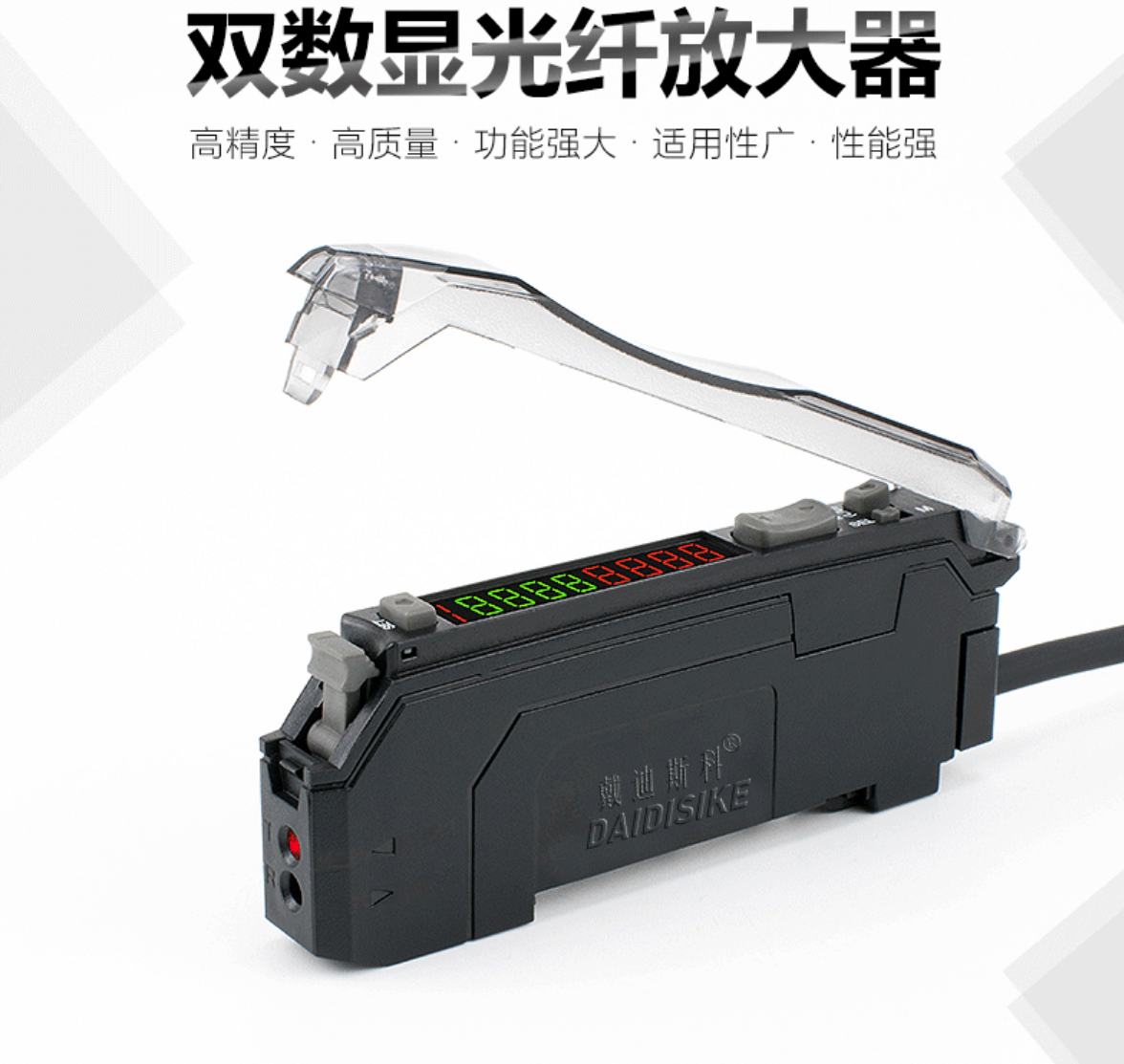
Detection Where Sensors Cannot Go
Every fiber sensing system splits into two halves. The amplifier — light source, receiver and switching electronics — clips onto a 35 mm DIN rail inside the panel. The fiber optic head is a purely passive light guide with no circuitry at all, so it shrugs off temperatures, vibration and electromagnetic fields that would kill a self-contained photoelectric switch. The result: an ultra-small detection point you can thread into a heated mold area, a jig slot a few millimetres wide, or a bracket right beside a welding gun.
DAIDISIKE builds five amplifier families around that idea, from potentiometer-adjusted economy units to a dual-display flagship whose green row shows the set threshold while the red row streams the live received-light value (0–9999) — your excess-gain margin is a number you read, not a guess. Pair any of them with our M3/M4/M6 fiber optic sensor heads or DK-KT/DK-KF matrix fiber units for area coverage.
Model Selection Table
| Family | Models (NPN / PNP) | Display & setup | Response | Supply | Output |
|---|---|---|---|---|---|
| Single display | DDSK-WDN / DDSK-WDP | Digital display; 1-point & 2-point teach; external control input | FINE 200 µs / TURBO 400 µs / SUPER 0.8 ms | DC 12–24 V | Open collector, 100 mA / 24 V DC |
| Dual display | DDSK-WAN / DDSK-WAP | Green threshold + red live value (0–9999) | 4-step: 25 / 50 / 200 / 400 µs (1000 Hz) | DC 12–24 V | NO+NC, open collector, 100 mA / 24 V |
| Menu type | DA4-DAIDI-N / DA4-DAIDI-P | Menu-driven dual display | 16–25 µs (fastest in lineup) | Contact factory | NPN / PNP (rating: contact factory) |
| Economy | DDSK-WZN / DDSK-WZP | Potentiometer, no display | 200 Hz response frequency | DC 10–30 V | NPN / PNP, NO+NC |
| High-speed economy | DDSK-NA11 / DDSK-NA11P | Potentiometer, no display | 250 µs | Contact factory | NPN / PNP (rating: contact factory) |
Undocumented cells are marked “contact factory” rather than estimated. All families mount on a 35 mm DIN rail and switch Light-ON / Dark-ON with one button. This is a general-purpose detection component, not an IEC 61496 certified safety part — do not use it alone for personnel protection.
DDSK-WDN / WDP Detailed Specifications
| Power modes | FINE 200 µs (fine discrimination) / TURBO 400 µs (extended range) / SUPER 0.8 ms (dusty environments) |
|---|---|
| Max system detection distance | 0–4000 mm (depends on fiber head) |
| Teaching | One-point (3 s long press), two-point (background + target), manual fine-tune |
| Intensity display | 0–4095 raw, or % of threshold (100 % = setpoint) |
| Stability indicator | Bar-graph LED, ±5 % / ±10 % / ±15 % steps vs setting |
| Output rating | Open collector 24 V DC / 100 mA max |
| OFF-delay timer | 10 ms / 40 ms fixed — stretches short pulses for PLC scan capture |
| External control input | Remote calibration, display switching, zero-shift, reset, emitter-off (ON 2 ms / OFF 20 ms) |
| Protection circuits | Reverse polarity (power + output), overcurrent, short circuit |
| Ambient light immunity | 20,000 lux incandescent / 30,000 lux sunlight |
| Environment | −25 to +55 °C, 35–85 % RH |
| Vibration / shock | 10–55 Hz, 1.5 mm amplitude / 500 m/s² |
| Power consumption | 710 mW standard / 540 mW eco |
| IP rating / dimensions | Contact factory (not stated in current documentation) |
Single-Display Family (DDSK-WDN / WDP)
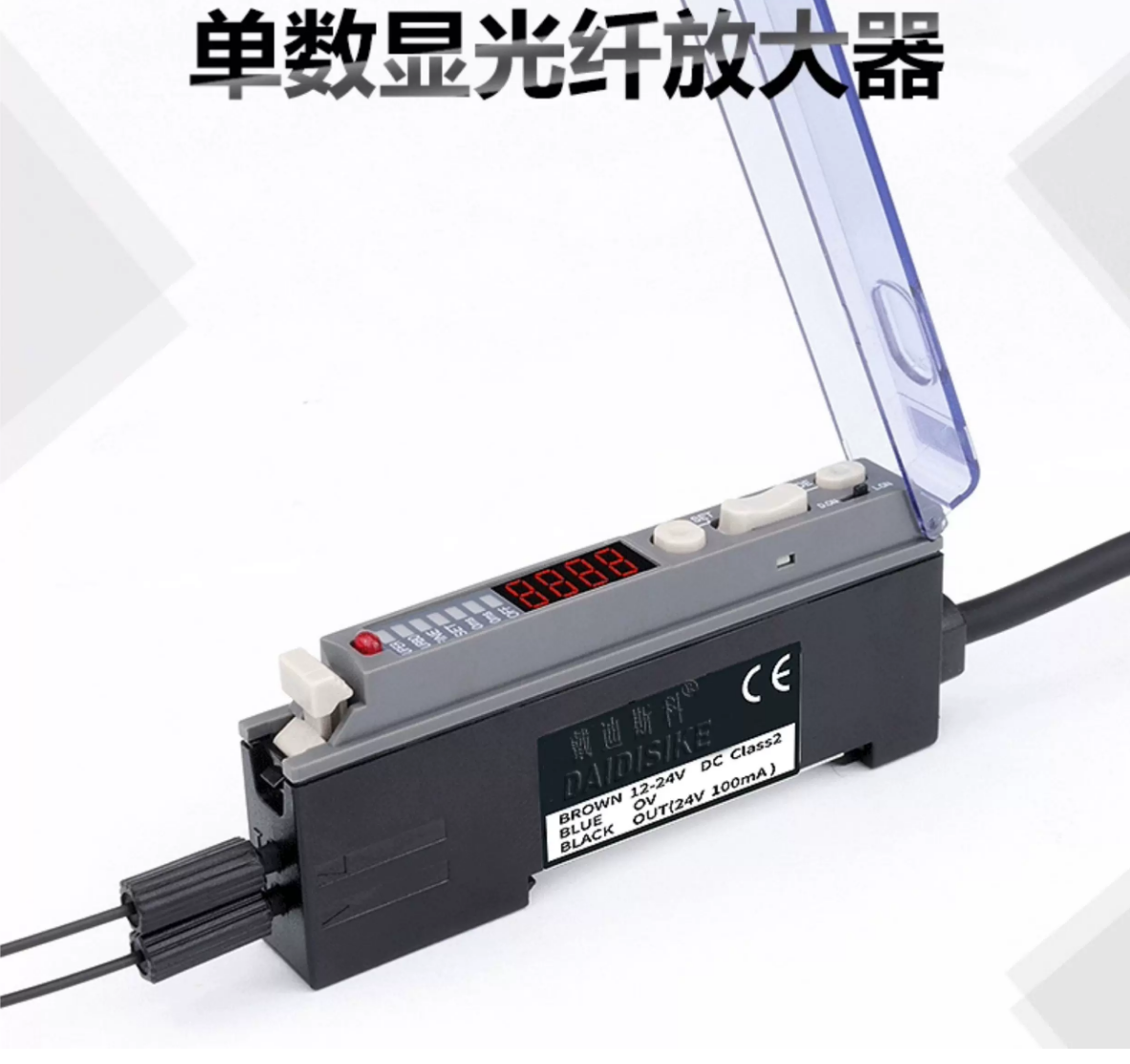
Where the Micro Detection Point Pays Off
Heated Fixtures & Mold Areas
Only the glass-fiber tip enters the hot zone; the electronics stay in the cool cabinet, so thermal cycling never touches a circuit board.
Millimetre-Wide Jig Slots
An M3 threaded tip or 90 mm sleeve probe confirms part-present deep inside jigs that no housed sensor body can enter.
SMT & High-Speed Small Parts
25 µs (WAN) or 16–25 µs (DA4) response catches components fired past the detection point at pick-and-place speed.
Welding Cells & VFD Cabinets
The passive probe is immune to arc EMI at the detection point — a classic false-trip location for conventional photoelectric switches.
Electrode Sheet & Film Lines
Paired with matrix fiber heads, the amplifier reads thin, low-contrast battery and film targets that single-spot sensors miss.
Export Machine Building
Same optics, two electrical worlds: N-suffix for sinking (Mitsubishi/Omron-style) inputs, P-suffix for sourcing (Siemens/Rockwell-style) inputs.
Frequently Asked Questions
Why use a fiber amplifier instead of a normal photoelectric sensor?
Because the sensing tip carries zero electronics. The amplifier sits safely on a 35 mm DIN rail in the cabinet while a passive glass-fiber probe — as slim as M3 — reaches the actual detection point. That lets you put a detection spot inside a heated fixture, a narrow jig slot, or right next to a welder or inverter, where a housed sensor's electronics would fail or simply not fit.
Which model family should I pick for high-speed lines?
The DA4-DAIDI menu-type amplifier is the fastest documented model at 16–25 µs. The WAN/WAP dual-display family offers a 4-step selectable response time of 25 / 50 / 200 / 400 µs, so one part number covers both fast small-part counting and slower, high-stability filtering stations.
Do I need to decide NO or NC when ordering?
No. Light-ON / Dark-ON (N.O./N.C.) logic is switched with one button press on the unit in the field, across the whole lineup. You only choose NPN or PNP at order time to match your PLC input cards.
How is the threshold set for a low-contrast target?
On the WDN/WDP single-display family, press teach once on the background and once on the target: the amplifier calculates the optimum threshold between the two readings automatically. A 3-second long-press one-point teach and manual fine adjustment are also available.
What detection distance can the system reach?
The amplifier platform is rated for a maximum system detection distance of 0–4000 mm, but the real figure depends on the fiber head you pair it with (through-beam heads reach further than diffuse) and the power mode selected — FINE 200 µs, TURBO 400 µs or SUPER 0.8 ms on the WDN. Send us your fiber head model and target for a distance reference.
Is the amplifier protected against wiring mistakes?
The WDN family documents reverse-polarity protection on both power and output lines, plus overcurrent and short-circuit protection on the open-collector output (rated 24 V DC / 100 mA max).
What is the MOQ, lead time and export packing for the fiber amplifier line?
MOQ, sample terms and lead time are confirmed per model by the factory — send your model list (e.g. DDSK-WAN + fiber heads) and destination country for a same-week quotation. NPN and PNP versions of every model ship export-packed with English labels. Certification documents are available on request.
Specs reviewed by Engineer Cai, Senior Application Engineer. See certificates.