
DK-KT / DK-KF Matrix Fiber Optic Units — Detection Bands, Not Spots
When the target is a whisper-thin electrode sheet or a small part that never passes the same place twice, one light spot is a gamble. An array of them is a guarantee.
- Multiple light points spread into a detection band
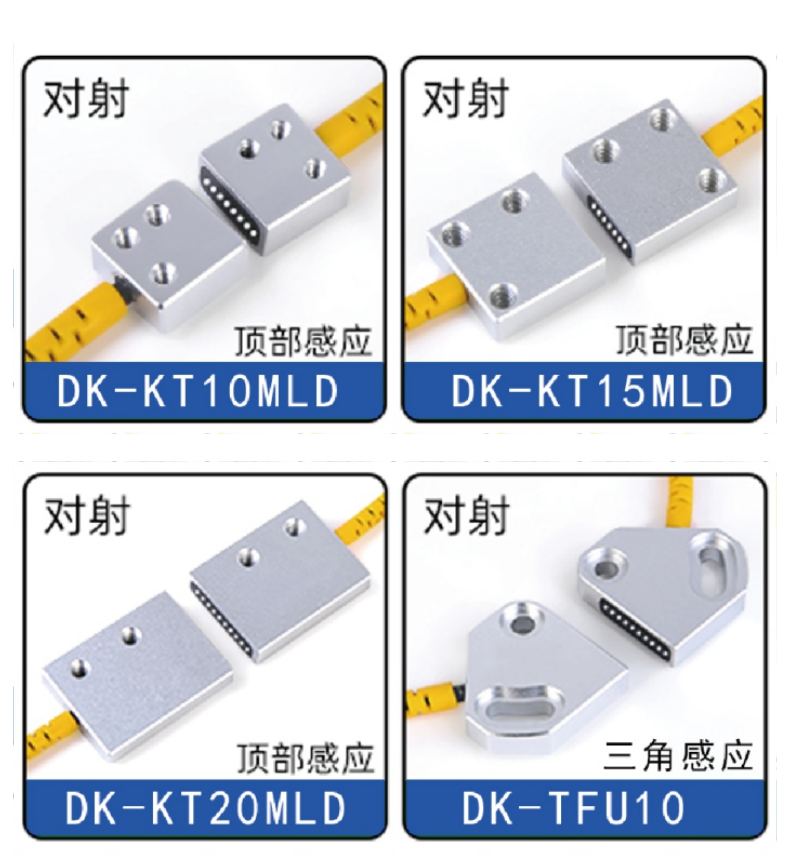
- DK-KT through-beam + DK-KF diffuse: 18 models
- Passive bar — no electronics in the hot/EMI zone
- One DDSK amplifier platform for the whole range
- Built for battery, film and feeder applications
Why an Array Beats a Spot
Battery electrode sheets, separator films and vibratory-fed small components share two traits: they present almost no surface to a sensor, and they never arrive in exactly the same position. A single-point fiber must be aimed at where the part should be. A matrix fiber unit lines up multiple emitting points behind one sensing face, creating a light band — the part is caught wherever it actually crosses.
The heads are passive optical bars in machined metal housings. All intelligence — teach, display, response-time selection, NPN/PNP output — comes from the DDSK fiber amplifier in the cabinet. For single-point work, see the standard T / KS / RC fiber optic heads.
Model Selection Table
| Size code | DK-KT (through-beam) | DK-KF (diffuse reflective) | Mounting sides needed |
|---|---|---|---|
| 10 | DK-KT10MLD | DK-KF10MLD | 2 / 1 |
| 15 | DK-KT15MLD | DK-KF15MLD | 2 / 1 |
| 20 | DK-KT20MLD | DK-KF20MLD | 2 / 1 |
| 25 | DK-KT25ML | DK-KF25ML | 2 / 1 |
| 30 | DK-KT30ML | DK-KF30ML | 2 / 1 |
| 35 | DK-KT35ML | DK-KF35ML | 2 / 1 |
| 50 | DK-KT50ML | DK-KF50ML | 2 / 1 |
| 120 | DK-KT120ML | DK-KF120ML | 2 / 1 |
| U10 | DK-KTU10 | DK-KFU10 | 2 / 1 |
Detection-face dimensions, beam pitch, cable length, IP rating and per-model response data are not published — confirm against factory drawings (contact factory) before finalizing a fixture. Matrix fiber units are not IEC 61496 certified safety components and must never be used alone for personnel protection.
Built-For Applications
Electrode Sheet Pass Detection
Battery electrode sheets and separators cross the band edge-on; the array reads them where a single spot sees nothing.
Coated & Laminated Film Lines
Thin reflective films trigger the band reliably during feed-through and in-position checks.
Vibratory Feeder Trays
Parts whose lateral position wanders are still counted — the band covers the full track width.
Conveyor Anti-Miss Counting
Small parts drifting across rollers cannot slip between beams the way they slip past a point sensor.
One-Sided Stations (DK-KF)
Hopper walls and single-access conveyor edges get band coverage with no opposite-side bracket at all.
High-EMI Detection Points
Passive bars work beside welders and VFDs; only the cabinet-mounted amplifier needs standard EMI care.
Frequently Asked Questions
What problem does a matrix fiber unit solve that a normal fiber head cannot?
A standard fiber head projects one spot, so the target must cross that exact point. A matrix unit spreads multiple light points into a band: a thin electrode sheet, a coated film edge, or a small part drifting sideways on a feeder gets detected anywhere along that band. It removes the class of missed detections caused by target position uncertainty.
DK-KT or DK-KF — how do I choose?
DK-KT is through-beam: emitter and receiver bars face each other across the target, giving the strongest signal and the best contamination tolerance. DK-KF is diffuse reflective: both functions sit in one bar, so only one side of the target needs mounting access and wiring. Pick KT when both sides are reachable, KF when they are not.
Does the matrix head output a signal by itself?
No — it is a fully passive optical component with zero electronics. All light generation, signal evaluation, display, teach functions and the NPN/PNP switching output live in the separate DDSK fiber amplifier (WDN/WAN/DA4 series).
What sizes are available?
Each series offers eight numeric sizes (10/15/20/25/30/35/50/120) plus a U10 model — 18 models in total. Exact detection-face dimensions should be confirmed against factory drawings before you finalize a fixture design; do not infer them from the model number alone.
Can it be installed near welding machines or variable-frequency drives?
Yes. The sensing bar contains no electronics, so arc and inverter EMI have nothing to disturb at the detection point. Standard EMI practice still applies to the amplifier in the cabinet.
What detection distance should I plan for?
The shared DDSK amplifier platform is rated up to a 4000 mm system maximum, but the real figure depends on the specific matrix unit and the amplifier power mode. Send us your model, gap and target material for a confirmed figure — we quote from test data, not guesses.
What about MOQ, samples and certificates for export orders?
MOQ and sample terms are confirmed per model by the factory — send your DK-KT/DK-KF model list and amplifier count for a quotation. Certification documents are available on request. Note these are general-purpose detection components, not IEC 61496 certified safety parts.
Specs reviewed by Engineer Cai, Senior Application Engineer. See certificates.