
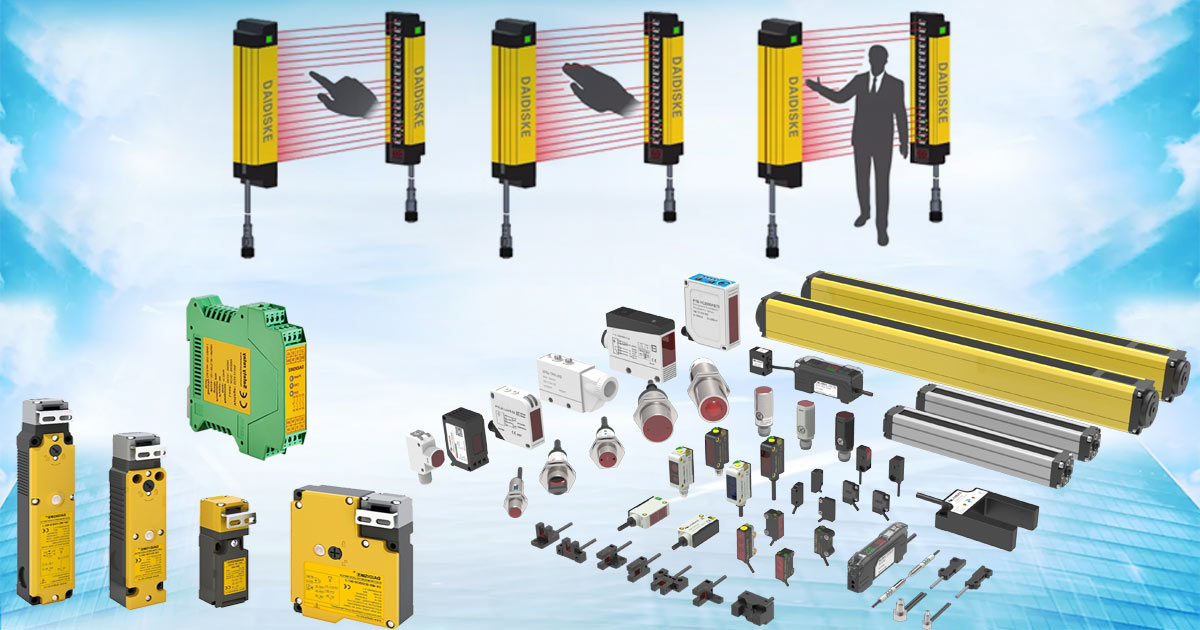
Buyers arrive at this product under three different names, and that can cause confusion. Leuze, ReeR and Banner mostly say measuring light curtain; SICK calls it a measuring automation light grid (the MLG family); Banner also markets a measuring array and a light screen. Same device, three search terms, one decision. Whatever the label on your drawing, the questions below are the ones that decide which unit you actually buy.
One honest line first, because it saves a dangerous mistake: a measuring light curtain measures, it does not guard people. If your job is to stop a machine when a hand reaches in, you need a certified safety curtain, not a measurement grid. We'll come back to that distinction below; keep it in mind throughout the selection.
What is a measuring light curtain, and how does it work?
It is a through-beam grid: an emitter bar and a receiver bar with a row of evenly spaced infrared beams. An object between them blocks some beams; the electronics read the blocked-beam pattern and report a value. The beams are scanned in sequence, so at every scan the grid has a one-dimensional picture of what occupies the field. From that picture the controller derives whatever you configured: the first-to-last blocked beam gives a measured span; a clear island surrounded by blocked beams may represent a hole or gap in suitable geometry; the moving edge of a web gives running width and center; sampling the profile as a part travels through gives its contour with a suitable motion reference. Detectable feature size also depends on scanning mode, object position, opacity and speed.
That is the whole principle, and it is identical whether the box says measuring light curtain, measuring light grid or measuring array. The DAIDISIKE DQL measurement light curtain is built on it, with catalogue beam spacing from 1.25 mm and a measurement output set (RS-485 Modbus-RTU, 4–20 mA, 0–10 V) chosen for direct PLC and analog-loop integration.
Measuring light curtain vs safety light curtain — what is the difference?
A measurement sensor supplies process data. A safety light curtain supplies a documented protective function through an approved safety interface and validated control chain. Similar optics or two transistor outputs do not confer that rating. DQL is measurement-only; the DQM catalogue wording does not establish an IEC 61496 Type, PL/SIL or approved safety-output architecture for this guide.
| Aspect | Measuring light curtain (e.g. DQL) | Safety light curtain (documented model, e.g. DQT4) |
|---|---|---|
| Primary job | Report height / width / profile / count (data) | Stop the machine when a person intrudes |
| Certification | Automation sensor — not a certified guard | IEC 61496 Type 2 / Type 4, ISO 13849-1 PL |
| Outputs | DQL: RS-485 Modbus-RTU, 4–20 mA, 0–10 V (DQM: dual-channel NPN/PNP) | Approved safety interface; monitoring arranged per manual |
| Personnel protection? | No — never wire as the safety device | Only within its documented capability and validated application |
| DQM evidence boundary | DQM is named a measurement safety light curtain in the catalogue, but an exact Type/PL/SIL and safety-interface document is required before any personnel-protection role | |
Use the DQL measurement specificationsfor process-data selection. The DQM cataloguelists measurement options, but its name is not a safety certificate. For protection, assess a documented device such as DQT4 (catalogued Type 4 / PL e). Do not transfer that rating to DQCor DQA without their own evidence.
Axis 1 — resolution and beam spacing (the number-one selection spec)
Specify what must be resolved and how accurately, before choosing beam spacing. Spacing is the distance between beam centers; minimum object size and edge resolution are separate performance measures. DQL lists spacing from 1.25 mm and DQM from 2.5 mm. Neither number is an automatic measurement accuracy or a cross-brand performance advantage. Validate the actual samples, orientation, measuring distance and line speed.
For reference, here is how the resolution / beam-spacing axis looks across the families buyers compare. These figures are from each vendor's own public datasheets and are quoted only to orient the selection, not to copy anything.
| Family | Resolution / beam spacing | Range / length (per vendor specs) | Notes |
|---|---|---|---|
| DAIDISIKE DQL | From 1.25 mm | Per ordered build | Measurement-only; RS-485 Modbus-RTU, 4–20 mA, 0–10 V |
| DAIDISIKE DQM | From 2.5 mm | Per ordered build | Measurement candidate; NPN/PNP outputs are not proof of a safety rating |
| SICK MLG-2 ProNet | 2.5 / 5 / 10 / 20 / 25 / 30 / 50 mm beam separation | 2 / 3 / 5 / 8.5 / 14.5 m | Family options vary; verify the exact model and scan mode |
| SICK MLG-2 WebChecker | Edge performance depends on model, mode and object position | — | Running-edge, width & center measurement |
| Banner A-GAGE EZ-Array | 2.5 mm edge resolution; detects 5 mm objects | 4 m range; heights 150–2400 mm | Multiple measurement modes; analog + discrete + serial; IO-Link, Modbus-RTU |
| Banner MINI-ARRAY two-piece | 9.5 mm or 19.1 mm beam spacing | Lengths 150–1830 mm | 19.1 mm spacing optimized for vehicle separation |
| Leuze CML 700i / 720 | Per ordered build | Up to 6 m; M12 | Interface variants include CANopen, IO-Link, RS-485 Modbus, PROFIBUS and PROFINET; not every interface on one unit |
Do not rank these families by the smallest number in a table: beam separation, edge resolution and detectable object size are not equivalent metrics. For example, Banner specifies 5 mm object detection and 2.5 mm edge resolution for EZ-Array. Build a like-for-like requirement for the same task and configuration before comparing candidates.
Axis 2 — output and interface (NPN/PNP, 4–20 mA, 0–10 V, Modbus-RTU)
Match the required data, not merely the connector.An analog signal can carry one scaled measurement, discrete outputs can report configured states, and a serial or fieldbus interface may expose richer process data. Verify available values, update rate, register mapping, electrical levels and the receiving PLC capability. Interface options differ within competitor families.
The DQL catalogue lists RS-485 Modbus-RTU, 4–20 mA and 0–10 V measurement outputs; confirm their wiring and configured value for the ordered build. DQM lists NPN/PNP discrete outputs. A discrete state is not a full dimensional profile, and two outputs do not establish safety OSSD. Ask how the required measurement is represented and verify integration rather than assuming that no interface hardware is needed.
Which measurement task — height, width, diameter, profile, counting, holes, edges?
Most named long-tail applications are just different reads of the same blocked-beam pattern. Here is how the common tasks map. A measuring light grid is genuinely versatile because once it knows which beams are blocked, software decides what that means.
| Measurement task | What the grid reads | Typical use |
|---|---|---|
| Height / width measurement | First-to-last blocked beam in the field | Online dimension inspection on a conveyor |
| Diameter sizing | Blocked span across a round part | Bar, tube, roll diameter checking |
| Contour / profile detection | Blocked pattern sampled as the part travels | Shape / protrusion / pallet-overhang checks |
| Object / parts counting | Blocked-then-clear transitions | Counting parts on a conveyor |
| Hole / gap detection | Clear island inside a blocked region | Missing-feature / gap monitoring |
| Edge detection & center positioning | Running edge position of a moving web | Edge guiding, web-width & center control |
| Pallet / protrusion monitoring | Beams blocked outside the allowed envelope | Detecting overhang before storage/transfer |
The table maps measurement concepts, not guaranteed functions on every order code. A hole needs a clear region in the appropriate blocked geometry; a moving profile needs time or encoder association. Closely spaced parts may not create a clear transition for counting. Confirm supported measurement modes on the selected product, including any DQLV vehicle-separation proposal.
SICK MLG, Banner EZ-Array or Leuze CML alternative — where does DAIDISIKE fit?
DAIDISIKE DQL/DQM can be considered for a measurement enquiry against SICK MLG, Banner EZ-Array or Leuze CML, but matching a nominal spacing is not an equivalence claim. Compare the complete measurement mode, range, timing, outputs, software and environmental requirements. Request current price, minimum order and delivery terms for the exact scope; this guide makes no performance, cost or lead-time guarantee.
How to choose — the short checklist
Resolution → output → size/range → measurement-only vs safety. In that order. Use these answers to shortlist a candidate, then test it:
- Smallest feature and tolerance? Check minimum object size, edge performance and spacing separately, on representative samples.
- How does the value reach the PLC? DQL: RS-485 Modbus-RTU, 4–20 mA or 0–10 V analog; DQM: dual-channel NPN/PNP discrete states. Confirm the required data is actually available and how the receiving input interprets it.
- Measuring height/length and range between emitter and receiver, per your conveyor or opening.
- Response time fast enough for your line speed and count rate.
- Measurement-only or also safety? DQL for data; DQM is not established as safety-rated here. Specify a separately documented protective function wherever personnel protection is required.
Send those five answers to our engineers on +86 15218909599 (phone / WhatsApp) or via the contact page, to review a DQL, DQM or DQLV candidate — or identify whether your job needs a separate safety curtain. The full measurement-grating range is on the detection & measurement grating page.
Sources & specifications cited
- SICK — MLG-2 WebChecker operating instructions — model-dependent edge measurement, scan time and object geometry.
- Banner Engineering — A-GAGE EZ-Array — EZ-Array object detection versus edge resolution, supported modes and interface variants.
- SICK MLG-2 ProNet operating instructions — model-dependent beam separation and operating range, not limiting range.
- Banner MINI-ARRAY two-piece family — nominal array lengths and beam-spacing options.
- Leuze — CML 700i / CML 720 measuring light curtains — CML 720 model selector, range and interface options.