
Consider a proposed sorter between a stocker and an EFEM: who commands its protective stop, who prevents restart, and who owns the shared access zone? This is an illustrative design question, not a customer quotation. Record those responsibilities before selecting hardware.
New construction and retrofit projects have different handover boundaries. Instead of inferring demand or project readiness from unverified fab schedules, collect the tool interface specification, equipment risk assessment, environmental acceptance plan and current procurement requirements for the actual installation.
The SEMI standards an integrator actually has to read
These four SEMI EHS guidelines address different equipment-level topics. Confirm the editions and assessment scope required by the buyer and applicable law; they are not a universal standalone sensor certification.
- SEMI S2: performance-based equipment EHS considerations. The SEMI store lists S2-0724E as current; agree the report scope and any deviations with the buyer.
- SEMI S8: ergonomics engineering. Review access, reach, posture and operator interaction alongside the machine's safety-control requirements.
- SEMI S14: fire-risk assessment and mitigation, including ancillary equipment and modifications. It does not prescribe one enclosure material or cable chemistry as the universal solution.
- SEMI S22: electrical design considerations including safety interlocks. A component type test does not establish the electrical safety of the complete equipment.
Note what that list does not say. None of these documents dictate a specific brand or model of safety light curtain or laser scanner. They set the surrounding requirements — cleanroom compatibility, fire risk, electrical isolation, ergonomic install — that the integrator’s chosen device has to fit inside. The product standard for the device itself is still IEC 61496-1/2 for light curtains and IEC 61496-3 for safety laser scanners, with the safety function evaluated against ISO 13849-1 (PL) or IEC 62061 (SIL).
Where OEM-locked safety dominates — and where it does not
The table is a responsibility checklist, not evidence of a particular OEM's installation or purchasing policy. Confirm the project contract and approved change procedure for each equipment boundary.
| Equipment | Safety scope | Integrator-procured sensors realistic? |
|---|---|---|
| EUV / DUV lithography | Prime-tool design and change control | Only through the responsible OEM's approved process |
| Etch equipment | Process, electrical and mechanical hazards interact | Define OEM approval and affected assessment scope |
| Deposition / CMP / implant | Tool-specific safety functions | Do not modify protective functions from a generic article |
| EFEM extensions | Shared robot and load-port interfaces | Agree responsibility for stop and restart across the interface |
| Sorters / stockers / custom load ports | Moving shelves, axes and operator access | Assess each access path and integration boundary |
| OHT load zones | Suspended load, hoist motion and floor access | Personnel sensing is only one part; mechanical retention remains |
| Wafer test / probe handlers | Access, motion and electrical hazards | Check local process, EMC and cleanliness requirements |
| Assembly / packaging cells | Machine and conveyor integration | Select guarding after risk and interface assessment |
| Sub-fab utility skids | Chemical, electrical, pressure and mechanical hazards | Optical sensors do not replace containment or isolation |
Integrator involvement is determined by the approved project scope. Neither an OEM label nor an ancillary-equipment label removes the need for a complete risk assessment, agreed interfaces and documented verification of the modified equipment.
Cleanroom compatibility — what actually matters
Obtain the actual zone classification and process limits rather than assigning one class to every fab. ISO 14644-14:2026 addresses equipment suitability by airborne particle concentration. It does not also approve cleanability, electrostatic properties or every material choice. Keep the following qualification topics separate.
Particle shedding. Request an assessment under relevant operating and handling conditions, including brackets, cables, labels and seals. A smooth metal housing can simplify design but does not prove low particle generation. Qualify the complete installed assembly against the site's particle limits, not just the sensor body.
Outgassing. Ask the process owner which airborne chemical contaminants and test conditions matter at the intended location. Material declarations help identify risks but do not replace measured outgassing data when that is required. Do not assume an industrial sensor supplier has a cleanroom-specific report unless it is supplied.
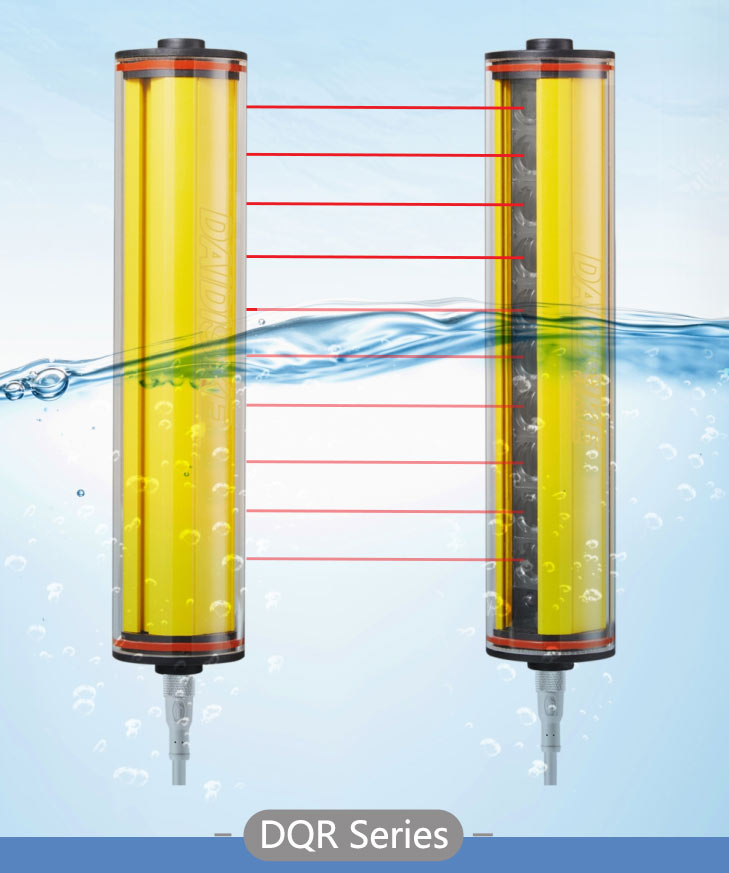
Wipe-down survivability. Identify the actual cleaning agent, concentration, temperature, contact time and frequency. Obtain compatibility evidence for optics, seals, labels and cable jackets. An IP65/IP68 test does not establish solvent resistance or years of cleaning life. The DQR / DQRF enclosure variants require this same review; do not infer chemical qualification from their water-ingress rating.
ESD and EMI — the noisy reality of a fab floor
Two electrical environment problems get conflated and they are different problems.
ESD — protecting the product from the installation. Use the fab's ESD control plan and the sensitivity of the products being handled. Conductive parts need the approved bonding arrangement, but grounding cannot remove charge from an insulating surface such as a coating. The ESD owner must assess essential insulators and appropriate controls such as qualified ionization. Do not scrape insulation or add ground connections contrary to the equipment manual.
EMI — protecting the sensor's function. Compare the exact device's immunity reports with RF generators, drives and other site sources. Cable routing and shield termination must follow both device and equipment EMC instructions; neither one-end nor two-end termination is universal. Investigate trips with hazardous motion safely disabled and never bypass the safeguard. A Type classification does not establish that every DQ family tolerates the specific fab environment.
SEMI requirement vs. typical safety device feature
Use the table to ask for evidence, not to declare that one feature automatically satisfies a SEMI requirement. The equipment assessor determines the applicable criteria and records remaining risks.
| SEMI requirement / fab driver | Evidence and system-level decision needed |
|---|---|
| SEMI S2 / mechanical hazards | Risk assessment, suitable documented sensor and validated complete protective stop |
| Operator interaction / S8 | Accessible controls and safe restart design; reset outside the hazard with appropriate visibility |
| SEMI S14 / fire risk | Materials, ignition sources and residual-risk assessment; no universal metal/LSZH shortcut |
| SEMI S22 / electrical design | Complete electrical design, protective measures and interlock assessment |
| Airborne particles | Equipment suitability assessment for actual location and operating conditions |
| ESD control | Approved bonding plus evaluation of insulating surfaces, products and process controls |
| EMC | Exact immunity evidence and manufacturer-approved installation practice |
| OHT / AMHS access | Occlusion and stop/restart validation plus mechanical load retention and isolation |
Equipment by equipment — where the sensors actually go
1. EFEM front sides and load-port handlers
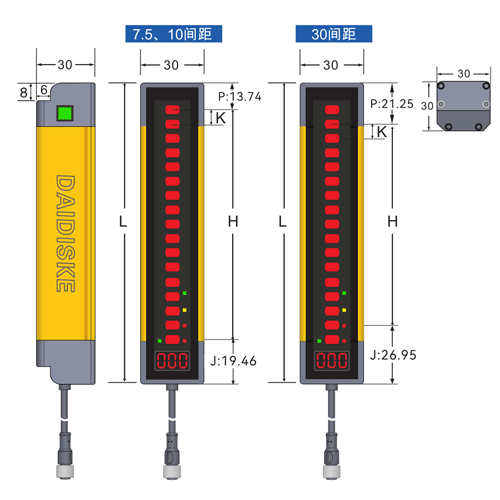
An equipment front-end module connects carrier handling and the process tool. For a custom extension, agree with the OEM which robot movements, access openings and shared safety signals change. Select documented detection capability and protected height for the approach geometry, measure the complete stopping performance and assess access around the optical field. A slim housing alone does not make a curtain suitable.
2. OHT and AMHS drop zones
OHT transfers create both motion hazards and suspended-load risks. A horizontal safety scanner may support personnel detection if field height, occlusion, minimum target capability and all access paths are validated. It cannot catch a dropped FOUP or replace hoist retention and mechanical safeguards. Compare the light curtain versus scanner geometry with the OEM's stop/restart interface. For maintenance, isolate hazardous energy and secure suspended loads under the approved procedure.
3. Stockers and sorters
Stockers and sorters can present moving shelves, lift axes and access to spaces behind an optical field. Determine whether interlocked guards, guard locking, optical protection or a combination is appropriate. Assess restart prevention and gravity-driven movement separately. A DQR enclosure is only a candidate after exact safety classification and environmental evidence are reviewed.
4. Wafer test and probe handlers
Test and probe handlers require their own access, electrical, motion, EMC and cleanliness assessment; do not infer a cleanroom class from the equipment name. Tray transfer may need an approved muting function, with validation that personnel cannot enter undetected. An ordinary conveyor sensor or PLC sequence cannot supply that safety function.
5. Sub-fab utilities and chemical/gas cabinets
Sub-fab pumps, abatement and chemical/gas utilities introduce pressure, chemical, thermal and electrical hazards beyond optical guarding. Apply containment, ventilation, gas detection and hazardous-energy controls as the process assessment requires. A sealed light curtain neither detects a leak nor proves suitability for a classified explosive atmosphere. Review all materials and ignition sources with the responsible equipment assessor.
The mistakes that get caught
Unqualified materials. Treat particle and chemical compatibility as acceptance evidence to obtain before ordering. Material names alone do not predict the behavior of brackets, seals and labels over the actual cleaning process.
Unresolved trips. Stop the affected hazardous operation, record diagnostics and investigate power, interference, alignment and contamination under the approved safe procedure. Bypassing the sensor is not a remedy; resume only after verification of the protective function.
Reset access. Position the reset control outside the hazard so it cannot be operated from within the protected space and provides the required view. Where visibility is incomplete, design additional presence/restart controls. Reset must not itself initiate hazardous motion; confirm the exact sensor/controller behavior.
ESD evidence, not a label. Bonding, insulation, ionization where appropriate, cleaning effects and verification belong to a coordinated ESD control plan. Neither an ESD sticker nor a single continuity measurement proves the whole installation acceptable.
Where DAIDISIKE fits — honestly
DAIDISIKE supplies industrial sensors for consideration in new and retrofit equipment. This article does not document customer fab installations or approval for prime-tool modifications. Define the actual integration scope and obtain the required evidence before treating any family as a fab-qualified choice.
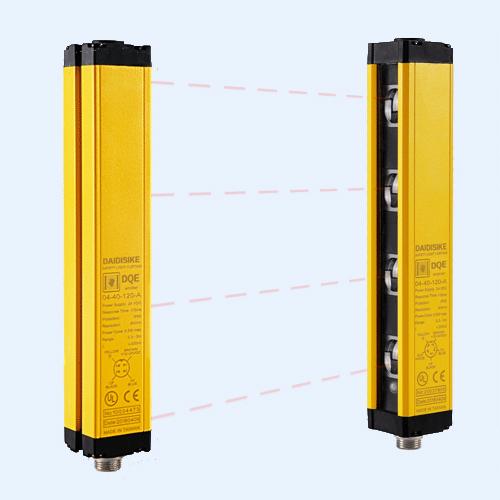
Start with the safety light curtain selection range for access geometry and the required documented protection level. DQC, DQA and DQE are not automatically Type 4 because they share this category; DQT4's published Type 4 architecture still requires exact variant evidence. DQR/DQRF enclosure ratings are not cleanroom qualifications. DLD, SDLD, DLDS and JPTG are non-safety perception devices and cannot protect an OHT drop zone. ST27 is confirmed Type 3, PL d, SIL 2, but no cleanroom, ESD or OHT-specific approval is established here.
The bottom line
The useful handover is a documented equipment design: clearly owned safety interfaces, verified stopping and restart behavior, environmental qualification for the exact location, and controlled maintenance. SEMI equipment assessment, IEC sensor safety evidence and cleanroom/ESD qualification answer different questions. None can be replaced by a catalog label or a photograph.
Related reading
DAIDISIKE DQR Sealed Light Curtain
Compare DQR/DQRF variant enclosure ratings; neither IP nor a sealed body establishes cleanroom or chemical compatibility.
Light Curtain vs Scanner
When to reach for a flat-plane light curtain and when a horizontal-plane safety laser scanner is the right answer.
DAIDISIKE Safety Light Curtain Range
The full DQA, DQC, DQT4, DQE, DQO, DQSA, DQR, MK and JER families at a glance.