
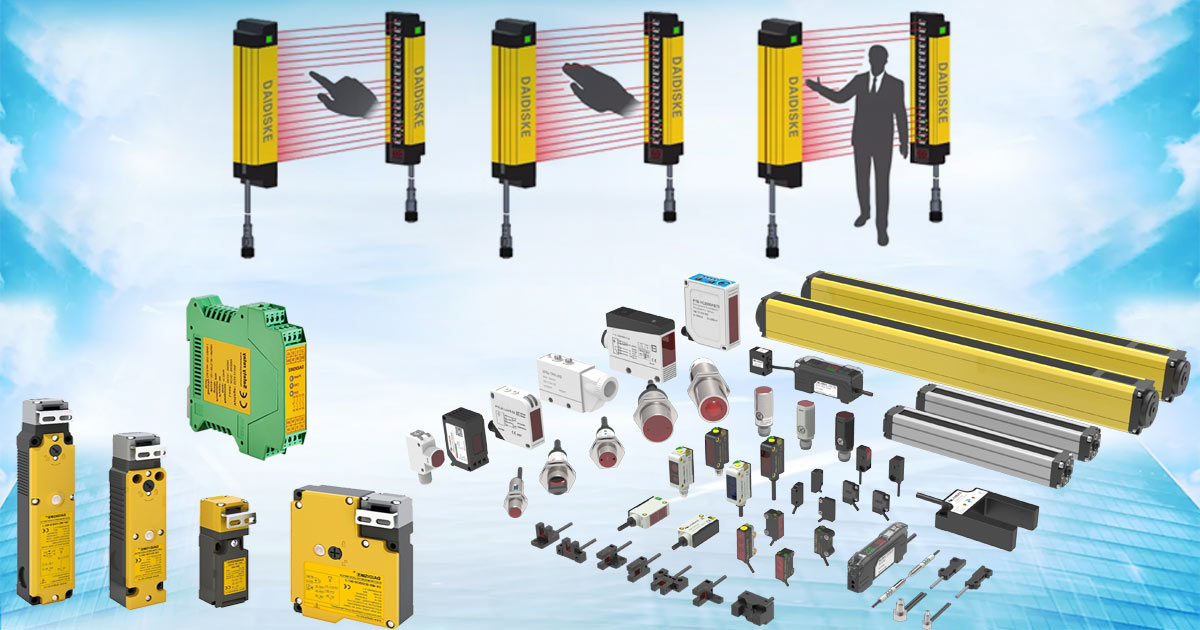
Textile processes can combine airborne fibre, sticky finishing mist and wet cleaning. These exposures affect the enclosure and exposed optical window differently. Assess extraction, cleaning access and signal diagnostics without compromising the protective field. For the model-documentation starting point, use our safety light curtain range and selection requirements; the application assessment below determines whether an optical guard is suitable at all.
The shape of the problem is three clusters: the application (which machine, which hazard, which resolution), the environment (dust, lint, washdown, and the IP65/IP67/IP68 answer to it), and sourcing (OEM/ODM, custom length for wide looms, low MOQ). We take them in that order.
What safety light curtain do I need for a loom, knitting or spinning machine?
Match documented detection capability to the smallest body part that can reach the hazard, within an approved safeguarding arrangement. Moving needle beds, yarn guides and sley/reed mechanisms create different access and stopping problems. A curtain is not automatically appropriate for all of them. The DQC model documentation distinguishes beam pitch from detection capability; neither DQC nor DQA should be described here as universally Type 4, dual safety OSSD or EDM-equipped. Obtain exact model evidence and a validated safety-related control design.
ISO 11111-1:2016 provides common requirements for its defined processes, read with the applicable machine-specific parts. Its scope excludes garment forming/making-up, nonwoven pressing and die cutting, spun-bonded/melt-blown production, and certain cutting devices such as laser, high-pressure water and ultrasonic cutters. It also excludes explosive-atmosphere use and machines made before the standards were published. Check the actual process, age and national requirements; do not apply this family to every cutting or nonwoven machine. IEC 61496 defines ESPE requirements, while the required PLr/SIL and the achieved control-function performance need their own assessment. Safety outputs must feed an approved compatible safety input, not an ordinary PLC. The DA31 model name alone does not establish OSSD compatibility or EDM; require the current manual for the exact variant and final switching arrangement.
How do I protect operators from nip points on winders and calenders?
Roller nips are in-running traps: establish the required physical guard, access geometry and stopping capability before proposing a light curtain. HSE textile-finishing guidance addresses guarding roller intakes and checking brakes. This guide does not give a universal safe nip gap: the former approximately 8 mm rule is not a validated calender criterion. A gap above an assumed value does not authorize replacing a nip guard with electro-sensitive protection. Consider entanglement, web threading, cleaning and access around the ends as well as direct finger reach.
Does dust and lint really affect safety light curtains — and which housing fixes it?
Yes — deposited lint and mist can attenuate light and cause interruptions; their frequency must be established from the actual installation. A sealed enclosure does not stop contamination landing on the external window. Use source extraction, suitable mounting and manufacturer-approved cleaning. Check optical operating range and signal margin separately from the physical safety distance. Never mask beams, bypass the guard or reduce a protective field to keep a dirty machine running.
For environmental selection, the DQR / DQRF documentation distinguishes plain DQR IP65 from the covered DQRF option up to IP68. MK is listed as IP65. None of these housing ratings establishes a safety Type/PL or chemical-cleaning compatibility. Our sealing and optical-window guide explains why enclosure ingress and surface fouling need separate controls.
What IP rating do I need for a dusty or washdown textile environment?
Specify the actual cleaning method, not a machine-name-to-IP shortcut. The first digit 6 in IP65, IP67 and IP68 denotes the same dust-tight enclosure category. Their water tests differ: water jets and immersion are not interchangeable qualifications. A particular hose pressure, temperature, detergent or finishing chemical needs explicit material and cleaning approval. All exposed optical windows still need inspection.
| Textile environment | Typical contamination | Sealing target | DAIDISIKE option |
|---|---|---|---|
| Spinning / carding / weaving hall (dry) | Heavy airborne lint, settled fibre | Dust-tight enclosure; exposed-window cleaning | MK lists IP65; validate safety function separately |
| Dyeing / finishing / wet nonwoven line | Finishing mist, washdown water | Defined water exposure plus chemical compatibility | DQR IP65 / covered DQRF up to IP68; not blanket washdown approval |
| Fabric / garment cutting room | Fabric dust, fly, low water | Window contamination and safe cleaning access | Exact detection capability, not catalogue pitch |
| Automated cutting / robot cell floor | Fabric dust on a floor zone | Enclosure, optics and coverage independently | DQSA perimeter curtain needs rating evidence; DLD is non-safety |
14 mm finger vs 30 mm hand — which for fabric and die cutting?
Resolution means documented detection capability, not beam pitch. A rated 14 mm detection capability and a rated 30 mm capability allow different intrusion allowances. Finer detection can reduce one distance term but does not remove reach-over, bypass or pass-through checks. DQC/DQA factory tables list pitch and detection separately. Garment making-up and nonwoven pressing/die cutting are outside the cited ISO 11111 scope, so establish their applicable machine requirements separately. A cutting press must also have an eligible, validated stopping function; do not assume that interrupting a sensor or de-energising a valve safely stops every cutting stroke.
How do I calculate the ISO 13855 safety distance on a cutting press?
Start with the applicable positioning case; S = K × T + C is introductory notation. It is not the complete ISO 13855:2024 assessment. For a relevant approach case, identify the terms in S = K × T + C, then check all other controlling requirements:
- S — minimum safety distance (mm) from the protective field to the hazard.
- K — approach-speed parameter selected using the applicable positioning method; the familiar 2000 mm/s hand-approach calculation and any 1600 mm/s recalculation have conditions.
- T — full worst-case time: exact sensor/configuration, safety logic, final switching and machine stopping, with any required allowances; do not substitute a typical response time.
- C — intrusion allowance for the applicable geometry. The familiar C = 8 × (d − 14), not below zero, applies only in its specified detection-capability/approach case; it is not a complete reach-over calculation.
Measure stopping performance under a competent, controlled procedure over the relevant loads and operating conditions. Check reach-over, under, around and undetected occupancy as well as the perpendicular approach. Revalidate after changes to the machine, sensor, braking or geometry. Use the minimum-distance engineering guide for the worked method, not as automatic approval of a textile cutter.
Light curtain or area scanner for an automated garment-cutting cell?
Curtain for a defined plane; safety-rated scanner for a suitably configured area, where the required function permits it. A person can pass through a curtain and remain behind it, so assess additional presence detection or restart interlocking and visibility. DQSA uses a reflector-based perimeter arrangement; it is not a 2D scanner, and its exact safety evidence must be checked. Industrial LiDAR categories distinguish non-safety DLD/SDLD/DLDS/JPTG sensing from ST27, whose Type 3, PL d, SIL 2 classification is user-confirmed. ST27 is not automatically suitable for a PL e requirement or for a dusty cutting cell.
| Textile machine / hazard | Guard type | Resolution / field | DAIDISIKE device |
|---|---|---|---|
| Loom / knitting / spinning point of operation | Machine guarding first; curtain only where eligible | 30 mm hand (14 mm if fingers reach) | DQC/DQA: exact rating and detection evidence required |
| Winder / calender roller nip | Physical nip guarding first; optical protection only if permitted and validated | Machine-specific nip guarding; no universal safe gap | No automatic model assignment |
| Fabric / garment die-cutting press | Applicable cutting-machine requirements and stopping eligibility first | Required detection and PLr from machine assessment | Documented safety model and compatible control chain |
| Dyeing / finishing / nonwoven washdown | Sealed light curtain | Verified detection, water exposure and cleaning media | DQR/DQRF variant-specific enclosure rating |
| Automated cutting / spreading cell floor | Area / perimeter scanning | Perimeter plane versus scanner area | DQSA perimeter curtain needs rating evidence; DLD is non-safety |
How does the DAIDISIKE range compare with the brands on a textile line?
An existing Banner, Leuze, SICK, Autonics, Schmersal, Pinnacle, Wintriss, Prismont, Pepperl+Fuchs or IFM device is a starting reference, not proof of interchangeability. These brands offer different product classes. Compare exact order codes, detection capability, safety classification, output diagnostics, restart/feedback arrangement, environmental limits and validated distance. DQC is not a universal Type 4 replacement. The brand compatibility method explains the evidence needed; ordinary inductive position sensors remain outside the personnel-protective function.
Can I get custom-length curtains and low MOQ as a textile machine builder?
Custom dimensions require an engineering review and a current quotation. Send protected height, complete opening geometry, required detection capability and PLr/SIL, operating range, supply and safety input requirements, cleaning media and measured stopping assessment. Confirm approved configurations, blind zones and whether customization affects the safety evidence. MOQ and lead time must be confirmed for the actual order; custom length alone is not a validated guard.
Send the hazard and operating modes, required detection and PLr/SIL, opening geometry, stopping assessment and cleaning conditions. We can review candidate documentation and quote options; the machine integrator retains responsibility for validation. Call or WhatsApp +86 15218909599 or use the contact page.
Sources and maintenance follow-through
Use ISO 11111-1:2016 scope with the relevant machine part, HSE textile finishing guidance, and HSE textile dust controls. Dust extraction and safe vacuum cleaning complement guarding; compressed-air blowdown can disperse hazardous dust. For optical faults, follow the safe light-curtain maintenance sequence. SICK explains the limits of IP water and chemical claims; these general limits do not certify a DAIDISIKE configuration.