
H-M Series M12/M18 Through-Beam Photoelectric Switch
Emitter + receiver pairs that keep detecting where dust defeats reflective sensors — spans from 2 m to a full 15 m from one M18 pair.
- Four range classes: 2 m / 5 m / 5 m / 15 m (+/-10%)
- Immune to target colour, gloss and surface finish
- NPN or PNP; single NO or complementary NO+NC
- Nickel-plated brass M12x63 / M18x73 barrels
- 10-30 VDC — runs on standard 24 V control power
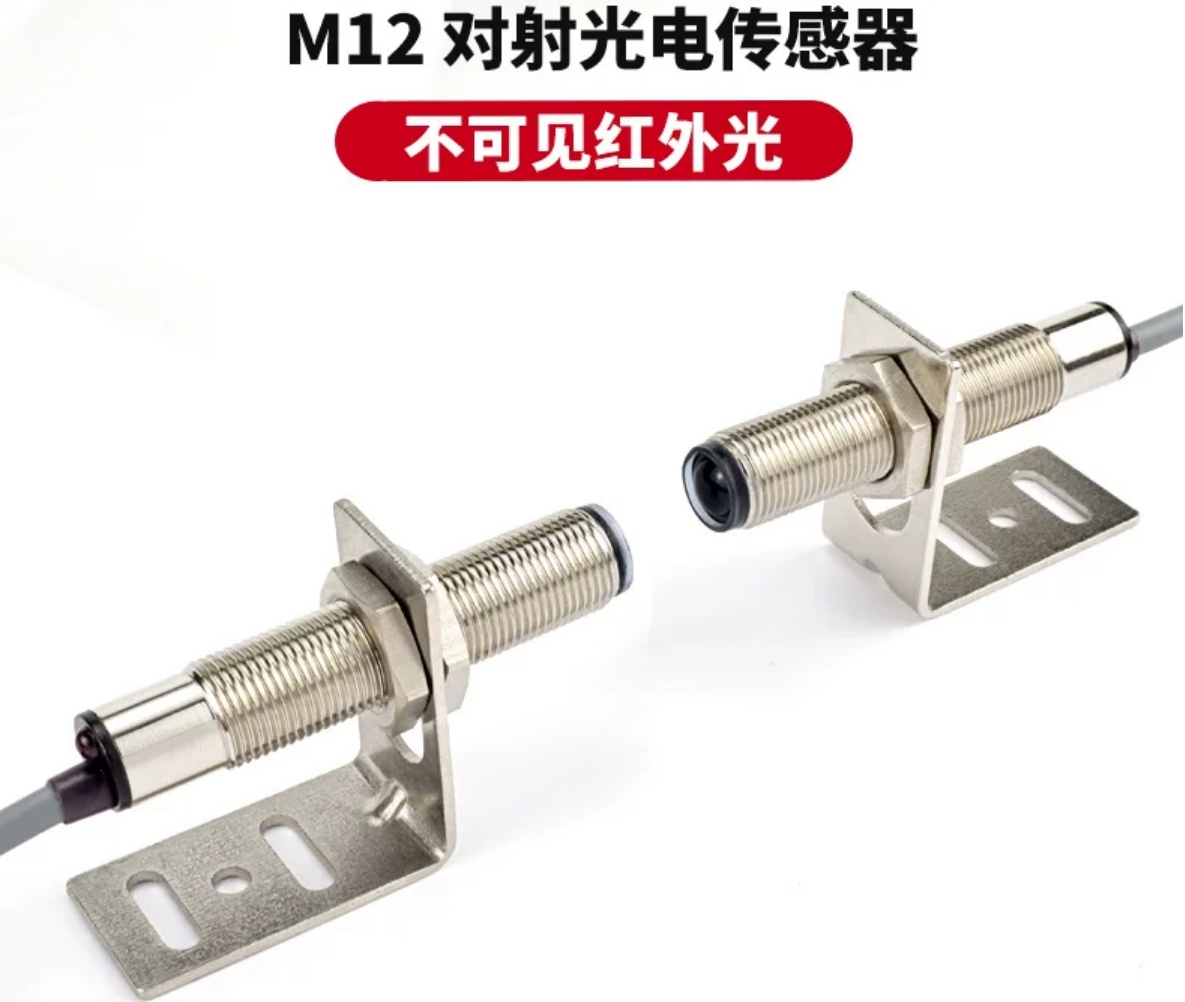
Built for Long Throws in Dirty Air
Every reflective sensing mode — diffuse or retroreflective — lives off the light that comes back. In woodworking shops, ceramics kilns, grain handling and recycling lines, airborne dust thins that return signal and settles on lenses until the sensor starts chattering. A through-beam pair works the other way round: the receiver watches a direct beam, which begins with orders of magnitude more optical margin. Dust must block almost the whole beam before detection is affected, so the same detection point that needed weekly lens cleaning with a diffuse head can run for months on an opposed pair.
The H-M series packages this mode in standard threaded metal barrels: M12 x 63 mm pairs rated 2 m or 5 m, and M18 x 73 mm pairs rated 5 m or a full 15 m — enough to span a warehouse door or a wide conveyor with a single pair and no reflector post. Because switching is by interruption, black rubber, shiny metal and film edges all read the same. All 16 models run on 10-30 VDC.
Note: general-purpose detection only. The H-M series is not an IEC 61496-certified safety component and must not be used on its own for personnel protection.
Installation & Alignment at a Glance
Original schematic: opposed-mode mounting. Align both barrels on one axis, confirm the receiver output with the gap clear, then lock the nuts.
M18 Pair — the 15 m Class
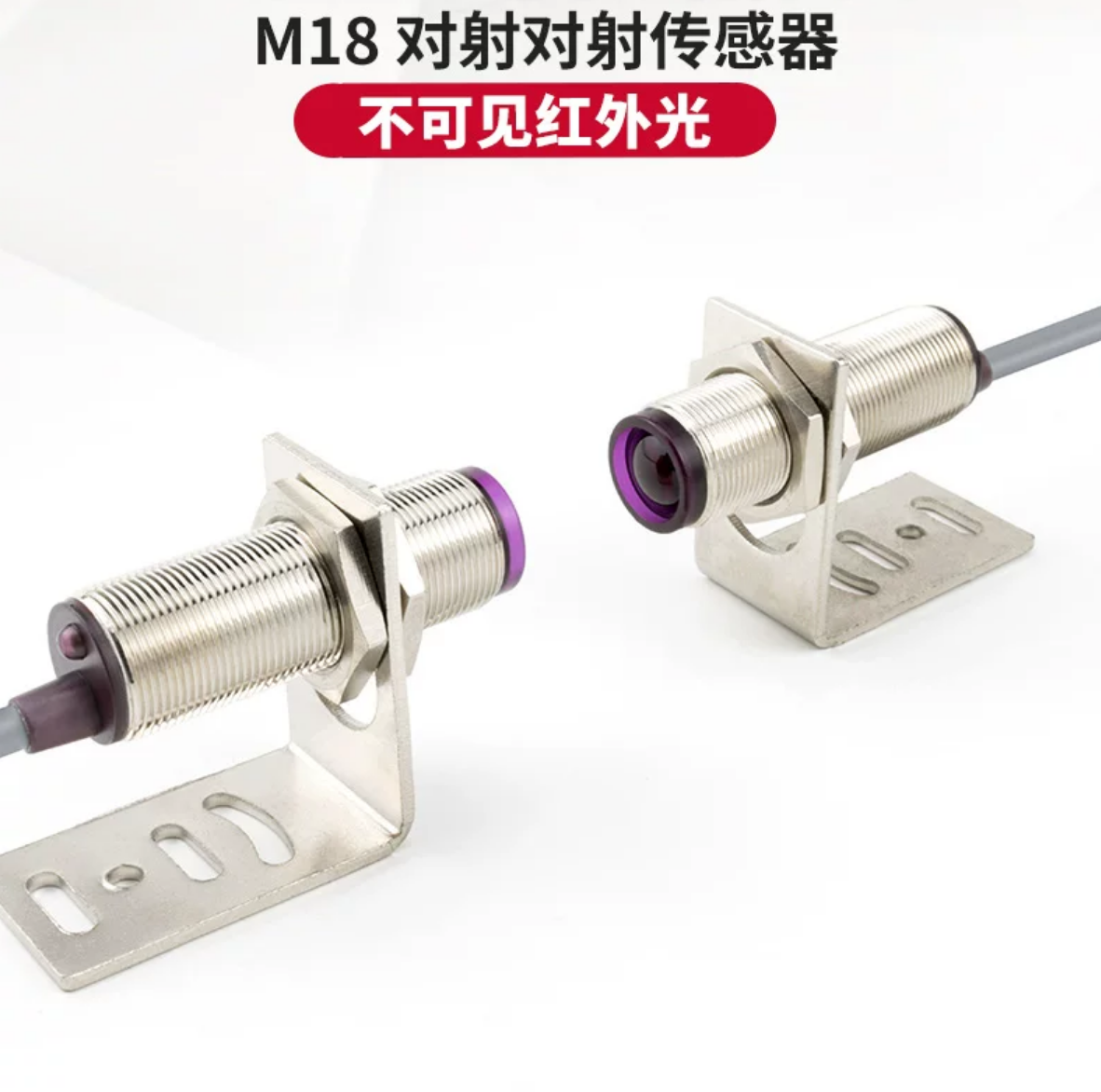
H1805M / H1815M use the larger M18 x 73 mm barrel; brackets and lock nuts are standard M18 sensor hardware.
Technical Specifications
| Sensing mode | Through-beam (opposed); separate emitter and receiver |
|---|---|
| Range classes | H122M: 2 m; H125M: 5 m; H1805M: 5 m; H1815M: 15 m (all +/-10%) |
| Barrel / thread | M12 x 63 mm (H122M/H125M); M18 x 73 mm (H1805M/H1815M) |
| Housing material | Nickel-plated brass |
| Output | N1 = NPN NO; P1 = PNP NO; N2 = NPN NO+NC; P2 = PNP NO+NC |
| Supply voltage | 10-30 VDC |
| Response time | Contact factory |
| Ingress protection | Contact factory |
| Light source | Infrared (invisible) per product literature; wavelength — contact factory |
| Certifications | Contact factory (documents on request) |
Selection Table — 16 Models
| Range class | Barrel | Rated range | NPN NO | PNP NO | NPN NO+NC | PNP NO+NC |
|---|---|---|---|---|---|---|
| H122M | M12 x 63 mm | 2 m +/-10% | H122MN1 | H122MP1 | H122MN2 | H122MP2 |
| H125M | M12 x 63 mm | 5 m +/-10% | H125MN1 | H125MP1 | H125MN2 | H125MP2 |
| H1805M | M18 x 73 mm | 5 m +/-10% | H1805MN1 | H1805MP1 | H1805MN2 | H1805MP2 |
| H1815M | M18 x 73 mm | 15 m +/-10% | H1815MN1 | H1815MP1 | H1815MN2 | H1815MP2 |
Each part number is supplied as an emitter + receiver pair. Match NPN (sinking) or PNP (sourcing) to your PLC input card; pick N2/P2 when one sensor must feed both control and alarm/interlock logic.
Typical Applications
Dusty Conveyor Cross-Belt Detection
In woodworking, ceramics, grain and recycling lines, airborne dust starves a diffuse sensor of return light. A through-beam pair only has to keep part of its direct beam alive, so it keeps switching where reflective modes fail.
Wide Gates and Portals
One H1815M pair spans up to 15 m across a doorway, lane or wide conveyor — a general-purpose pass-through trigger with no reflector post and no mid-span supports (not a safety function).
Chute and Drop-Point Flow Monitoring
Mounted across a chute, the beam reports material presence regardless of whether the product is black rubber, glossy metal or clear-edged film.
Mixed / Dark / Reflective Targets
Detection is by interruption, not reflection — target colour, gloss and surface finish do not change the switching point.
Frequently Asked Questions
Why choose a through-beam pair instead of a diffuse sensor in a dusty plant?
A diffuse sensor must receive light reflected off the target; suspended dust and coated lenses quickly eat that weak return signal. A through-beam pair sends a direct beam from emitter to receiver, which starts with far more optical margin, so it stays reliable at long range in dusty air. It also switches on interruption, so dark or glossy targets read identically.
What ranges does the H-M series cover?
Four classes, all rated +/-10%: H122M (M12 barrel, 2 m), H125M (M12, 5 m), H1805M (M18, 5 m) and H1815M (M18, 15 m). Pick the shortest range that covers your span with margin.
What do the N1 / P1 / N2 / P2 suffixes mean?
N1 = NPN with a single NO output; P1 = PNP with a single NO output; N2 = NPN with complementary NO + NC outputs; P2 = PNP with complementary NO + NC. With N2/P2 one receiver can feed a control input and an alarm/interlock input at the same time. That makes 16 models across the four range classes.
How precisely must the emitter and receiver be aligned?
They must face each other on the same optical axis with the beam clear in the normal state. The threaded M12x63 / M18x73 nickel-plated brass barrels lock with standard nuts and hold alignment once tightened; align at installation, verify the receiver output, then torque the nuts.
Can these sensors guard an operator opening or replace a safety light curtain?
No. The H-M series is a general-purpose detection product, not an IEC 61496-certified safety component, and must not be used alone for personnel protection. Use a certified safety light curtain for guarding tasks.
Will it detect clear film or glass?
Only if the edge or body blocks enough of the beam. Largely transparent targets that let most light through are not reliable through-beam targets — consider a sensing mode matched to transparent materials and test with real samples first.
How do I order, and are samples available for line trials?
Specify the range class (H122M/H125M/H1805M/H1815M) plus output suffix (N1/P1/N2/P2) — each order is an emitter + receiver pair. Trial pairs for line testing are generally supported; contact the factory for current sample terms, MOQ and lead time.
Specs reviewed by Engineer Cai, Senior Application Engineer. See certificates.
Safety Light Curtain — Customer Cases
Real installations from DAIDISIKE clients. Click any case to view in full. Filter by scenario to quickly find a similar setup.