
Economy Inductive Proximity Switch M8/M12/M18/M30 — JNX/JNS Series
The budget tier of the DAIDISIKE cylindrical range: four thread sizes, one straightforward spec, priced for volume OEM machine building.
- Sensing distance 1 mm (M8 flush) up to 15 mm (M30 non-flush)
- DC 3-wire, 10–30 V, NPN/PNP with NO/NC — 4 outputs per size
- 0.1 ms response / 1 kHz switching on M8–M18
- IP67 housing, −25 to +70 °C, LED indicator
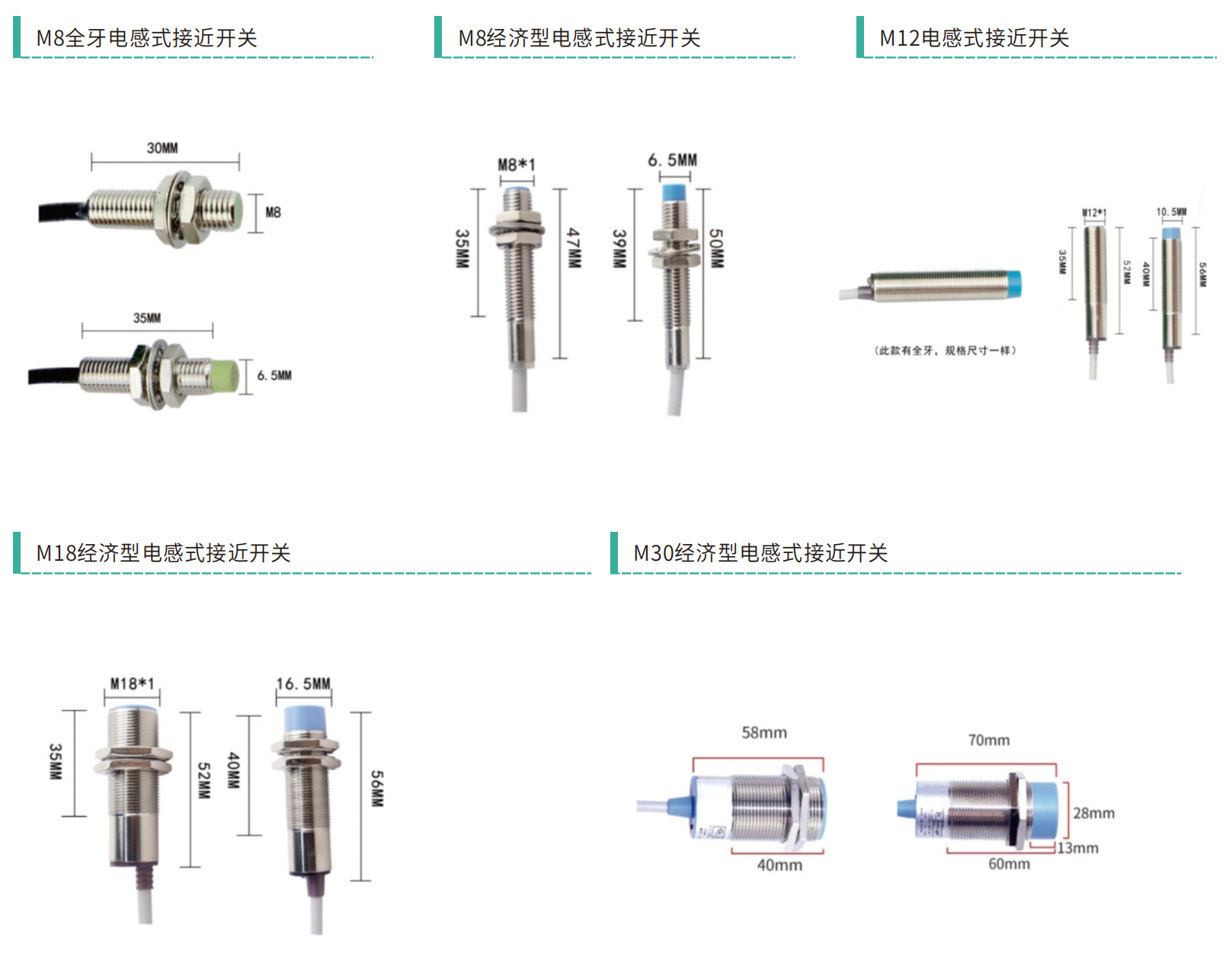
- JNX option: continuous full-thread M8 body for free mounting position
Where This Series Sits in the DAIDISIKE Range
DAIDISIKE builds its cylindrical inductive switches in two tiers. The standard tier — covered on the M8, M12 and M18/M30 three-wire pages — offers multiple body lengths and housing finishes per size. The JNX/JNS economy tier on this page deliberately keeps one flush and one non-flush variant per thread size, which is what lets it hit a lower price point without touching the parts of the spec that matter day-to-day: the same 10–30 V DC 3-wire wiring, the same NPN/PNP NO/NC output choices, the same IP67 sealing and −25 to +70 °C rating.
Pick this series when the machine needs dozens of ordinary position or presence points and unit cost drives the BOM; step up to the standard tier when you need specific body lengths, stainless housings or connector tails. If your panel is wired for 2-wire sensors instead, see the DC 2-wire or AC 2-wire families — this line is 3-wire DC only.
How an Inductive Proximity Switch Works
The coil at the sensing face radiates a high-frequency electromagnetic field. A metal target entering the field draws eddy currents, damping the oscillation; the trigger stage detects the amplitude drop and switches the transistor output — no contact, no moving parts, nothing to wear out.
Model Selection Table
| Models (NPN NO / PNP NO / NPN NC / PNP NC) | Size / series | Mounting | Sensing distance Sn | Response / frequency | Output & wiring | Connection |
|---|---|---|---|---|---|---|
| JNX0801N1P / P1P / N2P / P2P | M8 full-thread (JNX) | Flush | 1 mm | 0.1 ms / 1 kHz | NPN/PNP, NO/NC, 3-wire DC 10–30 V | 1.5 m cable (longer on request) |
| JNX0802N1 / P1 / N2 / P2 | M8 full-thread (JNX) | Non-flush | 2 mm | 0.1 ms / 1 kHz | NPN/PNP, NO/NC, 3-wire DC 10–30 V | 1.5 m cable (longer on request) |
| JNS0801N1P / P1P / N2P / P2P | M8 (JNS) | Flush | 1 mm | 0.1 ms / 1 kHz | NPN/PNP, NO/NC, 3-wire DC 10–30 V | 1.5 m cable (longer on request) |
| JNS0802N1 / P1 / N2 / P2 | M8 (JNS) | Non-flush | 2 mm | 0.1 ms / 1 kHz | NPN/PNP, NO/NC, 3-wire DC 10–30 V | 1.5 m cable (longer on request) |
| JNS1202N1P / P1P / N2P / P2P | M12 (JNS) | Flush | 2 mm | 0.1 ms / 1 kHz | NPN/PNP, NO/NC, 3-wire DC 10–30 V | 1.5 m cable (longer on request) |
| JNS1204N1 / P1 / N2 / P2 | M12 (JNS) | Non-flush | 4 mm | 0.1 ms / 1 kHz | NPN/PNP, NO/NC, 3-wire DC 10–30 V | 1.5 m cable (longer on request) |
| JNS1805N1P / P1P / N2P / P2P | M18 (JNS) | Flush | 5 mm | 0.1 ms / 1 kHz | NPN/PNP, NO/NC, 3-wire DC 10–30 V | 1.5 m cable (longer on request) |
| JNS1808N1 / P1 / N2 / P2 | M18 (JNS) | Non-flush | 8 mm | 0.1 ms / 1 kHz | NPN/PNP, NO/NC, 3-wire DC 10–30 V | 1.5 m cable (longer on request) |
| JNS3010N1P / P1P / N2P / P2P | M30 (JNS) | Flush | 10 mm | 0.5 ms / 500 Hz | NPN/PNP, NO/NC, 3-wire DC 10–30 V | 1.5 m cable (longer on request) |
| JNS3015N1 / P1 / N2 / P2 | M30 (JNS) | Non-flush | 15 mm | 1 ms / 300 Hz | NPN/PNP, NO/NC, 3-wire DC 10–30 V | 1.5 m cable (longer on request) |
Model code logic: N = NPN, P = PNP; 1 = NO, 2 = NC; trailing P = flush (embeddable). Housing material for this economy line is not published — contact the factory if your application requires a specific housing alloy.
Common Specifications
| Sensing type | Inductive (metal targets) |
|---|---|
| Supply voltage | 10–30 V DC, 3-wire |
| Output | NPN or PNP transistor, NO or NC |
| Overload / short-circuit | 180 mA overload trip point, built-in short-circuit protection |
| Protection rating | IP67 |
| Operating temperature | −25 °C to +70 °C |
| Indicator | Built-in LED switching-state indicator |
| Cable | 1.5 m standard; longer lengths on request |
Typical Applications
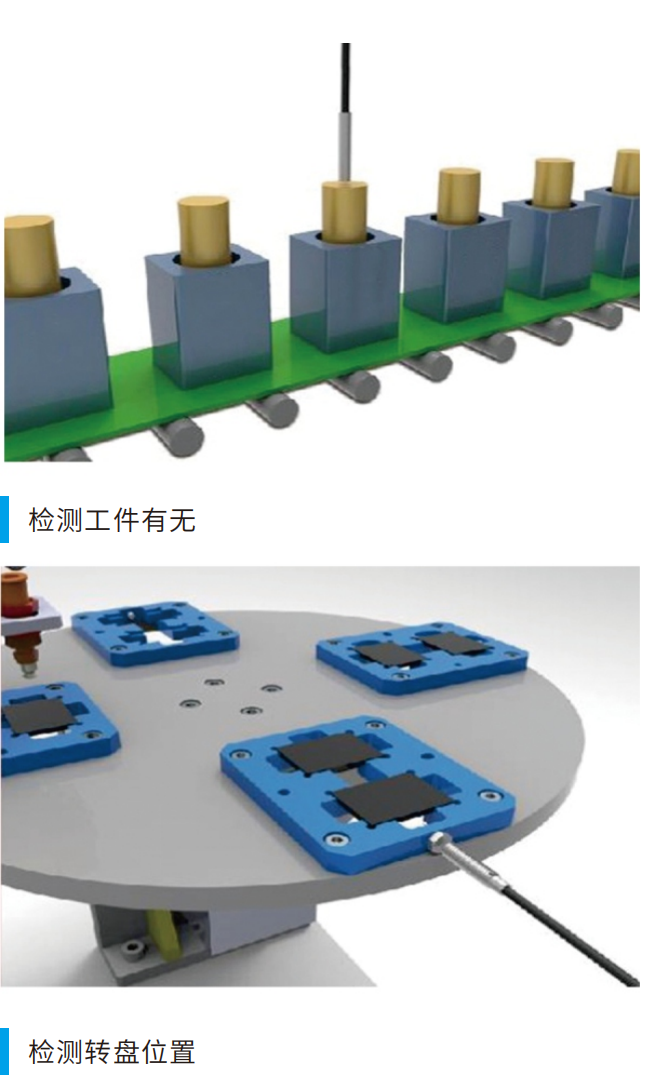
Conveyor presence points
Confirming a metal workpiece or carrier has arrived before the next station cycles.
Indexing tables
Stop-position confirmation on rotary tables — 0.1 ms response keeps up with fast indexing.
Metal part counting
Up to 1 kHz switching on M8–M18 sizes for tallying parts passing a fixed point.
Machine limit sensing
Basic home/limit positions on general machinery where dozens of low-cost points are needed.
Application Examples
Frequently Asked Questions
How is this economy JNX/JNS series different from the standard DAIDISIKE M8/M12/M18/M30 proximity switches?
It is the budget tier of the same cylindrical family. The standard series (see the M8, M12 and M18/M30 pages on this site) uses stainless-steel or nickel-plated brass housings with several body lengths per size; the JNX/JNS economy line trims the option list to one body per size and mount type, keeping the same DC 3-wire 10–30 V wiring, NPN/PNP NO/NC outputs and IP67 sealing at a lower unit price for volume OEM builds.
What sensing distances does the JNX/JNS economy series cover?
M8: 1 mm flush / 2 mm non-flush; M12: 2 mm flush / 4 mm non-flush; M18: 5 mm flush / 8 mm non-flush; M30: 10 mm flush / 15 mm non-flush. Rated values apply to a standard mild-steel target; non-ferrous metals reduce the usable distance — ask the factory for a correction factor before finalising a tight design.
What is special about the JNX full-thread M8 version?
The JNX M8 body is threaded continuously from face to tail, so the mounting nuts can clamp it at any point along the barrel — handy when the bracket position is not fixed at design time. The JNS versions have a conventional body with a defined thread section. The full-thread option is catalogued for M8 only; ask the factory about other sizes.
Which output should I order — NPN or PNP, NO or NC?
Match your PLC input card: NPN (sinking) for most Japanese/Asian-style controls, PNP (sourcing) for most European-style controls. NO closes when metal arrives; NC opens. Every size and mount type in this series is stocked in all four combinations, so the electrical choice never forces a mechanical compromise.
How fast can these sensors switch?
M8, M12 and M18 sizes respond in about 0.1 ms with switching frequency up to 1 kHz. The larger M30 coil is slower: roughly 0.5 ms / 500 Hz for the flush version and 1 ms / 300 Hz for the non-flush version. For counting faster than that, consider a photoelectric sensor instead.
Can I use these to interlock a machine guard door?
Only as a plain position signal. These are general-purpose sensors, not certified safety components — they are not rated to any IEC 61496 / ISO 13849 safety category and must not be the sole means of personnel protection. Use a certified safety interlock switch or safety light curtain for guarding duty.
What is the MOQ, lead time and cable option for export orders?
Standard cable length is 1.5 m; longer cables can be produced to order. MOQ and lead time depend on the model mix and quantity — as the factory we quote per enquiry, and samples of stock variants are usually available quickly. Send your model list through the contact page for a same-week quotation.
Specs reviewed by Engineer Cai, Senior Application Engineer. See certificates.