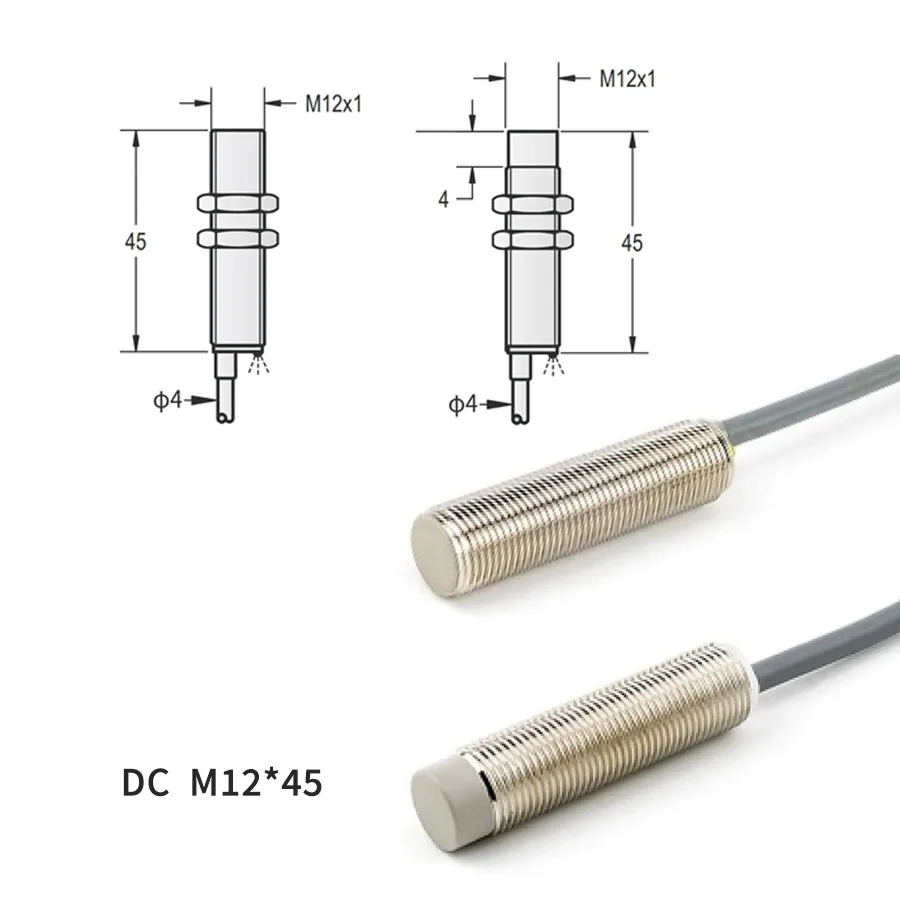
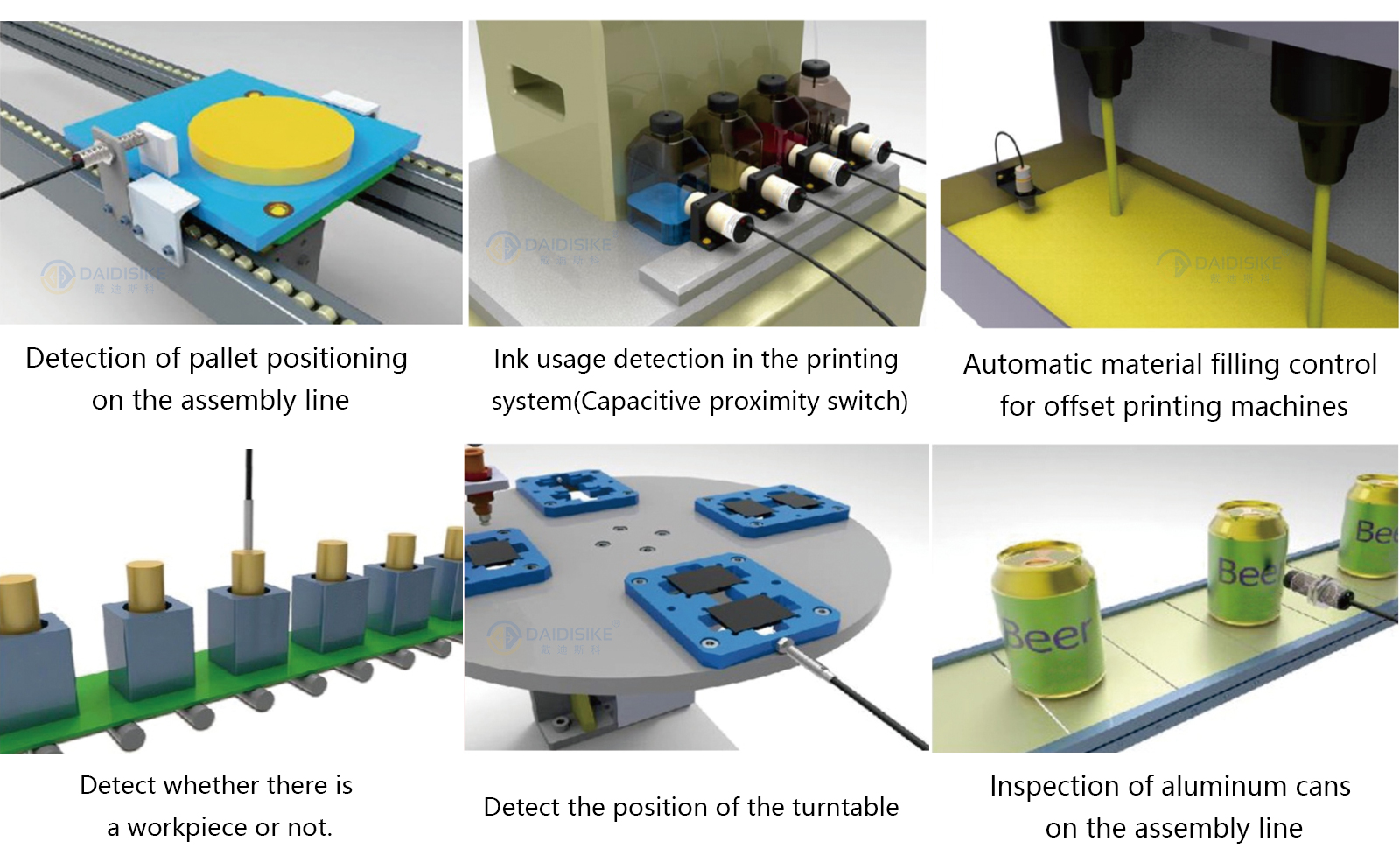
DC two-wire inductive proximity sensor series is a non-contact metal detection device for industrial automation, including M8, M12, M18, and M30 models. It supports DC two-wire power supply and detects metals like iron, steel, and aluminum. The brand is known for high reliability, durability, and cost-effectiveness, widely used in mechanical manufacturing, assembly lines, robotic arms, and conveyor systems. Sensors carry an IP67 protection rating for stable operation in harsh environments like humidity, dust, or vibration. Outputs include NO (D1) / NC (D2) for easy PLC integration. Two-wire design simplifies wiring and reduces costs while maintaining precision. Key advantages: 1-25mm sensing range, LED indicators, short-circuit protection with a 120 mA overload trip and 1 kV / 1 ms / 1 kΩ surge protection, a standard 2-metre cable, and flush (P) / non-flush (T) mounting for optimized performance.
The DAIDISIKE DC two-wire inductive proximity sensor series is a non-contact detection device designed for industrial automation. This series includes M8, M12, M18, and M30 size models, supporting DC two-wire power supply, suitable for detecting metal objects such as iron, steel, aluminum, and other non-magnetic metals. The DAIDISIKE brand is renowned for its high reliability, durability, and cost-effectiveness. These sensors are widely used in mechanical manufacturing, assembly lines, robotic arms, conveyor systems, and other fields. The sensors carry an IP67 protection rating, enabling stable operation in harsh environments such as humidity, dust, or vibration. Output types include normally open (NO) and normally closed (NC), facilitating integration into PLC or control systems. Compared to three-wire or four-wire sensors, the two-wire design simplifies wiring, reduces installation costs, while maintaining high-precision detection.
The key advantages of this series include: a graded sensing range (from 1mm to 25mm depending on the model and mounting type), LED indicator for status monitoring, short-circuit protection with a 120 mA overload trip, and 1 kV / 1 ms / 1 kΩ surge protection. A 2-metre cable is standard, with longer lengths available on request. Users can choose flush (P) or non-flush (T) mounting based on application needs to optimize detection performance.
Specifications Table
The following is a detailed specifications table for the DAIDISIKE DC two-wire inductive proximity sensor series, organized by size:
Parameter
M8
M12
M18
M30
Model Size
M8
M12
M18
M30
Sensing Distance (Flush, P)
1 / 2 mm
2 / 3 / 4 mm
5 / 8 mm
10 / 16 mm
Sensing Distance (Non-Flush, T)
2 / 4 mm
4 / 6 / 8 mm
8 / 12 / 16 mm
15 / 25 mm
Supply Voltage
10-30V DC
10-30V DC
10-30V DC
10-30V DC
Wiring
2-wire, in series with load
2-wire, in series with load
2-wire, in series with load
2-wire, in series with load
Output Type
NO (D1) / NC (D2)
NO (D1) / NC (D2)
NO (D1) / NC (D2)
NO (D1) / NC (D2)
Switching Frequency
2 kHz (1 mm P) / 1.5 kHz (2 mm P) / 2 kHz (2 mm T) / 800 Hz (4 mm T)
300 Hz (2 & 3 mm P) / 100 Hz (4 mm P) / 300 Hz (4 & 6 mm T) / 100 Hz (8 mm T)
300 Hz (5 mm P) / 150 Hz (8 mm P) / 300 Hz (8 mm T) / 100 Hz (12 & 16 mm T)
300 Hz (10 mm P) / 100 Hz (16 mm P) / 300 Hz (15 mm T) / 100 Hz (25 mm T)
Short-circuit Protection
Yes
Yes
Yes
Yes
Overload Protection Point
120 mA
120 mA
120 mA
120 mA
Surge Protection
1 kV / 1 ms / 1 kΩ
1 kV / 1 ms / 1 kΩ
1 kV / 1 ms / 1 kΩ
1 kV / 1 ms / 1 kΩ
Indicator
LED
LED
LED
LED
Protection Rating
IP67
IP67
IP67
IP67
Operating Temperature
-25°C to +70°C
-25°C to +70°C
-25°C to +70°C
-25°C to +70°C
Connection Method
2 m cable (longer on request)
2 m cable (longer on request)
2 m cable (longer on request)
2 m cable (longer on request)
Body Length / Thread
M8×1 × 45 mm
M12×1 × 45 mm
M18×1 × 55 mm
M30×1.5 × 55 mm
Operating (load) Current
3-100 mA
3-100 mA
3-100 mA
3-100 mA
Leakage Current
<0.8 mA
<0.8 mA
<0.8 mA
<0.8 mA
Voltage Drop across Sensor
<6 V
<6 V
<6 V
<6 V
Supply Ripple
<10%
<10%
<10%
<10%
Switching Hysteresis
15% (Sr)
15% (Sr)
15% (Sr)
15% (Sr)
Repeat Accuracy
<3-5% (Sr)
<3-5% (Sr)
<3-5% (Sr)
<3-5% (Sr)
Temperature Drift
<10% (Sr)
<10% (Sr)
<10% (Sr)
<10% (Sr)
Housing Material
Contact factory
Contact factory
Contact factory
Contact factory
Weight
Contact factory
Contact factory
Contact factory
Contact factory
Certifications
Contact factory
Contact factory
Contact factory
Contact factory
Note: Specifications may vary slightly by specific model; please refer to the product manual for exact values. Sensing distance is for standard iron targets (size twice the sensing distance).
Technical Parameters
The technical parameters of the DAIDISIKE DC two-wire inductive proximity sensors are as follows, ensuring high performance and reliability in industrial environments:
Supply Voltage Range: 10-30V DC, two-wire (the sensor is wired in series with the load); supply ripple <10%.
Operating (load) current 3-100 mA; leakage current <0.8 mA; voltage drop across the sensor <6 V.
Wiring: brown (BN) to the positive supply, blue (BU) through the load back to positive.
Output: NO (model code D1) or NC (model code D2).
Short-Circuit Protection: Built-in, with an overload current protection point of 120mA.
Surge Protection: 1kV / 1ms / 1kΩ.
LED Indication: Built-in LED for output status display, convenient for on-site debugging.
Switching Frequency: highest at the shortest sensing distance of each size — M8 2kHz (1mm flush) down to 800Hz (4mm non-flush); M12 300Hz down to 100Hz; M18 300Hz down to 100Hz (150Hz at 8mm flush); M30 300Hz down to 100Hz.
Protection Rating: IP67; operating temperature -25°C to +70°C.
Cable: 2m standard, longer lengths available on request.
Mounting: flush (P) versions can be embedded in surrounding metal; non-flush (T) versions need a metal-free clearance zone around the sensing face but reach a longer distance.
Target Material: metal targets. Rated Sn assumes a standard mild-steel target; non-ferrous metals are detected at a shorter distance — contact the factory for reduction factors.
Housing material, weight and certification: contact the factory (not published in the current catalogue for this series).
The figures above are transcribed from the factory selection table for the DC two-wire series; items not published there are marked as "contact the factory" rather than estimated.
Working Principle
The working principle of the DAIDISIKE DC two-wire inductive proximity sensor is based on electromagnetic induction. Specifically, the sensor contains a high-frequency oscillation circuit internally, which generates an alternating magnetic field. When a metal object (target) enters the sensor's sensing area, eddy currents are induced in the target, altering the impedance and amplitude of the oscillation circuit. The sensor detects this change and, through an internal amplifier and comparator circuit, converts the signal into a switch output.
Detailed process:
1. Oscillator Generates Magnetic Field: The front-end coil of the sensor produces a high-frequency magnetic field (typically several hundred kHz).
2. Target Approaches: The metal object enters the magnetic field, absorbs energy, and generates eddy currents, causing field attenuation.
3. Detects Change: The oscillator's amplitude or frequency change is captured by the detection circuit.
4. Signal Processing: Through threshold comparison, outputs a switch signal (NO or NC).
5. Two-Wire Design: Power and signal are transmitted via the same pair of wires, simplifying the circuit; the load is connected in series in the power loop, and when the sensor activates, current changes drive the load.
This non-contact detection avoids mechanical wear, extending service life compared with mechanical limit switches. In professional terms, this is an "Inductive Proximity Sensor," designed with reference to the general industry specification for proximity switches (IEC 60947-5-2), commonly used for "Position Sensing" and "Presence Detection." Compared to capacitive sensors, inductive ones are better suited for metal targets and unaffected by dust or liquids.
Frequently Asked Questions
What is a DC two-wire inductive proximity sensor and how does it wire up?
A DC two-wire sensor carries both power and the switching signal on the same pair of conductors, with the load wired in series in the supply loop. This cuts wiring to two cores instead of three, simplifying installation. The DAIDISIKE series runs on 10-30 V DC with NO (D1) or NC (D2) output, built-in short-circuit protection and 1 kV / 1 ms / 1 kΩ surge protection.
Which size should I pick: M8, M12, M18 or M30?
Size sets the sensing distance and body length. Flush versions are rated 1-2 mm (M8), 2-4 mm (M12), 5-8 mm (M18) and 10-16 mm (M30); non-flush versions are rated 2-4 mm (M8), 4-8 mm (M12), 8-16 mm (M18) and 15-25 mm (M30). The M8 and M12 bodies are 45 mm long, the M18 and M30 bodies 55 mm. Faster targets need the higher switching frequency of the shorter sensing ranges — the M8 1 mm flush version switches at 2 kHz, the M8 4 mm non-flush version at 800 Hz.
What is the difference between two-wire and three-wire (NPN/PNP) proximity switches?
Two-wire sensors are wired in series with the load, so they suit simple NO/NC switching with minimal cabling, but they pass a small residual current through the load and drop some voltage across the sensor. Three-wire PNP or NPN sensors keep load and supply separate for cleaner signals into a PLC. Choose two-wire when you want the simplest wiring and the controller tolerates the residual current. For this series the factory table gives a leakage current below 0.8 mA and a voltage drop below 6 V across the sensor, with a 3-100 mA operating (load) current window.
Can this replace an Omron, Balluff or Autonics two-wire proximity sensor?
Usually yes. It shares the standard M8/M12/M18/M30 thread, 10-30 V DC two-wire operation, IP67 rating and a comparable 1-25 mm sensing range, so it fits the same brackets and 2 m cable run. Match the body size, flush (P) or non-flush (T) type and NO/NC output to the unit being replaced for a drop-in swap.
What protection rating and target materials does it support?
Every model is rated IP67 and specified for -25 °C to +70 °C, suitable for humid, dusty and vibration-prone lines. It detects metal targets; rated sensing distance Sn assumes a standard mild-steel target, and non-ferrous metals such as stainless steel and aluminium are detected at a shorter distance. Contact the factory for material reduction factors and housing material on a specific model.