
BGS-CX441 / BGS-CX442 Background Suppression Photoelectric Sensor
Switches by distance, not brightness — so a black part is detected and the shiny belt just behind it is not.
- Two optics: 2 mm precision spot (CX441) or 15 mm wide spot (CX442)
- 10–100 mm / 20–300 mm adjustable cutoff distance
- Published black/white differential: 80 mm / 280 mm
- < 0.5 ms response, 100 Hz switching
- NPN or PNP by order code, N.O./N.C. by wiring, IP65
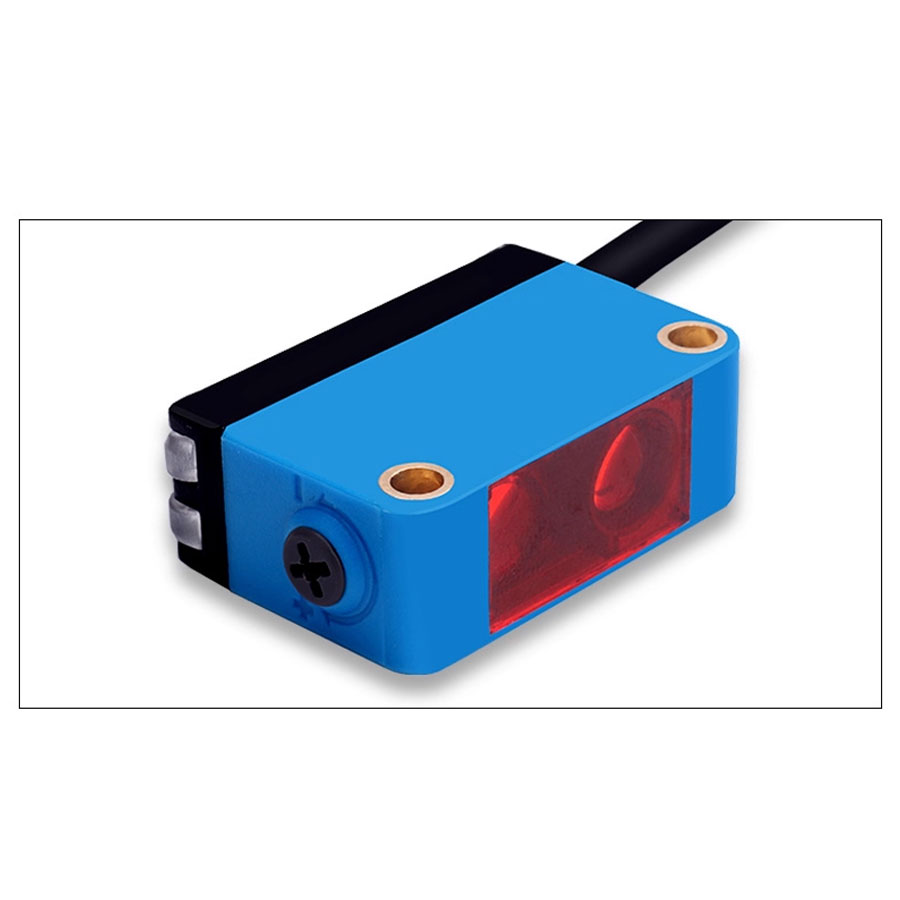
Why Background Suppression Beats Plain Diffuse Sensing
A standard diffuse-reflective sensor makes its decision from how much light comes back. That works until the target is dark (little light returns — missed detection) or the background is bright or metallic (too much light returns — false detection). The BGS-CX441 and BGS-CX442 instead evaluate where the light comes back from: reflections returning from beyond the set cutoff distance are rejected outright, while anything inside the cutoff trips the output — whether it is white cardboard or black rubber.
The two models share the same electronics and differ in optics. The CX441 projects a 2 mm spot for small or tightly spaced parts; the CX442 spreads a 15 mm spot that averages the reflection across textured, perforated or mesh surfaces so a hole in the surface is not mistaken for a missing product.
Triangulation-style BGS principle: reflections from inside the set distance switch the output; reflections from farther away — however bright — are suppressed.
Model Selection Table
| Model | Detection Method | Sensing Distance | Output |
|---|---|---|---|
| BGS-CX441N | Background suppression, 2 mm small spot | 10–100 mm adjustable (black/white differential 80 mm; 100 mm on white paper) | NPN, N.O./N.C. by white control wire |
| BGS-CX441P | Background suppression, 2 mm small spot | 10–100 mm adjustable (black/white differential 80 mm; 100 mm on white paper) | PNP, N.O./N.C. by white control wire |
| BGS-CX442N | Background suppression, 15 mm wide spot | 20–300 mm adjustable (up to 500 mm on white; black/white differential 280 mm) | NPN, N.O./N.C. by white control wire |
| BGS-CX442P | Background suppression, 15 mm wide spot | 20–300 mm adjustable (up to 500 mm on white; black/white differential 280 mm) | PNP, N.O./N.C. by white control wire |
Common ratings: DC12–24V ±10% supply, current consumption under 30 mA, response under 0.5 ms (100 Hz), IP65 housing, 2 m cable. Parameters not listed here (e.g. minimum detectable object, operating temperature, light source / emitted wavelength) — please contact the factory for confirmation before final design-in.
Note: general-purpose detection sensors, not IEC 61496-certified safety components — do not use them alone for personnel protection.
Typical Applications
Black Rubber & Dark Plastics on Conveyors
Distance-based switching keeps the trip point stable on low-reflectivity parts that starve an ordinary diffuse sensor of returned light.
Targets Just in Front of a Background
Set the cutoff between part and belt, tray or machine frame — the background sitting millimetres behind the target stays invisible.
Mesh Belts & Perforated Plates (CX442)
The 15 mm wide spot averages light over holes and gaps, so open surfaces do not read as a missing product.
Mixed Light/Dark Product Runs
Published black/white differential distances mean one setting survives a colour changeover without re-teaching.
Frequently Asked Questions
How is a BGS sensor different from an ordinary diffuse photoelectric sensor?
An ordinary diffuse sensor switches on reflected brightness, so a shiny background can out-shine a dark target and cause false or missed triggers. The BGS-CX441/CX442 evaluate the distance the light returns from: anything beyond the set cutoff is ignored regardless of how reflective it is, and anything inside it is detected even if it is black.
Which should I choose — BGS-CX441 or BGS-CX442?
Choose BGS-CX441 (2 mm spot, 10–100 mm adjustable) for small, precisely positioned or closely spaced targets. Choose BGS-CX442 (15 mm wide spot, 20–300 mm adjustable, up to 500 mm on white) when the surface is perforated, meshed or uneven — the wide spot averages the reflection so a hole does not read as an absent part.
What does the black/white differential distance figure mean in practice?
It is the sensing distance the sensor holds when the target changes from white to black: 80 mm for CX441 and 280 mm for CX442. Keep your mounting distance inside that figure and one setting covers both dark and light products on the same line.
Can I detect a part lying almost flat on the conveyor belt?
Yes — this is the classic BGS use case. Set the cutoff distance between the part surface and the belt surface; the belt behind the part is suppressed even though it is only a short distance further away.
How do I select N.O. or N.C. output?
By wiring, not by part number. All four models are 4-wire with a white control wire: leave it floating for one logic, tie it to 0V for the other. NPN vs PNP is fixed by the order-code suffix (N or P).
How fast do these sensors respond?
Response time is under 0.5 ms with a 100 Hz switching frequency — sufficient for presence checks and counting on typical conveying and sorting lines. Supply is DC12–24V ±10% at under 30 mA, and the housing is IP65 with a 2 m cable.
Can these sensors be used for machine safety / personnel protection?
No. The BGS-CX441/CX442 are general-purpose detection sensors, not IEC 61496-certified safety components, and must not be used on their own for personnel protection. For guarding tasks use a certified safety light curtain such as the DQC series.
What is the minimum order quantity, and can I get samples?
As the factory we support small trial orders and sample evaluation before volume purchase. Contact us with your target quantity and application — export packing, OEM marking and mixed-model consolidated shipments can be arranged.