
Q17 / Q18C Flat-Mount Square Inductive Proximity Switch
Screws down like a limit switch, detects like a prox — cube bodies with 5 mm or 8 mm of non-contact range.
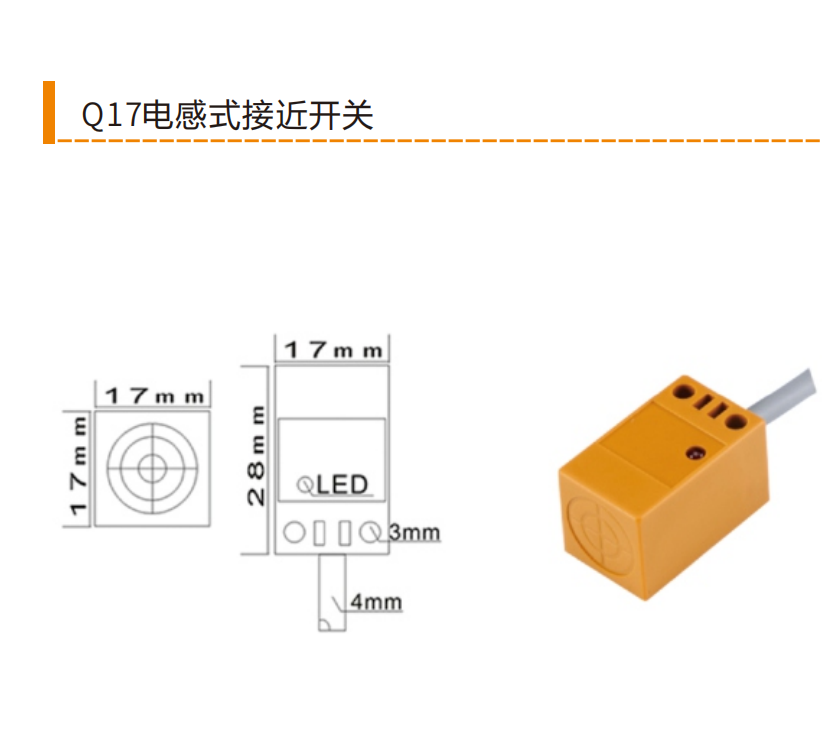
- Q17: 17 × 17 × 28 mm; Q18C: 18 × 18 × 35.5 mm, PBT, LED
- 5 mm or 8 mm rated sensing distance
- 10 – 30 V DC, IP67, −25 °C to +70 °C
- DC 3-wire NPN / PNP, NO / NC — 16 part numbers
- Flat-face mounting on brackets and frames
- Ø4 mm cable outlet, BN/BK/BU color code
The bracket decides the sensor
Ask a maintenance fitter what fails on a barrel sensor installation and the answer is rarely the sensor — it is the mounting. Thin lock nuts loosen under vibration, the bore was drilled two millimetres off, and re-aiming means two wrenches in a space that fits neither. The Q17/Q18C sidestep all of it: the cube sits flat on the frame, two screws hold it, and the sensing face lands exactly where the drawing said it would.
With 5 mm and 8 mm ratings, these bodies also out-reach comparably priced small barrels: our own M8 flush sensors give you 1–3 mm to work with, while a Q17 at 8 mm tolerates target run-out that would have a small barrel either crashed into or out of range. Factory drawings cover both side-sensing and top-sensing face arrangements; the catalogue does not assign a separate code to the sensing direction, so tell us which face you need and we will confirm the matching drawing and part number.
Flat-Face Mounting vs Threaded Barrel
Same job, different mechanics: the cube format trades the barrel thread for a flat base and gains sensing distance in the bargain.
Model Selection Table
| Model (NPN / PNP) | Series | Sensing distance | Output logic | Body size |
|---|---|---|---|---|
| Q1705N1 / Q1705P1 | Q17 | 5 mm | NPN NO / PNP NO | 17 × 17 × 28 mm |
| Q1705N2 / Q1705P2 | Q17 | 5 mm | NPN NC / PNP NC | 17 × 17 × 28 mm |
| Q1708N1 / Q1708P1 | Q17 | 8 mm | NPN NO / PNP NO | 17 × 17 × 28 mm |
| Q1708N2 / Q1708P2 | Q17 | 8 mm | NPN NC / PNP NC | 17 × 17 × 28 mm |
| Q18C05N1 / Q18C05P1 | Q18C | 5 mm | NPN NO / PNP NO | 18 × 18 × 35.5 mm |
| Q18C05N2 / Q18C05P2 | Q18C | 5 mm | NPN NC / PNP NC | 18 × 18 × 35.5 mm |
| Q18C08N1 / Q18C08P1 | Q18C | 8 mm | NPN NO / PNP NO | 18 × 18 × 35.5 mm |
| Q18C08N2 / Q18C08P2 | Q18C | 8 mm | NPN NC / PNP NC | 18 × 18 × 35.5 mm |
Housing material: PBT (both series). Model code = series + sensing distance (05 / 08) + N/P (NPN / PNP) + 1/2 (NO / NC).
Technical Specifications
| Item | Specification |
|---|---|
| Body size | Q17: 17 × 17 × 28 mm · Q18C: 18 × 18 × 35.5 mm |
| Rated sensing distance Sn | 5 mm or 8 mm (both series) |
| Response time | 0.2 ms (5 mm) · 0.3 ms (8 mm) |
| Switching frequency | 1 kHz (5 mm) · 500 Hz (8 mm) |
| Housing material | PBT |
| Status indicator | LED |
| Supply voltage | 10 – 30 V DC |
| Ripple | < 10 % |
| No-load current | < 10 mA |
| Max. load current | 150 mA |
| Leakage current | < 0.01 mA |
| Voltage drop | < 1.5 V |
| Switching hysteresis | < 15 % (Sr) |
| Repeat accuracy | < 3.0 % (Sr) |
| Degree of protection | IP67 |
| Ambient temperature | −25 °C to +70 °C |
| Temperature drift | < 10 % (Sr) |
| Short-circuit protection | Yes |
| Overload current protection point | 180 mA |
The 5 mm and 8 mm ratings apply to a standard mild-steel target; derate for stainless, aluminium, brass and copper.
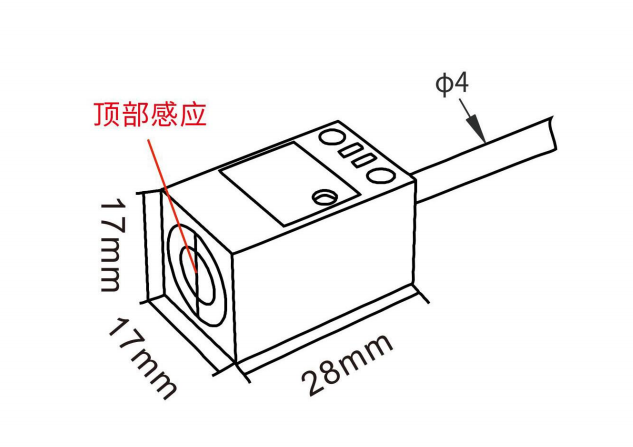
Top-sensing Q17 arrangement: the coil looks out of the 17 × 17 mm end face, with the Ø4 cable exiting the rear.
Typical Applications
Machine-Tool Position Sensing
Confirms slides, turrets and fixtures on CNC and conventional machines, mounted to existing flat bracketry.
Limit-Switch Upgrades
Replaces worn mechanical limit switches with non-contact detection — same mounting style, no moving parts.
Conveyor & Packaging Lines
Counts and confirms metal parts, pucks and carriers passing a fixed point, with 8 mm of tolerance for wander.
Cylinder End-of-Travel
Reads a metal flag on cylinders and slides to hand solid position states to the PLC.
Frequently Asked Questions
Why choose a square Q17/Q18C over a cylindrical M12 or M18 sensor?
Mounting. A cube body screws flat against the machine frame with ordinary fasteners — no drilled bore, no pair of thin nuts, no wrench clearance behind the panel. On fabricated brackets and welded frames, a flat face with screw holes is usually already there, so the square format installs in minutes and holds its aim after impacts better than a barrel clamped by nuts.
What sensing distances are available?
Both series come in a 5 mm version (model code 05) and an 8 mm version (code 08), rated on standard steel targets. Choose 5 mm when the target is tightly guided and you want a crisp switching point; choose 8 mm when the mechanism has play or thermal growth and you need working margin.
How do I decode a model number like Q1708P2?
Series + distance + output + logic: Q17 body, 8 mm sensing distance, PNP output, normally-closed logic. N denotes NPN, P denotes PNP; suffix 1 is NO, suffix 2 is NC. Q18C codes read the same way, e.g. Q18C05N1.
What are the Q17's physical details?
The Q17 measures 17 × 17 × 28 mm in a PBT (polybutylene terephthalate) housing, with a status LED visible on the front face and a Ø4 mm cable outlet. Factory drawings show both side-sensing and top-sensing face arrangements — tell us the target approach direction when ordering.
What about the Q18C's dimensions and the series' voltage and IP ratings?
The Q18C is 18 × 18 mm across the sensing face with an overall length of 35.5 mm (31 mm body plus cable gland), fixed by two Ø3.2 mm holes on 11 mm centres, and it shares the housing and output options with the Q17. Both series run on 10–30 V DC with less than 10 % ripple, are sealed to IP67 and rated −25 °C to +70 °C. Switching frequency is 1 kHz on the 5 mm versions and 500 Hz on the 8 mm versions, with 0.2 ms and 0.3 ms response times respectively.
Can these replace a mechanical limit switch one-for-one?
Functionally yes, for metal targets: the NO/NC selection reproduces the contact logic and the flat body mounts in the same style of location. Electrically, remember the output is a DC transistor, not a dry contact — wire it to a PLC input or through an interposing relay, and match NPN/PNP to your input card polarity.
How do I get pricing, samples and delivery terms?
Send the part numbers (or your target distance, output type and mounting photos) via the contact page. Our export sales team will confirm MOQ, sample availability, unit pricing and lead time to your region, with certification documents available on request.