
PZ-MK10 One-Touch Teach Laser Sensor
Teach it the empty station once — then anything that shows up in front of that background gets detected. Changeover is one button, not one technician.
- One-touch teach against the real installed background
- 10–500 mm setting distance (light background / reflector)
- 10–200 mm on dark backgrounds — rated separately
- Falls back to 200 mm diffuse mode with no background
- 3-wire, 2 m cable — drop-in for standard photoelectrics
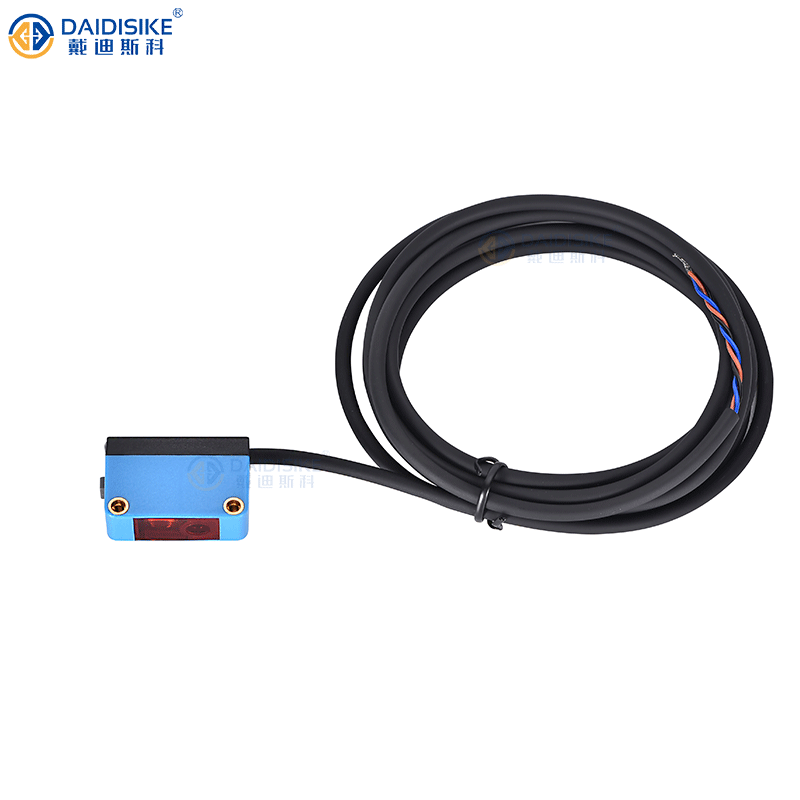
Detection Logic That Survives Product Changeovers
Conventional diffuse sensors are tuned to the target — so every new product color, surface or size risks a re-tune. The PZ-MK10 inverts the logic: a single button press teaches it the background — the belt, the fixture plate, the wall behind the station. From then on, any object appearing in front of that reference switches the output, regardless of what the object looks like. When the product changes, nothing needs to change; when the fixture changes, the operator re-teaches in seconds.
The catalog rates the setting distance honestly by backdrop: 10–500 mm with a light background or reflector plate, 10–200 mm against dark backgrounds, and a 200 mm standard diffuse mode when no background exists at all — so a temporary setup still detects. The laser emitter puts a small, visible-geometry spot exactly where you aim it, and the 3-wire, 2 m-cable wiring replaces a conventional photoelectric sensor without rework. In DAIDISIKE's smart detection lineup it is the laser, fixed-background tier — its vision-based sibling, the PZ-CM10 intelligent-learning photoelectric switch, covers stations where target features vary instead.
Background Teach-In, Step by Step
The sensor stores the distance signature of the empty station; any object closer than the learned reference switches the output — independent of the object's own color or finish.
Technical Specifications
| Model | PZ-MK10 |
|---|---|
| Detection method | Laser, background-referenced with one-touch (push-button) teach |
| Setting distance — light background / reflector | 10–500 mm |
| Setting distance — dark background | 10–200 mm |
| Detection distance — no background (diffuse mode) | 200 mm |
| Wiring | 3-wire (black output wire), 2 m pre-wired cable |
| Output polarity (NPN/PNP) | Not specified in catalog — confirm with factory before ordering |
| Laser class / response / IP / voltage | Contact factory for latest datasheet |
| Installation requirement | Sensor and background static; strong vibration or displacement not supported |
Smart Detection Lineup
| Model | Principle | Use when… |
|---|---|---|
| PZ-MK10 (this page) | Laser, background-referenced teach-in | Backdrop is stable and fixed; presence/absence switching with fast re-teach |
| PZ-CM10 | Vision-based feature recognition | Target features vary and the decision must key on the object itself |
The PZ-MK10 is a detection sensor, not an IEC 61496 certified safety component, and must not be used on its own for personnel protection — use a safety-rated light curtain or interlock for guarding.
Stations It Fits
Fixed-Background Conveyors
Presence/absence detection against a constant belt or plate — taught up to 500 mm with a light backdrop or reflector.
Dark Fixtures & Frames
A separately rated 10–200 mm dark-background range covers black fixtures and machine frames honestly.
High-Changeover Lines
Operators re-teach in seconds at each product change — no dial tuning, no maintenance call.
Two-Tier Detection Cells
Pair with the PZ-CM10 vision switch: laser tier for stable backdrops, vision tier for variable target features.
Frequently Asked Questions
What does "background-referenced" actually mean in operation?
Instead of being tuned to the target, the PZ-MK10 is taught what the empty station looks like — the conveyor belt, fixture plate or wall behind it. Anything that then appears in front of that learned background trips the output. This makes it robust for presence/absence detection where targets vary but the backdrop does not.
How far can it be set, and why do the ranges differ by background?
With a light background or reflector plate the setting distance is 10–500 mm; against a dark background it is 10–200 mm, because a dark backdrop returns less light to reference; with no background at all the sensor falls back to standard diffuse operation at 200 mm. The catalog specifies each condition separately rather than quoting one optimistic number.
How fast is a product changeover?
One button press. An operator re-teaches the sensor against the new fixture or belt in seconds — no dials, no technician, no trimpot drift. For lines that change products several times per shift, this is the whole argument for the sensor.
PZ-MK10 or the PZ-CM10 vision sensor — which one for my station?
They are the two tiers of the same detection lineup. Choose the PZ-MK10 (laser, background-referenced) when the station has a stable, fixed backdrop and you need clean presence/absence switching. Choose the PZ-CM10 visual intelligent-learning photoelectric switch when target features vary and the detection decision must key on the object's own appearance rather than the background.
What are the installation constraints?
The sensor and its reference background must be mounted statically — the catalog excludes strong vibration or displacement of either. In no-background diffuse mode, detection of transparent and curved/arc-surface objects is reduced. If the target sits beyond 500 mm, or the background moves, choose a different series (e.g. a through-beam pair).
What is the wiring and output polarity?
Standard 3-wire configuration with a black output wire and a 2 m pre-wired cable — it drops into the wiring of a conventional photoelectric sensor. The catalog does not specify NPN or PNP polarity: confirm the output type with the factory against your PLC input card before ordering; do not assume either.
MOQ, samples and documentation?
Sample units for evaluation are available — contact the factory with your background type, setting distance and required output polarity. Laser class, response time, IP rating and operating voltage are supplied with the latest datasheet on request; we do not print unconfirmed figures. Not an IEC 61496 certified safety component — never use it for personnel guarding.
Specs reviewed by Engineer Cai, Senior Application Engineer. See certificates.
Safety Light Curtain — Customer Cases
Real installations from DAIDISIKE clients. Click any case to view in full. Filter by scenario to quickly find a similar setup.