
JNS 90° Right-Angle Laser Diffuse Sensor — M4 / M6
One bent head does the whole job: emit, receive, switch — from one side of the target, in mounting spots with almost no depth behind the panel.
- 90° body: cable exits sideways, minimal mounting depth
- M4: 10–50 mm · M6: 15–100 mm adjustable range
- 650 nm visible laser — aim by eye, ~2 mm spot
- 5 ms response, 100 Hz, repeatability <5% Sr
- NPN/PNP × NO/NC, IP65 stainless, 10-30VDC
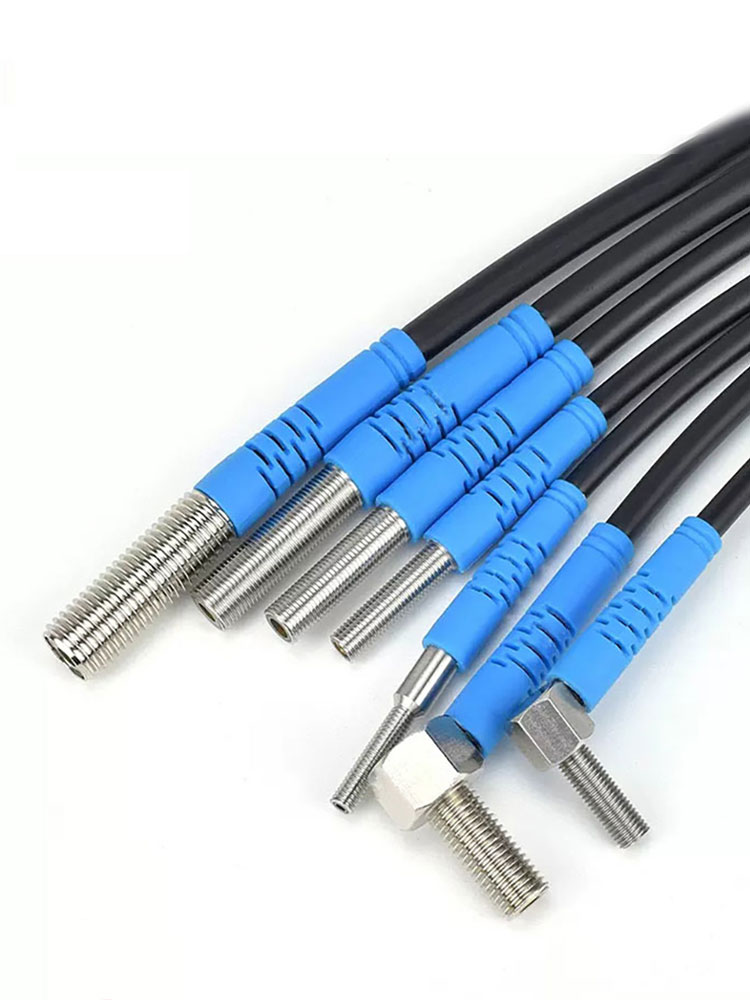
Reflector-Free Detection Around a Corner
A diffuse reflective sensor closes the optical loop on the target itself: the head emits the laser, the target scatters it, and the same head catches the return. No reflector to mount, no second unit to wire and align. The JNS packages that principle into an M4 or M6 stainless barrel bent 90° — the beam leaves through the thread while the cable runs flat along the fixture, cutting the required mounting depth to roughly the body height alone.
If your target is dark, transparent, or must be caught across a wide gap, step up to the opposed-pair DS 90° laser through-beam switch in the same bent-body family.
Model Selection Table
| Model | Thread / body | Detection range | Output | Logic |
|---|---|---|---|---|
| JNS0440N1-90° | M4 × 18 mm | 10–50 mm | NPN | NO |
| JNS0440P1-90° | M4 × 18 mm | 10–50 mm | PNP | NO |
| JNS0440N2-90° | M4 × 18 mm | 10–50 mm | NPN | NC |
| JNS0440P2-90° | M4 × 18 mm | 10–50 mm | PNP | NC |
| JNS06100N1-90° | M6 × 20 mm | 15–100 mm | NPN | NO |
| JNS06100P1-90° | M6 × 20 mm | 15–100 mm | PNP | NO |
| JNS06100N2-90° | M6 × 20 mm | 15–100 mm | NPN | NC |
| JNS06100P2-90° | M6 × 20 mm | 15–100 mm | PNP | NC |
Ranges rated on a 100×100 mm white board; dark or low-reflectance targets shorten the usable distance. All models share the 90° bent body — confirm the sideways cable exit suits your fixture before ordering.
Technical Specifications
| Type | Laser diffuse reflective photoelectric sensor, 90° right-angle body |
|---|---|
| Light source | 650 nm visible red laser (laser class: contact factory) |
| Spot size | ≈2 mm standard; custom 0.5 / 1.0 mm available |
| Detection range | M4: 10–50 mm · M6: 15–100 mm (adjustable, white-board rated) |
| Supply voltage | 10-30VDC |
| No-load / max load current | <10 mA / 120 mA (overload protection point 150 mA) |
| Leakage / voltage drop | <0.01 mA / <1.5 V |
| Response / switching frequency | 5 ms / 100 Hz |
| Hysteresis / repeatability | <15% Sr / <5% Sr |
| Indicator | Yellow output LED |
| Housing / IP | Stainless steel, IP65 |
| Operating temperature | 0 to +55 °C |
| Cable | φ3.8 mm, 1.5 m PVC, 3×0.15 mm² (fiber front section 3.5 mm×420 mm on M4 / 4.5 mm×420 mm on M6) |
| Short-circuit protection | Yes |
Typical Applications
Compact Assembly Fixtures
Threads directly into an M4/M6 hole in the jig; the visible spot confirms aim on the seated part in seconds.
Narrow Slots & Channels
Detects into channels where no straight sensor could route its cable behind the wall.
PCB & Small-Component Checks
Close-range presence verification at 10–100 mm on pick-and-place and test stations.
Inside Machine Panels
The bent body tucks against panel walls, freeing the depth a straight connector run would consume.
Retrofit Detection Points
Adds a sensing point to existing machines where drilling deeper clearance is not an option.
One-Sided Conveyor Edges
Presence and pass checks where the far side of the product is simply unreachable.
Frequently Asked Questions
When does the 90° diffuse body beat both a straight diffuse sensor and a through-beam pair?
When two constraints stack: only one side of the target is reachable (ruling out a through-beam pair), and there is little or no depth behind the mounting face (ruling out a straight body plus its cable bend). The JNS answers both — a single bent head, cable flat along the panel, sensing off the target itself.
What detection ranges do the M4 and M6 versions cover?
M4: 10–50 mm adjustable. M6: 15–100 mm adjustable. Both are rated against the standard 100×100 mm white test board. Because diffuse detection reads light bounced off the target's own surface, dark, matte or rough objects reduce the usable distance — plan margin, or ask us to evaluate your worst-case part.
Why does the visible 650 nm laser matter in practice?
You can see the ~2 mm red dot during installation, so aiming into a fixture slot takes seconds instead of trial-and-error with an invisible infrared beam. The tight laser spot also keeps the sensor from being fooled by background objects next to a narrow target.
Which output combinations are available?
Four per size: NPN or PNP transistor output, each as normally-open (suffix 1) or normally-closed (suffix 2) — e.g. JNS0440N1-90° is the M4 NPN NO version, JNS06100P2-90° the M6 PNP NC version. Supply is 10-30VDC.
How fast is it, and how repeatable?
Response time 5 ms with a maximum switching frequency of 100 Hz; switching hysteresis is under 15% and repeatability under 5% of the set range (per the series selection table). Max load current is 120 mA with a 150 mA overload protection point, leakage below 0.01 mA.
Can it detect transparent or mirror-like objects?
Transparent objects return very little diffuse light and mirror surfaces reflect the beam away from the receiver, so both are unreliable targets for any diffuse sensor. For clear films or glass, use a through-beam pair such as our DS 90° series and detect by beam attenuation — talk to us before specifying.
What are the ordering and export details?
Specify size (M4/M6), output (N/P), logic (1/2). Housing is stainless steel, IP65, cable φ3.8 mm 1.5 m PVC (3×0.15 mm²), operating temperature 0 to +55 °C, yellow output LED. Custom 0.5/1.0 mm spots are available. MOQ and lead time are quoted per model; certification documents on request. This is a general-purpose detection switch — not an IEC 61496 certified safety component, never a substitute for a safety light curtain.
Specs reviewed by Engineer Cai, Senior Application Engineer. See certificates.