
DS 90° Right-Angle Laser Through-Beam Switch — M4 / M6
When there is no room behind the mounting face, bend the sensor, not the machine: a stainless through-beam pair whose cable exits sideways from an 18–20 mm body — yet still spans 20 metres.
- 90° bent body — near-zero rear clearance needed
- 650 nm laser, 1.5–2 mm spot (0.5/1.0 mm custom)
- 20 m range · 5 ms response · 100 Hz
- NPN/PNP × NO/NC — four versions per size
- IP65 stainless steel, 10-30VDC
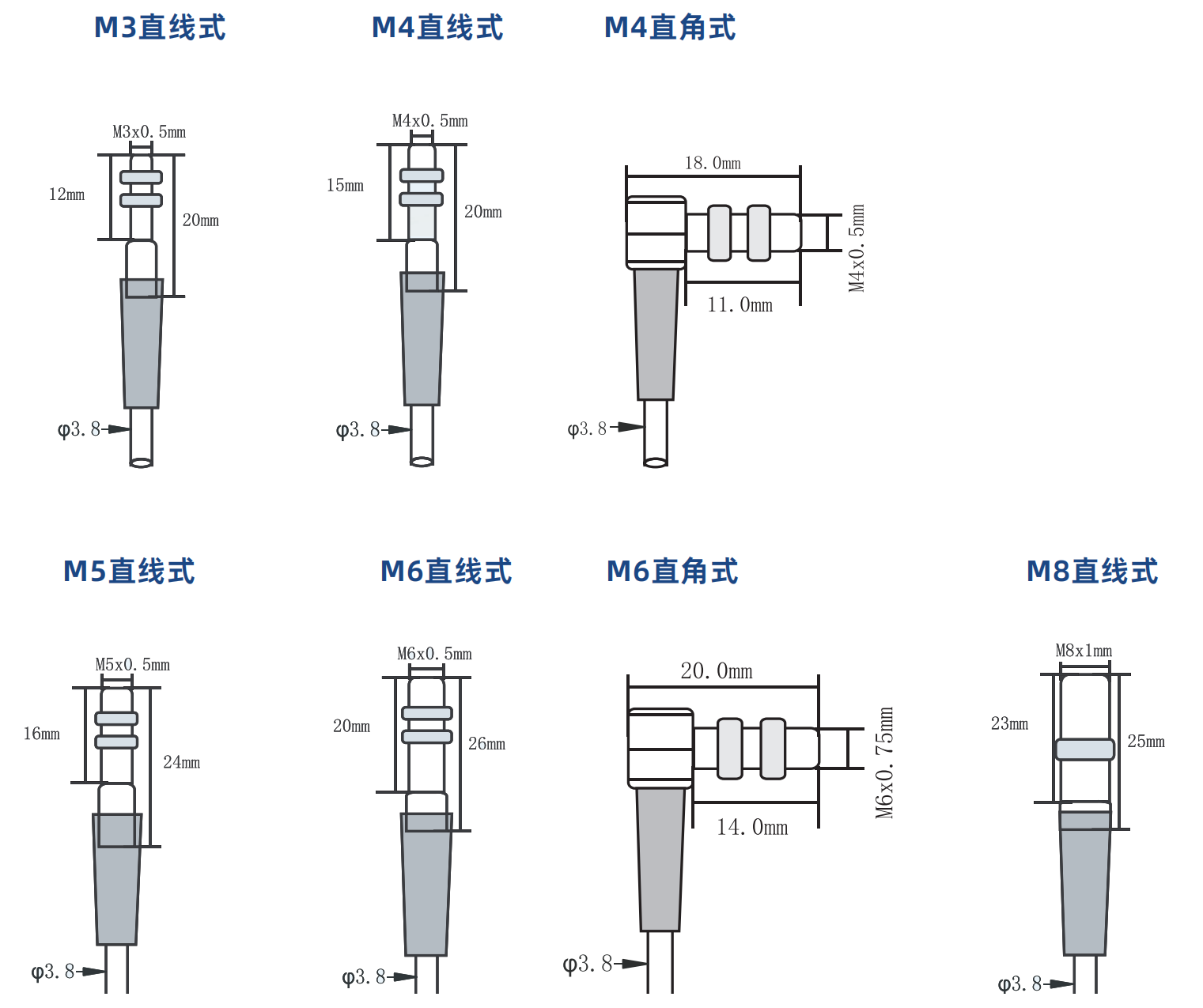
The Geometry Problem the 90° Body Solves
Through-beam detection is the most robust photoelectric principle — the receiver stares straight at the emitter, so dark, matte or shiny targets all read the same. Its weakness has always been packaging: two sensors, two cables, and each one needs body length plus bend radius behind its mounting point. The DS series folds that requirement into the housing itself. The optical axis exits through the threaded barrel while the cable leaves at 90°, flat along the panel.
Need one-sided mounting instead? The companion JNS 90° laser diffuse sensor uses the same bent-body idea with emitter and receiver in a single head.
Model Selection Table
| Model | Thread | Output | Logic | Range | Spot |
|---|---|---|---|---|---|
| DS0420N1 | M4×0.5 | NPN | NO | 20 m | ≈1.5 mm |
| DS0420P1 | M4×0.5 | PNP | NO | 20 m | ≈1.5 mm |
| DS0420N2 | M4×0.5 | NPN | NC | 20 m | ≈1.5 mm |
| DS0420P2 | M4×0.5 | PNP | NC | 20 m | ≈1.5 mm |
| DS0620N1 | M6×0.75 | NPN | NO | 20 m | ≈2 mm |
| DS0620P1 | M6×0.75 | PNP | NO | 20 m | ≈2 mm |
| DS0620N2 | M6×0.75 | NPN | NC | 20 m | ≈2 mm |
| DS0620P2 | M6×0.75 | PNP | NC | 20 m | ≈2 mm |
Through-beam type: emitter and receiver are sold and used as a matched pair. Range rated on a 100×100 mm white paper target; custom 0.5 mm / 1.0 mm spots available on request.
Technical Specifications
| Type | Laser through-beam photoelectric switch, 90° right-angle body |
|---|---|
| Light source | 650 nm red laser (laser class: contact factory) |
| Detection range | 20 m (M4 and M6, vs 100×100 mm white paper target) |
| Spot size | M4 ≈1.5 mm · M6 ≈2 mm · custom 0.5 / 1.0 mm |
| Body dimensions | M4: 18.0 mm overall, 11.0 mm thread · M6: 20.0 mm overall, 14.0 mm thread |
| Supply voltage | 10-30VDC |
| Output | NPN / PNP, NO (1) / NC (2), max load 150 mA |
| Protection circuits | Short-circuit protection, 180 mA overload protection point |
| Leakage current / voltage drop | <0.01 mA / <1.5 V |
| Response / switching frequency | 5 ms / 100 Hz max |
| Hysteresis / repeatability | <15% Sr / <5% Sr |
| Housing / IP | Stainless steel, IP65 |
| Cable | φ3.0 mm OD, 1.5 m PVC, 3×0.15 mm²; ~450 mm leads at sensor end |
| Operating temperature | Contact factory (not stated in current documentation) |
Typical Applications
Roller & Laminator Gaps
Aligns a beam in the crowded space beside roll shafts where straight bodies cannot point at the target.
Conveyor Tray Position
Spans the conveyor width; 5 ms response keeps up with indexing cycles.
Needle & Slender Part Detection
The 1.5 mm (or custom 0.5 mm) spot resolves syringe needles and fine wires that defeat larger beams.
Electrode Coating Void Checks
Several pairs side by side scan coated strips point-by-point for gaps and pinhole voids.
Cell / Panel Centering
Parallel beam rows confirm flat workpieces are seated and centered on the line.
Item-by-Item Food Line Counting
A suspended beam verifies each piece passing on continuous processing equipment.
Frequently Asked Questions
Why choose the 90° bent body over a straight through-beam sensor?
Mounting depth. A straight M4/M6 sensor needs its full body length plus a cable bend radius behind the mounting face. The DS body turns 90° inside an 18–20 mm envelope, so the cable leaves sideways along the panel — the sensor fits between rollers, inside laminator frames and against walls where a straight body physically cannot aim at the target.
How far apart can the emitter and receiver be?
Rated 20 m for both M4 and M6 versions, measured against the standard 100×100 mm white paper target. That is far beyond any diffuse sensor of this size, and the margin means dusty or slightly misaligned installations at a few metres still run with excess gain to spare.
How small an object can it resolve?
The standard laser spot is approximately 1.5 mm (M4) or 2 mm (M6) — and a 0.5 mm or 1.0 mm custom spot is available for finer work such as needle tubes, coating voids or gap inspection. Detection of an object is reliable when it fully interrupts the spot.
Which output versions exist?
Four per thread size: N1 = NPN normally-open, P1 = PNP normally-open, N2 = NPN normally-closed, P2 = PNP normally-closed. Supply is 10-30VDC, max load 150 mA with a 180 mA overload protection point and built-in short-circuit protection.
M4 or M6 — what actually differs?
Thread and body size only, plus spot size: M4×0.5 mm thread, 18.0 mm overall, 11.0 mm threaded section, ~1.5 mm spot; M6×0.75 mm thread, 20.0 mm overall, 14.0 mm threaded section, ~2 mm spot. Range (20 m), electronics and IP65 stainless housing are identical. Choose by your mounting hole and how much thread engagement you want.
Does target color affect a through-beam sensor?
Far less than a diffuse sensor — the receiver watches the emitter, not the target. Dark or matte objects still block the beam. Only transparent objects need care: they attenuate rather than block the beam, so consult us before specifying for clear films or glass.
How do I order, and can this be used for machine safety?
Order emitter and receiver as a matched pair, stating thread size (04/06), output (N1/P1/N2/P2) and any custom spot. Cable is φ3.0 mm, 1.5 m PVC, 3×0.15 mm². MOQ and lead time are quoted per model; certification documents are available on request. Note: this is a general-purpose positioning switch, not an IEC 61496 certified safety component — never use it for personnel-protection interlocks.
Specs reviewed by Engineer Cai, Senior Application Engineer. See certificates.