
FS-KNS 5 mm Slot-Type Photoelectric Switch
A fork sensor built for high-rate counting inside OEM machines: it resolves 1 mm objects in 0.3 ms and runs from the same 5 V rail as your logic board.
- 5 mm slot, detects opaque objects down to 1 mm
- 0.3 ms max response — no missed counts at feed-rail speed
- NO + NC delivered together on separate wires
- 5-24 VDC +/-10%: one part number for 5 V and 24 V systems
- Six housing profiles (302-307), IP64 ABS body
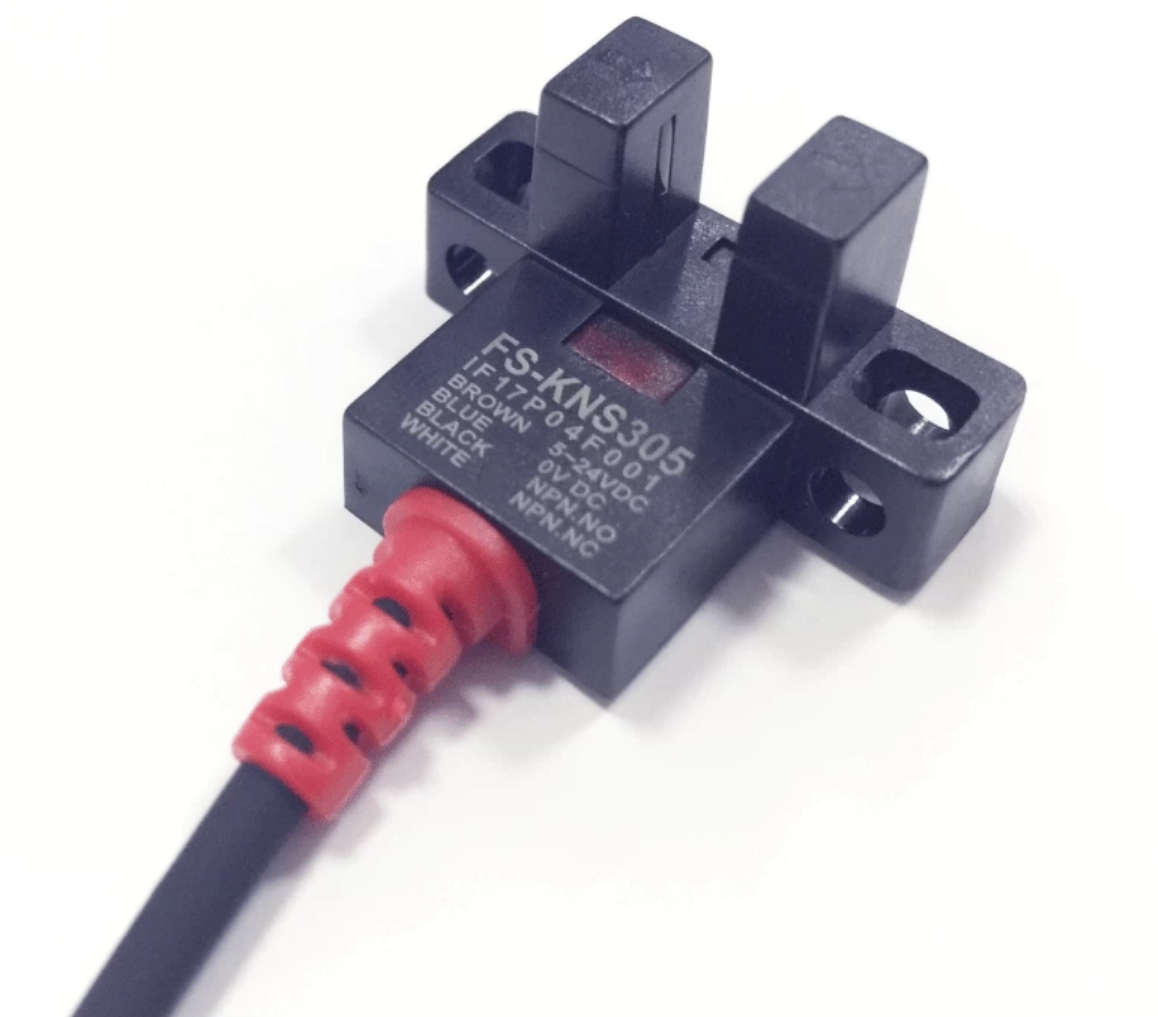
Why a Slot Sensor — and Why This One
A slot (fork) sensor puts the emitter and receiver in one rigid U-shaped body, permanently aligned across a 5 mm gap. Anything opaque that enters the slot cuts the beam and flips the output — detection does not depend on target colour, gloss or reflectivity, and there is nothing to align on site.
The FS-KNS pushes that principle toward fast, fine-pitch work: a 1 mm minimum detectable object and a 0.3 ms maximum response let it count closely spaced pins, flags and stamped parts that stream through a feeder rail. Because the supply range spans 5-24 VDC +/-10%, equipment builders can hang it off a 5 V logic rail in terminal equipment (printers, kiosks, dispensers) or a 24 V machine circuit — the same part number either way, switching up to 100 mA directly.
Note: the FS-KNS is a general-purpose detection sensor. It is not an IEC 61496-certified safety component and must not be used on its own for personnel protection.
How the Slot Beam and Dual Outputs Behave
Original schematic: an object entering the 5 mm slot interrupts the beam; the NO and NC wires switch simultaneously within 0.3 ms.
Dimension Drawings — 305 / 306 Profiles
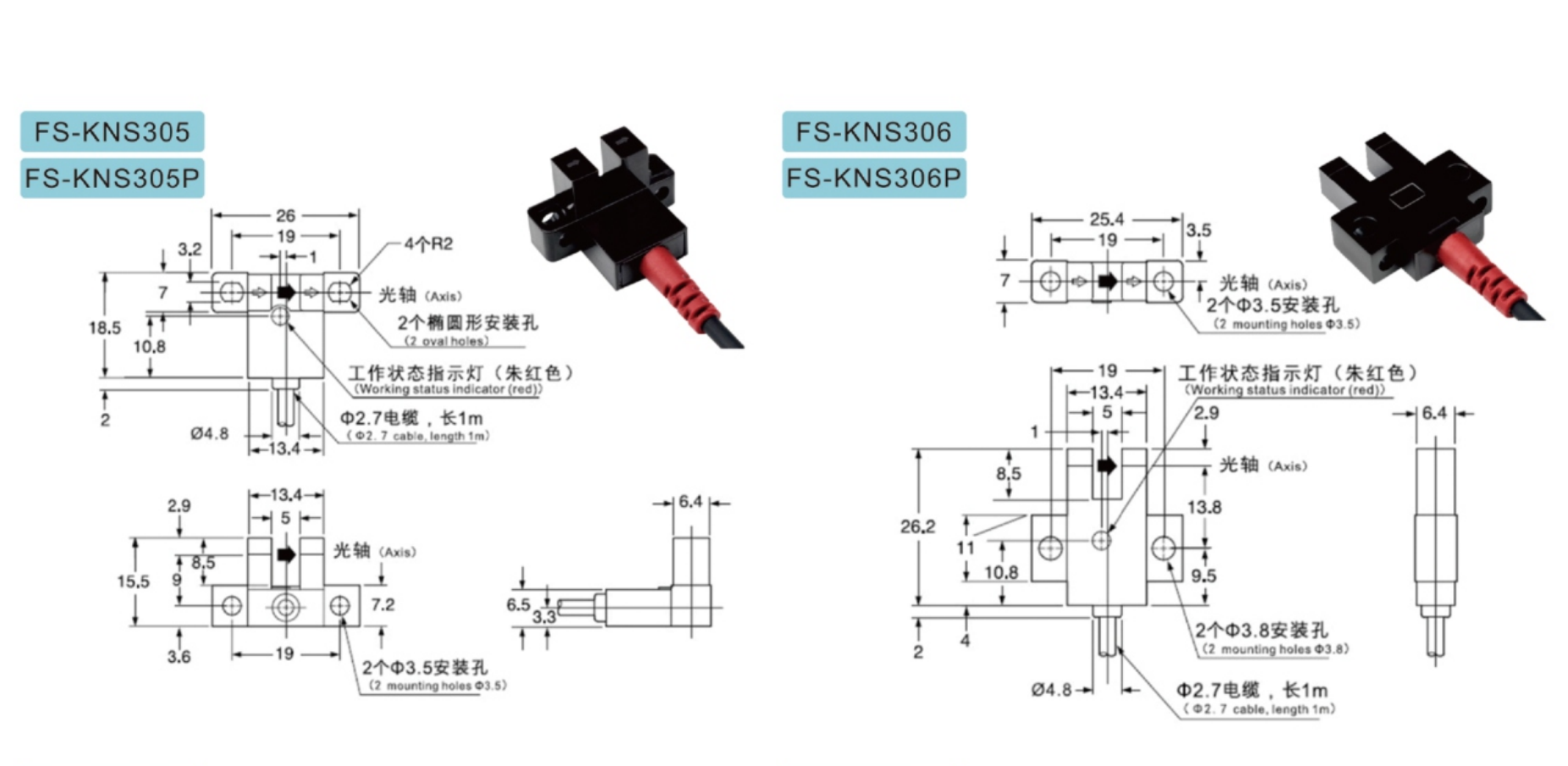
Two of the six housing profiles. Each profile changes the mounting-hole layout and lead exit, not the optics.
Technical Specifications
| Sensing mode | Slot / fork type (opposed beam in U-housing) |
|---|---|
| Slot width | 5 mm (fixed) |
| Minimum detectable object | 1 mm diameter, opaque |
| Response time | 0.3 ms max |
| Supply voltage | 5-24 VDC +/-10% |
| Switching capacity | 100 mA max |
| Output | NO + NC simultaneously; N = NPN, P = PNP |
| Wiring | Brown = V+, Blue = V-; two signal wires (white/black) carry NO and NC — see note below the selection table |
| Housing | ABS, IP64 |
| Housing profiles | 302 / 303 / 304 / 305 / 306 / 307 |
| Operating temperature | Contact factory |
| Certifications | Contact factory (documents on request) |
Selection Table
| Housing profile | Output versions | Signals | Slot / min. object |
|---|---|---|---|
| 302 | N (NPN) / P (PNP) | NO + NC simultaneous | 5 mm / 1 mm |
| 303 | N (NPN) / P (PNP) | NO + NC simultaneous | 5 mm / 1 mm |
| 304 | N (NPN) / P (PNP) | NO + NC simultaneous | 5 mm / 1 mm |
| 305 | N (NPN) / P (PNP) | NO + NC simultaneous | 5 mm / 1 mm |
| 306 | N (NPN) / P (PNP) | NO + NC simultaneous | 5 mm / 1 mm |
| 307 | N (NPN) / P (PNP) | NO + NC simultaneous | 5 mm / 1 mm |
The exact printed order-code format combining the profile number and the N/P suffix is pending factory confirmation — contact the factory to confirm the code before ordering. Wiring note: the catalogue lists white = NO / black = NC, while labels on some production units mark black = NO / white = NC; follow the label on the delivered unit.
Typical Applications
Counting Inside OEM Terminal Equipment
Runs straight off a 5 V logic board in printers, kiosks, ticket machines and dispensers — no 24 V rail or level shifting needed for flag and paper-edge detection.
Vibratory Feeder Rails
0.3 ms response keeps up with small parts streaming through the 5 mm slot in quick succession, so counts stay accurate at full feed rate.
Fine-Part Presence Checks
Resolves pins, terminals, springs and wire down to 1 mm diameter — targets that larger photoelectric sensors routinely miss.
Home / Limit Position with Interlock
The NO and NC signals arrive on separate wires at the same time: one drives position logic, the other gives a wire-break-detectable interlock line.
Frequently Asked Questions
Can the FS-KNS run directly from a 5 V logic supply?
Yes. The rated supply range is 5-24 VDC +/-10%, so the same sensor works on a 5 V embedded logic rail or a 24 V industrial control circuit without a converter. This is why the series is popular inside OEM terminal equipment such as printers and kiosks as well as on factory machines.
How small an object can the FS-KNS detect, and how fast?
It detects opaque objects down to 1 mm diameter passing through its fixed 5 mm slot, with a maximum response time of 0.3 ms. That combination suits high-rate counting of pins, thin flags and small stamped parts.
Does one FS-KNS give both NO and NC signals?
Yes. Both a normally-open and a normally-closed signal are brought out simultaneously on separate wires — no mode selection is needed. Choose the N suffix for NPN or the P suffix for PNP to match a sinking or sourcing controller input.
Which wire is NO and which is NC?
Brown is V+ and blue is V- on all units. For the two signal wires, the catalogue lists white = NO / black = NC, while the printed label on some production units marks black = NO / white = NC. Always follow the label on the delivered unit, or contact the factory to confirm before wiring a batch.
What are the 302-307 housing profiles?
Six body outlines within the same series, offering different mounting orientations and lead-exit directions for tight installations (see the dimension drawings for the 305/306 profiles). The exact printed order-code format that combines the profile number with the N/P suffix is pending factory confirmation — tell us your profile and output type and we will confirm the code before you order.
Is the FS-KNS a certified safety component?
No. It is a general-purpose detection sensor, not an IEC 61496-certified safety component, and must not be used on its own for personnel protection. For machine safeguarding use a certified safety light curtain instead.
What is the MOQ, and can you supply samples for design-in testing?
Small trial quantities and design-in samples are generally supported for OEM projects. Contact the factory with your target profile (302-307), output type (NPN/PNP) and annual usage, and a sales engineer will confirm current MOQ, sample terms and lead time.
Specs reviewed by Engineer Cai, Senior Application Engineer. See certificates.
Safety Light Curtain — Customer Cases
Real installations from DAIDISIKE clients. Click any case to view in full. Filter by scenario to quickly find a similar setup.