
DD-670 Series Plug-In Slot Photoelectric Switch
The slot sensor your maintenance team will thank you for: unplug the failed unit, plug in the spare, restart the line.
- Plug-in connector body — replacement without rewiring
- 5 mm slot width, 940 nm infrared through-beam
- 5 housing styles incl. two close-mounting types
- NPN or PNP × indicator logic: N / P / NA / R versions
- Light-ON / Dark-ON set by the connector (L) terminal
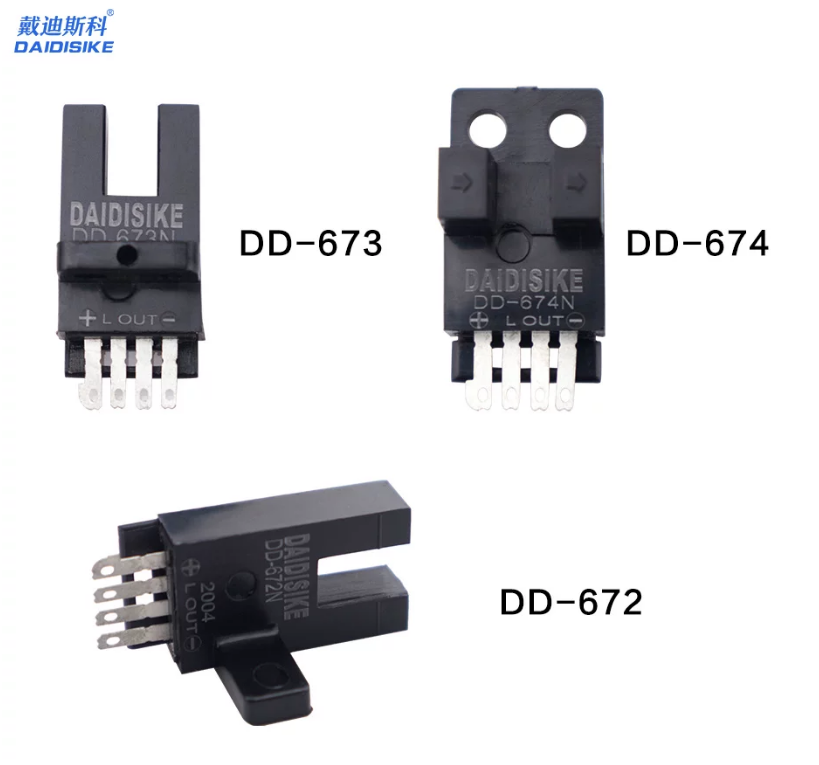
Designed Around the Two Minutes That Matter
Over a slot sensor's life, the expensive minutes are not the ones spent detecting flags — they are the ones spent replacing it while a line waits. Lead-wire sensors turn that into an electrician job: open the cabinet, disconnect, re-terminate, test. The DD-670 series moves the interface to a plug-in connector on the sensor body itself, so the harness never moves and the swap is a hand operation.
The ordering matrix is deliberately regular: 5 housing styles (standard, L-type, T-type and two close-mounting bodies for side-by-side arrays) × 4 output/indicator versions (NPN or PNP, indicator on light-received or beam-blocked) = 20 part numbers. On top of that, the (L) terminal lets any unit run Light-ON or Dark-ON by wiring alone — one spare covers both logics.
One physical unit, two logics: the (L) terminal decides Dark-ON or Light-ON at the harness, independent of the part number.
Model Selection Table — 20 Part Numbers
| Models | Detection Method / Housing | Detection Slot | Output Versions |
|---|---|---|---|
| DD-670N / P / NA / R | Through-beam slot, plug-in connector — standard housing | 5 mm slot width | N=NPN·Light-ON ind. / P=PNP·Light-ON ind. / NA=NPN·Dark-ON ind. / R=PNP·Dark-ON ind. |
| DD-671N / P / NA / R | Through-beam slot, plug-in connector — L-type housing | 5 mm slot width | Same four output/indicator versions |
| DD-672N / P / NA / R | Through-beam slot, plug-in connector — T-type housing (slot centre 7 mm) | 5 mm slot width | Same four output/indicator versions |
| DD-673N / P / NA / R | Through-beam slot, plug-in connector — close-mounting type 1 | 5 mm slot width | Same four output/indicator versions |
| DD-674N / P / NA / R | Through-beam slot, plug-in connector — close-mounting type 2 | 5 mm slot width | Same four output/indicator versions |
Common ratings across the series: GaAs infrared LED (940 nm), minimum detectable object 2 × 0.8 mm, hysteresis 0.025 mm max, response frequency 1 kHz min (3 kHz typical), supply DC5–24V ±10% at 35 mA max (NPN) / 30 mA (PNP), IP50 per IEC 60529. Operation logic on every model: (L) terminal open = Dark-ON, (L) shorted to V+ = Light-ON. Operating temperature range and mating-connector details are not published — contact the factory to confirm before design-in.
Note: general-purpose detection sensors, not IEC 61496-certified safety components — do not use them alone for personnel protection.
Typical Applications
Home / Origin Position on Automated Machines
A flag through the 5 mm slot gives a repeatable reference; a failed unit is unplugged and replaced in seconds during production.
Cam & Indexing-Table Flag Detection
Classic photomicrosensor duty — the through-beam slot reads each vane pass regardless of flag colour or finish.
Feeder Full/Empty Signalling
A paddle or flag interrupting the slot reports hopper state to the line controller.
Harness-Built OEM Equipment
Pre-terminated harnesses plug straight onto the sensors at final assembly — no per-sensor wiring station needed.
Frequently Asked Questions
What is the practical benefit of the plug-in connector body?
Replacement without rewiring. The harness stays fixed to the machine; the sensor body unplugs and a spare plugs in — a line operator can do it during a short stop, without opening the control cabinet or calling an electrician.
What do the suffixes N, P, NA and R mean?
They combine output transistor and indicator logic: N = NPN with the indicator lit when light is received; P = PNP, indicator on light received; NA = NPN with the indicator lit when the beam is blocked; R = PNP, indicator on beam blocked. Pick NPN/PNP to match your controller input and the indicator behaviour your technicians prefer at commissioning.
Can one part number cover both Light-ON and Dark-ON logic?
Yes — that is the point of the (L) terminal on the connector. Leave (L) open for Dark-ON operation (output energises when the beam is blocked), or short (L) to V+ for Light-ON (output energises when the beam is received). Maintenance can stock one spare per output type and cover both logics.
Which housing style should I choose?
DD-670 is the standard body; DD-671 (L-type) and DD-672 (T-type) re-orient the slot and mounting for different bracket geometries; DD-673 and DD-674 are close-mounting styles for placing several sensors side by side at narrow pitch. All five share the 5 mm slot and the same output matrix.
What flag dimensions suit the slot?
The slot width is 5 mm, with a GaAs infrared emitter/receiver pair facing each other across it, and the standard minimum detectable object is 2 × 0.8 mm opaque. Confirm your interrupter flag passes freely inside 5 mm; for thicker or fluttering flags step up to the 13 mm DD-303N/DD-403N. On the T-type DD-672 the slot centre sits 7 mm from the mounting face.
What are the electrical and environmental ratings?
Supply DC5–24V ±10% (ripple P-P 10% max), current consumption 35 mA max on NPN versions and 30 mA on PNP versions, response frequency 1 kHz minimum (3 kHz typical), hysteresis 0.025 mm max, and IP50 protection per IEC 60529 — dust-protected, so keep it inside dry equipment. Operating temperature range and cable/connector accessory details are not published; ask the factory to confirm those before design-in.
Is the DD-670 a safety sensor?
No. It is a general-purpose position/presence sensor, not an IEC 61496-certified safety component, and must not be used alone for personnel protection.
Can you quote mixed housings and outputs in one order?
Yes — the 20-model matrix is stocked as one family, so mixed part numbers can ship together. Contact the factory with the split; samples, OEM marking and certification documents are available on request.