
DD-303N / DD-403N Wide-Gap Slot Photoelectric Switch — 13 mm Fork
A slot sensor with breathing room: the gap is wide enough for a fluttering web, the optics still catch a 0.5 mm edge.
- 13 mm detection gap — ~2.6× the standard 5 mm fork
- Still resolves objects down to 2.2 × 0.5 mm
- 0.05 mm max hysteresis for a crisp, chatter-free trigger
- 940 nm invisible IR — indifferent to shop lighting
- DC5–24V ±10% at 15 mA max, NPN output
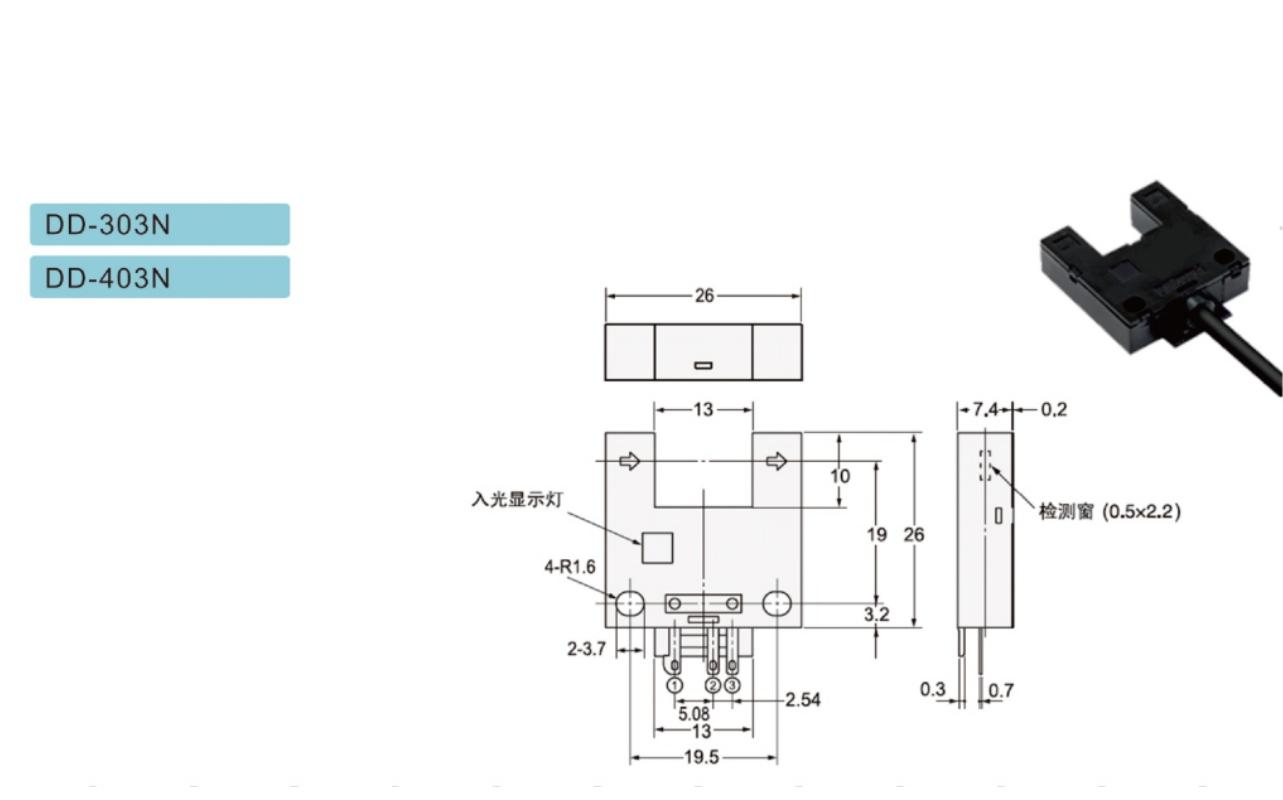
Tolerance in the Gap, Precision at the Edge
Fork sensors fail in the field for a mundane reason: the material does not stay where the CAD model put it. A sheet edge lifts, a flag is a millimetre thicker after a supplier change, a web wanders — and a 5 mm slot starts clipping or jamming. The DD-303N / DD-403N answer with a 13 mm through-beam gap: the same emitter-opposite- receiver principle, but with real mechanical headroom on both sides of the target path.
Crucially, the optics do not get lazier with the wider gap. The sensor still resolves a 2.2 × 0.5 mm object, and differential travel is held to 0.05 mm — so an edge position or float-flag application keeps a tight, repeatable switching point even while the target moves loosely in the slot.
The wide fork keeps the moving material off the sensor body while the through-beam still registers every pass of the edge.
Model Selection Table
| Model | Detection Method | Detection Range / Object | Output |
|---|---|---|---|
| DD-303N | Through-beam slot (fork), 13 mm gap, 940 nm IR | Objects within the 13 mm gap; min. detectable 2.2×0.5 mm | NPN |
| DD-403N | Through-beam slot (fork), 13 mm gap, 940 nm IR | Objects within the 13 mm gap; min. detectable 2.2×0.5 mm | NPN |
| DD-303N-1 | Through-beam slot (fork), 13 mm gap, 940 nm IR | Objects within the 13 mm gap; min. detectable 2.2×0.5 mm | NPN; switching logic — contact factory to confirm |
| DD-403N-1 | Through-beam slot (fork), 13 mm gap, 940 nm IR | Objects within the 13 mm gap; min. detectable 2.2×0.5 mm | NPN, Light-ON (normally open) confirmed |
Common ratings: hysteresis 0.05 mm max, response frequency 100 Hz min, DC5–24V ±10% at 15 mA max, IP50. Slot depth, temperature range and lead details are not published — contact the factory to confirm before design-in.
Note: general-purpose detection sensors, not IEC 61496-certified safety components — do not use them alone for personnel protection.
Typical Applications
Fluttering Sheet & Web Edges
The 13 mm gap lets an edge bounce and wander without scraping the fork, while 0.05 mm hysteresis keeps the switch point clean.
Thicker Flags and Packaged Parts
Parts that jam a standard 5 mm fork pass freely through 13 mm — no mechanical rework of the flag or guide.
Float-Flag Level Indication
A flag rising and falling inside the wide slot gives a simple full/empty signal on hoppers and reservoirs.
Path Wander / Misalignment Alarms
Use the wide gap as a coarse corridor: material that strays out of it breaks or restores the beam as a warning signal.
Frequently Asked Questions
When is a 13 mm slot better than the common 5 mm one?
Whenever the object cannot be guaranteed to pass through a 5 mm corridor: fluttering sheet edges, thicker flags, packaged parts, or loosely guided material. The DD-303N/DD-403N gap is roughly 2.6× wider than a standard 5 mm fork, buying mechanical tolerance without changing the sensing principle.
Does the wider gap cost detection resolution?
No — the minimum detectable object remains 2.2×0.5 mm, fine enough for a thin sheet edge or a small tab, and hysteresis stays at 0.05 mm max so the on/off point does not smear as the target drifts in the gap.
How does a through-beam slot sensor differ from a reflective one?
In a slot (fork) sensor the emitter and receiver face each other across the gap, so detection is a clean beam-break decision — target colour, gloss and background play no role. Reflective sensors read light bounced off the target and are sensitive to its surface.
What output logic do the variants have?
All models are NPN. The DD-403N-1 is confirmed Light-ON (normally open — output ON while the beam is received). The DD-303N-1's logic is not yet confirmed for publication; contact the factory before ordering if the logic matters to your circuit.
What are the electrical basics?
Supply DC5–24V ±10% at 15 mA max, so the sensor runs off 5 V logic boards and 24 V industrial rails alike. The emitter is a 940 nm GaAs infrared LED; response frequency is 100 Hz minimum — suited to presence and position, not high-speed counting.
Can it work in wet or washdown environments?
No. Rated IP50 (dust-protected, no water protection), the sensor belongs inside dry equipment enclosures. For splash-exposed slot sensing use the IP65-rated DD-L25/L45 micro-slot series instead.
Is this a safety component?
No. It is a general-purpose detection sensor, not an IEC 61496-certified safety component, and must not be used alone for personnel protection.
How do I order or get samples?
Send the model and quantity through our contact page. As the factory we support samples for evaluation, OEM marking and export consolidation; certification documents are available on request.