
The representative cell: one operator, one open side, two different hazards
This is a representative power-press cell — not a named customer, tested installation or measured performance claim. An operator stands at a fixed station and runs the press from a Type IIIC two-hand control: two guarded buttons that must be pressed concurrently and synchronously to initiate the slide. Its positioning and sustained-actuation behavior must be validated for the press so that releasing an actuator cannot allow access before the hazard reaches the required safe state.
The problem is the other side. The point of operation also faces an open loading and inspection plane where a second worker — a loader, a helper, a QC inspector — can approach and reach toward the dies. The two-hand control on the operator's station does nothing to stop a stroke the operator legitimately initiates while that second person's hand is in the die area. That open access plane is exactly what a suitable guard or protective device must address. Assess the press photoelectric-guard application limitsbefore selecting an ESPE arrangement.
↓ Separate compatible safety inputs ↓
Validated safety logic and restart prevention
↓ Monitored final elements / press control ↓
Required press safe state — demonstrated stopping capability
Concept only: no raw OSSD joining, generic muting input or assumed DA31 compatibility.
Why is two-hand control alone insufficient when others are nearby?
This is the load-bearing point of the whole case, and it comes straight from the standard. ISO 13851 explicitly states a two-hand control device only offers protection for the person using it. A two-hand control forces both of the operator's hands onto actuators away from the danger zone, so neither of their hands can be in the point of operation during the stroke. That is the entire scope of its protection. It has no way to know whether anyone else is near the dies.
A second person's access must be addressed, but the standard does not automatically demand a light curtain in every case. Fixed or interlocked guards or other permitted devices may be appropriate. In the United States, OSHA 1910.217 prohibits presence-sensing protection on full-revolution clutch presses; additional control-reliability and brake-monitor requirements also apply in its stated cases. A light curtain cannot make an ineligible press stoppable.
The standards, and what each one actually governs
It helps to keep the lanes straight, because each standard answers a different question:
- ISO 13851 (two-hand control devices) — defines the THCD types. Type IIIC is the highest: both hands (simultaneous), synchronous actuation within a ≤ 0.5 s simultaneity tolerance, self-monitoring, realized to Category 4 / PLe. And the clause that drives this case: it protects only the user.
- IEC 61496 (ESPE) — the light curtain's product standard. Type 4 uses redundancy with continuous self-monitoring, suitable up to SIL 3 / PLe; Type 2 is capped at about PLc and is not appropriate for a press point-of- operation hazard.
- ISO 13855 (positioning / safety distance) — where to put the curtain: S = K·T + C, including reach-over / reach- under height tables.
- ISO 13849-1 (SRP/CS) — the control-system integrity: Performance Levels a–e and Categories. A press stop is typically PLd or PLe, realized with Category 3 or 4 where required by the design. Their diagnostic requirements differ; Category 3 does not guarantee detection of every fault before the next demand.
- IEC 62046 (application of presence-sensing) — selection, positioning, configuration, commissioning, and the muting and blanking application requirements; the current IEC edition is 62046:2026.
- ISO 3691-4 (driverless trucks / AGVs) — relevant to the applicable driverless-truck system where one serves the cell. A horizontal safety scanner may be appropriate only after its function, coverage and stopping assessment; it does not replace vertical reach-in protection at the press.
Standards and legal obligations have different roles. Check the exact applicable national adoption and market conformity route rather than asserting that IEC publication alone grants, or rules out, presumption of conformity. The safety assessment and documented device evidence remain necessary.
How do you calculate where the light curtain goes? S = K·T + C
The following is simplified distance notation, not the complete ISO 13855:2024 procedure. Select the applicable approach case first:
- K is human approach speed, not machine speed. The familiar 2000 and 1600 mm/s values have case-specific conditions and minimum-distance rules; they are not interchangeable. Do not use a generic whole-body label to select a lower value.
- T = total stopping time. This is sensor response + safety logic/communication where present + final switching + machine stopping using worst-case values without omitting stages or double-counting delays already included in a measured interval. A device mounted too close to the hazard leaves residual danger precisely because someone forgot the press's own run-down in T.
- C = intrusion distance from detection capability d. For a normal-approach vertical curtain, C = 8·(d − 14) mm is a specific example for d ≤ 40 mm, never below zero, with further case limits.
Use the model's documented detection capability, not beam pitch. Under the stated example expression, d = 14 mm gives C = 0 and d = 30 mm gives C = 128 mm. These are arithmetic illustrations, not complete mounting distances or universal body-part thresholds.
We are deliberately not publishing a single computed S for this fictional press — T depends on the real machine's measured stopping time. Use the formula and your own measured numbers. For a full worked method, see our ISO 13855 safety-distance guide.
What does the resolution table look like? (the C term, side by side)
| Detection capability d | Illustrative access class | C = 8·(d − 14) mm | Typical use |
|---|---|---|---|
| 14 mm | Finger | 0 mm | Fine reach-in; all other distance and geometry checks still apply |
| 30 mm | Hand | 128 mm | Larger intrusion allowance in this limited example; other controlling distances may make the final position unchanged |
| > 40 mm | Leg / body | Do not apply this C expression; select the proper approach case | Perimeter / whole-body access guarding |
A wrong detection-capability assumption invalidates the distance calculation. Also assess reaching over, under and around the field, and whether a person can pass through and remain undetected.
The other three ways a hand gets in: reach-over, reach-under, reach-around
A vertical curtain only guards the plane it covers. ISO 13855 height tables and good installation practice close the rest:
- Reach-over — if the top beam is too low, a person reaches over the field. Set the top beam high enough per the ISO 13855 height tables.
- Reach-under — determine whether a hand or person can pass below the field and reach the hazard. A generic 300 mm floor gap is not a safe allowance for a press hand-access opening; close reachable bypasses with appropriate guarding.
- Reach-around — side gaps let a person reach around the field. Close the remaining sides with hard guards.
Each of these defeats the curtain while it still reports “guarded.” They are installation failures, not device failures — and they are entirely on the integrator to get right.
The convergence point: validated safety logic and final-element monitoring
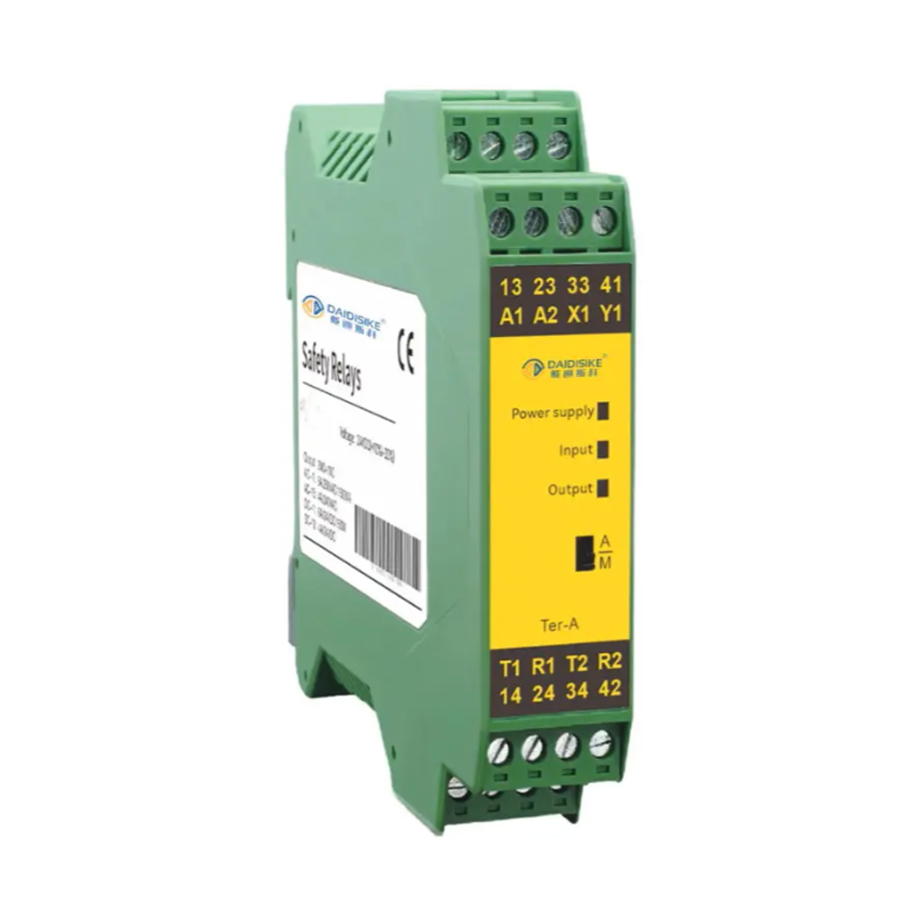
Both protective paths must command the required press safe state through appropriately evaluated safety inputs and validated logic. Select a safety relay or controller architecture by supported input types, required functions and final-element monitoring. Do not connect two devices to one OSSD input pair or assume a DA31 accepts two-hand, ESPE, reset, E-stop and muting functions together without its manual.
Final-element monitoring must match the design.An EDM feedback loop can detect a failure of suitable contactors before restart when implemented as specified. Press clutch/brake monitoring may require additional measures; a generic EDM label is not enough. Establish the monitoring and restart functions from the selected controller and press documentation. DA31 capabilities remain unconfirmed for this combined architecture.

Where DAIDISIKE products fit this cell
Framed vendor-neutrally, by role — no invented specs:
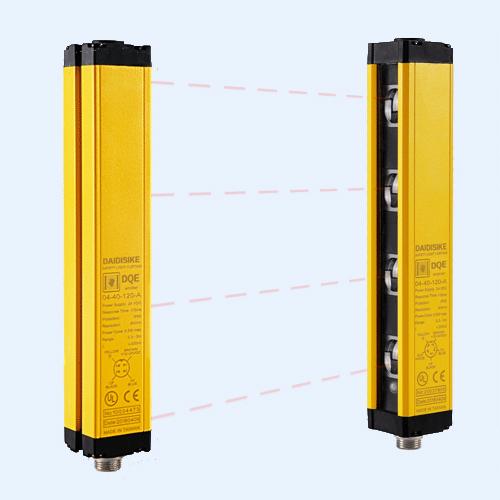
- Light-curtain selection range— compare documented protective devices for the assessed opening. DQC has no published Type/PL declaration on its current page; do not call it the Type 4 line. Confirm detection capability and required performance for the exact candidate.
- DQS / DQSA / DQV — catalogue families to evaluate for field geometry, not an automatic approval for body protection. Exact safety ratings and detectable-object limits are required before any protective role.
- DA31 — a proposed relay requires an exact manual and evidence that its input, output, reset and monitoring functions support the design. No combined two-hand/curtain approval is asserted here.
- LiDAR supplier and selection information— DLD is non-safety obstacle perception, not safety-rated presence detection. ST27 is confirmed Type 3 / PL d / SIL 2, but its exact approved use and a separate AGV/area safety assessment are required. Neither establishes protection of the die reach-in plane.
The close-to-run sequence and the failure modes it tolerates
Functionally the system behaves like this:
- Operator presses both buttons concurrently and synchronously (≤ 0.5 s tolerance) → two-hand path permits a stroke.
- The curtain field over the open access plane must be clear → OSSD high. A broken field prevents a stroke regardless of the buttons.
- Separate evaluated inputs satisfy the validated safety logic; only then can the designed machine-control sequence permit a cycle.
- The specified test piece interrupts the field → protective outputs change state → safety logic commands the final elements → the hazard reaches its required safe state within the total time T used for distance S.
- The required final-element checks and deliberate restart arrangement must be satisfied. Clearing the field or operating reset alone must not initiate hazardous motion.
Validate the fault behavior required by the assessment: actuator faults, wiring shorts, loss of supply, optical faults and final-element failures. Category 3 and Category 4 are not interchangeable promises that every fault is detected before the next demand. Document the complete architecture and tests, including stopping performance and prevention of unexpected restart.
Common mistakes engineers make on this exact cell
- Assuming two-hand control = full safeguarding. It protects its user; other reachable routes require suitable guards or protective devices selected for the press.
- Mounting the curtain too close — forgetting that T in S = K·T + C includes the press's own stopping time, not just the curtain response.
- Wrong K or wrong C / wrong resolution — using an approach constant outside its allowed case, or substituting beam pitch for documented detection capability.
- Reach-over / reach-under / reach-around defeats — reachable gaps above, below or beside the detection field.
- No EDM / no monitored final elements — a welded contactor goes undetected and drops the realized PL.
- Muting/blanking abuse — muting the curtain to feed material instead of designing it per IEC 62046 re-opens the bystander hazard.
- Using a Type 2 curtain, or a laser scanner where a vertical curtain is required — Type 2 caps at ~PLc; a horizontal LiDAR zone does not protect a vertical reach-in plane.
- Two independent stops with no common safe state — both paths must achieve the required safe state; a stroke must be impossible while the curtain field is broken.
How does this compare to other brands' kit?
Cross-brand purchasing does not approve a combined architecture. Compare exact two-hand, ESPE and controller documents and the required functions; family names do not establish interchangeable inputs or PL. The Pilz PNOZ alternativesand Allen-Bradley Guardmaster alternativespages are candidate-review guides, not certificates for this cell.
The takeaway
Begin with the press type, stopping capability and every reachable access route. Where a light curtain is permitted and suitable, validate its field, distance and control chain alongside the operator's two-hand function. Use exact device evidence and controlled validation, not an assumed DQC/DA31 pairing. This scenario has no measured press stop time and is not ready-to-wire guidance.
Primary sources and scope
ISO 13851:2019 addresses two-hand devices, not which machine must use a given Type. OSHA 1910.217supplies the cited US mechanical-press requirements. ISO 13855:2024and IEC 62046:2026address positioning and protective-equipment application; consult the actual texts and applicable machine-specific standard.