
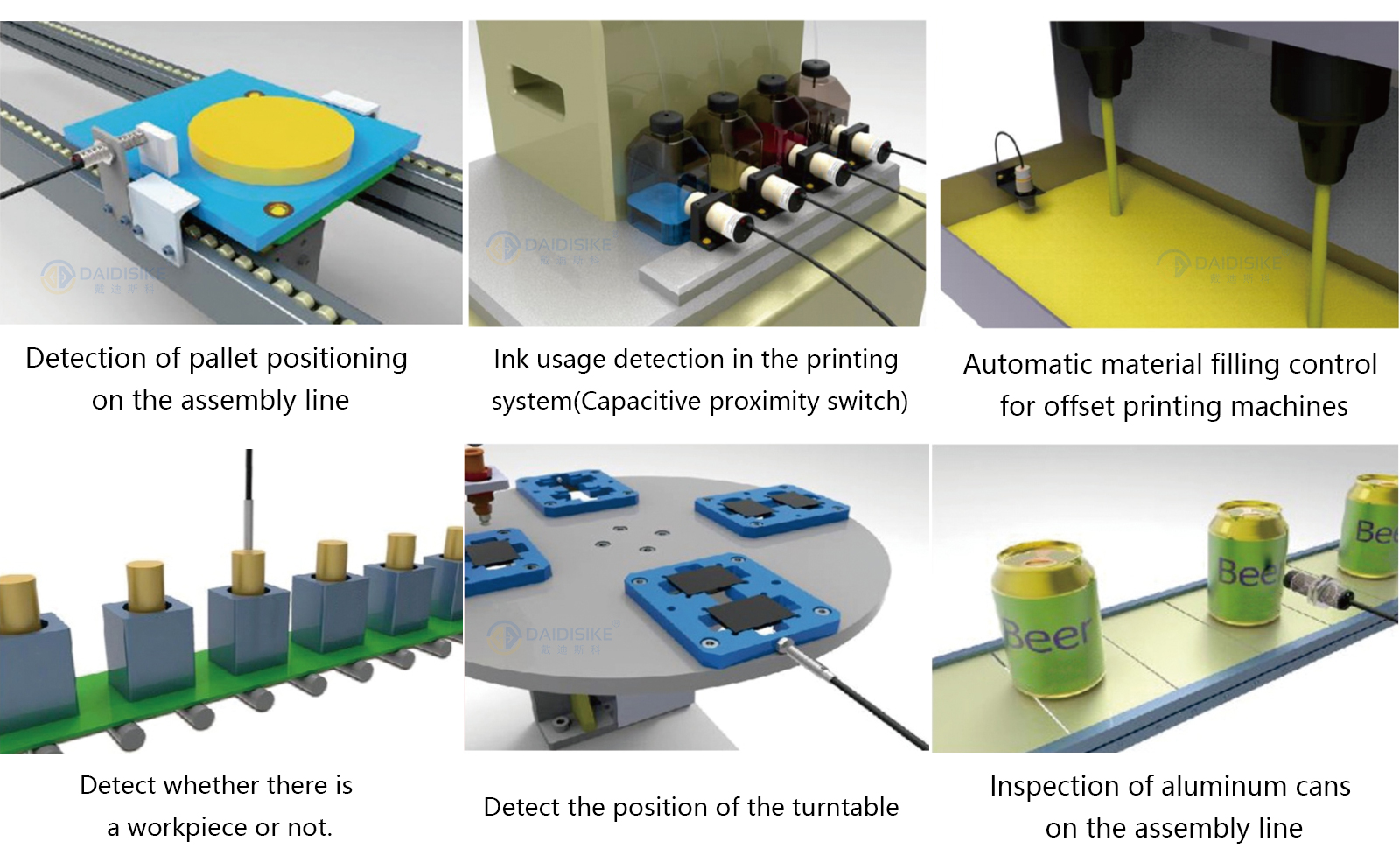
We keep cross-reference notes for the brands customers arrive with, and on the inductive-sensor side the two that come up most are Balluff and Turck. Both are excellent sensors. The reason a buyer is reading this is usually not quality — it is lead time and price on a high-volume consumable. An inductive proximity switch is a commodity-grade part on most machines: it counts parts, confirms a clamp, senses a cam. When you need fifty of them and the branded line quotes a long lead, a factory-direct candidate requires the complete electrical, target, environmental and mechanical checks described below.
The honest caveat up front, the same one we give on light curtains: an inductive sensor “replacement” is not a part number you look up and drop in. It is a match on size, sensing distance, output type and mounting class. Also verify input thresholds, load current, leakage, response time and connector pinout before testing the replacement. Get the flush/non-flush wrong, or under-range on aluminium, and the machine throws phantom faults. Everything below is about getting the match right.
Use the standard inductive proximity switch range to shortlist ordinary process sensors. A Balluff or Turck replacement still needs the complete order code and datasheet: compare target material, operating gap, mounting clearance, switching frequency, load current and pinout as well as size. Ordinary switching sensors are not personnel-protection devices.
What do the Balluff BES and Turck Bi/Ni part codes actually tell you?
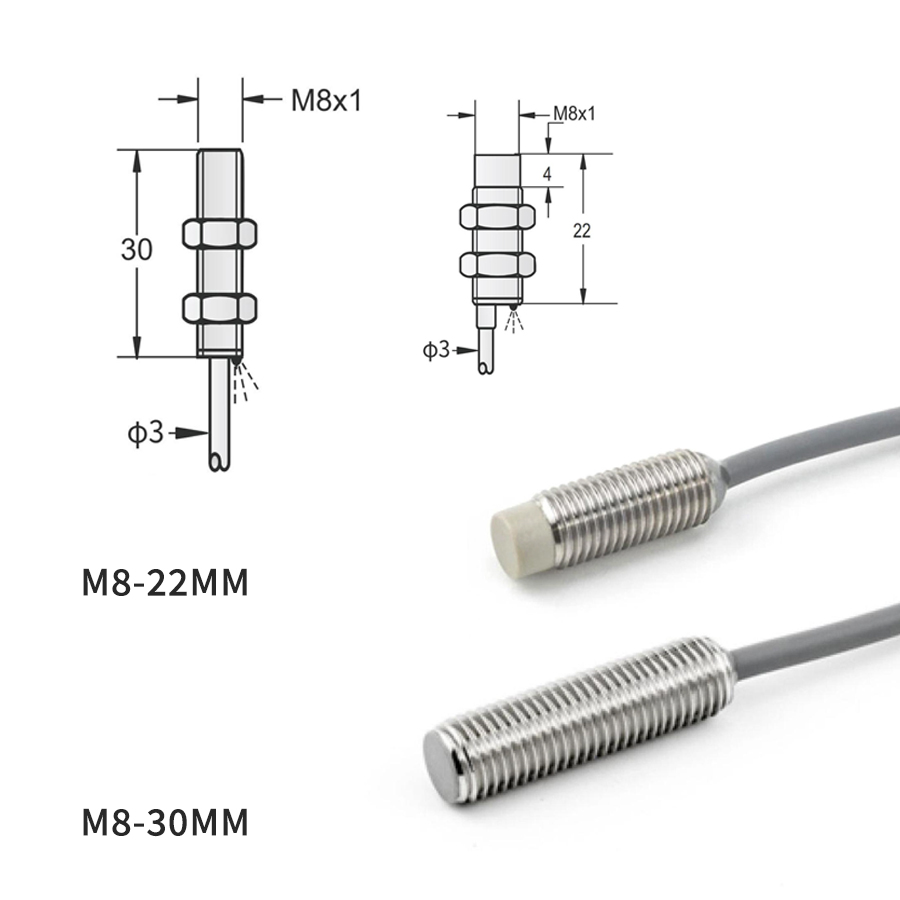
Balluff packs the family into a BES prefix; Turck encodes the function — BI for shielded/flush, NI for non-shielded/non-flush — directly into the code. Balluff's inductive range carries the BES family name (for example the long-running BES 516 series), spanning shielded and unshielded barrel sensors in the standard threaded sizes. The electrical and mounting class lives in the rest of the order code rather than the prefix, so with a Balluff part you read the datasheet for the range, output and shielding.
Turck is more legible at a glance. BI = a shielded (flush-mountable) inductive sensor; NI = a non-shielded (non-flush) inductive sensor; the number after it is the rated sensing distance in millimetres; a U (as in BI15U, NI12U) marks the uprox+ / uprox3 Factor 1 technology. So a BI15U-M30 reads as “flush M30, ~15 mm range, Factor 1” and an NI12U-M18 as “non-flush M18, ~12 mm range, Factor 1.” That is enough to identify a candidate family as an initial description. The full suffix still matters for the output function, pinout and environmental features. Use the original datasheet and the Turck uprox catalogue to verify the complete item before proposing a replacement.
What sensing distance does each barrel size give?
Range scales with diameter and roughly doubles when you go from shielded (flush) to non-shielded (non-flush). These are typical rated distances against mild steel; non-ferrous metals read shorter unless the sensor is a Factor 1 type. Confirm the exact figure on the original label — it is printed there — and match it.
| Barrel size | Shielded / flush (typ.) | Non-shielded / non-flush (typ.) | DAIDISIKE standard range |
|---|---|---|---|
| M8 | ~1.5–2 mm | ~2–4 mm | up to ~3 mm |
| M12 | ~2–4 mm | ~4 mm | up to ~6 mm |
| M18 | ~5 mm | ~8–12 mm | up to ~10 mm |
| M30 | ~8–10 mm | ~15 mm (Factor 1 to ~20 mm) | up to ~20 mm (non-flush) |
The pattern is the same on Balluff, Turck and DAIDISIKE because it is physics, not branding: a bigger coil reaches farther, and a shielded coil trades reach for the ability to sit flush in metal. So a Turck NI12U-M18 description does not prove that a DAIDISIKE M18 has the same distance on aluminium. Compare a Balluff BES shielded M12 against a specific flush M12 candidate in the same way; accept only documented operating conditions.
Flush vs non-flush — the one mistake that bites
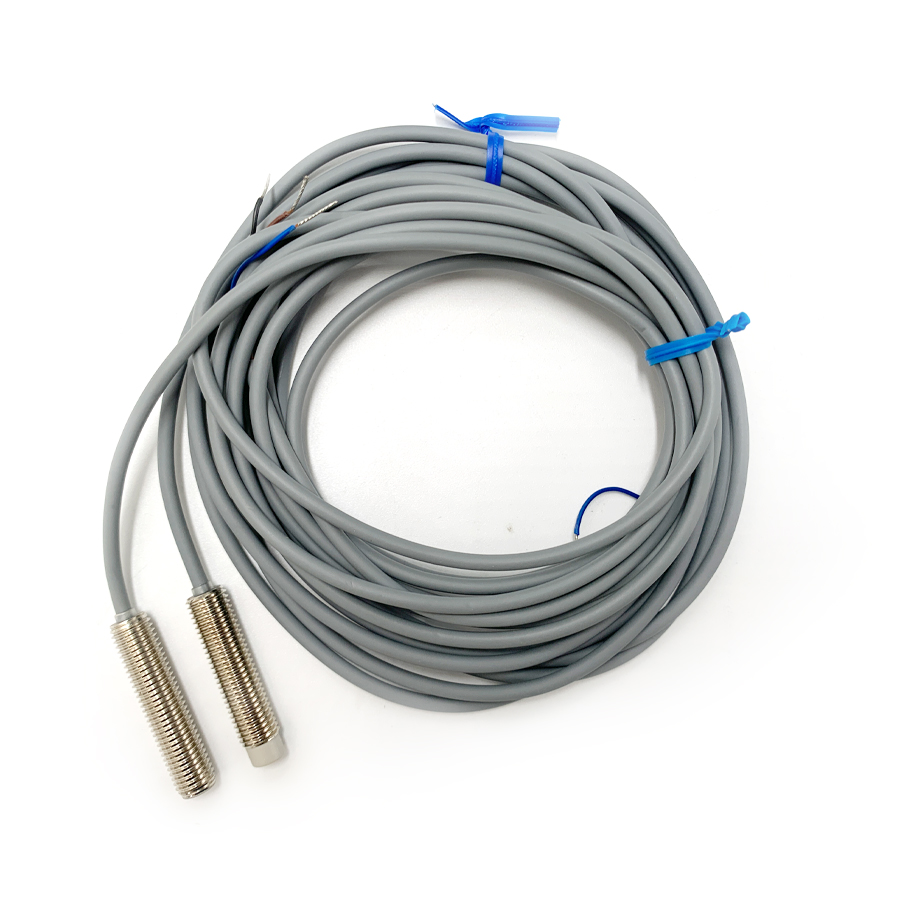
Order the mounting class the original used. A flush (shielded) sensor can sit level with surrounding metal; a non-flush (unshielded) sensor must stand proud with a clear zone around and in front of the face. This is the single most common cross-reference error. Someone matches size and range, ships a non-flush part to replace a flush one, the installer recesses it into the same steel bracket, and the sensor latches permanently on the bracket metal. The fix is free if you catch it at order time: Turck tells you outright (BI vs NI), Balluff tells you in the datasheet, and you order the matching DAIDISIKE build.
Practical rule: if the sensor is recessed into a fixture, jig or metal block, you want flush / shielded. If it stands off a bracket looking at a target across an air gap and you need maximum reach, you want non-flush / unshielded. DAIDISIKE builds both for M8, M12, M18 and M30, so the choice is a line item, not a compromise.
How do PNP/NPN, 2-wire/3-wire and NO/NC map across?
The complete output code helps identify a candidate; confirm its datasheet and the PLC interface before mapping the connection. The switching electronics come in a small, fixed set. A 3-wire sensor has separate supply and signal lines and is either PNP (sources current, signal switches to +V) or NPN (sinks current, signal switches to 0 V). A 2-wire sensor puts itself in series with the load and must follow its specified AC/DC type and polarity; it carries off-state leakage current and an on-state voltage drop. The contact function is NO (normally open) or NC (normally closed).
On many sensors this is printed as an output code such as AP6X (PNP) or AN6X (NPN), often with a trailing letter for the contact function. PNP is the common default in European and modern PLC wiring; NPN persists in some Asian and legacy panels. None of it is a barrier: read the code off the Balluff or Turck unit, and DAIDISIKE supplies the same M8/M12/M18/M30 sensor in PNP or NPN, NO or NC, all on 10–30 V DC. Match the polarity exactly — wiring a PNP where the PLC input expects NPN (or vice versa) is the second most common field error after flush/non-flush.
Full Balluff / Turck → DAIDISIKE cross-reference
This is a starting map from the public family conventions, not a drop-in part number. Always confirm the four numbers against the original unit before ordering.
| Original family / example | Reads as | Output / supply | DAIDISIKE match |
|---|---|---|---|
| Balluff BES 516 (shielded barrel) | Flush M8–M30, range per code | 3-wire PNP/NPN, NO/NC, 10–30 V DC | DAIDISIKE flush (shielded) same size |
| Balluff BES (unshielded barrel) | Non-flush M8–M30, longer range | 3-wire PNP/NPN, NO/NC, 10–30 V DC | DAIDISIKE non-flush (unshielded) same size |
| Turck BI (e.g. BI15U-M30) | Shielded / flush, ~15 mm, Factor 1 | 3-wire, PNP/NPN per suffix | Standard M30 candidate only; Factor 1 parity not established |
| Turck NI (e.g. NI12U-M18) | Non-shielded / non-flush, ~12 mm, Factor 1 | 3-wire, PNP/NPN per suffix | Standard M18 candidate only; verify actual range, no Factor 1 parity |
| Turck uprox+ / uprox3 (…U…) | Factor 1 — equal range all metals | 3-wire PNP/NPN, NO/NC | No standard-sensor substitute where Factor 1 is required |
Housing, thread, connector and environment
Match the thread (M8/M12/M18/M30), the termination (cable pigtail or M8/M12 connector), and the IP/temperature rating. The body is a threaded barrel in nickel-plated brass or stainless steel with two nuts; that is standardised across brands, so a DAIDISIKE M18 screws into the same M18 hole as the Balluff or Turck it replaces. What you confirm is the termination — a fixed cable (2 m PVC/PUR is typical) versus an M8 or M12 quick-disconnect plug — and the sealing: verify the exact IP rating, connector seal and chemical compatibility. IP67/IP68 immersion claims do not establish high-pressure washdown suitability. If the original was a high-temperature, weld-field-immune or extended-range special, tell us, because those are specific builds rather than the standard barrel.
For a worked single-size example with the full DAIDISIKE variant table, see the M8 inductive proximity sensor product page; the same flush/non-flush and PNP/NPN/NO/NC logic applies up through M30.
Is naming Balluff and Turck legal, and how do you keep it honest?
Brand names identify the products being compared; they do not imply affiliation, endorsement or proven compatibility. We reference Balluff and Turck by name so you can find the DAIDISIKE candidate — no partnership or endorsement is implied. Comparative advertising and trademark requirements depend on the jurisdiction. What we deliberately do not do: we don't reproduce their catalogues, we don't use their logos, and we don't decode or invent their internal part-number fields or publish specs we can't verify from public family conventions. The cross- reference rests on four things you read off your own unit — size, sensing distance, output, mounting class — plus the well-documented meaning of BI/NI and Factor 1. Those details are a starting shortlist, not proof of equivalence.
Send us those four numbers off your installed Balluff or Turck sensor, the connector type and the target metal, and we'll return a matching DAIDISIKE M8/M12/M18/M30 — or tell you plainly if a standard barrel won't do it. More brand cross-references live in the brand replacement & compatibility guide.