
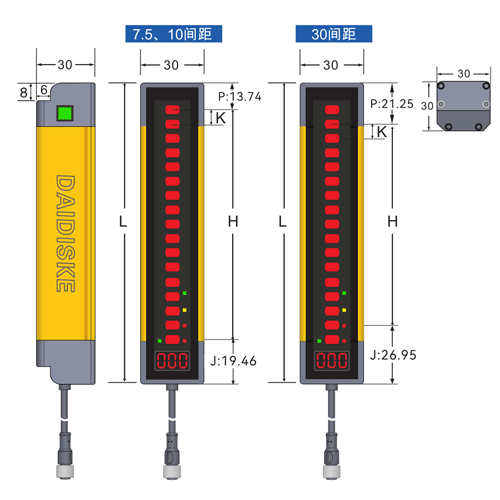
When comparing a camera proposal with an existing guarded opening, start with the protective geometry and the required safety performance. Compare light curtain resolution and opening coverage against the camera's documented detection volume, response time and occlusion limits. A shared camera label does not imply the same sensing principle or certification.
The two product classes, briefly
A safety light curtain is an active opto-electronic protective device (AOPD) covered by IEC 61496-1 and IEC 61496-2. A transmitter sends an array of modulated infrared beams across a fixed plane; a receiver confirms each beam every cycle; an obstruction switches the safety outputs. The technology is simple, mature, and very fast. A Type 4 curtain typically supports PL e / SIL 3 and runs response times in the 10–20 millisecond range. DAIDISIKE’s DQT4 and DQA families fit this description.
Camera safety requirements depend on the sensing principle. IEC TS 61496-4-2 covers reference-pattern techniques, while -4-3 covers stereo vision. Do not assign a ToF device to the stereo standard because it produces a depth image: the safeVisionary2 product information lists Type 2 under IEC 61496-3, PL c and SIL 1. Check the certificate and manual of the exact camera.
- 3D time-of-flight (ToF). A single sensor illuminates the scene with modulated infrared light and measures the round-trip time at each pixel to produce a depth image. The SICK safeVisionary2 is the established commercial example — 512×424 depth pixels, a 68°×42° field of view, 30 Hz frame rate, response time from approximately 55 ms, with up to 24 configurable fields and certification to PL c.
- Stereo vision. Two or three passive cameras triangulate depth from disparity. Pilz SafetyEYE is the archetype: a multi-camera sensing head feeding a separate analysis unit, monitoring up to roughly 72 m² from a 4 m install height, requiring a minimum scene illumination from around 300 lux and rated to Cat. 3 / PL d / SIL 2.
Both classes are real ESPE, both can be integrated into a safety function with a defined Performance Level, and both are fundamentally different from a flat light curtain in what they can monitor.
What the camera actually sees
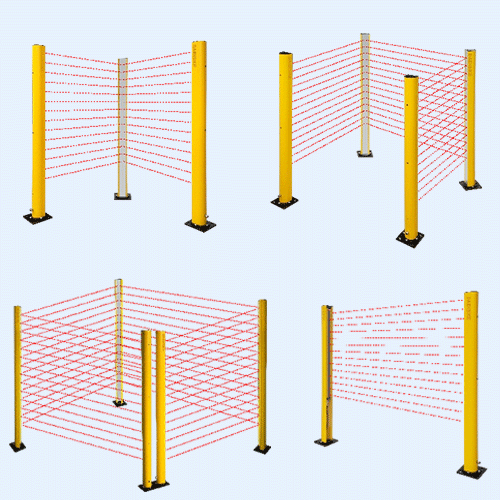
A light curtain monitors a plane; a safety camera can monitor configured volumes. This can help with stepped workspaces or oblique approach paths, but coverage remains bounded by the certified field of view, range, resolution and occlusion rules. Warning fields alone must not be credited with a safe slowdown. Set protective distances from the actual stopping performance and applicable positioning method, not from fixed example distances.
The cost of that flexibility is that the camera is now inferring depth from a noisy signal, not breaking a hard beam. That changes everything that follows: response time, lighting dependence, detection capability, and the achievable Performance Level.
The honest side-by-side
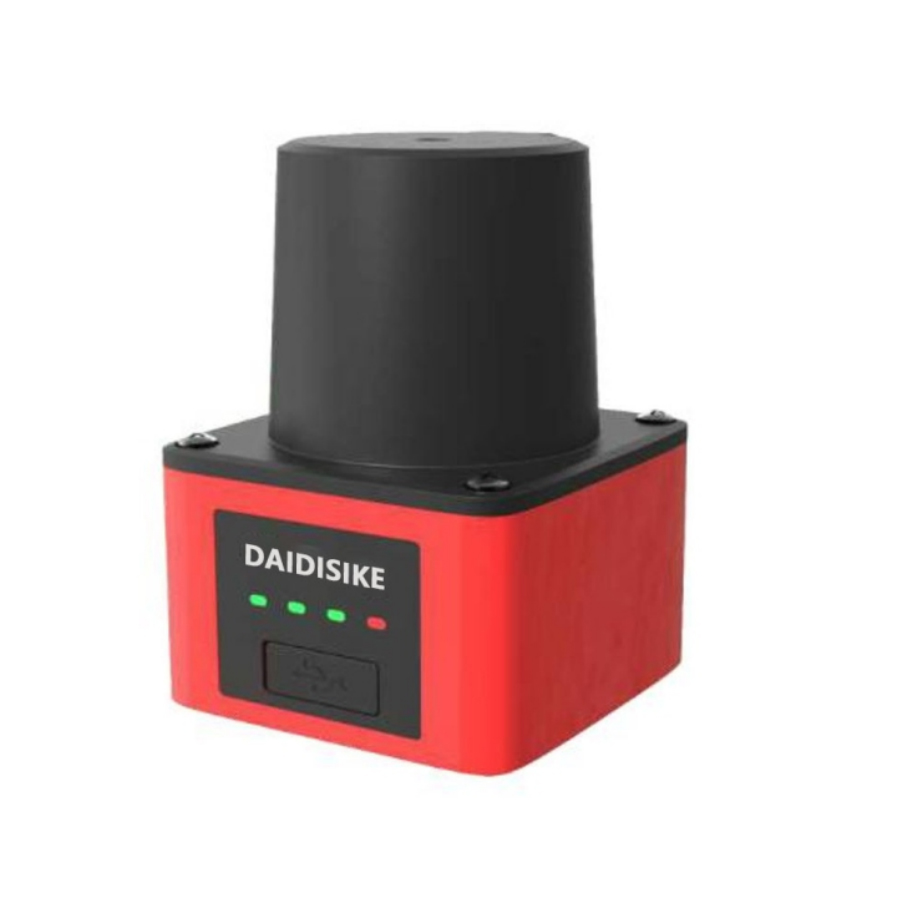
Here is what the comparison looks like with the rhetoric removed. We have included a safety laser scanner column because in practice the three devices compete more often than the two-device pitch suggests.
| Characteristic | Type 4 light curtain | Safety laser scanner | 3D ToF safety camera |
|---|---|---|---|
| Standard | IEC 61496-1 / -2 (AOPD) | IEC 61496-1 / -3 (AOPDDR) | Device-specific: ToF and stereo use different assessment scopes |
| Geometry monitored | Flat plane | Horizontal 2D floor zone | True 3D volume |
| Typical response time | Exact model, height and configuration dependent | Exact scan and sampling configuration dependent | From ~55 ms, longer with multi-sampling |
| Example device capability — not complete-function performance | PL e / SIL 3 (Type 4) | PL d / SIL 2 typical | PL c (safeVisionary2 example); verify each stereo system |
| Detection capability | From 14 mm (finger) | From ~30–70 mm (leg/body) | Configurable hand 20 mm / arm 40 mm / leg 50 mm / body 200 mm |
| Range | Up to ~20 m beam length | Use certified protective range; do not substitute measurement range | safeVisionary2: up to 2 m protective; extended mode up to 4 m with specified reference background; warning 7.3 m |
| Ambient lighting | Model-specific ambient-light limits | Model-specific ambient-light limits | Check each manual; the cited ToF example is indoor, stereo illumination is system-specific |
| Hardware footprint | Transmitter + receiver pair | Single scanner head | Camera head; stereo needs analysis unit |
| Relative cost | Baseline | Quote the complete configured system | Quote camera, logic and integration |
Read the table as a comparison of examples, not universal class limits. Use the exact configured response time in the complete stopping-time calculation, together with the relevant geometry allowances. Device capability does not establish the achieved PL of an installed function; a PL c device must not be assumed to fulfil a PL d or PL e requirement.
Where the camera wins
1. Collaborative robot speed-and-separation monitoring
Speed-and-separation monitoring combines safety-related sensing, robot motion information and a validated protective response. Assess the integrated application under ISO 10218-2:2025 and applicable collaborative-operation requirements. A qualified camera may help cover an approach volume, but an ordinary warning output is not a safety-rated speed command, and the camera must support the performance required for that particular function.
2. Walk-in cells with complex geometry
A welding cell with an L-shaped operator station, a bench at one elevation and a fixture at another, an AGV docking face that is sometimes a wall and sometimes an opening — these all want a volumetric protection profile. A 3D safety camera can describe such a shape in software; reproducing the same coverage with curtains and scanners often takes three or four devices, more cabling and more configuration risk.
3. Press and machine approach where slowdown matters
A camera may supplement point-of-operation guarding with approach monitoring, if its certified performance and field geometry fit the application. Any credited slowdown must reduce the machine hazard through validated safety-related signals and logic; a warning does not guarantee that an operator slows down. Calculate the protective separation and retain independent point-of-operation protection where required.
Where the curtain still wins
1. Defined access openings
A defined access opening is a candidate for a light curtain. Compare the DQA configuration or another documented model against the required resolution, active height and safety capability. Mounting, safety logic, final elements, restart prevention and validation remain part of the design. Adding a relay does not by itself establish PL e or a sub-20 ms machine stop.
2. Fast hazards needing finger resolution
For a press, punch or shear requiring fine detection and short response, compare the documented detection capability and worst-case response of each candidate. The camera examples here do not establish suitability for a 14 mm finger-detection function. Check the applicable machine standard and complete stopping performance before deciding whether a curtain or another guard can satisfy the requirement.
3. PL e / SIL 3 safety functions
If your risk assessment demands PL e, a PL c 3D ToF camera is not, by itself, sufficient. Stereo-vision systems like SafetyEYE reach PL d, which is enough for many cobot cells but still below the highest tier. Combine the camera with a independently validated protective function on the immediate hazard if needed. Adding a Type 4 curtain does not upgrade a PL c camera or a PL d scanner; verify each safety function and every access route.
4. Harsh, dusty or outdoor environments
The camera examples in this comparison are intended for their documented operating environments. Sunlight, weld flash, dust, condensation and reflective surfaces can affect optical devices, including curtains and scanners. Select an explicitly suitable device and validate the actual conditions; an outdoor measurement range does not establish personnel protection. See the industrial LiDAR selection guide for the safety-versus-perception distinction.
A clean decision flow
We use the same four-step check whenever this question comes up on a real cell:
- Is the hazard a flat opening or a 3D volume? Flat opening → light curtain. Volume → continue.
- What Performance Level does the risk assessment require? Compare the documented capability of the exact device and the complete function with the required PLr. A PL c ToF example is not a PL d device, and adding another guard does not upgrade its rating.
- How fast is the hazard? Use the worst-case sensor, logic and machine stopping times, plus the applicable distance allowances. ISO 13855 does not universally require sub-20 ms sensors.
- What does the environment look like? Check lighting, contamination, reflectivity and occlusion against each manual, then test the installed coverage and fault response. An indoor location alone does not guarantee detection.
The result may be a curtain, scanner, camera or complementary devices on different access routes. Select each for the function it must perform and validate any interactions; this article does not establish how frequently a combined arrangement is needed.
Where DAIDISIKE fits — honestly
DAIDISIKE builds safety light curtains and safety laser scanners. We do not currently make a 3D ToF safety camera, and we will not pretend otherwise. What we do is supply the flat-plane and 2D area devices that sit alongside a 3D camera in a well-designed cell: the DQT4 Type 4 light curtain for access openings and point-of-operation, the DQSA area protection for larger flat zones, and ST27 (user-confirmed Type 3 / PL d / SIL 2) for suitable safety-scanning applications. DLD-series LiDAR is non-safety perception. Confirm any controller or relay against the required OSSD, reset and monitoring functions. If a customer needs 3D vision-based safety for a cobot cell, we will say so — and we will scope the curtain and scanner architecture around it so the safety chain actually delivers the Performance Level the risk assessment requires.
The bottom line
Safety-rated 3D cameras add a useful option when volume coverage matters. The assessment standard depends on the sensing principle: the cited safeVisionary2 ToF example is listed under IEC 61496-3, while stereo vision has a different scope. Compare exact safety capability, coverage, response, environmental limits and installed cost; no technology is a universal replacement for curtains or scanners.
Related reading
Light Curtain vs Scanner for Robot Cells
Perimeter access detection vs area protection on robot cells — when to pick which.
Future of AI-Integrated Safety Sensors
Where intelligent vision and machine learning fit (and don't) inside certified safety.
How to Choose an Industrial LiDAR Scanner
Safety vs navigation LiDAR, range and protective fields for AGV and perimeter use.