
JNS-W70 / JNS-W500 Long-Range Color Mark Sensor
Registration mark detection from up to 500 mm away — mount the sensor where the machine allows, not where the web dictates.
- JNS-W70: 30–70 mm · JNS-W500: 50–500 mm standoff
- White LED reads virtually any mark/background pair
- NPN/PNP and N.O./N.C. switchable on one unit
- IO-Link + external teach / emitter-off input
- 5 response settings from 200 μs · IP65 · 10–30 VDC
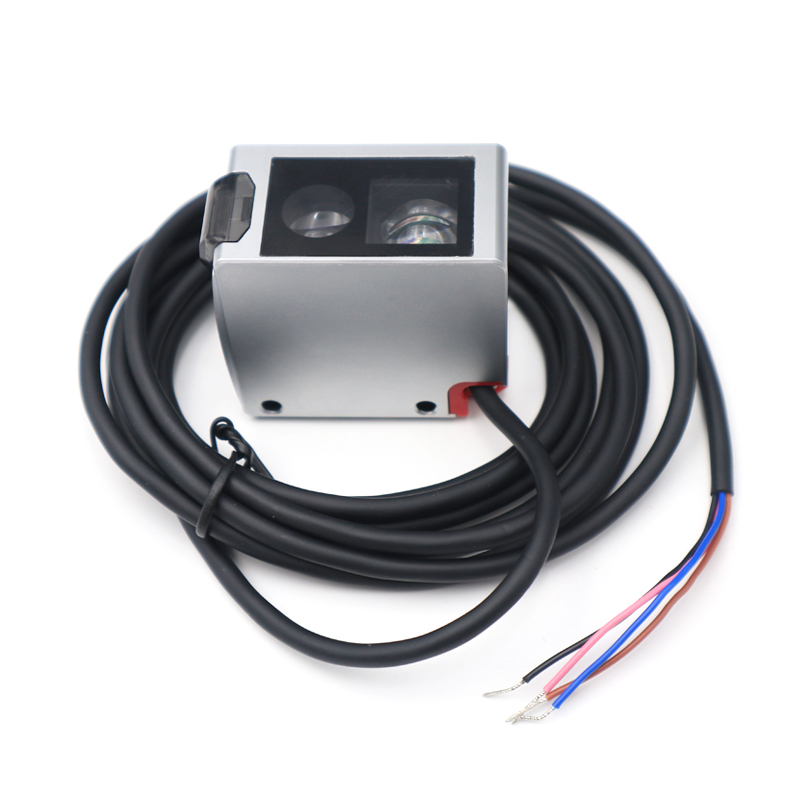
When the Sensor Cannot Sit Next to the Web
Every converting engineer has met the bracket problem: the only place a conventional mark sensor could read the web is 20 mm from a heat-sealing bar, inside the glue mist, or behind a fixed guard. The JNS-W series dissolves the problem instead of fighting it — JNS-W70 reads marks at 30–70 mm, and JNS-W500 stretches the working distance to half a meter, so the sensor mounts on cool, clean, accessible structure and looks through the gap.
The long reach does not cost flexibility. A white LED emitter covers the full visible spectrum, handling mark/background color pairs that defeat single-color emitters. Output polarity (NPN/PNP) and logic (N.O./N.C.) switch on the unit itself, and IO-Link brings remote teach and diagnostics — one part number for every PLC convention your machines ship with. Five response settings from 200 μs to 500 ms and built-in on-delay/off-delay/one-shot timers finish the integration without extra hardware. The IP65 housing weighs just 128 g.
Standoff Distance: Conventional vs JNS-W
A conventional contrast sensor must crowd the web; the JNS-W500 reads the same mark from across the machine frame — through a guard opening if needed — with the spot growing from φ3.5 mm at 100 mm to φ20 mm at 500 mm.
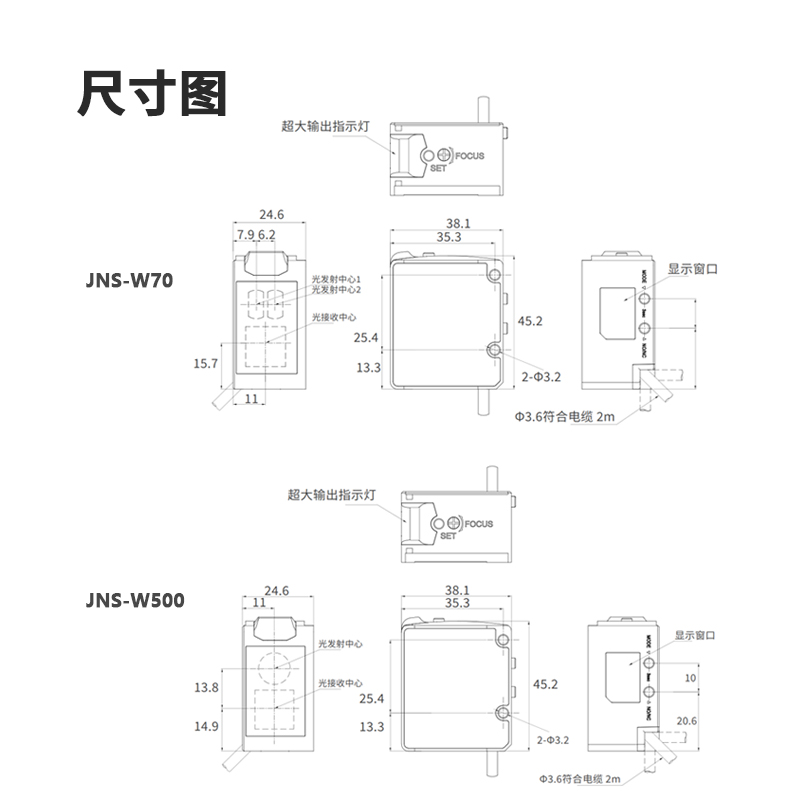
Dimension drawings — both models share the compact 38.1 × 45.2 mm housing outline with two φ3.2 mounting holes and a 2 m φ3.6 cable.
Technical Specifications
| Detection range | JNS-W70: 30–70 mm · JNS-W500: 50–500 mm |
|---|---|
| Light spot | W70: approx. 1.6 × 2.9 mm @ 50 mm · W500: φ3.5 mm @ 100 mm to φ20 mm @ 500 mm |
| Light source | White LED |
| Output | NPN / PNP open-collector switchable (≤30 V, ≤100 mA, residual ≤2 V); N.O. / N.C. switchable |
| Communication | IO-Link; external input configurable as teach or emitter-off |
| Response time | 200 μs / 1 ms / 10 ms / 100 ms / 500 ms (selectable) |
| Timer function | OFF / on-delay / off-delay / one-shot |
| Current consumption | ≤50 mA at 24 V |
| Operating voltage | 10–30 VDC |
| Protection rating | IP65 |
| Weight | 128 g |
Model Selection
| Model | Working distance | Spot | Choose when… |
|---|---|---|---|
| JNS-W70 | 30–70 mm | ~1.6 × 2.9 mm @ 50 mm | Small marks needing fine resolution at close-to-mid standoff |
| JNS-W500 | 50–500 mm | φ3.5 mm @ 100 mm → φ20 mm @ 500 mm | Maximum installation freedom; larger marks at long standoff |
Below 30 mm mounting distance choose a close-mount sensor such as the FS-S72 (18–28 mm) instead. The JNS-W series is a detection sensor, not an IEC 61496 certified safety component, and must not be used on its own for personnel protection.
Where the Standoff Pays Off
Next to Heat Sealers
Keep the sensor out of the hot zone on FFS and bag-making machines while still reading the mark at the seal station.
Spray & Splash Zones
Detect through the clean air gap instead of mounting inside coating, gluing or washdown-adjacent areas.
Through Guard Openings
Sense the web through an existing frame or guard opening — no custom close-mount bracket inside the machine.
Fluctuating Web Position
The wide working band absorbs web-distance variation on unwinders and festooned webs without re-positioning.
Frequently Asked Questions
Why would I pay for standoff distance on a mark sensor?
Because the best sensing position is often physically unavailable: next to a heat-sealing bar, inside a spray/splash zone, or behind a guard panel. Conventional mark sensors need to sit within a few tens of millimeters of the web; the JNS-W500 reads the same mark from up to 500 mm away, so the sensor lives where the machine has room — and stays out of the heat and mess.
JNS-W70 or JNS-W500 — how do I choose?
By mounting distance and mark size. JNS-W70 works at 30–70 mm with a fine ~1.6 × 2.9 mm spot at 50 mm, resolving small marks. JNS-W500 works at 50–500 mm with a spot growing from φ3.5 mm at 100 mm to φ20 mm at 500 mm, so at long range the mark must be correspondingly larger. Electrically the two are identical.
Does one unit really cover both NPN and PNP systems?
Yes — output polarity (NPN/PNP open-collector, ≤30 V, ≤100 mA, residual ≤2 V) and logic (N.O./N.C.) are both switchable on the same unit. One part number covers mixed-brand PLC installations, which simplifies export machine building and spares stocking.
What does the white LED buy me over a red or green emitter?
A single-color LED only sees good contrast for some mark/background color pairs. The white LED spans the visible spectrum, so the same sensor handles a much wider range of print colors without swapping emitter variants when the artwork changes.
Is it IO-Link capable?
Yes, both models carry IO-Link alongside the discrete output, enabling remote parameter setting and diagnostics from an IO-Link master. The external input is also configurable as a teach input or an emitter-off input.
Which response setting should I run?
Five settings are selectable: 200 μs, 1 ms, 10 ms, 100 ms and 500 ms. Use 200 μs or 1 ms for narrow marks at line speed; use the longer settings to stabilize difficult, low-contrast targets. On-delay, off-delay and one-shot timers shape the pulse inside the sensor if the PLC needs it.
What are the environmental ratings and how do I order?
IP65 housing (dust-tight, water-jet protected), 10–30 VDC supply, ≤50 mA at 24 V, 128 g. A 3D STEP model of the W500 is available for machine design. Contact the factory with your standoff distance and mark size for quotation, lead time and the latest datasheet; certification documents on request. Not an IEC 61496 certified safety component.
Specs reviewed by Engineer Cai, Senior Application Engineer. See certificates.
Safety Light Curtain — Customer Cases
Real installations from DAIDISIKE clients. Click any case to view in full. Filter by scenario to quickly find a similar setup.