
EE-SX67 Slot Photomicrosensor for OEM Equipment
The invisible workhorse inside automated machines: a pre-aligned U-slot detector for home, limit, count and index points — in eight housing shapes so the sensor fits the design, not the other way round.
- Emitter + receiver factory-aligned in one U-housing
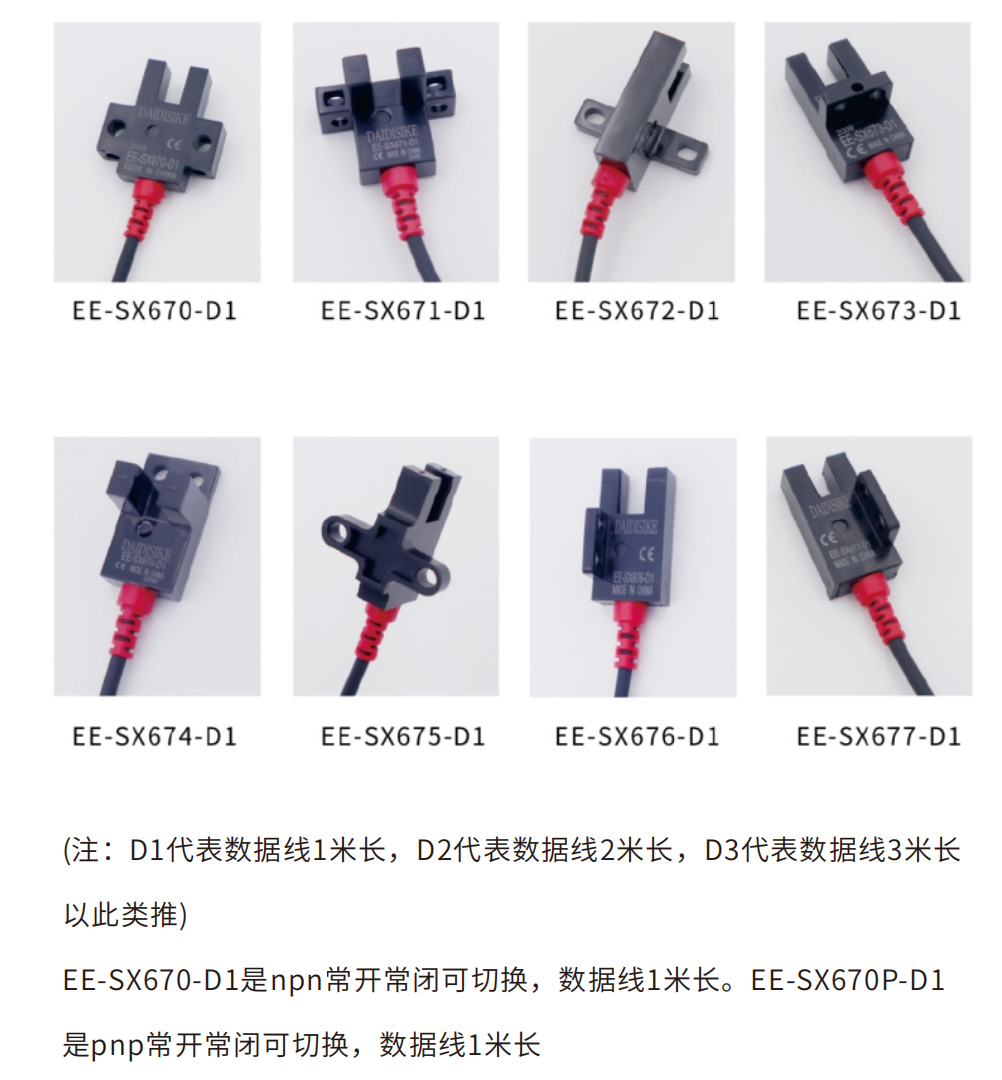
- 8 shapes: EE-SX670 – EE-SX677
- NPN and PNP versions of every shape
- NO/NC selected by wiring — one SKU, both logics
- Pre-wired cables: 1 m / 2 m / 3 m (D1/D2/D3)
Product Overview
Every automated machine hides a handful of questions it must answer thousands of times a day: is the axis at home? has the tray reached the end? did a part pass? The EE-SX67 series answers them with a through-beam U-slot photomicrosensor: emitter and receiver face each other across a fixed slot, aligned at the factory, so a flag or tab breaking the beam produces a crisp, repeatable switch point with zero field alignment.
Because these sensors are designed into equipment rather than bolted on afterwards, mechanical fit matters more than raw specs. That is why the series offers eight housing shapes (EE-SX670 – EE-SX677) — different outlines, mounting orientations and cable exits — each in NPN and PNP versions. Detection logic is not even a part-number decision: wire the black lead for NO (Light-ON) or join white to brown for NC (Dark-ON), so one stocked unit serves both philosophies.
Units arrive pre-wired with 1, 2 or 3 m of cable (D1/D2/D3 suffix), ready to route straight to the controller — a deliberate fit for OEM production lines building many machines to one drawing.
How U-Slot Detection Works
Ordering / Selection Table
| Housing Shape | NPN (1 m cable) | PNP (1 m cable) | Cable Options |
|---|---|---|---|
| Shape 0 | EE-SX670-D1 | EE-SX670P-D1 | -D1 = 1 m -D2 = 2 m -D3 = 3 m (longer: same pattern, per factory availability) |
| Shape 1 | EE-SX671-D1 | EE-SX671P-D1 | |
| Shape 2 | EE-SX672-D1 | EE-SX672P-D1 | |
| Shape 3 | EE-SX673-D1 | EE-SX673P-D1 | |
| Shape 4 | EE-SX674-D1 | EE-SX674P-D1 | |
| Shape 5 | EE-SX675-D1 | EE-SX675P-D1 | |
| Shape 6 | EE-SX676-D1 | EE-SX676P-D1 | |
| Shape 7 | EE-SX677-D1 | EE-SX677P-D1 |
Part-number pattern: EE-SX67[shape 0–7][P optional]-D[cable length in meters]. Example: EE-SX672P-D2 = shape 672, PNP, 2 m cable.
Technical Specifications
| Sensing method | Through-beam across a U-slot, factory pre-aligned |
|---|---|
| Slot width | 5 mm (all eight shapes, per factory dimension drawings) |
| Housing shapes | 8 (EE-SX670 – EE-SX677) |
| Output type | NPN (no suffix) or PNP (P suffix) |
| Detection logic | Selected by wiring — black = NO (Light-ON); white joined to brown = NC (Dark-ON) |
| Indicator | Light-ON indicator LED on every shape |
| Cable | Pre-wired 4-core, Ø2.8 mm, 0.15 mm² conductors; D1 = 1 m, D2 = 2 m, D3 = 3 m |
| Min. object / response / IP rating / supply | Contact factory — not published for this series |
General-purpose position-sensing component — not an IEC 61496-certified safety component; never use it alone for personnel protection.
Typical Applications
Axis Home / Zero Detection
A flag on the moving carriage passes through the slot at the reference point — the standard homing recipe on linear modules and robots.
End-of-Travel Limits
Optical limit sensing with no contact wear, replacing mechanical limit switches inside actuators and stages.
Feeder Track Counting
Each part crossing the slot interrupts the beam once — clean pulses for counting small components off vibratory feeders.
Rotary Index Triggers
A cam or slotted disc through the fork gives a repeatable trigger per index step on turntables and dial machines.
Frequently Asked Questions
Why do OEM designers default to slot (fork) sensors for in-machine detection?
Because alignment is already done. In a U-slot photomicrosensor the emitter and receiver are fixed and factory-aligned in one housing — you bolt it on and it works. On equipment with dozens of home, limit and index points, eliminating per-point beam alignment saves real assembly and service time compared with separate through-beam pairs.
How do I choose among the 8 housing shapes?
EE-SX670 through EE-SX677 differ in outline, mounting-hole orientation and beam direction, not in detection function. Pick the shape whose slot faces your flag's travel direction and whose feet match the space you have — the shape digit is independent of output type and cable length, so changing shape does not change the electrical order code logic.
Do I need to stock separate NO and NC part numbers?
No — that is a quiet cost saver of this series. Detection logic is chosen at wiring time: land the black wire for normally-open (Light-ON) behavior, or join the white wire to the brown wire for normally-closed (Dark-ON). One stocked unit covers both logic needs across your machines.
How are NPN and PNP versions coded?
No suffix = NPN (sinking), P suffix = PNP (sourcing) — e.g. EE-SX672-D1 is NPN, EE-SX672P-D1 is PNP. Every one of the 8 shapes exists in both, so mixed PLC fleets can standardize on one sensor family.
What cable options are available?
Sensors come factory pre-wired; the D-suffix sets the length: D1 = 1 m, D2 = 2 m, D3 = 3 m, with longer runs following the same pattern subject to factory availability. Full part-number pattern: EE-SX67[shape 0-7][P optional]-D[length].
What about slot width, response time and IP rating?
The factory dimension drawings give a 5 mm slot width on all eight shapes (EE-SX670 through EE-SX677); each unit also carries a light-ON indicator LED and a 4-core 2.8 mm cable (0.15 mm² conductors, 1 m standard). Response time, minimum detectable object, supply range and IP rating are not published for this series and we will not guess them here — contact the factory, or consider our DD-670 or DD-L25/L45 micro-slot series where those numbers are documented.
Is this a safety interlock component?
No. Slot photomicrosensors are position/counting components, not IEC 61496-certified safety devices, and must not implement personnel protection. For guarding, use a certified safety light curtain such as the DQC series.
What are the purchasing terms for export?
Standard shapes and cable lengths normally ship quickly from Foshan stock, and small trial mixes across shapes/outputs are usually accepted. Send your part-number list (e.g. EE-SX674P-D2 x 200) for MOQ, lead time and documentation at quotation.
Specs reviewed by Engineer Cai, Senior Application Engineer. See certificates.