DK-SCZ-II Hot & Cold Metal Detector
A laser distance instrument engineered for the one environment that destroys ordinary sensors: the metallurgical floor — furnace heat, steam, and dust included.
- Active laser: detects molten, hot and cold metal alike
- 1 mm accuracy · 0.1 mm resolution · 10 Hz update
- Water-cooling + air-purge ports built into IP65 housing
- Switching + 4–20 mA + RS232 outputs on one unit
- Ranges 0.1–3 / 5 / 10 / 20 m · control room up to 200 m away
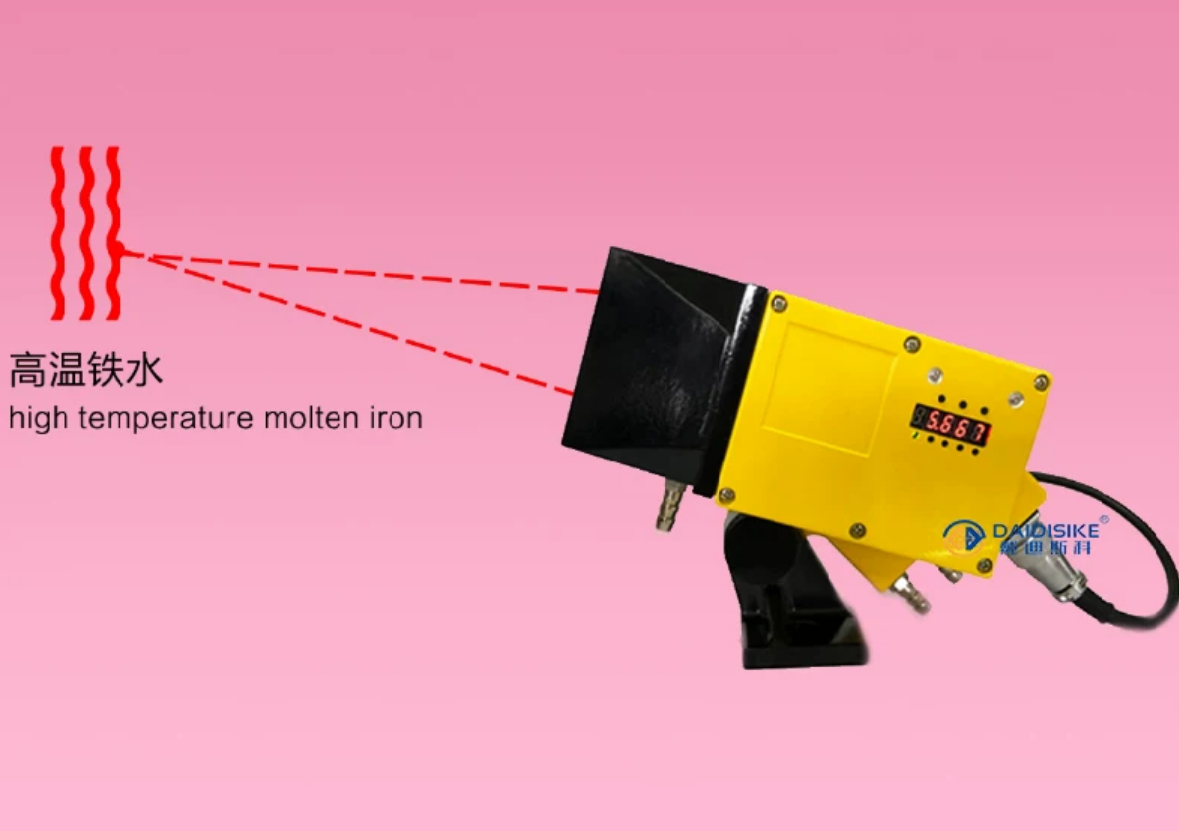
Built for the Metallurgical Environment First
Sensor datasheets rarely mention what a casting floor actually does to instruments: radiant heat that cooks electronics, steam and graphite dust that coat every lens, and targets that swing from 1,500 °C melt to cold slab within one process step. The DK-SCZ-II is specified from that reality backwards. Its aluminum IP65 housing carries dedicated water-cooling and compressed-air purge ports (0.3 MPa each), so it mounts directly at melting and casting stations without a third-party cooling jacket, and its optics stay clear inside a permanent air curtain.
Because it is an active laser instrument — a modulated semiconductor laser with an amplified photoelectric receiver — it does not care whether the target glows. Molten aluminum, red-hot billet or room-temperature stock all return the same kind of answer: a distance, measured to 1 mm accuracy at 10 Hz over factory-set ranges of 0.1–3, 5, 10 or 20 m. One unit therefore replaces the classic pairing of a passive hot-metal detector plus a separate level meter: its programmable switching output handles position interlocks, the 4–20 mA loop feeds the DCS, and RS232 streams data to SCADA — with the control cabinet sited up to 200 m away on shielded cable.
Active Laser vs Passive Infrared Detection
Passive IR needs a glowing target; the DK-SCZ-II sends its own modulated beam, reads the reflection through steam and dust, and returns millimeter-grade distance for hot and cold metal alike.
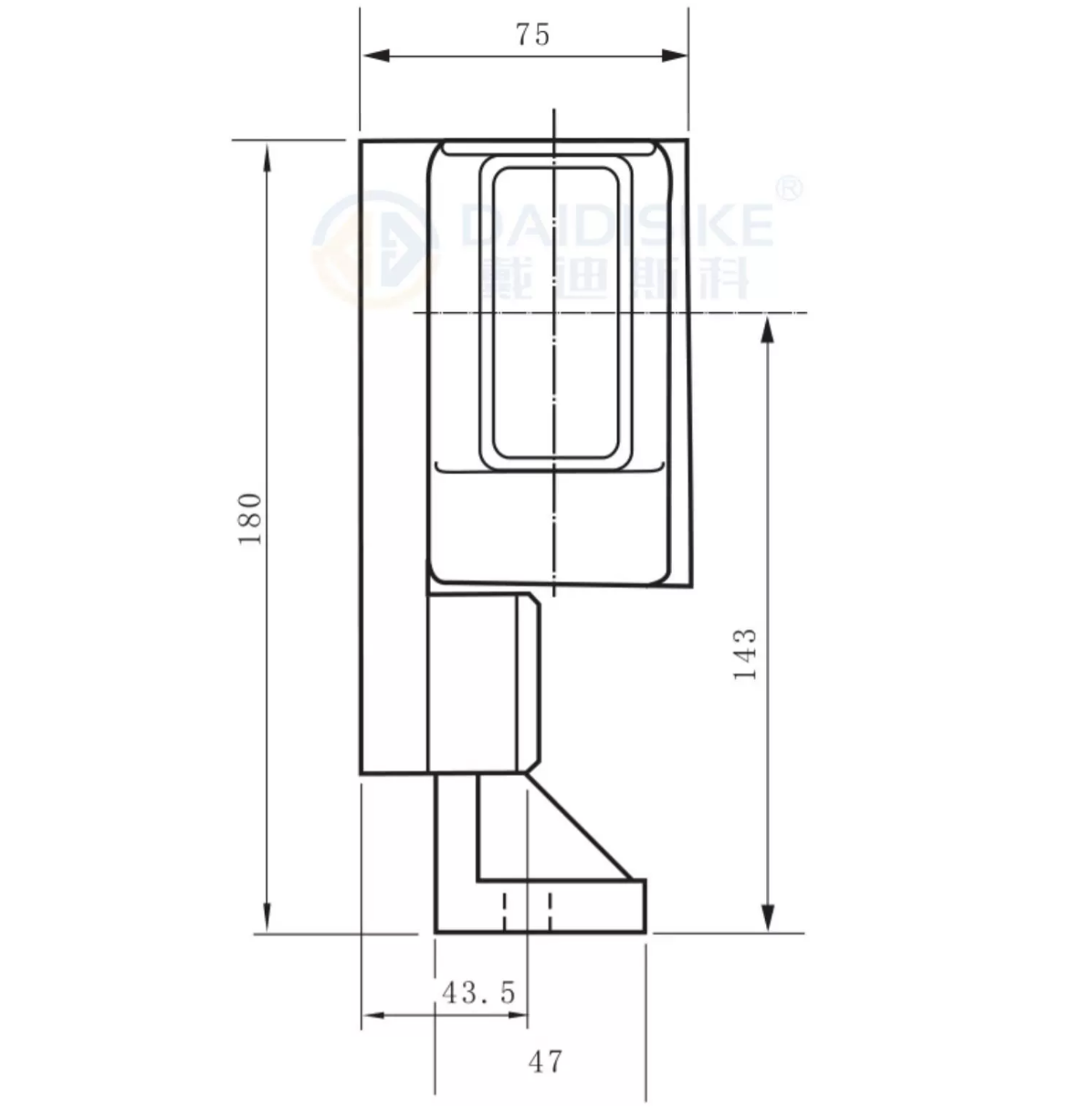
Housing outline with mounting bracket — approx. 180 mm overall height, 75 mm body width (see drawing for bracket hole spacing).
Technical Specifications
| Model | DK-SCZ-II (laser distance type, hot & cold metal) |
|---|---|
| Measuring range | 0.1–3 m / 5 m / 10 m / 20 m (selected at ordering) |
| Accuracy | 1 mm |
| Resolution | 0.1 mm |
| Repeatability | 0.5 mm |
| Measuring rate | 10 Hz |
| Switching output | Programmable setpoint + hysteresis, 0.5 A load |
| Analog output | 4–20 mA scalable, load impedance ≤ 500 Ω |
| Serial interface | RS232, 9600 baud ASCII (RS422 on request) |
| Power supply | 10–30 VDC |
| Cooling / purge | Water-cooling port 0.3 MPa; compressed-air purge 0.3 MPa |
| Housing | Aluminum, IP65 |
| Signal cable | Up to 200 m, shielded |
| Operating temperature / dimensions | Contact factory for latest datasheet |
Range Selection
| Range option | Typical duty |
|---|---|
| 0.1–3 m | Workpiece arrival, cut-to-length pacing, slab/plate tracking at close standoff |
| 5 m | Line position detection with extra mounting clearance from the hot zone |
| 10 m | Furnace and ladle level, mid-depth vessels |
| 20 m | Tall tanks and large-vessel level measurement |
The DK-SCZ-II is a process measurement instrument, not an IEC 61496 certified safety component, and must not be used on its own for personnel protection.
Melt Shop & Mill Applications
Molten Aluminum Level Control
Closed-loop furnace and holding-furnace level via the 4–20 mA output with millimeter-grade measurement.
Molten Iron Detection
Presence and position of hot metal on metallurgical lines — active laser keeps working as surfaces cool.
Hot Rolling Slab Tracking
Position-triggered interlocks for slab and plate tracking using the programmable switching output.
Continuous Casting Floors
Water cooling, air purge and IP65 sealing let the head live beside the strand where steam and dust are constant.
Frequently Asked Questions
Why does an active laser beat a passive infrared hot metal detector in a melt shop?
A passive IR detector only sees what glows — once the billet skin cools or a cold slab passes, the signal is gone. The DK-SCZ-II carries its own modulated semiconductor laser and photoelectric receiver, so the same head detects molten metal, red-hot billet and cold stock, and it returns an actual distance reading rather than a bare on/off glow signal.
How does the housing survive next to a furnace?
Three defenses are built into the IP65 aluminum housing: a water-cooling circuit (0.3 MPa port) for high ambient temperature, a compressed-air purge (0.3 MPa) that keeps steam, smoke and dust off the optics, and a fiber-coupled emitter/receiver architecture that lets the electronics sit back from the worst heat. No third-party cooling jacket is needed at casting and melting stations.
What accuracy and update rate does it deliver?
1 mm accuracy, 0.1 mm resolution and 0.5 mm repeatability at a 10 Hz measuring rate — continuous distance/level data precise enough for closed-loop furnace level control, not just presence detection.
Which measuring range should I order?
Four factory-selectable ranges: 0.1–3 m, 5 m, 10 m and 20 m. Close-range workpiece arrival and slab tracking typically use 0.1–3 m or 5 m; furnace, ladle and tall-vessel level measurement selects 10 m or 20 m by vessel depth. The ordering-suffix system is being finalized — tell us the application and we configure the variant.
How does it connect to a PLC, DCS and SCADA at the same time?
Three interfaces coexist on one unit: a programmable switching output with user-set setpoint and hysteresis (0.5 A load — drives interposing relays directly), a scalable 4–20 mA analog output (load ≤ 500 Ω) for the DCS, and an RS232 serial stream (9600 baud ASCII; RS422 on request) for logging. The control room can sit up to 200 m away over shielded cable.
Does steam and dust in continuous casting blind it?
The modulated-laser plus amplified-receiver design is specified for exactly that environment: the modulation lets the receiver separate its own beam from ambient glow, giving strong penetration and interference immunity in the humid, dusty, steam-laden air of casting floors — and the air purge keeps the window itself clear.
Purchasing: configuration, lead time, certificates?
Send us the measuring range, target (molten aluminum, molten iron, billet, cold stock), mounting standoff and available utilities (cooling water / compressed air); the factory returns a configured quotation and lead time. Certification documents are available on request. The DK-SCZ-II is a process instrument, not an IEC 61496 certified safety component — do not use it for personnel protection.
Specs reviewed by Engineer Cai, Senior Application Engineer. See certificates.
Safety Light Curtain — Customer Cases
Real installations from DAIDISIKE clients. Click any case to view in full. Filter by scenario to quickly find a similar setup.