
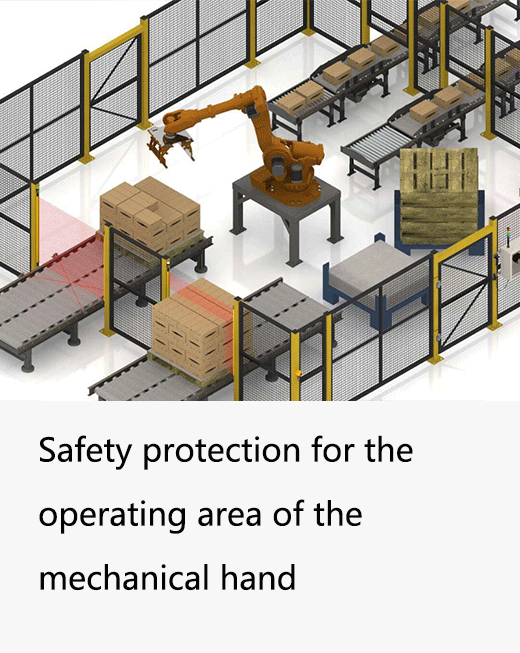
Use the industrial machine-safety standards framework to record which hazards each standard and safety function actually covers. Then use the humanoid-line perimeter and area sensor guide for the separate device-selection decision. Neither a pilot announcement nor a sensor catalogue is a completed integration safety case.
The last eighteen months have been the moment humanoids moved from demonstration footage to repeatable industrial work. They are not everywhere, and the published examples concern specific tasks and trials rather than a universal safeguarding layout. That gap, between what is technically deployed and what the public images suggest, is where most safety conversations go wrong. This article walks the gap.
What actually shipped: the 2025-2026 production deployments
Before any talk of standards, it is worth being specific about which humanoids have actually done industrial work, because the field is full of staged demos and the regulatory picture only makes sense in light of the real deployments.
- Figure 02 at BMW Group Plant Spartanburg. A roughly ten-month deployment that concluded in late 2025. Figure 02 retrieved and positioned sheet-metal parts for body-shop welding on the X3 line, ran five days a week for ten-hour shifts, moved over 90,000 components across about 1,250 operating hours, and contributed to more than 30,000 vehicles. The pilot has ended; BMW has since announced a second pilot in Plant Leipzig and a Center of Competence for Physical AI in production.
- Apptronik Apollo at Mercedes-Benz. Apollo is in pilot operation at the Mercedes-Benz Digital Factory Campus in Berlin-Marienfelde and at a Hungarian plant, performing component transport to the line and early-stage quality checks. Mercedes has since taken an equity stake in Apptronik. Tasks remain narrow and the cells are safeguarded.
- Agility Digit at GXO Logistics (SPANX). The first publicly announced multi-year, Robots-as-a-Service commercial deployment of a humanoid. Digit moves totes from collaborative robots onto conveyors at the SPANX fulfilment site and passed the 100,000-tote operational milestone in late 2025. It works alongside AMRs inside a defined work zone.
- Tesla Optimus, Unitree, and others. Tesla has shown Optimus units inside its own Fremont and Gigafactory areas for internal materials-handling tasks; Unitree H1 / G1 / H2 units have been deployed in supplier and research environments. None of these to our knowledge have published a verified, audited production deployment of the scale of the three above.
These public reports establish that specific tasks were trialled or deployed; they do not disclose every guard, operating mode or validation result. Do not infer unrestricted coexistence, a universal fencing rule or a sensor bill of materials from them.
What ISO 10218:2025 says — and does not say — about bipeds
The major 2025 revision of ISO 10218 (Parts 1 and 2) was the first structural rewrite of the industrial robot safety standard since 2011. Three changes matter for humanoids:
1. Industrial manipulation and mobility are distinct scopes. The ISO 10218-1:2025 scope and Part 2 integration scope exclude mobility hazards for robots on mobile platforms. Evaluate relevant industrial manipulation requirements without claiming that this covers walking, balancing or falling. ISO 3691-4:2023 is for driverless industrial trucks, not automatically every biped.
2. Collaborative operation needs application-level evidence. Use the applicable provisions of ISO 10218-2:2025 and the relevant contact assessment rather than a collaborative-robot label. ISO/TS 15066:2016 is still listed by ISO as published and to be revised; do not describe it as no longer a separate document or assume its contact limits validate a falling whole robot.
3. Cybersecurity is in scope. The 2025 revision adds explicit cybersecurity requirements for the robot controller and its connections. This is relevant to humanoids because a connected controller or update mechanism can affect safety-related configuration, and a network surface is now treated as a safety-relevant attribute.
What the standard still does not do is provide a biomechanical injury model for a falling, stumbling, or balancing biped, or a test method for a humanoid’s stop-on-fault behaviour while balancing. Those gaps are not oversights — they are real research questions. ISO 13482 covers personal-care and service robots, including humanoids in non-industrial settings, but it is not the standard a factory integrator will be audited against. The integrator must document coverage and gaps in the complete risk assessment. ISO/CD 25785-1 specifically concerns actively controlled stability and includes legged robots, but a committee draft is not a published conformity standard. Follow the robot manufacturer's validated fault and stability evidence rather than simply combining truck and manipulator labels.
Why fenced cells are still doing the real safety work
A reasonable question from outside the safety profession is: if collaborative operation works for cobots — if a UR or a Doosan can share a bench with a person under PFL rules — why can’t a humanoid? The answer is geometric and dynamic, not ideological.
A power-and-force-limiting assessment depends on bounded contact conditions, mass, speed and geometry. A walking robot can also lose footing, drop its load or fall under gravity. Do not assume that conventional manipulator contact limits establish safety for a whole-body fall. Obtain application-specific stability and fault-condition evidence and assess physical separation where sensing cannot contain the hazard.
A perimeter-controlled cell is one risk-reduction option, but it still needs a boundary beyond foreseeable movement, falling and dropped-load reach. Choose access and occupancy measures from the actual safety assessment; do not present fencing as the only legally supportable configuration for every humanoid.
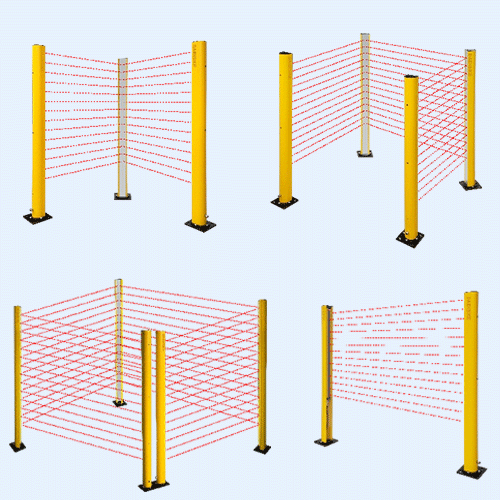
The safeguarding layers in a 2026 humanoid workcell
Walk through how a typical humanoid cell is actually built today, and the resemblance to a conventional robotic cell is the point.
1. Perimeter fencing and interlocked access
The cell boundary is a physical fence or guard with one or two controlled access points. The access doors carry coded safety interlock switches with guard locking, so the door cannot open while the humanoid is in motion, and the cell cannot be commanded to run while the door is open. This is the most boring layer and the one that does the most safety work. For high-energy or slow-coast situations, guard locking that holds the door until the robot has reached a verified safe state is mandatory under ISO 14119 — not a nice-to-have.
2. Light curtains at the human interface
At a loading or inspection opening, select a protective device with the detection capability and safety performance required by that specific function. No universal Type 4 / PL e / SIL 3 rating follows from the word humanoid. Check reach-through and whole-body access separately. If material transfer needs muting, use a supported safety-related sequence and geometry that prevents foreseeable person passage alongside or behind the load.
3. Area scanners covering the floor
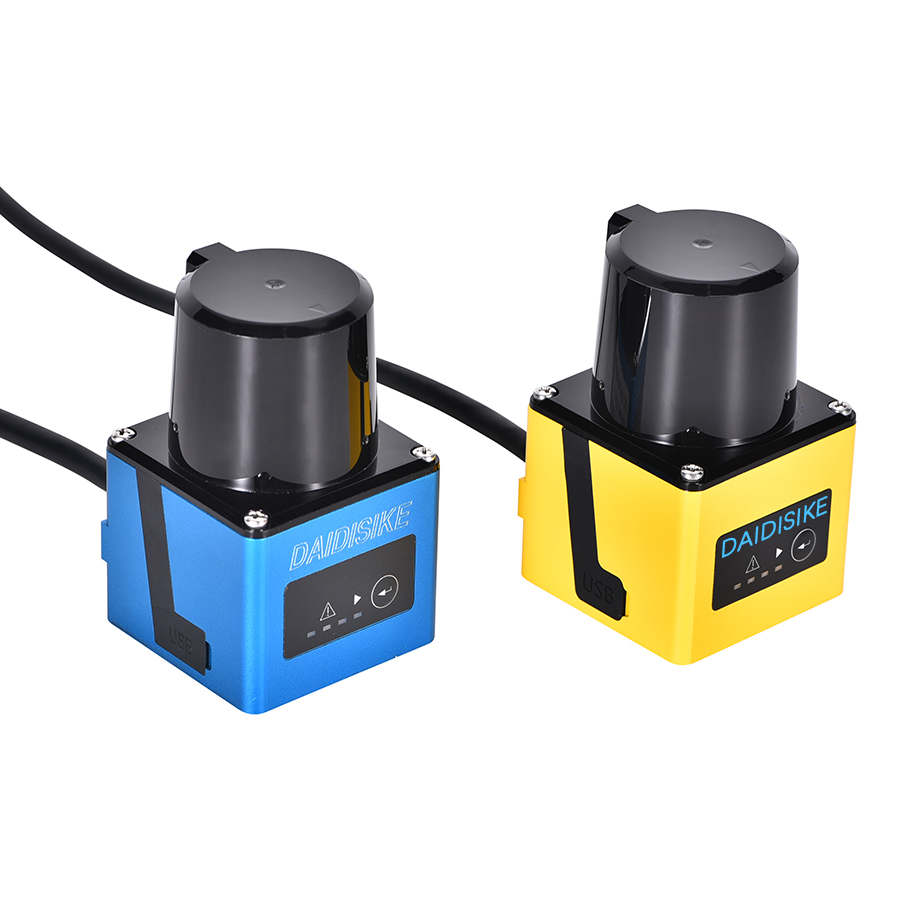
A humanoid moves around its workcell. That movement makes flat, plane-style safeguarding insufficient: you need to know whether a person is in the floor zone the robot might step into, not just whether they have crossed a defined boundary. A safety laser scanner certified to IEC 61496-3 covers an area, with multiple field sets switched by cell state: a larger protective field during free motion, a tighter one when the robot is at a stationary station. Same principle as an AGV, different mounting. For larger cells or irregular footprints, an area-type light curtain such as the DAIDISIKE DQSA series can complement the floor scanner by covering vertical detection.
4. Pressure-sensitive mats and edge devices
For dead zones behind fixtures or under benches where a scanner cannot see, a safety mat or sensitive edge fills the gap. These older technologies are unfashionable but completely valid; ISO 13856-1 and -2 still apply.
5. The humanoid’s own perception — as a non-safety layer
Onboard torque, camera, LiDAR and balance functions vary by robot. Ordinary perception is not credited as person protection; a claimed safety function requires evidence for the exact hardware, software, performance level and application. Certified sensing can be onboard or external, but its mounting location alone does not establish or invalidate certification.
Conventional safeguards vs humanoid-specific gaps
| Safeguard layer | Maturity for humanoids in 2026 | Standard the integrator cites |
|---|---|---|
| Perimeter fence + interlocked guard locking | Mature — identical to a conventional robot cell | ISO 14119, ISO 13857 |
| Safety light curtain at operator opening | Mature — Type 4 / PL e / SIL 3 readily available | IEC 61496-1/2, ISO 13855 |
| Safety laser scanner on the floor zone | Mature — precedent is AGV/AMR safeguarding | IEC 61496-3, ISO 3691-4, ANSI R15.08 |
| Pressure-sensitive mat / sensitive edge | Mature for dead-zone coverage | ISO 13856-1/2 |
| PFL collaborative operation (whole biped) | Not yet — no validated biomechanical model for a falling humanoid | ISO 10218-2:2025 (manipulator portion only) |
| Humanoid’s own cameras / LiDAR as safety function | Ordinary perception is non-safety; evaluate any specifically certified function separately | Exact claimed function requires applicable certification and validation evidence |
| Safety of the AI / motion-planning stack | Open research — cybersecurity in scope under ISO 10218-1:2025, but probabilistic behaviour is not a deterministic safety function | ISO 10218-1:2025 (partial), ISO/IEC 27001 for the network surface |
The pattern is consistent: the mature, conventional safeguards carry the safety case, and the new, humanoid-specific capabilities are layered on as productivity and behaviour improvements rather than as protective devices. That allocation of responsibility is what allows a competent integrator to sign off the cell at all.
What is honestly still unsolved
A practical article should not finish without naming the gaps. Three of them are worth tracking.
Biomechanical injury model for a falling biped. The PFL limits in ISO 10218-2:2025 were derived from quasi-static and transient contact studies between manipulator links and specific body regions. A whole humanoid losing balance and falling forward onto a kneeling worker is not the same contact mechanics. Until a research consortium produces validated test methods for this case — analogous to what ISO/TS 15066 did for cobot contact — PFL operation for a biped will not be credible.
Stop-on-fault while balancing. Removing drive torque is not a universal safe stop for a wheeled or legged robot. Braking, stability and payload retention depend on the exact machine. So ‘safe stop’ for a biped means something different — reaching a stable braced posture, or controlled descent — and that behavior needs fault-condition evidence for the exact machine. Track the developing ISO/CD 25785-1 work without representing a draft as a completed certification route.
Safety of probabilistic AI behaviour. The motion-planning, manipulation, and locomotion policies on a modern humanoid are learned, often updated over the air, and probabilistic in their output. A safety function under ISO 13849-1 is, by contrast, deterministic and bounded. The honest answer in 2026 is that the AI layer is not currently inside the safety function. ISO 10218-1:2025 added cybersecurity requirements, which is the start of bringing the network surface into scope, but the treatment of learned behaviour as a safety-relevant artefact is still an active research area in the IEEE robotics standards working groups and in the A3 R15.06-related working groups in North America.
Where DAIDISIKE fits — honestly
The market noise around humanoids has produced a great deal of inbound interest in ‘humanoid-rated’ safety sensors, which do not exist as a product category — and we think will not, because the gap is not in the protective device, it is in the standards above it. What does exist is a well-tested family of safeguards that the confirmed deployments at BMW, Mercedes-Benz and GXO all use in some combination.
Within that picture, DAIDISIKE’s contribution is the conventional perimeter layer. The DQSA area-type light curtain fits the walk-in operator interface of a humanoid cell; the DQA exact-model light curtain options covers point-of-operation openings; ST27 protective scanners are user-confirmed Type 3 / PL d / SIL 2. DLD05A3, DLD20A5 and DLD30T-5N are non-safety industrial perception devices, not credited protective floor scanners. An external safety controller does not change that boundary.
No component purchase establishes collaborative operation for a humanoid. Select and validate each protective function for the actual robot, access paths, stopping behavior and fall envelope.
The bottom line
Published industrial pilots show useful tasks, not a general safety approval. Determine applicable industrial-robot requirements, explicitly assess mobility and stability gaps, and obtain evidence for the complete application rather than extrapolating from publicity.
The integrator’s job, then, is the same as ever: do the risk assessment honestly, build the layers the standards require, and resist the temptation to let marketing footage define the safeguarding strategy. The humanoid is impressive. The fence, the curtain, and the scanner are what let you ship it.
Primary deployment context: BMW's February 2026 pilot report, Mercedes-Benz's March 2025 Apollo report and Agility's tote milestone. Standards development: ISO/CD 25785-1.
Related reading
Robot Cell Safety in 2026: ISO 10218:2025
What the major 2025 revision changed for industrial robot cells — cybersecurity, collaborative applications, and PFL integration.
DAIDISIKE DQSA Area Light Curtain
Area-type light curtain for whole-body detection around larger robot envelopes and walk-in workcells.
AGV & AMR Safety Laser Scanners
How certified safety scanners protect mobile robots — the closest precedent for safeguarding a walking humanoid.