AGV & AMR Obstacle Avoidance: Which Safety LiDAR Scanner Range to Choose (5m vs 20m)
Speed and precision — that's the current game in AGV and AMR navigation. But keeping up isn't just about faster motors. As Automated Guided Vehicles and Autonomous Mobile Robots move more swiftly, carry bulkier loads, and handle ever-tighter turns, ensuring absolute safety without hindering throughput is a complex, front-of-mind engineering challenge.
Relying on old-school bumper switches is a non-starter; they react after the contact. Even traditional ultrasonic sensors, with their slow response and wide, unpredictable beams, can be a headache for precise navigation. True, dependable collision avoidance — the kind that keeps your facility running smoothly — starts with talking about Safety LiDAR Scanners.
We get it. At DAIDISIKE, we developed our DLD Series LiDAR Scanners specifically to strip away the anti-collision puzzles AGV integrators face. Let's look at the technical details on AGV obstacle avoidance and get clear on why choosing the right scanning range — specifically 5 meters versus 20 meters — is a critical, robot-defining choice.
Range Matters: More Than Just a Specification
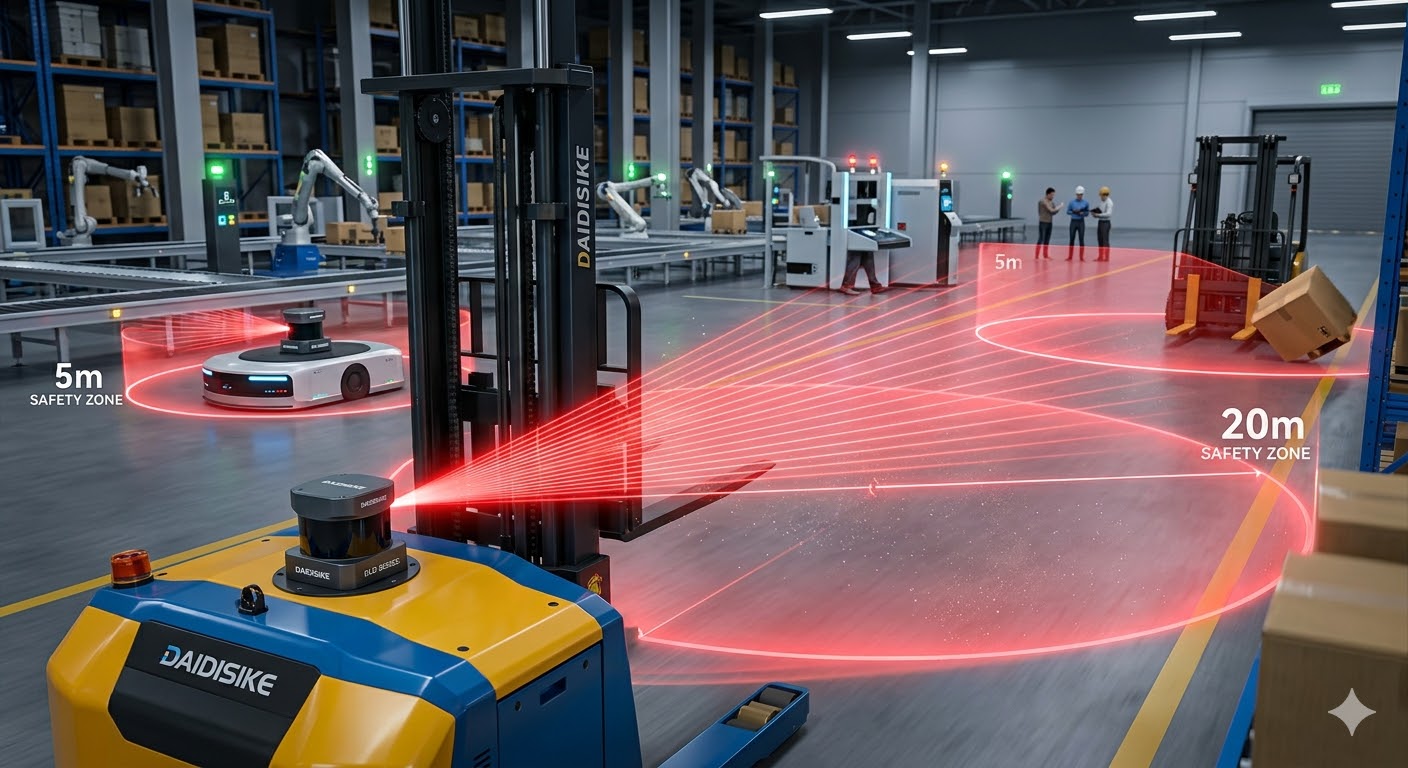
For anyone picking an AGV obstacle avoidance sensor, range isn't just a number on a datasheet. It's the difference between a controlled stop and a chaotic mess. You wouldn't install a 2-meter range sensor on a robot running full tilt at 2 m/s. It's about understanding the basic physics of braking.
An AGV's full stopping distance isn't just about the brakes. It's a combination:
System Response Time + Braking Mechanical Delay + Robot Inertia (Slide Distance).
When you have a massive, 1,000 kg AMR, its inertia is huge. Stopping that thing is a whole different beast than stopping a small delivery bot. That's why we offer two tailored LiDAR models with fast, standard NPN outputs to match different kinds of robot dynamics.
DLD5: Your Agile Navigator
The DLD5 NPN LiDAR is precision personified. With its highly precise 5-meter detection radius, it is the perfect choice for:
- Tight Spaces: Perfect for compact AMRs and service robots navigating hospital corridors, restaurants, or narrow warehouse aisles where a large scanning range would constantly be pinging off walls and causing unnecessary stops.
- Low to Medium Speeds: Perfect for AGVs moving at more cautious speeds (below 1.5 m/s) where a 5 m zone gives it all the time it needs.
- Precision Cornering: A sharp, focused range is fantastic for mapping out customized, asymmetric warning and stop zones during tricky turning maneuvers.
DLD20: Built for Heavy Lifting
Now, if your robot is hauling massive metal coils or pallets down a long, clear logistics corridor at 3 m/s, you need the long view. This isn't about precision; it's about massive area protection. The DLD20 NPN Laser Scanner gives you that future view with a 20-meter protection field. Think:
- High-Speed Forklifts & Heavy AGVs: For high-speed forklifts and heavy AGVs that can easily require 5 to 10 meters just to decelerate from top speed without dropping their payload.
- Long Corridor Clarity: This range lets an AMR see forklifts, pallets, or people from a safe distance, giving it time to make a smooth path correction instead of slamming on the emergency brakes.
- Area & Perimeter Defense: On or off a mobile platform, its range makes it a great choice for large robotic welding cells or general perimeter monitoring.
The “Asian Backbone”: Why We Stick with NPN
Both the DLD5 and DLD20 keep it simple with standard NPN (Sinking) outputs. If you're building the control cabinet for an AGV, you know that NPN is the lifeblood of Asian and custom-built control boards.
Built for the Factory Floor, Not a Laboratory
Any engineer knows an optical sensor is only as good as its ability to ignore “noise.” In a real-world factory, cheap LiDARs fail constantly. The DAIDISIKE DLD series is engineered to stand up to the typical real-world conditions that knock lesser sensors offline:
| Environmental Challenge | The DAIDISIKE Solution |
|---|---|
| Ambient Sunlight (Lux) | Advanced optical filtering and algorithms ensure your LiDAR isn't blinded when the AGV drives past an open loading dock door. |
| Airborne Dust & Particles | Multi-echo technology lets the laser look past suspended dust or light smoke, preventing phantom obstacle alarms and unnecessary braking. |
| Crosstalk (Other AGVs) | When a fleet of 50 AGVs crosses paths, their lasers can interfere. Our encoded laser pulses ensure the DLD sensor only processes its own reflections. |
Secure Your Fleet’s Future with DAIDISIKE
Designing a reliable obstacle avoidance system doesn't have to drive up your Bill of Materials (BOM). Factory-direct sourcing eliminates multi-tier distribution margins on imported sensors. Instead of just buying a specification, focus on the application: use the 5m DLD5 for agile tasks and the 20m DLD20 for heavy lifting and high-speed transit. This kind of thoughtful integration, combined with our fast NPN outputs, gets you a world-class level of safety and efficiency, straight from the factory.
Are you an AGV manufacturer or a factory automation integrator looking to genuinely upgrade your mobile robot's “eyes”? Contact DAIDISIKE today. Our engineering team can help you configure the perfect safety LiDAR zone shapes and offer competitive, factory-direct pricing to secure your fleet.