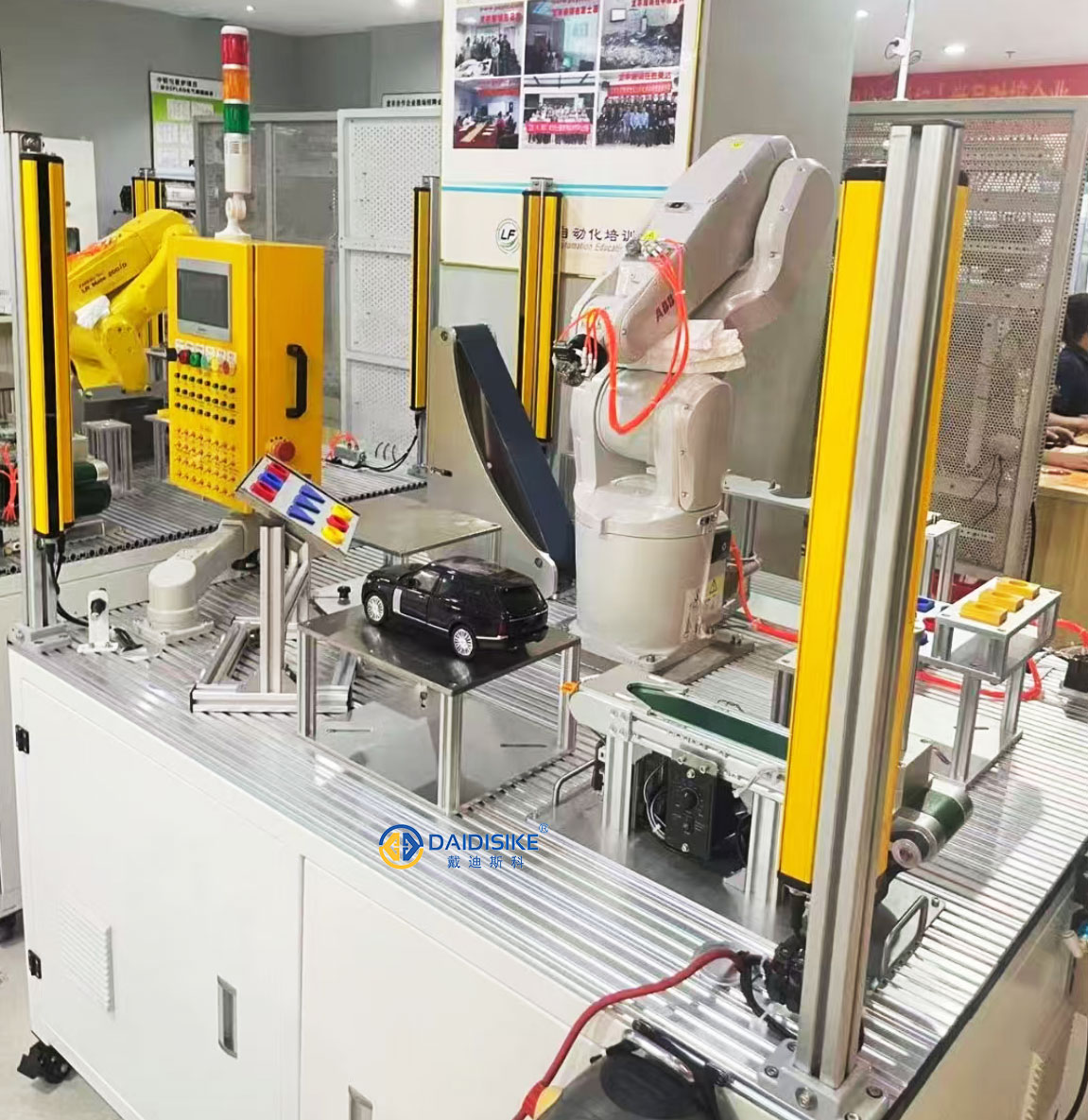
Muting vs. Blanking: Which One Does Your Conveyor System Actually Need?
A Field Engineer’s Perspective on Balancing Throughput with Human Safety.
In a high-speed warehouse or a 24/7 automated assembly line, your safety light curtain should be a silent protector, not a constant source of frustration. If your line grinds to a halt every time a product moves down the conveyor, your “safety” has become a bottleneck. At DAIDISIKE, we design our sensors with Logic Intelligence to solve this exact conflict.
Two terms often dominate technical discussions: Muting and Blanking. Choosing the wrong one is more than a technical error — it’s a choice between a dangerous safety gap or a line that refuses to stay running. Let’s break down the field-tested reality of both.
1. Muting: The “Temporary Hall Pass”
Muting is a temporary, automated suspension of the safety function. It’s designed for logistics where a pallet or vehicle must pass through the curtain without triggering a shutdown. Our DAIDISIKE DQT Series handles this by integrating with external sensors to confirm: “This is a pallet, not a person.”
The Logic Behind the BeamMuting depends entirely on the timing and sequence of signals. If the sensors are triggered in the wrong order, the system instantly defaults to safety and stops the machine. To understand the micro-timing required for these signals, explore our breakdown of how safety light curtain sensors work.
2. Blanking: The “Blind Spot” Strategy
Blanking is a different beast. It is a semi-permanent bypass of specific beams within the light curtain. If a fixed machine part or a support rail always sits in the path of the sensor, you use Fixed Blanking to “ignore” those specific points while the rest of the curtain remains 100% active.
Fixed Blanking: Ignores a static object, like a tool or a structural bar.
Floating Blanking: Allows an object of a specific size (like a moving cable or hose) to pass through the curtain anywhere, as long as it doesn't exceed the pre-set diameter.
3. The DAIDISIKE Solution: DQE & DQT4 Series
Whether you are managing a robotic welding cell or a packaging conveyor, your hardware needs to be as smart as your logic. We’ve optimized our flagship models for these specific industrial challenges:
DAIDISIKE DQE Series: The versatile workhorse. Perfect for general automation and assembly where flexibility and ease of setup are the primary goals.
DAIDISIKE DQT Series (Type 4): Our premium safety solution. These are essentially safety computers capable of processing complex muting sequences with millisecond precision to ensure your line never stops unnecessarily.
Summary: Efficiency and Safety can Coexist
Don't let “Nuisance Trips” dictate your production schedule. By correctly implementing Muting or Blanking, you protect your most valuable asset — your people — without sacrificing a single percentage of throughput. If you’re ready to upgrade your facility to a smarter, more resilient safety system, explore our full range of Safety Light Curtains.
Overwhelmed by Safety Standards? Our engineers specialize in conveyor logic and ISO compliance. We can help you configure the perfect DQE or DQT sequence for your specific facility. Consult a DAIDISIKE Expert Today →
Cost-effective side safeguarding using mirror reflection.
Frequently Asked Questions
What is the difference between muting and blanking on a safety light curtain?
Muting temporarily and automatically disables the curtain for a defined part of the cycle — for example, to let a pallet pass — then re-arms. Blanking permanently ignores one or more fixed beams so a stationary object, such as a fixture or conveyor rail, can sit in the field without tripping the curtain.
When should I use muting?
Muting suits material-transport situations where product must pass through the detection field but people must not. It relies on muting sensors arranged so that only the expected object — not a person — satisfies the muting condition. The sequence and timing must be set so the safety function is restored as soon as the product has passed.
When should I use blanking?
Blanking suits a fixed obstruction that always occupies part of the field, such as a workpiece guide or conveyor frame. Fixed blanking ignores specific beams; floating blanking allows a small moving object. Blanking reduces the effective resolution, so the safety distance may need to be re-checked.
Does muting or blanking reduce safety?
Both bypass part of the protective field, so they must be configured carefully. Incorrect muting timing or excessive blanking can leave a gap a person could exploit. Each should be applied only where the risk assessment allows, with muting sensors and timing validated and blanking kept to the minimum needed.
Does blanking affect the safety distance?
Yes. Blanking beams or allowing a floating object effectively coarsens the resolution, which increases the intrusion distance C in the ISO 13855 formula. When blanking is used, recalculate the minimum safety distance using the reduced effective resolution.