
Here is a scenario we have seen more than once. A plant buys a good Type 4 light curtain for an aging mechanical press, mounts it neatly across the point of operation, wires it through a safety relay, and considers the press “done.” It looks right. It photographs well. And it is not safe — because nobody measured how long that particular press actually takes to stop, and the curtain is mounted closer than the real stopping time allows.
Presses cause some of the most severe injuries in manufacturing: amputations, crush injuries, the kind of incident that ends careers. They also tend to be old — a stamping press can run for forty years — which means guarding them is usually a retrofit, not a clean-sheet design. This article is the retrofit checklist we walk through with engineers, in the order the work should actually happen.
Step 1 — Risk assessment, before you buy anything
The temptation on a retrofit is to skip straight to ordering a light curtain. Resist it. The risk assessment decides what kind of protection the press needs, what body parts are exposed, from which directions, during which part of the stroke, and how many people are at risk. Those answers drive every later choice — resolution, mounting, whether muting is needed, whether two-hand control should be retained. Buy hardware before the assessment and you will usually buy the wrong hardware.
Step 2 — Choose resolution from the hazard, not the catalogue
Light curtain resolution is the smallest object the curtain is guaranteed to detect. For press work the practical bands are:
| Resolution | Detects | Typical press use |
|---|---|---|
| 14 mm | Finger | Hand-fed stamping where fingers can enter the die area |
| 20-30 mm | Hand / wrist | Point-of-operation where exposure is hand, not finger |
| 40 mm+ | Limb / body | Access detection at a guarded perimeter, usually muted for feed |
For a press where the operator hand-feeds blanks and fingers can reach the die, 14 mm finger detection is the safe default. A common error is choosing a coarser resolution because it is cheaper or because the curtain can then sit further back — but resolution is a safety parameter, not a budget lever. It is set by the hazard. Whichever resolution you choose, it feeds directly into the next step, because resolution changes the minimum distance.
Step 3 — Measure the real stopping time
This is the step that gets skipped, and skipping it is what makes a tidy installation unsafe. The ISO 13855 safety distance depends on how long the whole machine takes to stop after the curtain trips — the overall system stopping performance. On an old press, that number is not on any datasheet, and even if it were, it would describe the press when it was new.
Brakes wear. Clutches slip. Hydraulic valves slow down. A press that stopped in 250 ms in 1998 may take 350 ms today. So a retrofit must include a measurement of the actual stopping time on the actual machine, in its current condition, with a stop-time measuring instrument. Measure it with the press warm and under representative conditions, and use the measured value — with margin — in the calculation, never an assumed one.
Step 4 — Calculate the safety distance (ISO 13855)
With resolution and stopping time in hand, the ISO 13855 minimum distance follows from the familiar relationship S = K × T + C: the approach speed K, the total time T (machine stopping time plus the curtain's own response time), and an intrusion-distance term C that depends on resolution. Mount the curtain any closer than S and a hand can reach the die before the ram stops — that is the failure mode this whole exercise exists to prevent.
We will not reproduce the full method here because we already have a dedicated guide; if you are doing this calculation, work through our ISO 13855 safety-distance guide alongside this article. The one point to carry over: the T in that formula is the measured stopping time from Step 3, not a hopeful estimate.
Step 5 — Monitor the stopping performance over time
Here is the uncomfortable truth about Step 3: you measured the stopping time on one day, and the press will not honour that number forever. The brake that gave you 280 ms this month will drift. And a light curtain installation, on its own, has no way of knowing.
That is what a stopping-performance monitor — often called a brake monitor — is for. It checks, cycle after cycle, that the press still stops within the time the safety distance assumed, and faults the press out before a degraded stop becomes a hazard. On a mechanical power press with a friction brake, treat it as essential. A light curtain without stopping-performance monitoring on such a press is a safety distance with an expiry date nobody is watching.
Step 6 — Handle the material feed without opening a hole
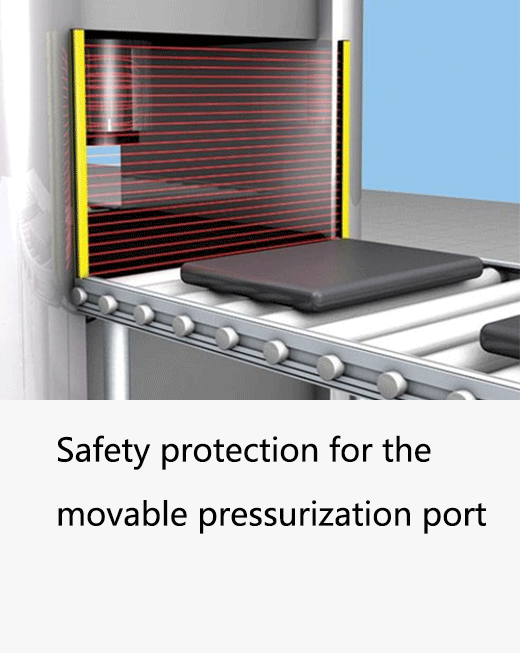
A press that is fed by a conveyor or a coil line has material crossing the curtain plane every cycle. If every passing blank tripped the curtain, the press could not run. The answer is muting — temporarily and automatically suspending the protective function while material, and only material, passes.
Muting is safe when it is designed so that the muting sensors can only be satisfied by the product, not by a person — correct sensor count, correct geometry, and a time limit on how long the mute can stay active. Muting is dangerous when it is set up loosely enough that an operator can walk through alongside the load. It is also frequently confused with blanking, which is a different function entirely. Before you design a feed pass-through, read our explainer on muting vs blanking.
A word on PSDI — and why we advise against it
Sooner or later someone on a press retrofit asks about PSDI — presence-sensing device initiation — using the light curtain itself to restart the press cycle the moment the operator withdraws their hands, with no separate start button. The appeal is obvious: it shaves a second or two off every cycle.
Our advice is to leave it alone on a retrofit unless a qualified safety engineer specifically designs and signs it off. PSDI is tightly restricted — permitted only on certain press types, heavily regulated, and dependent on the press being in excellent mechanical condition. It also removes a deliberate human action from the cycle, which removes a margin for error. On a machine that amputates, that margin is worth more than the throughput. The honest cost-benefit on most older presses does not favour PSDI.
The standards, briefly
A press retrofit answers to several standards at once: ISO 16092 for press safety specifically (with parts for mechanical, hydraulic and pneumatic presses), ISO 13855 for positioning the protective device, IEC 61496 for the light curtain as electro-sensitive protective equipment (Type 4 on a press), and ISO 13849-1 or IEC 62061 for the reliability — the Performance Level or SIL — of the complete stop function. Regional power-press regulations apply on top. Satisfy the set, not a favourite member of it.
Throughput — the part everyone actually worries about
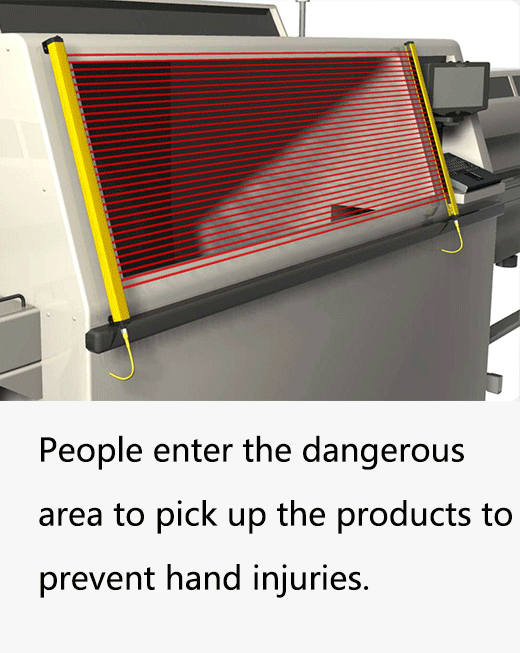
The unspoken fear behind most press retrofits is that safety will cost cycle time. In practice a well-designed light curtain retrofit often improves throughput compared with the fixed gate or interlocked guard it replaces, because the operator can load and unload with free hand movement instead of opening and closing a physical barrier. The places throughput genuinely suffers are the avoidable ones: nuisance trips from poor optical interference immunity, and a curtain mounted needlessly far back because the stopping time was never measured and a worst-case guess was used instead. Both are fixed by doing the steps above properly, not by cutting corners on safety.
Where DAIDISIKE fits
For completeness: DAIDISIKE has supplied press guarding for two decades, and stamping-press peripherals are part of our core business. The DQS press photoelectric safety guard is built specifically for point-of-operation hand protection on presses; the DQE and DQA Type 4 families cover finger and hand resolutions; and the DA31 safety relay handles the OSSD evaluation and EDM feedback. What we cannot ship in a box is the stopping-time measurement and the safety distance — those are site work, and they are the part that actually keeps the operator's hands attached. If you are planning a retrofit, our engineering team can help scope it properly.
The bottom line
The light curtain is the easy, visible part of a press retrofit. The retrofit succeeds or fails on the parts that do not photograph well: a real risk assessment, a measured stopping time, a correctly calculated ISO 13855 distance, and a stopping-performance monitor watching the brake for the next twenty years. Do those, choose resolution from the hazard, be careful with muting, and stay away from PSDI unless an expert owns it — and an old press becomes a genuinely safe machine that also runs faster than it did behind a hard guard.