
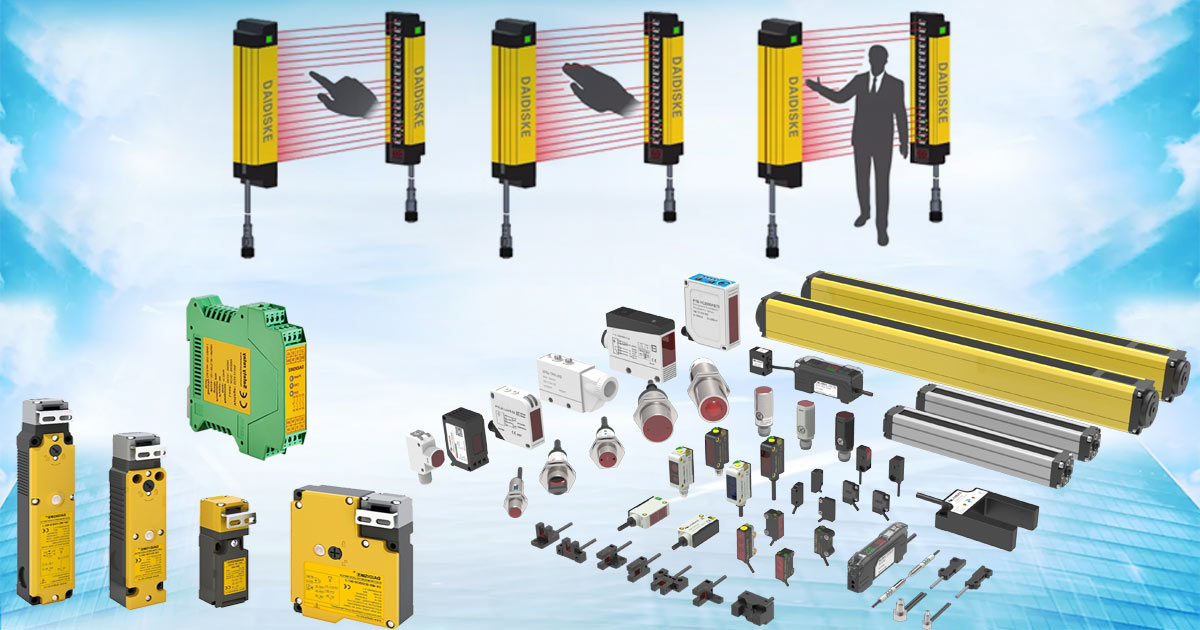
Most light-curtain selection guides start from the catalogue: pick a resolution, pick a height, done. In ceramics and glass that order is backwards. The thing that kills a sensor early in these plants is not the wrong resolution — it is dust caking the optics, water getting past a marginal seal, or radiant heat from a kiln baking the housing. So we start where the failures start: with the environment.
Why does the environment, not the feature list, decide the sensor?
Ceramics is a dust problem, glass is a heat-and-water problem, and both add a sharp-edge laceration hazard — each of those maps to an IP rating and a detection resolution before you look at anything else. Walk a tile plant and the air near the press is thick with body powder; the frit press and the dry grinding and edging stations throw fine particulate that settles on every horizontal surface, including a curtain's lenses. Walk a glass plant and you meet the opposite extremes in the same building: radiant heat off tempering furnaces and kilns, and standing water on the wash and wet-cut lines. On top of both, glass and fired ceramic edges cut — a guarding failure on a cutting or edging line is a laceration, not just a crush.
Translate that into two specifications. The IP rating answers the dust-and-water question: IP65 for a dusty press or grinding cell, IP68 for a washdown or wet line. The detection resolution answers the hazard question: finger (~14 mm) or hand (~30 mm) at a press point of operation, coarser (40 mm+) only for arm/body detection at a perimeter. Get those two right for the environment and the rest of the selection — height, range, outputs — falls out cleanly.
What IP rating and curtain suit a dusty ceramic tile or frit press?
Specify at least IP65 so settled dust does not cause nuisance trips, and a finger or hand resolution sized to the opening; the DAIDISIKE MK is the IP65 dust-sealed curtain for these cells. A ceramic tile press, a frit press and a dry grinding or edging machine all share the same problem: fine powder in the air that, over weeks, films the optical windows. IP65 means the housing is dust-tight and tolerates the low-pressure wash-downs used to clean the cell, which is what keeps a curtain working as dust accumulates. The DAIDISIKE MK (IP65) is built for exactly this dusty press and grinding duty.
At the point of operation, the DQC Type 4 hand-guard and the DQA (10–30 mm finger/hand) cover the operator's reach into a frit or tile press. A practical note on dust: do not over-specify a fine finger resolution where only hands can reach, because the finer the resolution the more sensitive the curtain is to a film of dust on the lenses. Match resolution to the real opening, leave range margin, and put lens cleaning on the maintenance schedule — that combination, not a higher IP number alone, is what stops dust-induced false trips.
How do you guard a wet glass wash or cutting line?
Standing water and regular wet cleaning justify stepping up from IP65 to IP68; the DAIDISIKE DQR is the IP68 outdoor/washdown curtain for wet glass wash and cut lines. A glass wash line and a wet cutting or scoring line expose the curtain to spray, splash and routine wash-down that an ordinary IP65 housing will eventually let past. The DAIDISIKE DQR is listed as an IP68 outdoor/washdown safety light curtain, built for wet glass handling and for rugged outdoor exposure where moisture would work into a lesser seal over time. Size its resolution and protective height to the opening you are guarding, and re-check the ISO 13855 distance for that resolution.
The sharp-edge angle matters here. On a glass cutting, scoring or edging line the consequence of an unguarded reach is a laceration, so the access guarding has to be reliable presence sensing, not a simple gate that can be propped open. A Type 4 curtain at the operator interface, plus a non-contact coded switch on any access door, gives you a safety circuit that fails safe. For the deeper sealing-level background — what IP65, IP67 and IP69K really protect against in dust and mist — see our IP sealing-level and window-protection guide.
Curtain or scanner: which for robot loading and palletizing on a glass line?
A curtain wins at the human point of operation for finger/hand detection and short response time; a safety laser scanner wins for horizontal area and perimeter guarding of robot loading and palletizing, where layout flexibility matters. A vertical light curtain protects a defined plane — the opening an operator reaches through. That is the right tool at a glass loading machine's manual feed point. But a robot loading a tempering furnace, or a palletizing station stacking finished panels, is approached across a floor area, sometimes from more than one side. A horizontal safety laser scanner covers that floor with programmable warning and stop fields and adapts to an irregular layout that a flat curtain plane cannot.
DAIDISIKE supplies both halves so you do not have to mix vendors across one cell. For area and perimeter guarding the DLD05A3 (5 m) and DLD20A5 (20 m) LiDAR, DLD30T-5N (40 m) and SDLD-05A (14 m TOF) watch the floor of a robot loading or palletizing cell, while the DQSA area curtain and the DQC/DQA curtains guard the human load point. The same curtain-versus-scanner trade-off, worked through for perimeter and area protection generally, is covered in our light-curtain selection guide.
How do you set the ISO 13855 safety distance for a press curtain?
Use S = K × T + C: K is the approach-speed constant (1600 or 2000 mm/s), T is the full chain response time including machine stop time, and C is the resolution-dependent intrusion term — so a coarser curtain mounts further back. Detection resolution does double duty in ceramics and glass: it sets whether you are catching fingers or hands, and it sets the C term in the ISO 13855 formula. A finger curtain (~14 mm) can sit closer to the hazard than a hand curtain (~30 mm). T must include the real machine stopping time — on a hydraulic press that means a stop-time measurement, not a catalogue figure — plus the curtain's response time and the relay's reaction. DAIDISIKE publishes a dedicated ISO 13855 safety distance calculator for this; run it every time you fix or change a resolution.
Which DAIDISIKE device fits which ceramics or glass station?
Match the station to the environment column first, then the resolution column — the device follows. This table is a starting map; confirm resolution, protective height and range against the machine and a fresh ISO 13855 calculation.
| Station / machine | Dominant stress | What to detect | DAIDISIKE fit |
|---|---|---|---|
| Ceramic tile / frit press point of operation | Heavy dust | Fingers / hands (~14 / 30 mm) | DQC, DQA; MK (IP65) for dusty housing |
| Dry grinding / edging cell | Dust + sharp edge | Hands at access opening | MK (IP65) curtain + DX-R1 door switch |
| Glass wash / wet cutting line | Water / washdown | Hands at operator interface | DQR (IP68 washdown) |
| Glass loading machine (manual feed) | Sharp edge | Hands at the feed plane | DQC / DQA, with muting/blanking as needed |
| Tempering furnace robot loading cell | Heat (keep sensor off furnace mouth) | Person on the floor area | DLD/SDLD LiDAR or DQSA area curtain |
| Palletizing / unloading station | Wide perimeter | Person crossing perimeter | DLD20A5 (20 m) / DLD30T-5N (40 m) LiDAR |
| Access doors / furnace-door interlock | Heat / access | Door open / closed | DX-R1 coded switch + DA31 relay |
One honest framing point about heat. Glass plants have real high-temperature zones near kilns and tempering furnaces, and the right engineering answer is usually to keep the optical safety device out of the direct radiant field — guard the human approach where the sensor can live, not at the furnace mouth. We describe the DQR strictly as its listed IP68 outdoor/washdown rating; we do not publish a wide-temperature number for it because that is not how it is specified. Where heat is the dominant constraint, the design fix is placement and shielding, plus a coded door interlock on the furnace door, not a claimed temperature spec.
What standards and what safety circuit pull this together?
Type 4 to IEC 61496-1/-2, PL e to ISO 13849-1, distance to ISO 13855, with OSHA presence-sensing guidance and ANSI B11.2 for hydraulic presses — closed by a DA31 relay and a DX-R1 coded switch. A presence-sensing safeguard on a ceramic or glass press is a Type 4 device (IEC 61496-1/-2), rated PL e to ISO 13849-1 and mounted at the ISO 13855 distance. For US press operators, OSHA's presence-sensing device guidance and ANSI B11.2 for hydraulic presses set the expectation. The curtain's dual-channel OSSD outputs feed a safety relay with external device monitoring (EDM) that drops the machine's contactors; DAIDISIKE pairs its curtains with the DA31 relay (PL e / SIL3). Access and furnace doors close out on the DX-R1 (ISO 14119 Type 4 coded) non-contact switch in the same circuit. Validate the whole chain to the required PL — the curtain alone is not the safety function.
How does DAIDISIKE compare with SICK, Keyence, Banner, Pilz and the rest?
The premium brands set the reference; DAIDISIKE is the Chinese OEM/ODM route — MOQ 1 set, 3–15 day lead, CE / IEC 61496 / ISO 9001 with TUV per order — for ceramics and glass OEMs and integrators watching unit cost. Plants in this sector evaluate against the established safety brands: SICK (deTec, S3000 safety laser scanner), Keyence (GL-R light curtain, SZ-V scanner), Banner Engineering (EZ-SCREEN, SX5 series), Pilz (PSENopt II), Leuze (MLC light curtains, RSL scanner), Omron (F3SG-R), plus Contrinex, Datasensing (Datalogic), Schmersal (SLC), ReeR, IDEC (SE2L) and Hokuyo (UAM) scanners. We reference these by name for honest comparison only — there is no partnership implied, and we do not quote their specs beyond what they publish.
DAIDISIKE's position against that field is straightforward: founded 2013, a 3000 m² factory exporting to 20+ countries, a minimum order of one set and a 3–15 day lead, carrying CE (self-declared), IEC 61496 and ISO 9001, with TUV testing arranged per order. For a ceramics or glass machine builder who needs both curtains and area scanners at a workable unit cost and a short lead, that combination — cost, low MOQ, fast turnaround, and one supplier for both the curtain and the LiDAR — is the case. For the wider brand-by-brand cross-reference, see the brand replacement & compatibility hub.
How do you add presence sensing to an existing ceramic press (PSDI)?
Retrofitting a presence-sensing device to an older press means sizing the curtain to the opening, measuring the real stop time, placing it at the ISO 13855 distance, and validating the relay/EDM chain — not just bolting a curtain on the front. Older ceramic presses were often guarded with fixed barriers or two-hand controls. Adding presence-sensing safeguarding (in some modes, PSDI — presence-sensing device initiation) lets the operator load and the press cycle without a physical gate, but it puts the whole burden on the safety chain being correct. Pick the resolution the opening needs, keep IP65 margin for the dust, measure the press stop time, compute the ISO 13855 distance, and prove the curtain → DA31 relay → contactor chain meets the required PL. Send us the press type, the opening dimensions and the measured stop time and we will spec the curtain, relay and switch as a set.
Guarding a ceramics or glass machine? Send us the station and the environment.
Tell us the machine, the opening, the stop time and whether the cell is dusty or wet, and our engineers will return a matched curtain, scanner, relay and switch set. Call or WhatsApp +86 15218909599 or use the contact page.
Standards & references
- IEC 61496-1 / IEC 61496-2 — electro-sensitive protective equipment; Type 4 light curtain requirements.
- ISO 13849-1 — safety-related parts of control systems; Performance Level (PL e) rating.
- ISO 13855 — positioning of safeguards with respect to approach speeds; S = K × T + C.
- ISO 14119 — interlocking devices associated with guards (coded non-contact switches).
- OSHA 29 CFR 1910.217 presence-sensing device guidance; ANSI B11.2 for hydraulic presses.