Brazilian buyers arrive here from a few clear directions: bringing a machine into adequacao NR-12; pricing a cortina de luz de seguranca NR12 for a press or packaging line; looking for an equivalente / similar / compativel alternative to SICK, Schmersal, Pizzato or Pilz they already run; scoping AGV scanner protection; or doing the INMETRO and custo-Brasil homework before importing from China. This guide answers all of those in order — with NR-12 as the spine, honest certification limits, and no invented local presence.
Why is NR-12 the engine of Brazil's safety-sensor demand?
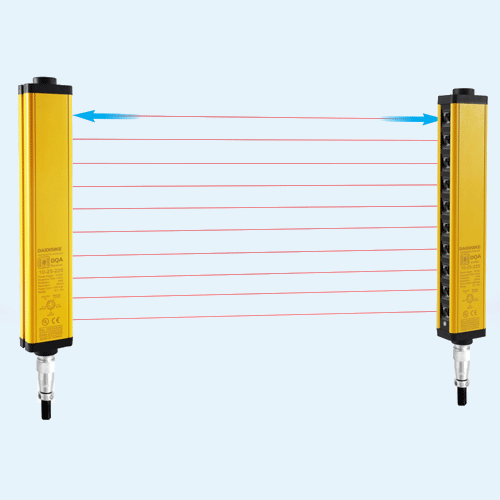
NR-12 turns machine guarding from a nice-to-have into a legal obligation with teeth — that is the whole demand story. NR-12 (Norma Regulamentadora 12, “Seguranca no Trabalho em Maquinas e Equipamentos”) is Brazil's mandatory machinery-safety regulation, enforced by the Ministry of Labour (MTE), and it is compulsory for both new AND used machinery in operation — not only imports, and across every sector. It is the functional equivalent of ISO 12100 + the EU Machinery scope, structured as a main text plus equipment-specific Annexes (Annex I optoelectronic detectors and safety distances; Annex VIII presses; and so on), and it explicitly recognizes cortinas / barreiras de luz (light curtains), rele / interface de seguranca (safety relays and controllers), comando bimanual (two-hand controls), intertravamento / bloqueio (interlock and guard-locking switches) and paradas de emergencia (e-stops) as protective devices.
The enforcement is what makes the demand non-discretionary. A fiscalizacao do trabalho inspector who finds serious and imminent risk can order immediate interdiction (interdicao) of the machine, the sector, or the whole establishment until the irregularity is fixed. Fines are defined under NR-28 and scale by infraction severity, the number of exposed workers, company size and recidivism; and on an accident the company and its managers can face civil and criminal liability (culpable bodily harm or homicide). For a plant manager, that converts a safety-sensor purchase from discretionary capex into risk mitigation — which is precisely why DAIDISIKE supplies the curtain + relay + guard-locking stack as one factory-direct kit.
Who is buying — and in which Brazilian industries and regions?
The heaviest NR-12 demand sits in the automotive-and-metalworking corridor, agribusiness packaging, and steel — concentrated in the SP / MG / RS axis. Automotive is the flagship: VW, GM, Fiat/Stellantis and Toyota across Sao Paulo, Minas Gerais and Rio Grande do Sul, with Stellantis' Betim (MG) the country's largest auto plant (~800,000 vehicles/yr) and BYD starting EV assembly at Camacari (BA) in July 2025 (~150,000 units/yr initial). Stamping/press shops, welding and body lines drive heavy comando bimanual + light-curtain + guard-locking demand. Steel & metalworking — ArcelorMittal Brasil (the largest producer), Usiminas (~28% of national output, MG), CSN (Volta Redonda, RJ) and Gerdau — make press/fabrication a core NR-12 target.
Beyond metal: food & beverage / agribusiness packaging (Brazil's packaging market is large and growing, with food makers a big share of demand) drives filling, palletizing and conveyor lines — the classic muting application. Plastics (injection molders), mining, appliances and electronics are also explicitly named NR-12 machine categories, and intralogistics / AGV & AMR adoption in automotive, F&B and e-commerce is a growing vector for area safety LiDAR. The main industrial zones: Greater Sao Paulo / the ABC Paulista (Santo Andre, Sao Bernardo, Sao Caetano) and the Campinas metro; Minas Gerais' “Steel Valley” (Ipatinga) plus the Betim auto cluster; Volta Redonda (RJ); Rio Grande do Sul and the South; Camacari (BA); and the Manaus Free Trade Zone (electronics, two-wheelers, polymers, metallurgy).
| Region / cluster | Dominant sectors | Heaviest NR-12 safety-sensor demand |
|---|---|---|
| ABC Paulista / Greater Sao Paulo / Campinas | Automotive, auto-parts, general assembly | Light curtains, comando bimanual, relays (press, body-shop) |
| Minas Gerais (Betim auto + Steel Valley) | Auto (Stellantis Betim), steel (Usiminas) | Press guarding, guard-locking, two-hand control |
| Volta Redonda (RJ) | Steel (CSN), metalworking | Curtains, interlocks, position sensing |
| Rio Grande do Sul / South | Steel (Gerdau origin), agribusiness, auto export | Light curtains, relays, muting (packaging) |
| Camacari (BA) / Manaus FTZ | EV (BYD), electronics, two-wheelers, polymers | Curtains, proximity sensors, robot-cell guarding |
Plant, capacity and market figures above are published context (TÜV Rheinland / Mordor Intelligence / company disclosures) describing the demand backdrop — not DAIDISIKE projections, and not a Brazil-specific unit-demand figure for safety sensors, which is not separately published. 2025/26 plant news (BYD Camacari) should be read as initial, not fully-ramped, capacity.
What does an NR-12 light curtain cost in Brazil — and where does factory-direct fit?
Branded NR-12 barriers carry a real premium through the Brazilian channel, and custo-Brasil stacks taxes on top; factory-direct removes the importer/distributor margin layer. As published Brazilian retail/marketplace anchors, NR-12 Category-4 light curtains run roughly: an entry EOS4-class unit ~R$2,840; a 195 mm 4-beam barrier ~R$5,174–5,390; and a 1000 mm 24-beam curtain ~R$4,713–6,558. Those are retail listings used only as a benchmark ceiling — not a DAIDISIKE quote and not wholesale. DAIDISIKE sits deliberately in that gap: branded-grade Type 4 / PL e / Cat.4 at China factory-direct price, quoted FOB China. We will not publish a fixed percentage undercut — your landed BRL depends on freight, the II / IPI / ICMS for your NCM and your despachante — but the structural saving is the distributor margin you stop paying.
| Channel (Brazil) | Price reference (benchmark) | What it is | Where DAIDISIKE sits |
|---|---|---|---|
| Retail / marketplace (anchor) | ~R$2,840 (entry) to ~R$6,558 (1000 mm 24-beam) | NR-12 Cat.4 light curtains, retail listings | Same class, factory-direct |
| SICK / Schmersal / Pizzato / Pilz | Premium (distributor + local support) | Genuine Type 4 / Cat.4, local stock | Like-for-like, lower cost |
| Schmersal (made-in-Brazil, Boituva) | Premium + “a pronta entrega” | Local production, short lead | Trades local stock for landed price |
| DAIDISIKE (FOB China) | Quoted per configuration, MOQ 1 | Type 4 / PL e / Cat.4, IEC 61496 | Factory-direct, MOQ 1 set |
The BRL figures are published Brazilian retail listings used as a price anchor, not DAIDISIKE quotes and not wholesale; we quote your exact configuration FOB and supply the export documents your despachante aduaneiro files for clearance.
Who supplies safety sensors in Brazil — and how is buying factory-direct different?
The channel is owned by entrenched incumbents with real local presence; that is the wall, and the white-space is landed price + MOQ. Schmersal has the deepest footprint — ACE Schmersal manufactures locally at Boituva (SP) with about 500 staff, producing safety switchgear, interlocks and proximity switches, and actively markets NR-12 content plus a “made-in-Brazil” lead-time edge. SICK Brasil employs about 135 people and leads sensing and machine-safety with a broad distributor net. Pizzato Elettrica reaches Brazil through its official distributor Techno Safe (with KAP repping in Santa Catarina), strong in guard-locking for NR-12. Omron, Banner, Pilz, Leuze, ifm, Pepperl+Fuchs and the domestic Brazilian maker WEG (heavily trusted locally) round out the field.
DAIDISIKE is the factory itself — a China-based manufacturer (est. 2013, exporting to 20+ countries) selling direct. We do not operate a Brazilian office, warehouse or appointed distribuidor; you import as the Importer of Record under your own CNPJ and Habilitacao no RADAR (Siscomex). Chinese factory-direct brands are largely absent from the formal distributor channel, so the honest pitch pairs the price/MOQ advantage with what Brazilian buyers actually value — verifiable Type 4 / PL e / Cat.4 compliance, clean export documentation for conformity, and application support — because the incumbents' real edge is local stock (a pronta entrega) and the engineers behind it. Realistic partners for a factory-direct line are the NR-12 integrators and distributors that already source on custo-beneficio.
What is a good alternative to SICK, Schmersal, Pizzato or Pilz that keeps the safety class?
A like-for-like device matched on the numbers that define the part — not a downgrade. Brazilian engineers tend to search by brand first, then add similar, equivalente, substituto or compativel com. For light curtains they benchmark SICK (deTec / C4000), Banner, Omron, Pilz and Leuze; for safety relays, Pilz PNOZ; for guard-locking, Schmersal AZM and Pizzato. To swap a curtain safely, line up resolution (14 mm finger or ~30 mm hand), protective height, sensing range and output/OSSD type, and a DAIDISIKE DQC / DQA / DQT4 drops into the same ISO 13855 (transposed via ABNT NBR ISO 13855) safety-distance envelope — same IEC 61496-1/-2 and ISO 13849-1 PL e / Cat.4 architecture, dual-channel OSSD, EDM.
| Brand / series (Brazil) | Type | Class | DAIDISIKE like-for-like |
|---|---|---|---|
| SICK deTec / C4000 | Light curtain | Type 4 | DQT4 (Type 4 / PL e) |
| Banner / Omron / Leuze | Light curtain | Type 4 / Type 2 | DQC · DQA (10–30 mm) · DQT4 |
| Pilz PNOZ | Safety relay | Cat.4 / PL e | DA31 / DA31-B (PL e / SIL 3) |
| Schmersal AZM | Guard-locking switch | ISO 14119 | DX-W2 / DX-W5 (up to 1300 N) |
| Pizzato (interlock) | Interlock / coded switch | ISO 14119 | DX-R1 coded magnetic · DX-series |
| Pepperl+Fuchs / ifm | Inductive proximity | Position (not safety) | M8 / M12 / M18 / M30 inductive |
Every brand name above is used nominatively for comparison from public knowledge — no partnership or endorsement is implied, and we never quote a competitor parameter we can't verify. For full model-by-model maps, see the Pilz PNOZ relay alternatives and Pizzato / guard-locking alternatives pages.
Power press & stamping under NR-12: can I even use a light curtain?
This is the single most important NR-12 nuance — and getting it wrong is a compliance and safety failure. NR-12 Annex VIII allows a press point-of-operation to be safeguarded by a “light curtain with redundancy and self-test, monitored by a safety interface” combined with two-hand control, and Annex VIII item 2.1.3 requires that interface de seguranca to be Category 4 per ABNT NBR 14153 (i.e. Cat.4 / PL e). But where the safe stopping of the ram cannot be guaranteed given the press speed and response time, light curtains alone are NOT permitted to protect the point of operation. In that case the correct route is two-hand control (comando bimanual) plus guard interlocking / guard-locking (intertravamento com bloqueio) — and the integrator's risk assessment decides which route your specific press takes.

Where a curtain is permitted, resolution selection comes first: a 14 mm-resolution curtain for finger protection at the point of operation, or a ~30 mm curtain for hand detection. NR-12 Annex I Table IV sets the intrusion constant C by resolution (≤14 mm → C=0; >14–20 mm → C=80 mm; >20–30 mm → C=130 mm; >30–40 mm → C=240 mm; >40 mm → C=850 mm), and the mounting distance follows ISO 13855: S = (K·T) + C with K=2000 mm/s for normal/vertical approach and K=1600 mm/s for horizontal approach. DAIDISIKE's DQA covers 10–30 mm finger/hand; DQC and DQT4 cover Type 4 hand guarding up to PL e.
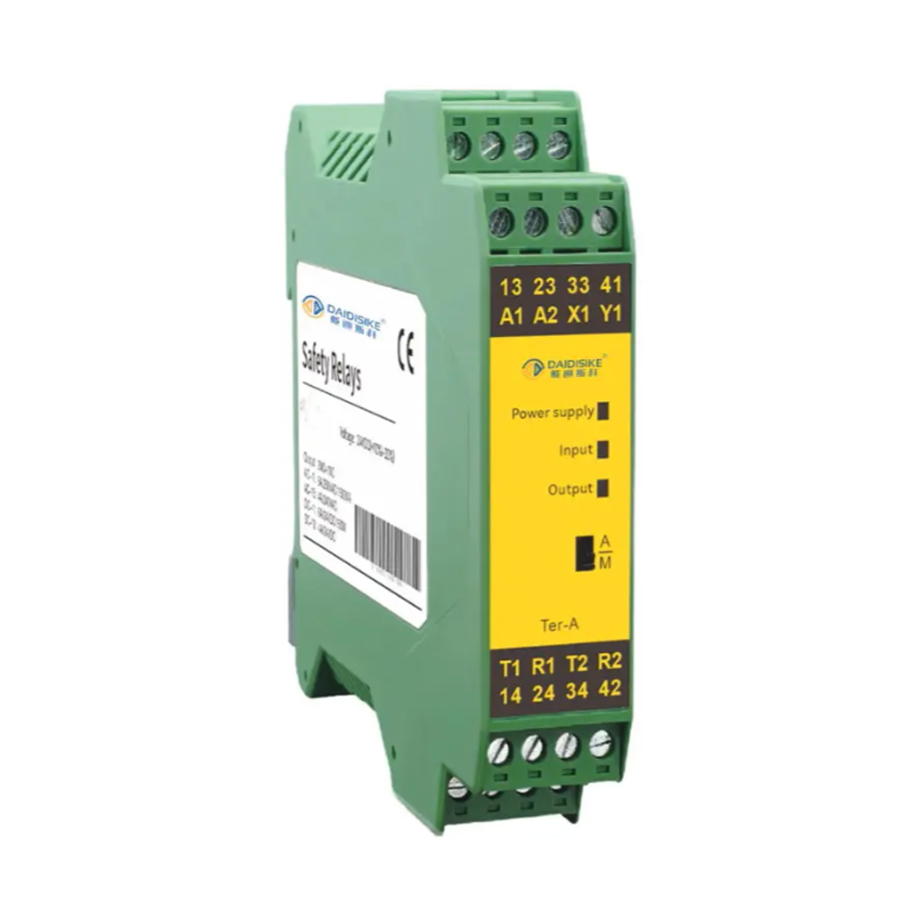
Close the circuit with a DA31 safety relay (rele de seguranca, PL e / SIL 3, force-guided contacts, EDM, <30 ms) so the stop command is itself control-reliable — exactly the Cat.4 interface de seguranca that Annex VIII item 2.1.3 demands. See our ISO 13855 safety-distance guide for the calculation that backs the mounting.
Packaging & palletizing: how does muting fit NR-12?
On agribusiness and F&B end-of-line, the light curtain has to let pallets and product pass without stopping the line — that is muting. A palletizer or conveyor infeed needs a body-presence curtain that the control system temporarily and automatically bypasses (muting) while a recognized pallet or carton passes, then re-arms — without ever leaving the operator unprotected. The muting sensors must be arranged so a person cannot trigger the bypass; the sequence below shows the standard arrangement.

AGV & AMR intralogistics: which scanner, and how should I position it?
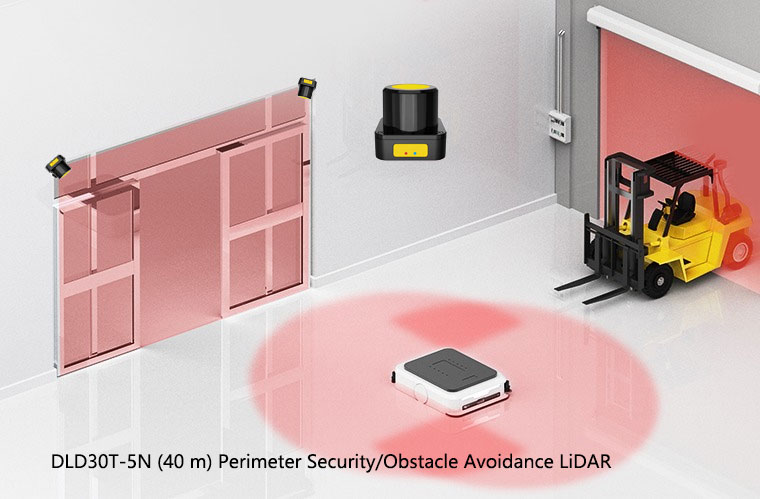
Brazil's nearshored-into automotive and F&B plants are adding AGV/AMR fleets — and area scanning is what protects a mobile robot. DAIDISIKE's DLD-series projects a 270-degree field with self-learning 16-zone groups: DLD05A3 (5 m), DLD20A5 (20 m) and DLD30T (40 m perimeter). One honest caveat for Brazil: these are published as obstacle-avoidance / automation LIDAR, not as a certified Type-3 safety laser scanner — so position them for AGV/AMR navigation, area and perimeter zone guarding, and pair the certified safety function (e-stop, guard monitoring) through the DA31 and Type 4 curtains. Where a buyer needs a certified ESPE safety function on the vehicle, that is a separate device class; we will not overstate the DLD's rating.
Can I import safety sensors from China to Brazil — MOQ, ports, and Incoterms?
Yes — and the MOQ objection is backwards: ours is 1 set, with a 3–15 day lead. Order a single sample, validate it against your ISO 13855 distance, fit-check brackets and OSSD wiring, then repeat at volume. The main gateway is the Port of Santos (Brazil's largest), with Paranagua, Itajai/Navegantes and Itaguai as alternatives; cited ocean transit China→Santos is roughly 30–45 days port-to-port (transshipment longer), and end-to-end with inland trucking and customs clearance is realistically 45–60 days, so build a buffer into NR-12 retrofit schedules.
The Incoterms reality matters here. DDP is generally not workable for commercial Brazilian imports, because Brazil requires a locally-registered Importer of Record holding a RADAR / Habilitacao (Siscomex) license to pay duties/taxes to Receita Federal from a Brazilian bank account. So a Chinese seller quotes FOB (China port) or CIF (Santos), with you — the Brazilian buyer — clearing import via a licensed despachante aduaneiro. The predominant payment methods for first orders are documentary Letters of Credit (L/C) and bank documentary collections; open account or cash-in-advance come later, once trust is established.
INMETRO, custo-Brasil taxes & NR-12 dossier — the import questions to settle first
Three things gate a clean import: INMETRO conformity, the II/IPI/ICMS tax math, and the NR-12 documentation your integrator owns. On INMETRO: it is Brazil's national conformity body, and many electrical/electronic/industrial categories must carry the Selo INMETRO conformity mark after testing by an accredited lab and certification body (TÜV SÜD, TÜV Rheinland, UL Solutions, DNV, Nemko) — non-conforming goods can be detained or rejected at port. An important honest qualifier: Portaria 179/2010 (now 115/2022) is the mandatory certification scheme specifically for explosive-atmosphere (Ex) equipment, NOT a blanket rule for ordinary safety light curtains. Whether a specific general-purpose safety-sensor SKU falls under a mandatory INMETRO program — versus being covered by NR-12 conformity at the point of use — depends on the product family and the current program list, so verify with an accredited certification body (OCP) for your exact HS/product. DAIDISIKE does not hold and does not claim an INMETRO mark; we supply the technical file (CE self-declared to IEC 61496, ISO 9001, TÜV per order) to support your certification or your broker's classification.
On custo-Brasil taxes: Brazil layers Imposto de Importacao (II, the import duty set by the Mercosur common external tariff for your NCM, typically 10–35% on CIF), IPI (federal excise, 0–15%), PIS/COFINS-Importacao and state ICMS (~17–19%+). They compound cascadingly — IPI on CIF+II, ICMS on CIF+II+IPI+itself (“por dentro”) — so the effective landed-tax burden is substantially higher than any single headline rate, and the exact II/IPI depends on the 8-digit NCM classification of the specific sensor. We will not print a fixed duty % or NCM on this page: confirm the precise NCM, II/IPI and your state's ICMS per SKU with a Brazilian customs broker, and note Brazil has been adding antidumping/extra tariffs on some Chinese goods and is mid-transition on indirect-tax reform (CBS/IBS), so treat any rate as time-sensitive.
On the NR-12 dossier: remember that NR-12 compliance is a system-level outcome — risk assessment (apreciacao / laudo de risco) + correct PL/Category + verified ISO 13855 safety distance + Portuguese documentation — owned by the integrator/OEM, not a property of any DAIDISIKE component. We supply the curtain (IEC 61496 Type 4), the relay (Cat.4 / PL e), the comando-bimanual logic and the guard-locking (ISO 14119) stack; your team owns the laudo and the conformity assessment on the actual machine.
What else does DAIDISIKE supply into Brazil — switches, proximity, full circuit?
The whole NR-12 safety circuit from one factory — curtains, safety LiDAR, relays, coded/guard-locking switches and proximity sensors. A curtain rarely ships alone, and each line has its own Brazilian “fornecedor / cotacao / orcamento” search demand. The DLD-series scanner a laser de seguranca above handles AGV/AMR and perimeter; the DA31 / DA31-B rele de seguranca closes the stop loop as the Cat.4 interface; the DX-R1 coded magnetic switch and DX-W2 / DX-W5 guard-locking chaves de seguranca com intertravamento (holding force up to 1300 N, positive-break NC, IP67, ISO 14119) handle portas de protecao; and inductive proximity sensors (sensor de proximidade indutivo) in M8/M12/M18/M30 (NPN/PNP, NO/NC, IP67/IP68) cover position and index sensing — note proximity switches are standard position sensors, not safety-rated. All factory-direct from the same supplier, MOQ 1 set.
Send the four numbers off your press or line — resolution (14 mm finger / 30 mm hand), protective height, sensing range, output/OSSD type — plus quantity, whether the press route needs comando bimanual + guard-locking instead of a curtain, and whether you want FOB or CIF Porto de Santos, and we'll return a firm quote, a 3–15 day lead, and the export documents your despachante needs for clearance. Sample at MOQ 1 set.
Contact DAIDISIKE → | Phone / WhatsApp +86 15218909599 · 915731013@qq.com
Sources & references
- DAIDISIKE — DQC Type 4 safety light curtain and the DQA finger/hand model — published resolutions and OSSD interface.
- IEC 61496-1/-2/-3, ISO 13849-1 (PL) and ISO 13855 — the standards that fix Type 4 architecture, PL e and the safety-distance calculation; ISO 14119 for guard-locking. NR-12 references these via ABNT NBR 14153 and ABNT NBR ISO 13849-1.
- NR-12 (Norma Regulamentadora 12) — mandatory machine-safety regulation enforced by the MTE; Annex I (optoelectronic detectors / Table IV) and Annex VIII (presses, two-hand control, Cat.4 interface). Confirm your machine's risk assessment (laudo) with your safety responsible; sources: TÜV Rheinland, braziliannr.com, adequada.eng.br.
- INMETRO — mandatory conformity mark; Portaria 179/2010 (115/2022) covers explosive-atmosphere equipment specifically. Confirm the exact program for your SKU with an accredited OCP (TÜV SÜD / UL Solutions / DNV); sources: TÜV SÜD, Novatrade Brasil.
- Import mechanics — Port of Santos, FOB/CIF, RADAR/Siscomex, Receita Federal, II/IPI/PIS-COFINS/ICMS cascading on CIF, 8-digit NCM; documentary L/C. Confirm the live NCM and duty with your despachante; sources: Santander Trade, US Commercial Guide.
- Brazil market & sectors — automotive (Stellantis Betim, BYD Camacari), steel (Usiminas, CSN, Gerdau, ArcelorMittal), packaging market, ABC Paulista; treated as published context, not DAIDISIKE figures.
- Incumbent channel — ACE Schmersal (Boituva, SP), SICK Brasil, Pizzato via Techno Safe / KAP, plus Omron, Banner, Pilz, WEG, Leuze. Retail BRL light-curtain figures are published Brazilian marketplace listings used only as a benchmark ceiling, not DAIDISIKE quotes.