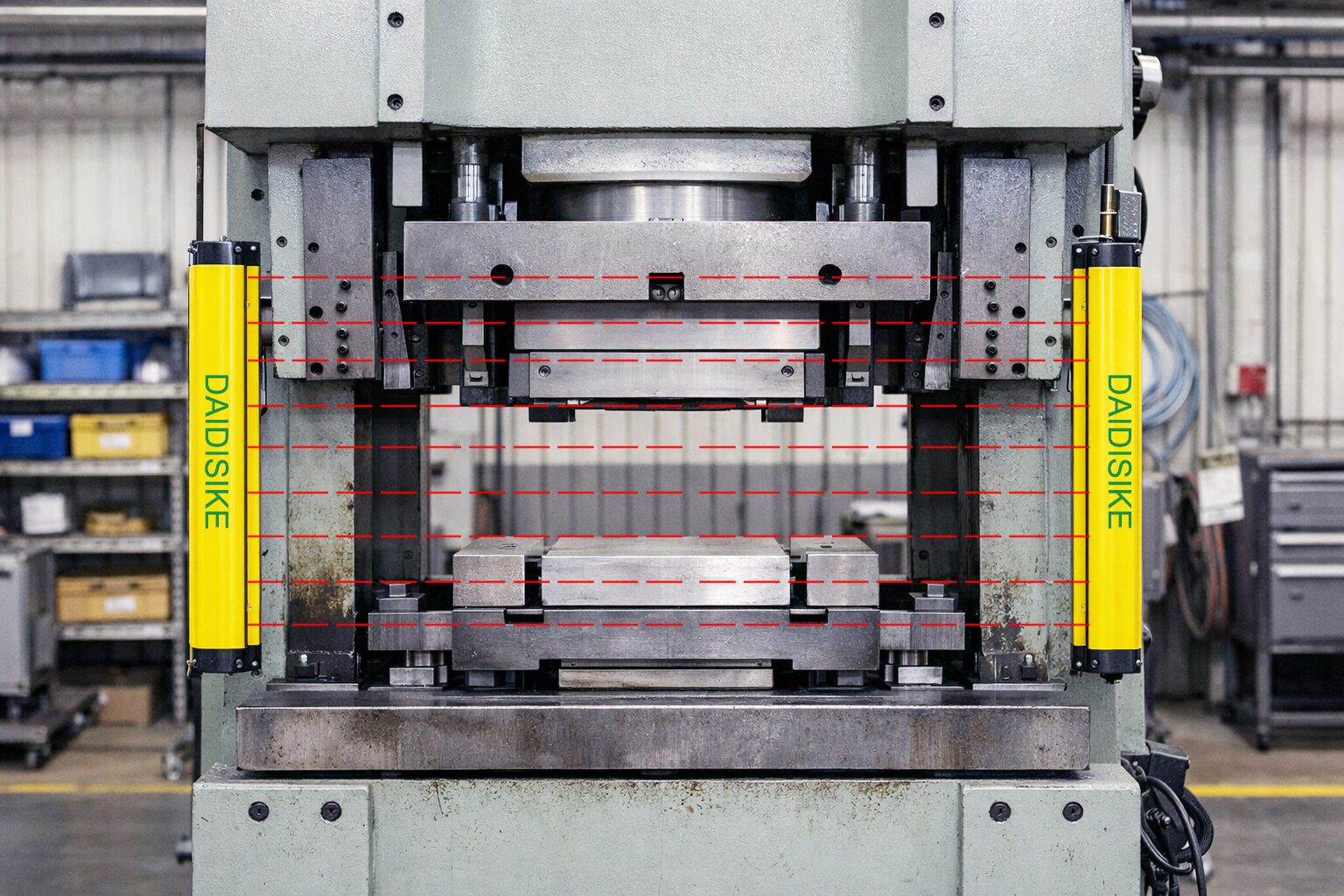
A customer called us last month with a question that, three years ago, nobody was asking: “Can your DQA curtain push its beam-attenuation history to our InfluxDB instance over OPC-UA every fifteen minutes?” The answer turned out to be “yes, with caveats”, but the more interesting thing was the question itself. Five years ago, a safety light curtain was a sensor with two OSSD outputs and a feedback wire. Today it's increasingly a node on an industrial network, and the spec sheet is starting to look very different.
We've spent the better part of 2025 watching three things converge: OPC-UA over TSN graduating from trade-show demos into actual production lines (most visibly at the German automotive OEMs), IO-Link Safety hitting commercial availability with master modules from Balluff, ifm, and Murrelektronik, and on-device diagnostic firmware getting good enough that maintenance teams can predict lens fouling before it triggers a nuisance trip. None of these are radically new technologies on their own. The interesting part is how they're collectively redefining what an engineer should actually look for on a safety light curtain datasheet in 2026.
The shift, in one sentence
The safety controller used to be the brain. The sensor was a dumb input. That asymmetry is now collapsing — modern light curtains carry meaningful compute, retain history, and speak digital protocols natively. The safety relay still exists (it must — you can't certify a safety function without one), but it's no longer the only place where intelligence lives in the loop.
The practical consequence for buyers: the questions you ask vendors have to change. “What's the response time?” and “What's the IP rating?” still matter, of course. But if those are the only questions you ask in 2026, you're buying a 2018 spec sheet at 2026 prices.
1. OPC-UA over TSN: real, but uneven
OPC-UA Safety as a specification was ratified by the OPC Foundation in 2021. The real-world rollout has taken until late 2025 to gain measurable traction, mostly because TSN (Time-Sensitive Networking) required new Ethernet hardware that wasn't cheap and wasn't backward compatible. The 2025 shift was hardware: the big PROFINET stack vendors (Siemens, Beckhoff, B&R) now ship TSN-capable safety I/O blocks at price points that compete with conventional ProfiSafe modules.
What this means for a light curtain: certain safety controllers can now talk to the curtain over Ethernet using a single deterministic protocol that's vendor-neutral. You're no longer locked into “PROFIsafe means Siemens, CIP Safety means Allen-Bradley, Safety-over-EtherCAT means Beckhoff.” The same curtain can theoretically work with all three brands if it speaks OPC-UA Safety.
We say theoretically because the implementation reality is still messy. The certified safety-function profile that a curtain ships with has to match what the controller expects, and getting both ends of that handshake right is non-trivial. As of mid-2026, we're seeing OPC-UA Safety adoption in maybe 5-10% of new greenfield installations — primarily in German automotive and semiconductor fabs that already standardized on the technology. For brownfield retrofits, ProfiSafe over PROFINET remains the default and probably will through 2028.
2. IO-Link Safety: less hype, more practical
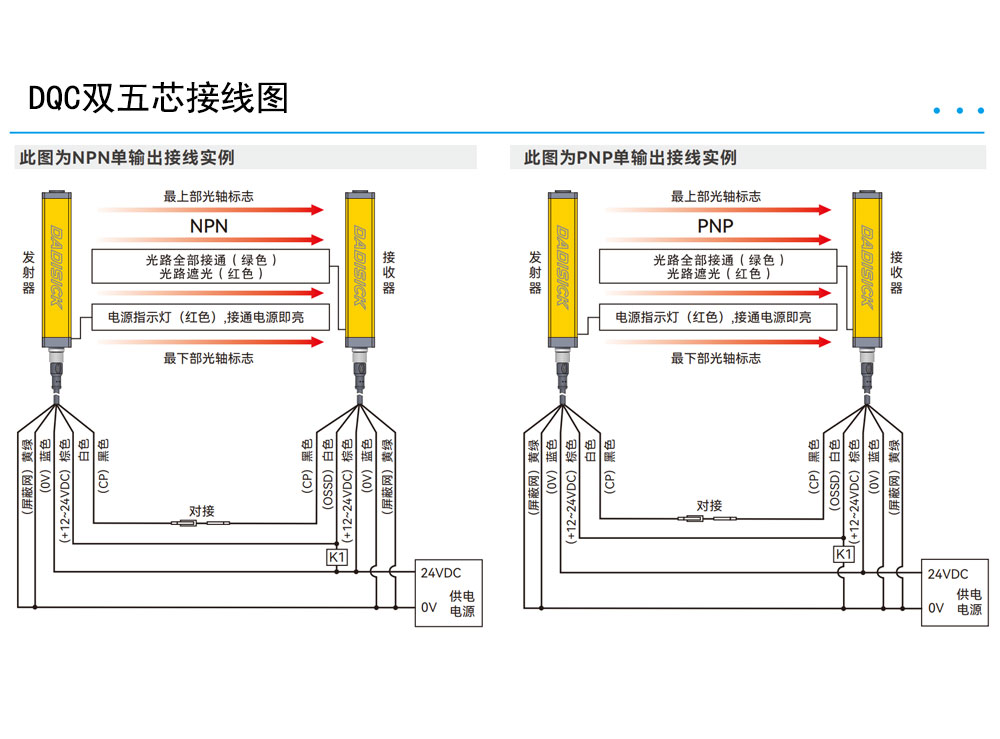
IO-Link Safety doesn't make headlines the way OPC-UA does, but it's arguably more useful for the average plant in 2026. It's a digital point-to-point protocol that sits between safety sensors and a safety-rated IO-Link master module, which in turn talks to the safety PLC over whatever fieldbus that PLC prefers.
What it replaces: dedicated dual-channel OSSD wiring from every sensor back to the cabinet. What it adds: a single 4-wire IO-Link cable per sensor that carries power, the safety signal, configuration data, and diagnostic telemetry. On a station with 8 light curtains, that's the difference between 48 wires and 32 wires hitting the cabinet — meaningful in a tight panel and even more meaningful when you're commissioning.
The configuration story is where IO-Link Safety quietly wins. With conventional OSSD wiring, configuring a curtain (changing zone parameters, swapping the muting timer, updating the response time) requires either a USB cable plugged into the device or DIP-switch wizardry. With IO-Link Safety, the configuration sits in the safety PLC's project file and gets pushed to the curtain on power-up. Replace a curtain in the field, and the new one self-configures the moment it's wired in. Compare that to the 20-30 minutes it currently takes to re-DIP-switch a Banner EZ-SCREEN LS replacement.
3. On-device edge diagnostics: predictive maintenance arrives in safety
The trend that's probably going to have the biggest day-to-day impact in plants is the least flashy: light curtains now retain enough operational history to do real predictive maintenance.
We've been tracking the diagnostic data exposed by current-gen safety curtains and the per-device telemetry typically includes:
- Per-beam attenuation history over the last 30-90 days. Gradual fouling shows up as a creeping signal-strength reduction long before any beam falls below the trip threshold.
- Alignment drift — small misalignments (under the alarm threshold) get logged. Catching a 5% drift trend lets you tighten the mounting bracket before vibration finally bumps a beam out of the receiver's cone.
- OSSD switching counter. Every Type 4 light curtain has a finite OSSD relay life (typically 10⁵ to 10⁶ switching cycles for relay-output variants). Knowing where you are in that budget matters for planned replacement.
- Internal temperature history. Useful for catching cabinet ventilation problems before they cook a curtain.
- Self-test result log. The Type 4 self-test runs every 4-8 ms; any anomaly even when it doesn't trigger a lockout gets time-stamped.
None of this is going to win a flashy product demo, but in aggregate it shifts safety light curtain maintenance from calendar-based to condition-based — the same shift that motor and bearing monitoring went through in the 2010s. The CMMS (computerized maintenance management system) plugin ecosystem is starting to catch up: IBM Maximo and SAP PM both shipped IO-Link Safety connectors in their late-2025 releases. We expect Fiix and Limble to follow in 2026.
4. What this means for the buyer in 2026
The standard list of buyer questions for a safety light curtain (resolution, range, response time, IP rating, PL/SIL rating) hasn't gone away. But there are now additional questions that really should be on the spec sheet:
| Question | What a good answer sounds like |
|---|---|
| Does it have a digital comms channel beyond OSSD? | “IO-Link Safety as standard, OPC-UA Safety with the X-firmware upgrade.” |
| What diagnostic telemetry is exposed? | “Per-beam attenuation, alignment trend, OSSD counter, temperature, fault log.” |
| Firmware-update path without uninstalling? | “Yes, via the IO-Link master.” |
| Added response-time latency on digital channel? | “Less than 1 ms incremental.” |
| MTTFd for the digital communication path? | “Documented in the safety manual section X.” |
| Network segmentation requirement? | “Safety network on dedicated VLAN with hardware diode to IT.” |
| Vendor lock-in for the comms protocol? | “Vendor-neutral profile, certified with [list of safety PLC brands].” |
One question we deliberately left off the list: “Is it AI-powered?” In our view, that's a marketing flag, not an engineering question. Some vendors are starting to label edge diagnostics as “AI” — strictly speaking, the pattern-matching algorithms running on a $30 microcontroller in the curtain housing are not what most engineers mean by AI. The predictive maintenance value is real; the AI label is mostly noise. We have a related article on where AI does and doesn't actually add value in safety sensors if you want the longer take.
5. The pitfalls — what to watch out for
A few things we've seen go wrong in early 2026 deployments:
Network latency breaks the ISO 13855 calculation. When a vendor quotes “15 ms response time,” they usually mean the curtain's internal trip-to-OSSD time. If you're reading the trip status over OPC-UA, the network round trip adds latency — 1-3 ms typically, sometimes more under load. That's extra T in the S = K × T + C safety-distance formula, and it has to be added in. We've seen one installation where the previously-valid 350 mm safety distance was retroactively non-compliant after a network upgrade increased jitter. Document T conservatively.
OPC-UA Safety profile mismatch. The protocol is standardized, but the safety-function profiles (e.g., the specific data structure for a light-curtain trip event) are still being harmonized. A curtain that's certified against the 2024 profile may not talk cleanly to a controller expecting the 2025 profile. Always test in a staging configuration before deploying.
Cybersecurity afterthought. Plants that bolted OPC-UA Safety onto the existing IT network — instead of building a segregated safety network — have already started to fail third-party security audits. The IEC 62443 reference architecture is non-negotiable. If your vendor's pitch deck doesn't mention network segmentation, ask why.
Diagnostic data treated as marketing fluff. The biggest miss we see is plants that buy a curtain with rich diagnostic data — and then never actually consume it. The IO-Link master sits there, the telemetry streams flow to nowhere, and a year later the curtain trips and nobody knows the lens has been at 12% attenuation for six weeks. Connect the data to your CMMS on day one or don't bother buying the connected variant.
6. Where DAIDISIKE sits in this picture
A word about our own product line, since you may be reading this on our site. The current DQA Type 4 / PL e / SIL 3 family ships with dual OSSD outputs and RS-485 Modbus-RTU for diagnostic access. That's 2022 architecture honestly — we're not yet shipping OPC-UA Safety or IO-Link Safety in production, though both are on the 2027 roadmap. The reason we're telling you this in print is that we'd rather you spec the right architecture for your plant than over-spec on marketing claims.
Three scenarios where the DQA family is the right call today:
- You're running a ProfiSafe-over-PROFINET network with a safety relay (e.g., our DA31 module) and the standard OSSD + EDM architecture is exactly what your safety engineer signed off on.
- You need a direct replacement for an Omron F3SG, Keyence SL-V, or SICK deTec4 and want the mounting-bracket compatibility and short lead time without rewriting your safety case.
- You're a cost-sensitive plant where the per-unit cost premium of IO-Link Safety masters and OPC-UA Safety controllers doesn't pencil out yet for your shift volumes.
If your plant is in any of the three scenarios above, talk to our engineering team. If you're in a greenfield 2027 automotive line with full TSN backbone, we'd honestly suggest checking back with us in Q3 2026 when we have OPC-UA Safety samples available, or comparing with the Pilz PSENopt II or SICK GuardShield families in the meantime.
7. Looking ahead to 2027
Three predictions, with our confidence levels:
(High confidence) By end-2027, OPC-UA Safety will be the default specification on greenfield automotive lines in Europe and North America. Brownfield retrofits will still be dominated by the legacy buses for another 5+ years.
(Medium confidence) IO-Link Safety will hit mainstream adoption in food/beverage and packaging, where the cable-count reduction has the clearest ROI. Heavy-industry retrofits will lag.
(Low confidence) Wireless safety OSSD will get a certified standard by 2028, but we don't expect mainstream deployment until 2030+. Latency and jitter on wireless are still a fundamental challenge for ISO 13855 calculations.
The bottom line
The Type 4 light curtain hardware on your factory floor in 2026 looks almost identical to the one from 2022. The data layer beneath it has changed dramatically. If your procurement workflow still treats “safety light curtain” as a commodity purchase decided on price and IP rating, you're leaving predictive maintenance value on the table — and potentially locking yourself into a protocol that will be a stranded asset by 2028.
Update the buyer questions. Verify the diagnostic data is actually consumed somewhere. Test the network architecture before rolling out at scale. None of this is exotic; it's just what a thoughtful 2026 specification looks like for what used to be a dumb optical sensor.