
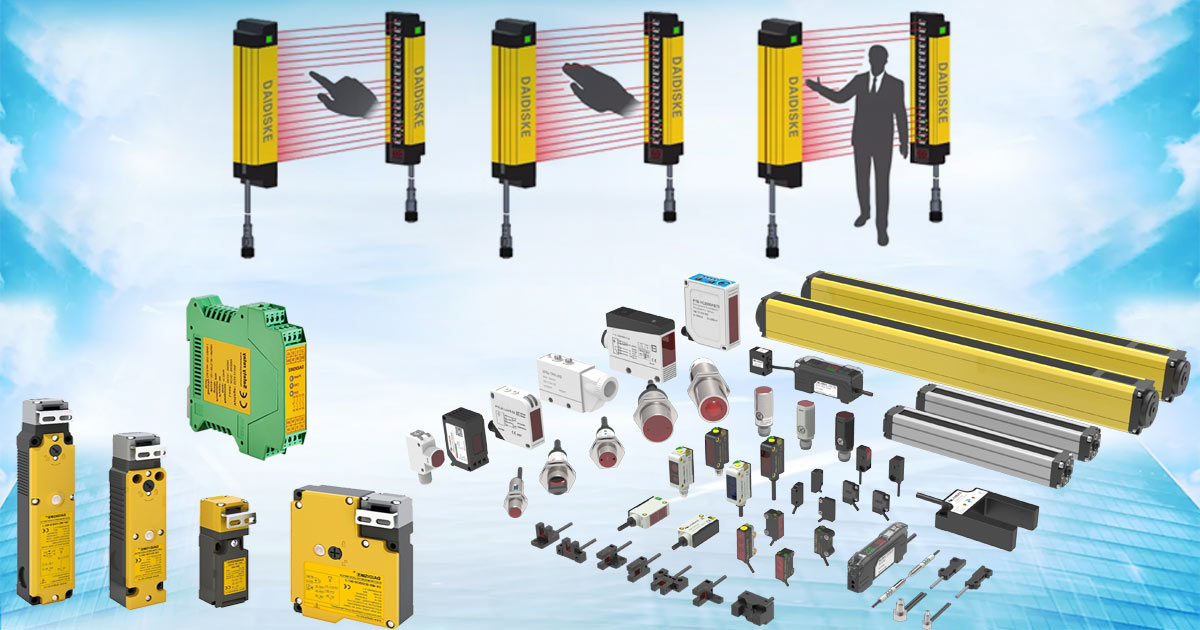
We keep cross-reference notes for the brands customers most often arrive with — Omron, Keyence, SICK, Banner, Leuze. Panasonic (sold for years under the SUNX brand) is a frequent one too, and it has a particular wrinkle that makes the replacement search urgent rather than optional: several of its most-installed models are now discontinued. So this guide leads with the discontinued parts, then covers the current ones, and is built the same way as the rest — from Panasonic's own published specifications, never from a manual or marketing sheet.
One blunt point first. A “replacement” for a safety light curtain is not a part number you look up and drop in. It is a match on four numbers — Type/PL class, resolution (minimum detectable object), sensing range, and output / OSSD scheme — followed by re-bracketing, re-pinning and a fresh ISO 13855 distance check. When those line up and the response time is equal or faster, the swap is sound. Everything below is about getting those four numbers right against the Panasonic SUNX range.
Which Panasonic SUNX light curtains are discontinued?
The SF4B Ver.2, SF2B Ver.2 and SF4B-G Ver.2 are discontinued; the SF4D, SF4C and SF4B-C remain current. Panasonic withdrew the SF4B Ver.2 hand-protection curtain in September 2022, along with the Type 2 SF2B Ver.2 and the robust SF4B-G Ver.2. For the SF4B-G, Panasonic itself documents partial mounting compatibility into the SF4D through the MS-SFD-4BG bracket — a useful tell that the SF4D is the intended in-brand path. If you are standardising on a single supplier rather than re-engineering twice, this is the moment buyers look outside the brand, which is exactly the high-intent, low-competition replacement search this page is written for.
How does a DAIDISIKE DQC replace a Panasonic SF4B?
The DQC matches the SF4B on Type 4 / PLe class, hand resolution and dual-channel OSSD; the differences are mechanical (brackets, connectors) and you re-check the safety distance. The Panasonic SF4B Ver.2 was a Type 4 curtain to IEC 61496, rated ISO 13849-1 Category 4 / PLe and SIL3, in a hand-protection configuration: a 20 mm beam pitch with a minimum detectable object around 25 mm, sensing range to roughly 9 m, IP67, and OSSD1/OSSD2 outputs with selectable NPN or PNP polarity. It is now discontinued.
The DAIDISIKE DQC Type 4 hand-guard is built to the IEC 61496 Type 4 architecture in a 30×30 mm profile, with a 30 mm-class hand resolution and dual-channel NPN/PNP OSSD with EDM. The hand-detection job the SF4B did maps directly. Two things you design for: the SF4B's protective heights and connector scheme mean new brackets and a re-pin to the DAIDISIKE connector, and you confirm the DQC ordered length matches the original protective field height. Where the original SF4B carried a Category 4 / PLe / SIL3 declaration that your machine's safety file relies on, specify the DAIDISIKE DQT4, which DAIDISIKE publishes at PL e.
What is the DAIDISIKE equivalent of the Panasonic SF4D (finger protection)?
The DQA — DAIDISIKE's 10–30 mm finger/hand line — is the match for the SF4D-F finger-protection variant. The Panasonic SF4D is the current Type 4 / PLe / SIL3 successor to the SF4B and reaches down to finger protection: the SF4D-F has a 10 mm beam pitch and a 14 mm minimum detectable object, a selectable sensing range of 0–12 m (or 0–15 m in long mode), a 10 ms response time (18 ms when units are connected in series), up to 5 units / 256 beams in a series connection, OSSD outputs with PNP/NPN selection, IP67 / IP65 and NEMA Type 13 sealing, and Panasonic's no-blind-zone design that detects right to the ends of the housing.
DAIDISIKE's DQA finger/hand curtain covers the 10–30 mm resolution band, which is the part that matters for the SF4D-F's 10 mm / 14 mm finger configuration, with dual-channel OSSD. If the original SF4D was specified for its no-blind-zone behaviour at a guarded edge — for instance hard up against a frame where you cannot afford a dead zone — pair the conversation with the DAIDISIKE DQO blind-spot-free line, which is the feature-parity talking point for that exact requirement. Confirm the SF4D's beam pitch, beam count and range off the label before you order; finger and hand variants share a family name but are not interchangeable.
What replaces the discontinued Panasonic SF2B (Type 2)?
The SF2B was Type 2 (PLc / SIL1), hand and body only — match it with a DAIDISIKE Type 2 line, or take the discontinuation as a chance to upgrade to Type 4. The Panasonic SF2B Ver.2 was a Type 2 safety light curtain reaching Performance Level c (PLc) / SIL1, with OSSD1/OSSD2 outputs, intended for hand and body protection — it did not offer finger protection. It is discontinued. Because the original was Type 2, you have a genuine choice: stay Type 2 with a DAIDISIKE Type 2 curtain where your risk assessment specifically permits PLc, or use the forced changeover to step up to Type 4 / PLe with the DQC (hand) or DQA (finger/hand) for a larger safety margin. The deciding factor is the performance level your machine's risk assessment actually requires — not the part that happened to be fitted. If you are unsure, our Type 2 vs Type 4 explainer walks through the distinction.
What about the SF4C ultra-slim and SF4B-C compact curtains?
The SF4C and SF4B-C are current Type 4 / PLe units for slim or compact installs; map them to the DQC, or to the DQT4 where the PL e declaration is load-bearing. The Panasonic SF4C is an ultra-slim Type 4 / PLe / SIL3 curtain — a 13 mm profile, among the thinnest in its class — with PNP OSSD1/ OSSD2 outputs, for tight machine frames where housing depth is the constraint. The SF4B-C is a compact Type 4 / PLe / SIL3 hand-protection curtain with a 20 mm beam pitch and ~25 mm minimum detectable object, with an operation range up to about 7 m. Both map onto the DAIDISIKE DQC for the hand-resolution guarding job; where the customer's safety documentation leans on the published PL e rating, specify the DQT4. DAIDISIKE does not currently publish a sub-13 mm ultra-slim housing, so if the SF4C was chosen purely because nothing else fit the frame depth, say so up front — that is a mechanical constraint to confirm before we quote, not something to paper over.
Where DAIDISIKE wins: the IP68 washdown / outdoor gap
Panasonic's SF-series tops out at IP67; the DAIDISIKE DQR is IP68, which is the genuine differentiator on washdown and outdoor replacement jobs. For ordinary factory air, IP65 is plenty and the DQC is the economical match. But food, beverage and pharma washdown lines, and any outdoor exposure, push past what an IP67 SF4B or SF4D comfortably covers. The DAIDISIKE DQR is built to IP68 specifically for that case — it is the model to quote when an SF-series curtain at IP67 is marginal for a wet or dusty environment. Reserve it for where the sealing actually matters; do not over-specify IP68 on a dry machine just because it is available.
Panasonic SUNX → DAIDISIKE cross-reference table
DQC for hand resolution, DQA for finger, DQT4 where PL e is load-bearing, DQR for IP68 washdown, DQO for no-blind-zone edges. This is a starting map from Panasonic's public specs, not a drop-in part number. Always confirm the four numbers against the installed unit's label and datasheet.
| Panasonic / SUNX model | Type / class & status | Resolution / range (published) | DAIDISIKE match |
|---|---|---|---|
| SF4B Ver.2 | Type 4, Cat 4 / PLe, SIL3 — discontinued | Hand: 20 mm pitch, ~Ø25 mm; to ~9 m; IP67 | DQC (hand); DQT4 where PL e is declared |
| SF4D / SF4D-F | Type 4, Cat 4 / PLe, SIL3 — current | Finger: 10 mm pitch, Ø14 mm; 0–12 m (15 m long); 10 ms | DQA (finger/hand 10–30 mm); DQO for no-blind-zone |
| SF2B Ver.2 | Type 2, PLc / SIL1 — discontinued | Hand / body only (no finger); OSSD1/OSSD2 | DAIDISIKE Type 2 line; or upgrade to DQC / DQA |
| SF4C | Type 4, PLe, SIL3 — current | Ultra-slim 13 mm profile; PNP OSSD1/OSSD2 | DQC / DQT4 (confirm frame-depth constraint) |
| SF4B-C | Type 4, PLe, SIL3 — current | Hand: 20 mm pitch, ~Ø25 mm; to ~7 m | DQC (direct hand match) |
| SF4B-G Ver.2 | Type 4, PLe, SIL3 — discontinued | Robust hand-protection (MS-SFD-4BG → SF4D) | DQC; DQR where IP68 sealing is needed |
The pattern is consistent: Panasonic's point-of-operation curtains converge on a 10 mm finger pitch (Ø14 mm) and a ~20–30 mm hand pitch (Ø~25 mm), all on dual-channel OSSD to IEC 61496 Type 4. That is the same envelope the DAIDISIKE DQA (finger) and DQC (hand) were built for. The divergence is at the edges — ultra-slim housings, IP68 sealing, no-blind-zone edges, and the Type 2 SF2B — and that is where you pick the DQT4, DQR, DQO or a Type 2 line instead. We ran the same exercise for the Banner, Leuze, Datalogic and Schmersal lines in our four-brand replacement guide, and the method carries over unchanged.
Is naming Panasonic and SUNX legal, and how is the comparison kept honest?
Naming a competitor's product to describe a compatible alternative is nominative reference and is legitimate; the comparison stays honest by using only Panasonic's published specs and DAIDISIKE's own published specs. We reference Panasonic and SUNX by name to tell you what the DAIDISIKE equivalent is — that is normal, lawful comparison and implies no Panasonic endorsement. What we deliberately do not do: we do not reproduce Panasonic's manuals, we do not use their trademarks or logos as our own, and we do not quote a parameter we cannot confirm from their public datasheet. The DAIDISIKE figures are from our own spec sheets — CE self-declaration, IEC 61496, ISO 9001 manufacturing, PL e per the relevant line, with TÜV testing available per order. If a number is not verifiable it is not in the table, which is why a couple of entries say “confirm against the original unit” rather than pretending to a precision we do not have for your specific build.
Replacing a discontinued Panasonic SF4B, SF2B or SF4B-G?
Send us the four numbers off your installed curtain — Type/PL class, resolution (mm), range, and OSSD output — plus the connector and supply voltage, and our engineering team returns a matched DQC, DQA, DQT4 or DQR, or tells you plainly if it does not fit. MOQ is one set; lead time 3–15 days; OEM/ODM customisation of resolution, height and connector is available.
Contact DAIDISIKE engineering · Phone / WhatsApp +86 15218909599
Sources & specifications cited
- Panasonic Industry — safety light curtains (SF4D, SF4C, SF4B-C) — Type 4 / PLe / SIL3; SF4D-F 10 mm pitch / Ø14 mm; range and OSSD figures.
- Panasonic Industry — SF4B / SF2B (discontinued) — SF4B Ver.2 hand 20 mm pitch / IP67; SF2B Ver.2 Type 2 PLc; discontinuation and SF4D migration.