
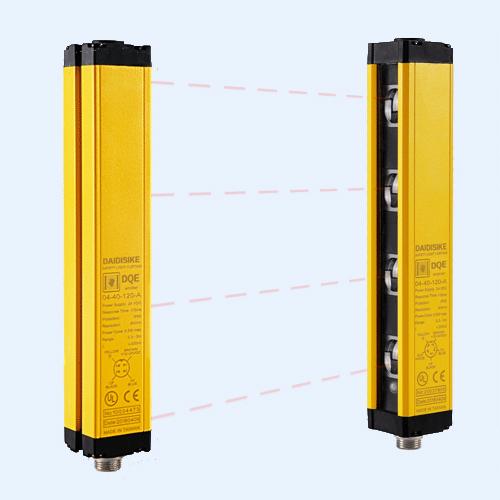
We keep cross-reference notes for the brands customers most often arrive with, and in the safety-light-curtain category the recurring name is Allen-Bradley — people write it every way, “Allen Bradley,” “AB,” “Rockwell,” “Guardmaster,” or just “GuardShield.” This page is the light-curtain companion to our existing Allen-Bradley Guardmaster safety-relay alternative page: there we mapped the GSR/MSR/440C-CR30 relays onto the DA31; here we map the GuardShield curtains onto the DAIDISIKE DQC / DQT4 / DQA, and show how the same DA31 closes the loop. Everything below is built from Rockwell's public ratings and our own published datasheets — never from a copied manual.
One blunt point before the detail: a safety light curtain is not a part number you look up and drop in. Rockwell's GuardShield order numbers (450L-B4FN0300YD, 440L-P4A2500YD, 445L-P4S3400YD and the rest) belong to Rockwell parts; a DAIDISIKE curtain has its own resolution, height and connector scheme. The swap is sound when a short list of parameters line up — resolution, protective height, range, response time, output type, connector and IP rating — and then you recompute the ISO 13855 safety distance because the new response time changes it. Everything below is about getting those right.
What is GuardShield, and what are the DAIDISIKE DQC / DQT4 / DQA?
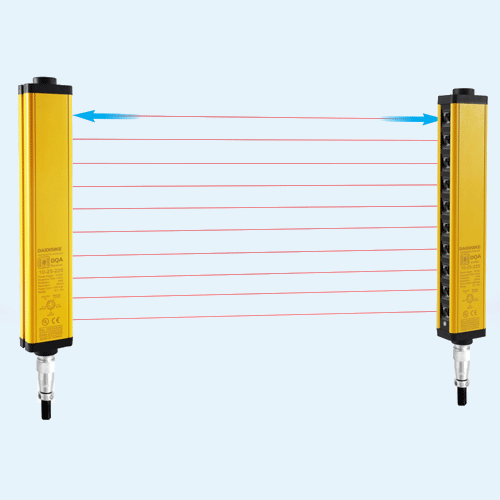
A safety light curtain is an electro-sensitive protective equipment (ESPE) array: a transmitter casts a grid of infrared beams to a receiver, and breaking the grid de-energises two redundant safety outputs (OSSDs). It is a Type 4 device per IEC 61496-1/-2 when it carries the highest fault-detection and optical requirements — the level you need for most machine point-of-operation guarding.
Rockwell's Guardmaster GuardShield is its curtain family, and it splits by application into two roles you must not confuse: POC (Point of Operation Control) — fine resolution finger/hand guarding at the danger point, beams spaced closely — and PAC (Perimeter Access Control) — whole-body detection around an area or at a machine entry, using a few beams at wide spacing. The three current bulletins: 450L (flagship POC: 450L-B Basic on/off, 450L-E Enhanced with integrated laser alignment, cascading, blanking and muting; 30×30 mm profile; protective heights 150–1950 mm in 150 mm steps), 440L (Type 4 standard, POC and PAC, 14 mm and 30 mm), and 445L (Safe 4 PAC, plus the small Micro 400 POC for semiconductor / micro-electronics / light assembly). The older 442L MicroView also turns up.
DAIDISIKE answers the POC side with two curtains. The DQC is the hand/finger workhorse: 30×30 mm profile (matching the 450L body), resolutions 10/14/20/25/30/40/80/200 mm, sensing range 0.3–3 m standard (0.3–6 m option), response ≤15 ms, IP65, ambient-light immunity ≥10,000 Lux, and dual-channel NPN/PNP OSSD with EDM — built to IEC 61496-1/-2 Type 4 architecture. The DQT4 emphasises the Type-4 story with resolutions 7.5/15/30 mm (the 7.5 mm option is finer than the typical GuardShield 14 mm finger), redundant dual-channel OSSD + EDM, response ≤20 ms typical, 30×30 mm body. For long range, the DQA flagship reaches up to 50 m in the H variant. All three are designed to Type 4 architecture and suitable for PL e / SIL 3 chains with a certified relay or PLC — they do not carry the rating standing alone.
Which GuardShield does what? A family map before you cross-reference
Identify POC vs PAC first, then pick the DAIDISIKE part. The single most common cross-reference mistake is treating a perimeter PAC curtain as if it were a finger-guarding POC curtain, or vice versa. Here is the honest map.
| GuardShield family | Role & what it is | Anchor part patterns | DAIDISIKE counterpart |
|---|---|---|---|
| 450L (POC, flagship) | Finger/hand POC; 450L-B Basic on/off, 450L-E Enhanced (laser align, cascade, blanking, muting); 30×30 mm; heights 150–1950 mm | 450L-B4FN0300YD, 450L-B4FN0900YD, 450L-E… | DQC (14/30 mm); DQT4 for 7.5 mm finger |
| 440L POC (Type 4 standard) | Finger/hand POC, 14 & 30 mm; blanking, beam coding, EDM, start/restart interlock; M12 QD | 440L POC Type 4 (14 mm / 30 mm) | DQC / DQT4 |
| 440L / 445L Safe 4 (PAC) | Whole-body perimeter; 2–4 beams at wide spacing (400/500 mm); optically-synced twin sticks; ranges to 18 m / 30 m long-range | 440L-P4A2500YD, 440L-_4A3400YD, 445L-P4S3400YD | DQA long-range, or DLD LiDAR for area — re-verify function |
| 445L Micro 400 (POC) | Small 20×15 mm housing, 14 mm; semiconductor / micro-electronics / light assembly; IP54 econ, IP69K food-grade options | 445L Micro 400 (needs MSR41/MSR42 controller) | DQC (IP65) — confirm IP54/IP69K need separately |
| 442L MicroView (legacy POC) | Older compact Type 4 POC curtain | 442L-TA40930CACD | DQC / DQT4 by resolution |
The takeaway: the DQC and DQT4 cross-reference cleanly to the POC curtains (450L-B, 440L POC, 445L Micro 400, 442L). For the PAC / whole-body role DAIDISIKE has no twin-stick optically-synced product line — you steer to the long-range DQA or to DLD LiDAR for area guarding and re-verify the safety function, because the technology differs.
DQC vs GuardShield 450L-B vs 440L POC — the side-by-side
The DQC's honest POC targets are the 450L-B and the 440L POC — all Type 4, 30×30-class bodies with matching 14 mm finger and 30 mm hand resolutions. This is a function-and-rating comparison from Rockwell / distributor public data, not a drop-in claim. Where a figure sits behind a registration-gated GuardShield datasheet, the cell says “per Rockwell datasheet” rather than guessing.
| Parameter | DAIDISIKE DQC | GuardShield 450L-B | GuardShield 440L POC |
|---|---|---|---|
| Type / standard | Type 4 architecture, IEC 61496-1/-2 | Type 4, IEC/EN 61496-1&-2 | Type 4, EN/IEC 61496 |
| System rating (with relay) | PL e / SIL 3 / Cat 4 chain (with certified relay/PLC) | SIL 3 (IEC 61508), PL e (EN ISO 13849-1) | SIL 3, PL e, Cat 4 |
| Resolution | 10 / 14 / 20 / 25 / 30 / 40 / 80 / 200 mm | 14 mm finger / 30 mm hand | 14 mm / 30 mm |
| Profile | 30 × 30 mm | 30 × 30 mm | Per Rockwell datasheet |
| Protective height | Sized to opening (L = P + H + J) | 150–1950 mm, 150 mm steps | Per Rockwell datasheet |
| Sensing range | 0.3–3 m std (0.3–6 m option) | e.g. 0.5–4 m (450L-B4FN0300YD) | Per Rockwell datasheet |
| Response time | ≤ 15 ms | < 15 ms (14 mm, per listing) | Per Rockwell datasheet |
| Outputs | Dual NPN/PNP OSSD + EDM | Dual OSSD (transceiver module option) | Dual OSSD; EDM, beam coding |
| Ambient-light immunity | ≥ 10,000 Lux | Per Rockwell datasheet | Per Rockwell datasheet |
| IP rating | IP65 | IP65 | IP65 (washdown rated) |
| Connector | M12 / aviation (confirm per order) | M12 micro QD (YD suffix) | M12 quick-disconnect |
| Sourcing | Factory-direct China, MOQ 1 set, 3–15 day lead | Rockwell distributor channel | Rockwell distributor channel |
Where the columns read “per Rockwell datasheet,” that is deliberate — exact GuardShield resolution, response-time and height tables sit in registration-gated documents (450L-TD001, 440L-UM001, 445L-IN005), so we cite the public ratings and ranges and tell you to confirm the precise numbers off your specific part number. The DQC column is from DAIDISIKE's published spec. The one cell that demands attention is range: the DQC standard 0.3–3 m (or 0.3–6 m option) is shorter than a 450L-E long-range configuration, so verify the operating distance against the exact unit you are replacing.
How does the curtain reach PL e / SIL 3? The DA31 closes the loop
No light curtain — GuardShield, DQC or otherwise — is PL e or SIL 3 on its own. The rating belongs to the complete safety function. The curtain is the sensing subsystem. To make a safe-stop function you take the receiver's two OSSD outputs and drive a certified safety relay or safety PLC that de-energises the machine's final elements and monitors that they actually dropped out (EDM). That stop element is the DAIDISIKE DA31: 24 V DC, 3NO+1NC force-guided safety contacts, transistor signal output, release response <30 ms, dual-channel PNP/NPN inputs with 1k–10kΩ open-circuit detection (EDM), rated EN ISO 13849-1 Cat 4 / PL e and IEC 62061 SIL 3 on a 22.5 mm DIN housing. It plays exactly the role a Guardmaster GSR/MSR relay plays downstream of a GuardShield curtain — which is why the relay cross-reference lives on its own Guardmaster alternatives page.

Wiring it is straightforward: both OSSD channels (choose PNP, the global default, or NPN) go into the DA31's dual-channel safety inputs so the relay sees the redundant pair and can spot a discrepancy or cross-short; the EDM loop runs through the downstream contactors' mirror contacts so a welded contactor blocks restart. Break the curtain and both OSSDs go low, the DA31 drops its three force-guided NO contacts, the machine de-energises, and the spare NC can signal a PLC or stack light.
Do I have to recalculate the safety distance? (ISO 13855)
Yes — every swap. Changing the curtain changes its response time, and changing resolution changes the intrusion factor, so the minimum mounting distance moves. ISO 13855 gives the minimum distance from the detection plane to the hazard as S = K·T + C, where K is the approach speed (2000 mm/s for hand/arm approach), T is the total stopping time of the whole system — the machine stop time plus the curtain response time plus the DA31 release time — and C is the intrusion/penetration distance, which depends on resolution (the finer the resolution, the smaller C).

Concretely: if you replace a GuardShield 450L finger curtain (response under 15 ms) with a DQT4 at ≤20 ms typical, T grows by a few milliseconds and S grows accordingly — you may need to move the bracket back. If you keep the same 14 mm resolution on a DQC at ≤15 ms, T is comparable but you still re-verify with the actual machine stop time. The full worked method is in our ISO 13855 safety-distance guide. Never assume the old mounting position still satisfies S after a swap.
What to verify before you swap a GuardShield curtain
Eight checks decide the swap; pull them off the installed unit, its label and its datasheet. This is the same discipline we apply to every brand cross-reference.
- Resolution — read the smallest body part to protect (14 mm finger, 30 mm hand, ≥40 mm body) and match the DAIDISIKE resolution to the GuardShield part's resolution. DQC covers 10–200 mm; DQT4 goes to 7.5 mm finger.
- Protective height — GuardShield 450L is sized in 150 mm steps; size the DAIDISIKE curtain (L = P + H + J) to cover the same protected opening.
- Operating range — GuardShield 450L runs roughly 0.5–4 m, PAC to 30 m. DQC is 0.3–3 m std (0.3–6 m option); DQA H goes to 50 m. Verify the range against the unit replaced.
- Response time → ISO 13855 — DQC/DQA ≤15 ms, DQT4 ≤20 ms vs 450L <15 ms. Recompute S = K·T + C; never assume the old distance holds.
- Output type — dual OSSD; choose PNP (global default) or NPN, and wire both channels into the DA31 dual-channel input with EDM through the force-guided contacts.
- Connector & mounting — M12 (8-pin) or aviation; confirm connector and bracket fit.
- IP rating — DAIDISIKE curtains are IP65; flag the GuardShield Micro 400 IP54 economy / IP69K food-grade niches and confirm any washdown need separately.
- Re-validate on the machine — the integrator owns the PL/SIL verification of the complete function; re-run the full validation on the actual machine.
Where DAIDISIKE honestly does not match GuardShield
We would rather tell you the limits up front than sell you the wrong part. Three places GuardShield does something the DAIDISIKE curtain line does not:
- No twin-stick optically-synced PAC line. The 440L / 445L Safe 4 PAC uses 2–4 beams at fixed wide spacings (400/500 mm) with the transmitter and receiver synchronizing optically — no electrical link between sticks. DAIDISIKE curtains are through-beam ESPE arrays, not a marketed twin-stick PAC product. For whole-body perimeter or area guarding, map to the DQA long-range or to DLD LiDAR (a different technology for the same safety goal) and re-verify the function.
- No 450L-E-depth muting / cascading / blanking. The 450L-E Enhanced documents integrated laser alignment, cascading, fixed/floating blanking and integrated muting to a depth DAIDISIKE does not publish. The DQC/DQT4 pages mention blanking/muting options, but confirm your specific muting/blanking/cascade requirement with DAIDISIKE before committing — do not assume feature parity.
- Ingress niches. The GuardShield Micro 400 offers IP54 economy and IP69K food-grade variants; DAIDISIKE curtains are published at IP65. If you have a washdown or food-grade requirement, confirm the IP rating separately.

Is naming Allen-Bradley and GuardShield legal, and how do you keep this honest?
Naming a competitor's product to describe a compatible alternative is nominative reference and is legitimate; we keep it honest by using only Rockwell's published ratings. We reference Allen-Bradley, Rockwell, Guardmaster and GuardShield by name to tell you what the DAIDISIKE equivalent is — normal, lawful comparison, with no implied partnership or endorsement. What we deliberately do not do: we do not reproduce Rockwell manuals, datasheet tables, images or logos; we do not reuse GuardShield order numbers (450L-, 440L-, 445L-…YD) on DAIDISIKE parts; and we do not invent matching certificate numbers, prices or specs we cannot publish. Every DQC/DQT4/DQA/DA31 figure here is from DAIDISIKE's own datasheet; every GuardShield figure is from Rockwell / distributor public data, with gated numbers flagged “confirm off your part number.”
Sources & specifications cited
- Rockwell Automation / Allen-Bradley Guardmaster GuardShield 450L POC safety light curtains (450L-B Basic, 450L-E Enhanced) — Type 4 (IEC/EN 61496-1&-2), SIL 3 (IEC 61508), PL e (EN ISO 13849-1); 30×30 mm; heights 150–1950 mm. Public ratings / distributor listings; exact tables per datasheet 450L-TD001.
- Allen-Bradley GuardShield 440L (POC & PAC) and 445L Safe 4 / Micro 400 — Type 4, 14 & 30 mm, optically-synced PAC pairs, IP54/IP65/IP69K variants; per datasheets 440L-UM001, 445L-IN005 and distributor part listings (450L-B4FN0300YD, 440L-P4A2500YD, 445L-P4S3400YD).
- DAIDISIKE DQC safety light curtain datasheet — IEC 61496-1/-2 Type 4; 30×30 mm; res. 10–200 mm; range 0.3–3 m (0.3–6 m opt.); ≤15 ms; IP65; ≥10,000 Lux; dual NPN/PNP OSSD + EDM.
- DAIDISIKE DQT4 & DQA datasheets — DQT4 res. 7.5/15/30 mm, ≤20 ms; DQA res. 10–200 mm, ≤15 ms, up to 50 m (H variant). DAIDISIKE DA31 safety relay — 3NO+1NC force-guided, dual-channel PNP/NPN + EDM, <30 ms, EN ISO 13849-1 Cat 4 / PL e, IEC 62061 SIL 3, 22.5 mm DIN.
- ISO 13855 — positioning of protective equipment with respect to approach speeds (S = K·T + C). IEC 61496-1/-2 — ESPE Type 4. EN ISO 13849-1 / IEC 62061 — PL / SIL of the safety function.