
We keep cross-reference notes for the brands customers arrive with, and ABB Jokab Safety is a special case because it is not a single product line. ABB acquired the Swedish company Jokab Safety, and the range now sold as “ABB Jokab Safety” is split by function: coded interlocks (Eden), light curtains (Focus), a programmable safety PLC (Pluto), a dynamic-signal controller (Vital), and a set of hardwired single-function relays (RT / BT / JSB). That structure matters, because there is no single “Jokab alternative” — there is a correct DAIDISIKE answer per family, and one family (Pluto) where the honest answer is “that is a different class of device.” This page goes family by family.
One discipline before the detail: a brand swap is sound only when you match the function and rating, not the label. ABB/Jokab order numbers (Eden 2TLA020051R5400, Focus II FII-4-30-900, Pluto B46, RT9 and so on) belong to ABB/Jokab parts; the DAIDISIKE parts have their own SKUs and terminal layouts. The job is to map function → function, confirm the rating, and re-wire.
How is ABB Jokab Safety structured?
Pick the family first; only then pick the DAIDISIKE part. Here is the honest map of the real ABB Jokab families, a few anchor models, and whether DAIDISIKE has a matching part — or doesn't.
| ABB Jokab family | What it is | Anchor models | DAIDISIKE match? |
|---|---|---|---|
| Eden | Non-contact coded interlock (Adam sensor + Eva actuator), monitoring only | Adam OSSD-Info M12-5 (2TLA020051R5400), Eva (2TLA020046R0800), Eden DYN/DYNlink | Yes — DX-R1 (coded magnetic; no DYNlink) |
| Focus / Focus II | Type 4 AOPD light curtains & grids, OSSD, built-in muting | FII-4-14 (finger), FII-4-30 (hand), FII-4-30-900, FII-4-K (grid) | Yes — DQC / DQT4 Type 4 curtains |
| RT / BT / JSB relays | Hardwired single-function safety relays (E-stop / gate / curtain monitoring) | RT6, RT7, RT9 (22.5 mm), JSBRT11 | Yes — DA31 (3NO+1NC, PL e / SIL 3) |
| Pluto | Programmable safety PLC, CAN Safe-Bus, multi-zone, analog/counter I/O | A20, B20, B22, B46, D20, D45 | No — safety-PLC class; DA31 is not a substitute |
| Vital + DYNlink | Dynamic single-channel series controller (up to ~30 sensors per loop) | Vital, Eden DYN series | No — no DAIDISIKE dynamic-bus equivalent |
| Safety laser scanner role | IEC 61496-3 Type 3 area/zone protective-field guarding | (Jokab safety-scanner role) | No — DLD LiDAR is NOT IEC 61496-3 rated |
A signature concept runs across several Jokab families: dynamic single-channel series connection (DYNlink) — chaining many sensors into one input on a Vital controller or Pluto. That is a genuine Jokab differentiator DAIDISIKE does not replicate, and it is the thing that most often turns a “simple swap” into an architecture decision. Keep it in mind as you read each family below.
Eden coded interlock → DAIDISIKE DX-R1: how close is the match?
Both are non-contact, coded, Type 4, PL e / SIL 3 monitoring-only interlocks — the difference is the coding technology and the DYNlink option. ABB Jokab Eden is a two-part sensor: Adam (the sensor) and Eva (the coded actuator). Adam senses Eva with no mechanical contact and no wear, in a PBT/epoxy-moulded housing rated IP67 and IP69K, −40…+70 °C, 360° mounting, with a rated operating distance of 0–15 ±2 mm. Eva is offered as a General code (interchangeable, low coding) or a Unique code (high coding, teach-in), and up to about 30 Eden can be chained in series without reducing the PL. It reaches SIL 3 / PL e / Cat. 4 with few components — chosen where defeat-resistance and washdown (IP69K) matter.
The DAIDISIKE DX-R1 is a non-contact magnetic-coded safety switch: ISO 14119 Type 4 high-level coded, ISO 13849-1 PL e / Cat. 4 / SIL 3, dual-channel NPN/PNP safety outputs, unique or universal coding, and cascade/series chaining. Functionally it lands on the same target as Eden — non-contact, coded, Type 4, PL e / SIL 3, series-connectable, and monitoring only (no guard locking; for guard-locking you move to the DX-series guard-locking switches and door bolts).
- Coding technology. Eden uses RF/coded sensing with an optional DYNlink dynamic single-channel mode; the DX-R1 is coded magnetic with no DYNlink/Vital dynamic-bus equivalent. If the cell uses Eden DYN in series on a Vital or Pluto, the DX-R1's plain dual-channel cascade is a different wiring topology, not a drop-in.
- Washdown / IP rating. Eden is IP67 and IP69K; the DX-R1's published rating is IP67 (up to IP68 on request). Confirm the washdown duty — do not assume the DX-R1 is IP69K.
- Operating distance & connector. Confirm the switching distance suits your door tolerance and that the M12 pinout and reset/info outputs map across.
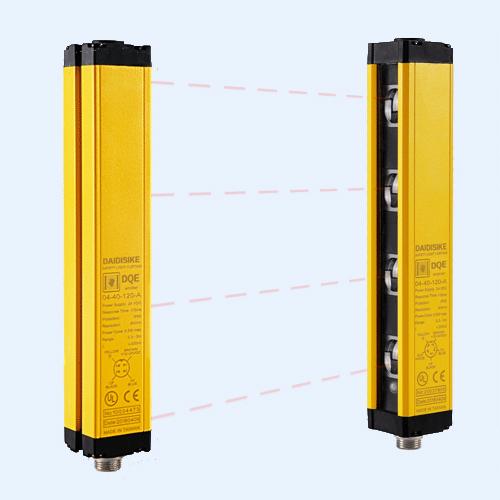
Focus / Focus II light curtain → DAIDISIKE DQC / DQT4
This is a strong match — both are Type 4 AOPDs with OSSD outputs and finger/hand resolutions — with two things to verify: protected height and integrated muting. ABB Jokab Focus II is an AOPD Type 4 light curtain per EN/IEC 61496-1/-2 with two OSSD outputs to the machine stop, available in 14 mm (finger, FII-4-14) and 30 mm (hand, FII-4-30) resolutions, plus up to 4-beam grids (FII-4-K). Response time runs roughly 14–45 ms depending on beam count — a FII-4-30-900 (30 mm resolution, 900 mm protected height) is about 25 ms. A defining feature: muting, override, blanking and break are built in, which is why Focus is positioned as the “low-cost complete-feature” range.
The DAIDISIKE Type 4 curtains map directly:
- DQC — resolutions 10/14/20/25/30/40/80/200 mm, response ≤15 ms, range 0.3–3 m, IP65, ≥10,000 Lux immunity, dual-channel NPN/PNP OSSD + EDM, ~30×30 mm body.
- DQT4 — IEC 61496 Type 4, resolutions 7.5/15/30 mm, range 0.3–3 m, response ≤20 ms, redundant OSSD + EDM, IP65, −10…+55 °C.
Both reach PL e / SIL 3 as a complete safety function — that is, the curtain plus a certified safety relay or PLC. That is exactly how Focus II reaches its system rating too; a curtain on its own is never “PL e” in isolation.

- Protected height. Map the FII-4-xx-[height] to a DQC/DQT4 length — the protected field must cover the same opening.
- Resolution. 14 mm finger or 30 mm hand — pick the matching DQC/DQT4 resolution; never coarsen detection to save cost.
- Muting. If the application relies on Focus II's integrated muting/blanking/override, confirm DAIDISIKE provides equivalent muting on the curtain — or move muting to the safety relay/PLC. (Do not assume the DAIDISIKE curtain replicates every Focus muting feature; confirm per part.)
- Response time & safety distance. Recompute the ISO 13855 minimum distance with the new response time.
RT-series relay → DAIDISIKE DA31 (and why Pluto is NOT in scope)
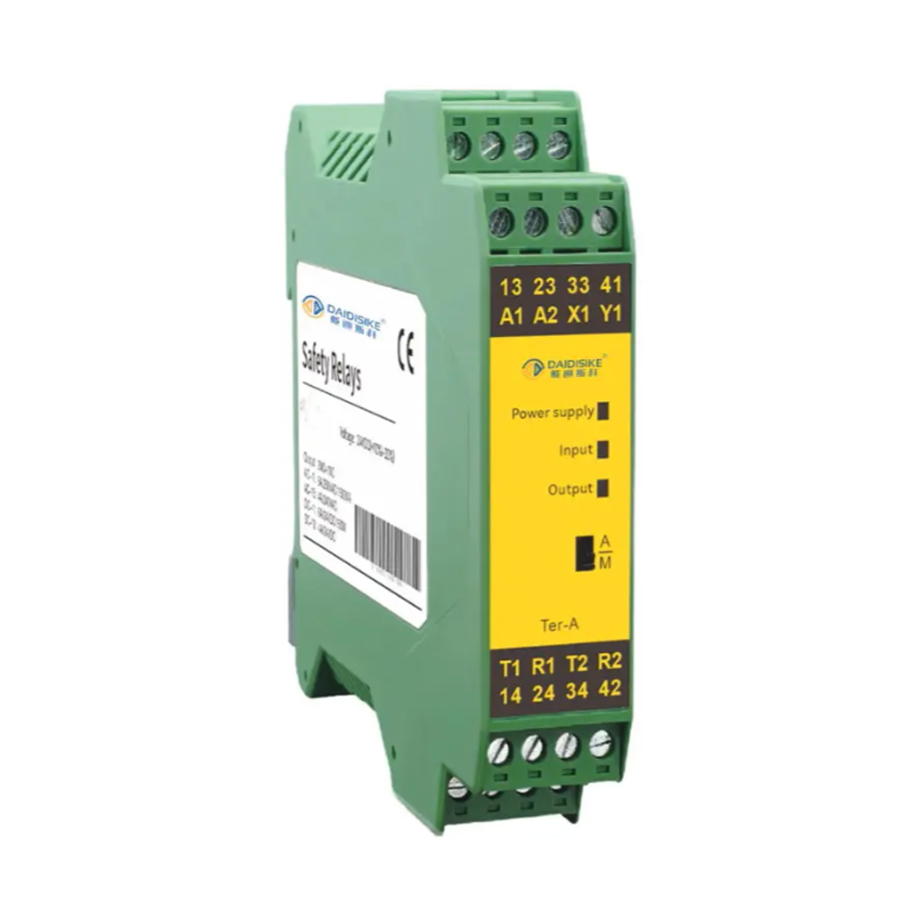
The DA31's real peer is the RT-series single-function relay — not the Pluto safety PLC. Match the function. ABB Jokab's hardwired single-function relays are the RT6, RT7 and RT9 (plus JSBRT11). The RT9 is a 22.5 mm, 24 VDC DIN module, IP20, −10…+55 °C, with 2 safety input channels, auto-reset + test-reset inputs, 2 NO enabling paths + 1 changeover info output, manual or automatic reset, EN 62061 / ISO 13849-1, SIL 3 / PL e / Cat. 4. The RT6 is the 3-enabling-path E-stop/gate workhorse with internal dual/supervised functions, two voltage-free transistor info outputs, and manual + auto reset.
The DAIDISIKE DA31 is a hardwired single-function safety relay at the same class: EN/ISO 13849-1 Cat. 4 / PL e, IEC 62061 SIL 3, 3NO + 1NC instantaneous force-guided contacts, a transistor info output (<500 mA / 24 VDC), dual-channel redundant inputs, EDM, release response <30 ms, 22.5 mm DIN, 24 VDC (+10/−20%), contact rating AC-1 6 A / 250 VAC and DC-1 6 A / 24 VDC. Its 3NO+1NC arrangement sits closest to the RT6.
| Parameter | DAIDISIKE DA31 | ABB Jokab RT6 | ABB Jokab RT9 |
|---|---|---|---|
| Type | Hardwired single-function safety relay | Hardwired single-function safety relay | Hardwired single-function safety relay |
| Safety class | Cat. 4 / PL e (ISO 13849-1) / SIL 3 (IEC 62061) | PL e / SIL 3 / Cat. 4 | SIL 3 / PL e / Cat. 4 |
| Output / enabling paths | 3 NO + 1 NC (force-guided) + info output | 3 enabling paths + transistor info outputs | 2 NO enabling + 1 changeover info output |
| Input channels | Dual-channel redundant + EDM | Dual / supervised | 2 safety input channels |
| Reset | Manual / automatic | Manual + automatic | Manual or automatic + test-reset |
| Release response | < 30 ms | Per ABB datasheet | Per ABB datasheet |
| Supply | 24 VDC (+10/−20%) | 24 VDC | 24 VDC |
| DIN width | 22.5 mm | Per ABB datasheet | 22.5 mm |
| Sourcing | Factory-direct China, MOQ 1 set, 3–15 day lead | ABB / Jokab distributor channel | ABB / Jokab distributor channel |
Where a cell reads “per ABB datasheet,” that is deliberate — we will not put a number in an ABB column unless it is published for that exact variant. Pull it from your unit's label.

Pluto is a programmable safety PLC (SIL 3 / PL e): every unit is a master on a CAN-based Pluto Safe-Bus, sees every other unit's I/O, runs DYNlink dynamic series loops, scales from the A20 (20 I/O) and B46 (46 I/O) to the D45 (8 safe analog inputs, high-speed counters), and is programmed in software for multi-zone, complex or analog safety logic. DAIDISIKE does not make a programmable safety PLC. A stack of DA31 relays is NOT an honest substitute for one Pluto coordinating many zones or DYNlink loops. Replace a Pluto with a DA31 only when the Pluto was doing a single fixed function (rare) — otherwise the correct answer is “you need a safety PLC,” and we will say so.
Where DAIDISIKE honestly has no ABB Jokab equivalent
A cross-reference is only useful if it is honest about the gaps. Three parts of the ABB Jokab range have no matching DAIDISIKE product, and over-selling them would put a machine at risk:
- Pluto safety PLC — programmable, Safe-Bus, multi-zone, analog/counter I/O. The DA31 is a hardwired single-function relay; it is not a Pluto substitute.
- Vital + DYNlink — the dynamic single-channel series controller and topology (up to ~30 sensors per loop). DAIDISIKE publishes no dynamic-bus controller; use a conventional dual-channel cascade into a relay instead.
- Safety laser scanner. The Jokab safety-scanner role is IEC 61496-3 (Type 3). The DAIDISIKE DLD05A3 / DLD20A5 LiDAR is explicitly NOT IEC 61496-3 safety-rated — it is an obstacle-avoidance / AGV-AMR navigation / perimeter-detection sensor. Do not present the DLD as a safety-scanner equivalent.
And on certification: ABB Jokab products carry standing TÜV certification, while DAIDISIKE's published parts are CE (self-declared on some lines) with TÜV third-party testing available per order. We state that plainly rather than imply parity.
What to match before you swap any ABB Jokab part
Read these numbers off the installed unit and its datasheet before ordering — the same discipline for every family.
- Function & family — interlock (Eden), curtain (Focus), relay (RT) or controller (Pluto/Vital)? Only the first three have a DAIDISIKE match.
- Coding / sensing (interlocks) — Eden RF + DYNlink option vs DX-R1 coded magnetic; confirm topology and washdown.
- Resolution & protected height (curtains) — 14/30 mm finger/hand and the FII-4-xx-[height] field length.
- Contacts, channels, EDM, reset (relays) — NO enabling paths in use, dual-channel inputs, EDM, auto vs monitored-manual reset.
- PL / SIL target — from your risk assessment (the DAIDISIKE parts reach PL e / SIL 3 as a complete function).
- DIN width & supply — panel budget (DA31 is 22.5 mm) and 24 VDC supply.
Send those off your installed Jokab parts and we will confirm the DX-R1, a DQC / DQT4 curtain or the DA31 fits — or tell you plainly that you need a safety PLC instead. The wider method and the other safety-relay cross-references (such as our Pilz PNOZ alternatives and Allen-Bradley Guardmaster alternatives) follow the same discipline.
Is naming ABB and Jokab legal, and how do you keep this honest?
Naming a competitor's product to describe a compatible alternative is nominative reference and is legitimate; we keep it honest by using only ABB/Jokab's published specs. We reference ABB, Jokab, Eden, Focus, Pluto, Vital and the RT-series by name to tell you what the DAIDISIKE equivalent is — normal, lawful comparison, with no implied partnership or endorsement. What we deliberately do not do: reproduce ABB/Jokab manuals, use their trademarks or logos as our own, reuse their order numbers (2TLA…, FII-4-…, RT6/RT9, Pluto A20/B46/D45) on DAIDISIKE parts, or invent matching certificate numbers or specs we cannot publish. Every DAIDISIKE figure here is from DAIDISIKE's own datasheets; every ABB/Jokab figure is from ABB/Jokab and distributor public data. Where a number isn't verifiable for your exact variant, the page says “confirm against the original unit” rather than faking precision.
Sources & specifications cited
- ABB Jokab Safety — product range — Eden (Adam + Eva), Focus II, Pluto, Vital, RT-series; family structure and ratings.
- ABB Jokab Eden non-contact coded sensor — SIL 3 / PL e / Cat. 4, IP67 + IP69K, 0–15 ±2 mm, OSSD and DYN/DYNlink versions; e.g. Adam OSSD-Info M12-5 (2TLA020051R5400), Eva (2TLA020046R0800).
- ABB Jokab Focus II Type 4 AOPD — EN/IEC 61496-1/-2, two OSSD, 14 mm / 30 mm resolutions, 14–45 ms, built-in muting; e.g. FII-4-30-900.
- ABB Jokab Pluto safety PLC and RT-series relays — Pluto A20 / B46 / D45 (CAN Safe-Bus, SIL 3 / PL e); RT6 / RT7 / RT9 hardwired single-function relays (PL e / SIL 3 / Cat. 4).
- DAIDISIKE DA31 safety relay datasheet — Cat. 4 / PL e / SIL 3, 3NO+1NC force-guided, EDM, dual-channel, <30 ms, 22.5 mm DIN, 24 VDC.
- DAIDISIKE DX-R1 magnetic-coded safety switch and DQC / DQT4 Type 4 light-curtain datasheets — ISO 14119 Type 4; IEC 61496 Type 4; PL e / SIL 3 as a complete function.