
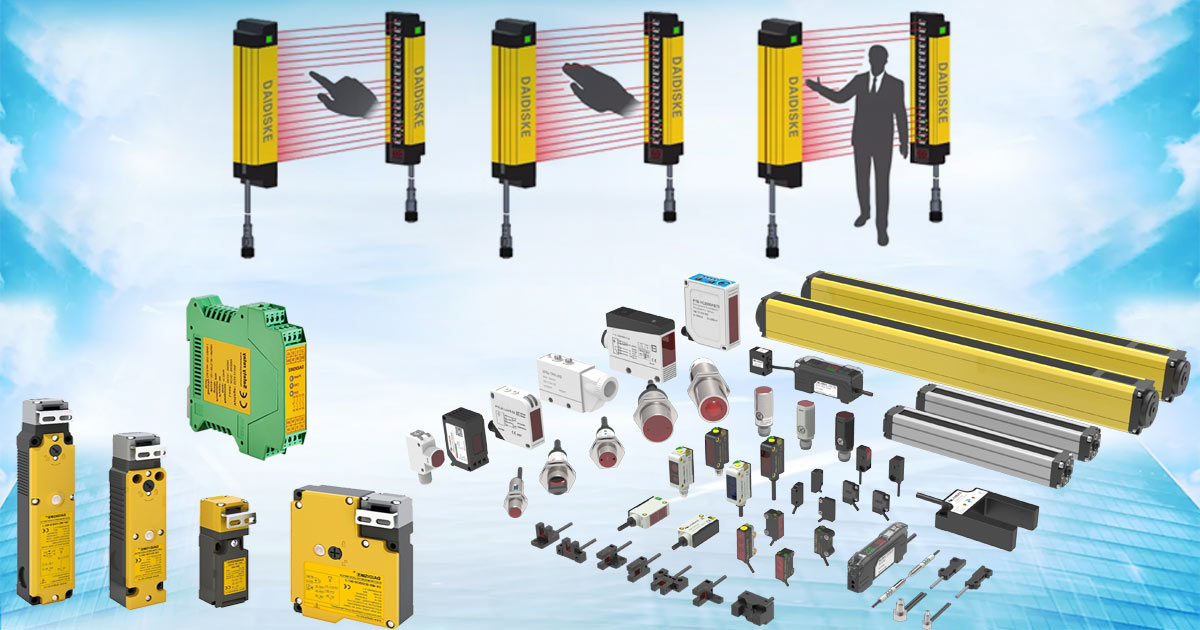
Every other industry buys a light curtain on resolution and range. In a wood shop you buy it on how well it survives the dust — because a curtain that reads “blocked” every twenty minutes from a fouled lens gets bypassed by frustrated operators, and a bypassed guard protects nobody. So this guide leads with the contamination problem, then walks the standards, then maps real machines to real models. No invented test numbers; only what DAIDISIKE actually publishes.
Why does my light curtain keep tripping on a panel saw or CNC router?
Nine times out of ten it is sawdust on the lens, not a real intrusion. A safety light curtain projects infrared beams from an emitter bar to a receiver bar; the receiver judges each beam “clear” or “blocked” against a signal-strength margin. Fine wood dust, and especially the very fine, static-clingy dust from MDF, particleboard and sanding, builds a film on the lens windows. As the film thickens the received signal falls toward the margin, and the curtain starts reading beams as blocked when nothing has entered the field. That is your nuisance trip.
The other usual suspects, in order: misalignment (machine vibration walks the brackets off true), a reflection off a glossy panel sitting near the field that lets light skip a genuinely blocked beam, and material in the field during feed that should be muted but isn't. The repair order is always the same: wipe both lens faces, re-align and lock the brackets, remove or screen nearby reflective surfaces, and add proper muting at the material-feed opening instead of defeating the guard. If a position fouls within hours rather than days, that machine has out-grown its IP rating — move it up a sealing tier so dust lands on an outer window you can wipe rather than working into the optics.
What IP rating does a light curtain need in a furniture factory?
Match the rating to the dirtiest spot, not the factory average — and expect to mix tiers along one line. The single most common purchasing mistake is buying one IP65 unit for the whole shop. The saw infeed may be fine on IP65, but the sander and edgebander positions almost always need a fully sealed, washdown-grade housing. Here is how the DAIDISIKE sealing tiers line up against woodworking conditions.
| Sealing / DAIDISIKE class | What it withstands | Typical woodworking position |
|---|---|---|
| IP65 — MK class | Dust-protected; low-pressure water jets | General panel-saw infeed, CNC-router cell, assembly guarding |
| IP67 — sealed build | Heavy dust; short immersion / occasional rinse | Boring/nesting cells, dustier saw lines, periodic washdown |
| IP68 — DQR washdown | Continuous immersion-grade sealing; hose-down | Belt sanders, calibrating machines, edgebanders, glue/lacquer lines, heavy MDF dust |
The logic is simple: a higher IP rating keeps dust and water on a wipeable outer window instead of letting it reach the optics, which is exactly the failure mode that drives false trips. At a hosed-down edgebander or a sanding line, the DAIDISIKE DQR IP68 washdown curtain is the part that earns its keep; at a dry saw infeed the IP65 MK is enough. For the wider sealing picture across welding, oil mist and dust, see our IP65 / IP67 / IP69K sealing-level explainer.
What does EN ISO 19085 require, and which part fits my machine?
EN ISO 19085 is the woodworking-machinery safety family; pick the part that names your machine and read it together with Part 1. ISO 19085-1 gives the common safety requirements for the whole family; each numbered part then covers a machine type. The electro-sensitive protective equipment (ESPE) you mount — the light curtain or scanner — has to satisfy both the common part and the machine-specific part, plus the generic safety standards (ISO 13849-1, ISO 13855, IEC 61496) underneath them.
| EN ISO 19085 part | Machine covered | Typical DAIDISIKE guarding |
|---|---|---|
| Part 1 | Common requirements (whole family) | Applies to every machine below |
| Part 2 | Horizontal beam panel saws | DQC hand-protection at the infeed |
| Part 3 | NC/CNC boring & routing (CNC routers) | DQSA Type 4 area curtain guards the cell opening (DLD LiDAR optional, navigation/warning only — not safety-rated) |
| Part 4 | Vertical panel saws | DQC / DQA point-of-operation guarding |
| Part 8 | Belt sanding / calibrating machines | DQR IP68 washdown curtain (heavy dust) |
| Part 14 | Four-sided moulders | DQT4 Type 4 / PL e at the working zone |
Outside Europe the same machines are governed by OSHA 1910.213 (woodworking machinery) and the general machine-guarding rule 1910.212, which require effective point-of-operation guarding but do not prescribe the device. A Type 4 light curtain configured to ISO 13849-1 PL d/e satisfies both regimes; the standards spine is the same, only the citing regulation changes.
Finger vs hand protection: which resolution for an edgebander or panel saw?
Resolution is the detection capability in millimetres — the smaller the number, the closer to the hazard you can mount, and the finer the body part it detects. A finger-protection curtain (about 14 mm, and 10–30 mm on the DAIDISIKE DQA) detects a finger entering the field and is used at close-up loading points such as an edgebander infeed where the hand works near the hazard. A hand-protection curtain (about 30–40 mm, the DAIDISIKE DQC) detects a hand or arm and suits a panel-saw infeed where the operator's whole hand is the thing to catch. Finer resolution means a smaller intrusion term C in the safety-distance formula, so a finger curtain can sit closer than a hand curtain — but it also costs more beams and tighter alignment, so don't over-specify it where hand resolution is genuinely sufficient.
How do I size the safety distance (ISO 13855) on a woodworking machine?
Use S = K × T + C, and remember the spinning blade or cutter keeps running after the stop signal. S is the minimum distance from the detection field to the hazard; K is the approach speed (commonly 2000 mm/s for a hand/arm at close range); T is the total stop time of the whole chain — curtain response + safety relay + the machine's own run-down to a safe state; and C is the resolution-based intrusion term. On woodworking machines the machine run-down dominates T: a panel-saw blade or a router spindle takes real time to coast to a stop, so measure the actual stop time rather than assuming it. DAIDISIKE curtains respond in 15 ms or less, which keeps the curtain's share of T small, but the brake on the machine is what you have to characterise. Work the full number through our ISO 13855 minimum-distance guide and recompute whenever you change resolution or stop time.
Which DAIDISIKE model fits which woodworking machine?
Map the model to the machine's hazard, opening and dust load — not to a single “woodworking” part number. Every DAIDISIKE light curtain here is designed to IEC 61496 Type 4 architecture with dual-channel OSSD, and is suitable for PL e safety chains when integrated with a certified relay/PLC (the DQR is rated up to PL d); the choice is about resolution, sealing and whether you are guarding a point of operation or a whole cell.
| Machine | Hazard / what to guard | DAIDISIKE model | Why |
|---|---|---|---|
| Horizontal / vertical panel saw | Infeed point of operation (hand) | DQC | Type 4 hand resolution, IP65; fast response |
| Edgebander loading | Close-up finger/hand near rollers | DQA | Fine 10–30 mm finger/hand resolution |
| Belt sander / calibrating / glue line | Heavy dust + washdown | DQR (IP68) | Immersion-grade sealing against dust/water |
| Four-sided moulder / high-risk cell | High-energy working zone | DQT4 | Type 4 / PL e for high-risk guarding |
| CNC router / nesting cell | Perimeter & access to the whole cell | DQSA (+ DLD LiDAR) | DQSA Type 4 area curtain is the safety stop at the opening; the DLD is an obstacle-avoidance LiDAR (not IEC 61496-3 safety-rated) for navigation/warning only, not the safety stop |
| Stop logic & guard door (any machine) | Dual-channel stop + door monitoring | DA31 + DX-R1 | PL e/SIL3 relay + ISO 14119 coded interlock |
For a CNC nesting cell the question “what guards the cell perimeter and access?” comes up a lot. The safety stop at the opening is done by a Type 4 area curtain (DQSA), with a DQC or DQA on the close-in point of operation. The DAIDISIKE DLD-series LiDAR is an obstacle-avoidance LiDAR, not IEC 61496-3 safety-rated — it can add AGV/AMR navigation and warning around the cell, but it is never the safety stop function and must be backed by the certified Type 4 curtain. If you do need a safety-rated area scanner, that is a different, IEC 61496-3 certified device class. New to selecting curtains? Start with how to choose the right safety light curtain.
How does DAIDISIKE compare to Pilz, Banner, Schmersal and the Chinese OEMs?
Two camps surround the woodworking buyer: premium Western brands and Chinese OEMs. DAIDISIKE's wedge is an export-ready, certified, washdown-capable OEM at low MOQ and fast lead. On the premium side you will see Pilz (PSENopt finger-protection light curtains and PSENscan safety laser scanners), Banner Engineering safety light curtains, Allen-Bradley GuardShield presence-sensing, Schmersal and IDEC safety light curtains, and press-shop names such as Wintriss Controls. On the Chinese-OEM side are Jining Keli, Huizhou SLC Technology, Guangzhou Cyndar, Shenzhen ESPE, Fuwei (Guangzhou), Nanjing KJT, HTM Sensors and Dongguan Dadi. These are named here only for honest, nominative comparison — no partnership or equivalence beyond the published class is implied.
Where DAIDISIKE fits: an English-language B2B export supplier whose curtains carry IEC 61496 Type 4 and ISO 13849-1 PL e, with an IP68 washdown option (DQR) that directly answers the woodworking dust/washdown problem, dual-channel OSSD outputs, CE self-declared certification and TÜV available per order, at MOQ 1 set with a 3–15 day lead and OEM/ODM branding for machine builders. We do not claim features we don't publish — active lens-contamination self-monitoring, radar-based SIL2 scanners and similar are competitor-specific and are not attributed to DAIDISIKE here. We sell on dust tolerance, sealing, certified architecture and supply terms.
How often should I clean the lens in a wood shop?
Clean on a schedule set by how fast the position fouls, then let the trip log tell you if the interval is right. There is no single published interval — it depends entirely on the dust load and the IP rating. A dry crosscut saw on an IP65 unit may go a shift or more; a sanding or edgebanding position can film a lens in hours, which is the signal to either shorten the cleaning interval or, better, move that position to a sealed IP68 DQR so dust sits on a wipeable outer window. Wipe both emitter and receiver faces with a soft, lint-free cloth, never an abrasive. Use the curtain's own alignment/diagnostic indicators and your nuisance-trip log as the real gauge: rising trips on a clean machine mean the cleaning interval is too long for that environment.
Buying for a build vs retrofitting an existing line
Machine builders design guarding in; furniture factories retrofit it on. DAIDISIKE serves both. If you are an OEM — a panel-saw, CNC-router, edgebander or moulder maker — you value design-in support, OEM/ODM branding, an MOQ of one set for prototypes and a 3–15 day lead to keep your own build schedule. If you are a furniture plant or a maintenance team retrofitting guarding to an existing or imported machine, you value a like-for-like Type 4 curtain that drops onto the opening, the right IP rating for the dust, and a matched relay and interlock so the stop logic is sound. The retrofit path is: risk-assess and set resolution/PL, pick the curtain and IP tier, compute the ISO 13855 distance from the machine's measured stop time, wire the OSSD outputs into a DA31 relay with EDM and a DX-R1 coded interlock on the door, then validate before returning to service.
Standards referenced
- EN ISO 19085 — Woodworking machines safety: Part 1 common requirements; Part 2 horizontal beam panel saws; Part 3 NC/CNC boring & routing; Part 4 vertical panel saws; Part 8 belt sanding/calibrating; Part 14 four-sided moulders.
- ISO 13849-1 — Safety-related parts of control systems; Performance Levels (PL d / PL e).
- ISO 13855 — Positioning of safeguards with respect to approach speeds (S = K × T + C).
- IEC 61496-1 / -2 — Electro-sensitive protective equipment; Type 2 / Type 4 classification.
- ISO 14119 — Interlocking devices associated with guards (coded / Type 4 interlocks).
- OSHA 29 CFR 1910.213 / 1910.212 — US woodworking machinery and general machine-guarding requirements.