
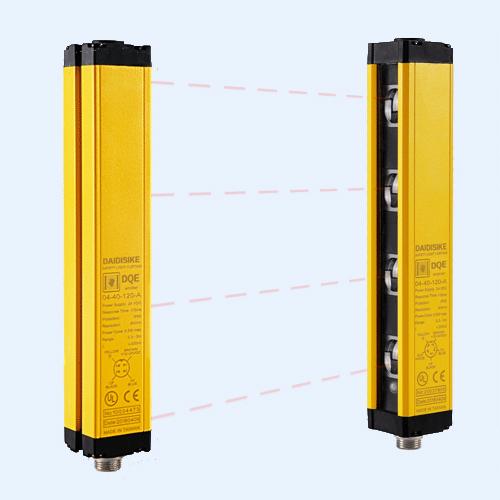
Thai buyers arrive here from a few clear directions: pricing a Type 4 ม่านแสงนิรภัย for a press or stamping line; looking for an เทียบเท่า / แทน (equivalent / replacement) to the Omron, SICK, Keyence, Pilz or Autonics they already run; scoping AGV/AMR scanner protection for a new intralogistics fleet; or doing the TIS, Form E and customs homework before importing from China. This guide answers all of those in order, with the EEC demand context, the Factory Act / B.E. 2564 compliance picture, honest certification, and no invented local presence.
Why is Thailand's EEC a strong safety-sensor market — and who is buying?
Thailand is the “Detroit of Asia,” and that automotive density is the anchor demand story for machine-guarding hardware. Thailand is Southeast Asia's largest automobile producer and exporter (around 10th largest globally), building 1,468,997 vehicles in 2024 (down 19.9% year-over-year), with the Federation of Thai Industries projecting roughly 1.50 million units for 2025 (about 1.0M for export and 0.5M domestic). Don't read the 2024 dip as a collapse — the 2025 projection holds the line, and the press/stamping, body-shop and conveyor density it represents is exactly where light curtains, safety relays, two-hand controls and guard-locking switches get installed. The auto cluster concentrates around Bangkok and the Eastern Economic Corridor (EEC) — the special economic zone spanning Chonburi, Rayong and Chachoengsao at the core of the “Thailand 4.0” strategy targeting next-gen automotive, smart electronics, robotics and logistics.
The demand isn't only automotive. Thailand is the world's second-largest HDD producer after China, with Western Digital, Seagate and Toshiba plants in Ayutthaya, Chonburi, Prachinburi and Nakhon Ratchasima; Western Digital alone employs about 28,000 people in Thailand and HDD-related exports run around THB 200 billion a year (the BOI approved WD's ~THB 23.5 billion expansion in 2024). On top of that sits a large rubber-glove and food-processing sector — major makers run multiple factories with combined installed capacity exceeding 52 billion gloves per year — all of which means small presses, palletizers, conveyor guarding and washdown-rated sensing. Province roles inside the EEC: Chonburi for established automotive + electronics supply chains, Rayong for chemicals, EV and battery assembly, and Chachoengsao for smart-manufacturing greenfield.
| Region / cluster | Dominant sectors | Heaviest safety-sensor demand |
|---|---|---|
| Chonburi (EEC) | Automotive + electronics supply chains, Laem Chabang port | Light curtains, safety relays (stamping, body-shop) |
| Rayong (EEC) | Chemicals, EV & battery assembly, heavy industry | Type 4 curtains, guard-locking switches, AGV scanners |
| Chachoengsao (EEC) | Smart manufacturing, greenfield automation | Robot-cell guarding, proximity sensors, relays |
| Ayutthaya / Prachinburi / Nakhon Ratchasima | Electronics / HDD (WD, Seagate, Toshiba) | Curtains, proximity sensors, palletizing guarding |
| Greater Bangkok & central plain | Food processing, rubber/gloves, packaging | Muting curtains, conveyor guarding, washdown sensors |
Production, employment, export and port figures above are published industry data (MarkLines / Just-Auto / EOS Global / Lexology / Tom's Hardware / ASEAN Briefing) describing the demand backdrop — not DAIDISIKE projections, and not a Thailand-specific unit-demand figure for safety sensors, which is not separately published.
What does a ม่านแสงนิรภัย cost in Thailand — and where does factory-direct fit?
Branded Type 4 barriers carry a real premium through the Thai distributor channel; factory-direct removes the importer/distributor margin layer. The verifiable anchors are published Thai distributor listings: safety light curtains commonly run in the rough range of THB 44,000 to THB 118,000 by spec (e.g. SCMA listings up to ~THB 118,400; IO Tech Mall lists a curtain model around THB 44,030), with a safety-relay module around THB 6,475. Omron, SICK, Keyence and Pilz sit in comparable premium territory through their networks; Autonics already plays the value card. DAIDISIKE sits deliberately in that gap: branded-grade Type 4 / PL e at China factory-direct price, quoted FOB China. We will not publish a fixed percentage undercut — your landed baht depends on freight, import duty on the CIF value, the 7% VAT and your forwarder — but the structural saving is the distributor margin you stop paying, and ACFTA Form E can cut the duty on top.
| Channel (Thailand) | Price reference | What it is | Where DAIDISIKE sits |
|---|---|---|---|
| Local distributor (anchor) | ≈ THB 44,000–118,000 (SCMA / IO Tech Mall curtains) | Branded Type 4 barrier, local stock | Same class, factory-direct |
| Omron / SICK / Keyence / Pilz | Premium (distributor + support) | Genuine Type 4, ASEAN service hub | Like-for-like, lower cost |
| Autonics (value) | Mid (regional distributors) | Broad low/mid range | Beats Autonics-tier on direct price |
| DAIDISIKE (FOB China) | Quoted per configuration, MOQ 1 | Type 4 / PL e, IEC 61496 | Factory-direct, MOQ 1 set |
The baht figures are published third-party distributor listings (SCMA, IO Tech Mall) used as price anchors, not DAIDISIKE quotes; we quote your exact configuration FOB and supply the export documents — including ACFTA Form E — that your broker needs.
Who supplies safety sensors in Thailand — and how is buying factory-direct different?
The channel is owned by entrenched incumbents with real local entities and ASEAN service hubs; that is the wall, and the white-space is price + MOQ. SICK (SICK (Thailand) Co., Ltd.) operates from Rama 9 Road, Huai Khwang, Bangkok as a regional ASEAN sales and service hub. Omron Industrial Automation Thailand markets a full safety range (guard monitoring, intrusion detection) from a Bangkok office plus a named distributor network. Pilz South East Asia (Thailand) Co., Ltd. has a direct Chatuchak office, and its PNOZ line is a de-facto standard for safety relays. Keyence runs a premium direct-sales / quote-on-request model, and Autonics competes as the value alternative through regional distributors. Local resellers such as SCMA (ifm safety lines) and QForce (Leuze) carry safety product with published baht pricing.
DAIDISIKE is the factory itself — a China-based manufacturer (est. 2013, exporting to 20+ countries) selling direct. We do not operate a Thai office, warehouse or appointed ตัวแทนจำหน่าย; you import directly from us under your own company. Chinese factory-direct brands are largely absent from the formal distributor channel, so the honest pitch pairs the price/MOQ advantage with the things buyers actually value — verifiable Type 4 / PL e architecture, clean export documentation and Form E, and application support for muting and AGV-scanner integration. The incumbents' real edge is local stock and the engineers behind it; most concentrate their offices in Bangkok (Huai Khwang / Chatuchak), so EEC-based factories often rely on distributor stock plus remote support — a gap a responsive factory engineer can help close.
What is a good alternative to Omron, SICK, Keyence or Pilz that keeps the safety class?
A like-for-like Type 4 device matched on the four numbers that define a curtain — not a downgrade. Thai engineers benchmark curtains against SICK (C4000, deTec), Omron (F3SG), Keyence (GL-R / SL-V), Banner (EZ-SCREEN), Leuze and Autonics, and relays against Pilz PNOZ. They search with mixed intent like “ม่านแสงนิรภัย Keyence เทียบเท่า”, “safety relay แทน Pilz” or “Pilz PNOZ ราคา” — Thai industry mixes transliterated English with Thai, and often types the English model directly. To swap safely, line up resolution (14 mm finger or ~30 mm hand), protective height, sensing range and output/OSSD type, and a DAIDISIKE DQC / DQA / DQT4 drops into the same ISO 13855 safety-distance envelope the outgoing barrier occupied — same IEC 61496-1/-2 and ISO 13849-1 architecture, dual-channel OSSD, EDM.
| Brand / series (Thailand) | Origin | Class | DAIDISIKE like-for-like |
|---|---|---|---|
| SICK C4000 / deTec | Germany | Type 4 | DQT4 (Type 4 / PL e) |
| Omron F3SG-RA | Japan | Type 4 | DQC · DQT4 |
| Keyence GL-R / SL-V | Japan | Type 4 | DQC · DQT4 |
| Banner EZ-SCREEN / Autonics | USA / Korea | Type 4 / Type 2 | DQA (10–30 mm) · DQC |
| Pilz PNOZ (safety relay) | Germany | PL e / SIL 3 | DA31 / DA31-B relay |
| Euchner / Schmersal (guard-lock) | Germany | ISO 14119 | DX-series · DX-R1-B |
Every brand name above is used nominatively for comparison from public knowledge — no partnership or endorsement is implied, and we never quote a competitor parameter we can't verify. For full model-by-model maps, see the Pilz PNOZ safety-relay alternative guide and the Autonics light-curtain & switch alternative guide.
Power press, stamping & body-shop: which curtain, what resolution, and how far back?
Press, stamping and automotive body-shop lines are the heaviest Thai use-case — a Type 4 curtain mounted to the ISO 13855 distance is the right class, and the Factory Act guarding duty is the legal hook. Thai stampers in the EEC run mechanical and hydraulic presses where the point-of-operation guarding question is non-negotiable. Resolution selection comes first: use a 14 mm-resolution curtain for finger protection right at the point of operation, and a ~30 mm curtain for hand detection. DAIDISIKE's DQA covers 10–30 mm finger/hand; the DQC (resolutions 10/14/20/25/30/40/80/200 mm, range 0.3–3 m, IP65, response ≤15 ms, dual-channel NPN/PNP with EDM/OSSD) and the DQT4 cover Type 4 hand guarding suitable for PL e when integrated with a certified relay.
The complete stop function — sensor plus logic plus actuator — is what reaches a Performance Level, not the curtain alone. The architecture diagram below shows the dual-channel chain (ISO 13849-1) that turns a Type-4 sensor into a PL e function: the curtain's OSSD pair into a force-guided safety relay with EDM, which commands the machine contactors. DAIDISIKE supplies the curtain + the DA31 relay; your integrator validates the complete function on the actual machine.

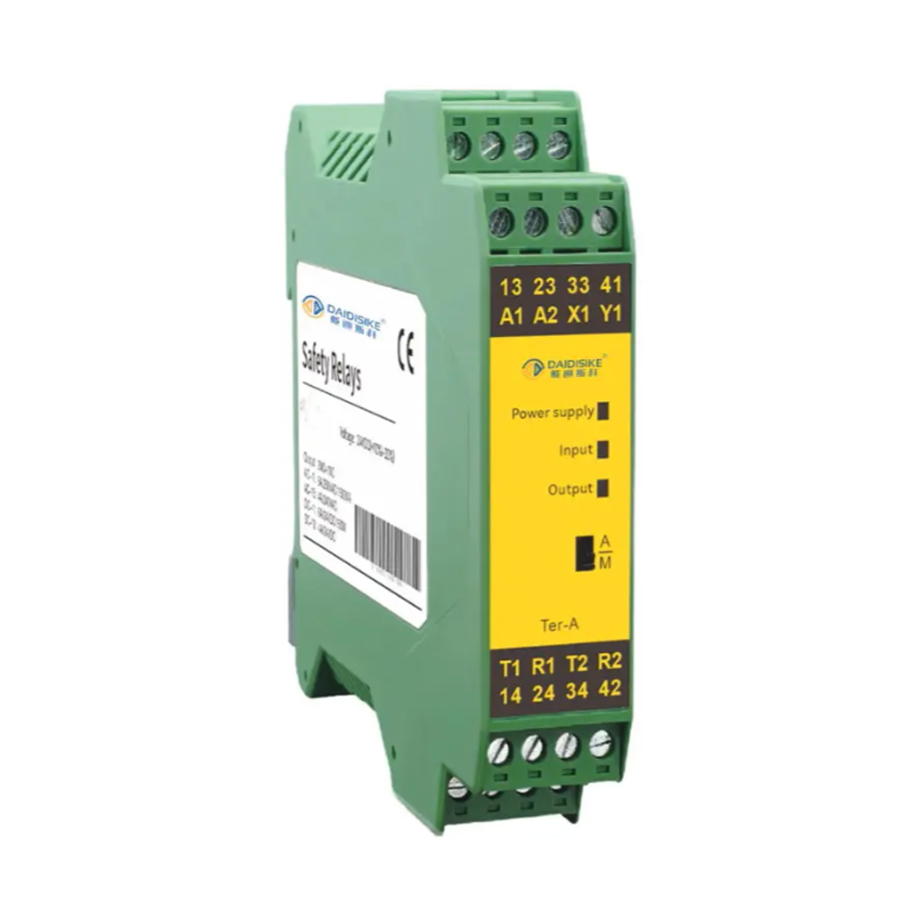
Close the circuit with a DA31 safety relay (เซฟตี้รีเลย์, designed to ISO 13849-1 PL e and IEC 62061 SIL 3, 22.5 mm width, 3NO+1NC, force-guided contacts, EDM) so the stop command is itself control-reliable. Thai engineers say both เซฟตี้รีเลย์ (transliterated, most common on listings) and รีเลย์นิรภัย; both mean the same module.
Conveyor in-feed / palletizing: how does muting let pallets pass without dropping protection?
On automotive part-transfer, electronics finishing and food-processing palletizing lines, muting is what lets material through the curtain while people are still stopped. A muted Type 4 curtain at a conveyor entry/exit temporarily and automatically suspends the protective function for the brief window a pallet or workpiece breaks the beams — distinguished from a person by the sequence and timing of two or more independent muting sensors — then re-arms. Get the sequence or geometry wrong and you either nuisance-stop the line or, far worse, leave a hole a person can walk through. The sequence diagram below shows the correct muting-sensor order and the timing window for a valid material pass-through.

Does Thai law require a Type 4 light curtain — Factory Act, B.E. 2564 and the IEC/ISO stack?
Thai law imposes a general machine-guarding duty but does not name a specific device — the technical spec comes from the harmonized IEC/ISO standards Thai plants adopt. Machine guarding is mandated under the Factory Act B.E. 2535 (1992) and the Occupational Safety, Health and Environment Act B.E. 2554 (2011), with the current operative rule the Ministerial Regulation on Standards for OSH Management and Operation of Machinery, Cranes and Boilers B.E. 2564 (2021) (gazetted 6 August 2021, replacing the B.E. 2552 version). These require dangerous moving parts and conveyors to be guarded, hazard zones to be designated, and machines to be kept in safe condition — enforced by the Department of Industrial Works (กรมโรงงานอุตสาหกรรม) under the Ministry of Industry. Public sources confirm only this general duty — there is no Brazil-NR-12-style statute naming Type-4 curtains by device.
In practice, because so many EEC plants supply global OEMs or export to the EU, safeguarding is specified to the same internationally harmonized stack the rest of the world uses: IEC 61496-1/-2 (Type 4 ESPE), ISO 13849-1 (PL up to PL e / Cat.4) and IEC 62061 (SIL up to SIL 3), ISO 13855 (safety distance S = K·T + C), ISO 13851 (two-hand control for presses), ISO 14119 (guard interlock / guard-locking) and ISO 13850 (e-stop). So a Type 4 ม่านแสงนิรภัย mounted at the ISO 13855 distance and wired through a PL e เซฟตี้รีเลย์ is the best-practice EHS arrangement that satisfies the guarding duty. Note this workplace-safety obligation (on the employer, confirmed by your เจ้าหน้าที่ความปลอดภัย / จป.) is separate from the TIS / มอก. product-marking question covered below. See our ISO 13855 safety-distance guide for the calculation that backs the mounting.
AGV & AMR intralogistics: which safety laser scanner, and what fields?
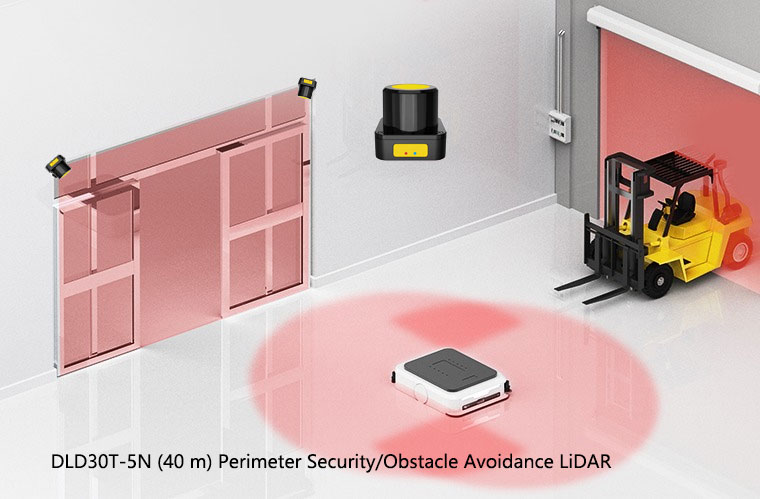
EEC intralogistics — moving parts and pallets between stamping, assembly and warehousing across automotive, electronics and F&B — is the fastest-growing scanner segment. AGV/AMR adoption is rising regionally as a global trend (Thailand-specific AGV demand figures are not published, so treat this as the regional trend applied to the EEC, not a Thai statistic). A safety scanner projects a protective field (slow/stop) and a warning field (pre-warn / speed-reduce) around the vehicle, switching field sets with speed and direction. DAIDISIKE's DLD-series — including the DLD30T-5N (40 m range, up to 30 Hz, IP67, 905 nm Class 1 laser, RS485/Modbus) — covers obstacle-avoidance and perimeter duty for AGV/AMR, gates and safety passages.
One honest caveat: the DLD-series is published as an obstacle-avoidance / perimeter LiDAR with Modbus output, not a third-party-certified Type-3 safety laser scanner. Position it for area monitoring and AGV navigation/obstacle-avoidance duty — not as a drop-in replacement for a certified safety scanner on a PL d stop function. If your application needs a certified safety-rated stop, tell us the required PL and we'll advise honestly rather than oversell the box.
Can I import safety sensors from China to Thailand — MOQ, Laem Chabang, and Incoterms?
Yes — and the MOQ objection is backwards: ours is 1 set, with a 3–15 day lead. Order a single sample, validate it against your ISO 13855 distance, fit-check brackets and OSSD wiring, then repeat at volume. The main gateway is Laem Chabang (Chonburi) — Thailand's largest deep-sea port, about 120 km southeast of Bangkok, the EEC's own port, which handled over 7 million TEU in 2024 and roughly 98% of Thailand's vehicle exports (a Phase 3 expansion targets up to 18M TEU by 2030); Bangkok Port (Klong Toey) is secondary. Port-to-port sea transit from major Chinese ports to Laem Chabang is roughly 5–10 days FCL; door-to-door commonly 10–18 days; LCL ~11–17 days — carrier/route dependent, so build a buffer into line-retrofit schedules rather than treating these as guarantees.
The Incoterms reality. The common terms are FOB China (you control freight) or CIF Laem Chabang (we arrange freight + insurance) — and note Thai customs values import duty on the CIF value, so the Incoterm choice affects your dutiable base. China forwarders also offer DDP, which bundles freight + clearance + duty + tax into the supplier quote and shifts that burden to the seller side. Payment is typically T/T wire, frequently a 30% deposit / 70% balance before shipment or after inspection; an L/C is typical for higher-value or first-time deals, and Alibaba Trade Assurance / escrow (~2–3% fee) is a lighter alternative.
TIS / มอก., import duty, 7% VAT & ACFTA Form E — the import questions to settle first
Three things gate a clean import: the TIS / มอก. marking question, the duty/VAT math, and the Form E duty saving. On TIS / มอก.: Thailand's conformity scheme is run by TISI (สมอ.) under the Industrial Product Standards Act B.E. 2511, with a mandatory red มอก. mark for products on the compulsory list and a voluntary mark. The mandatory list is dominated by household appliances, lighting, wires/cables, plugs/sockets and distribution boards — not industrial machine-safety control gear. Public sources did not confirm a mandatory TIS number for safety light curtains, relays or laser scanners (HS 8536 / 9031), so whether a given SKU is mandatory-TIS, voluntary-TIS or out of scope is item-specific. Verify per HS code with TISI directly or a local certification body (TÜV SÜD, TÜV Rheinland, Bureau Veritas or UL all run TISI-access services) before importing. Separately, any wireless-enabled device needs NBTC (กสทช.) approval. DAIDISIKE does not hold or claim a TIS mark; we supply the technical file (CE self-declared to IEC 61496, ISO 9001, TÜV per order) to support your classification.
On duty and VAT: Thai import duty is ad valorem on the CIF value and spans a wide range (sources cite roughly 0–80%) depending on HS classification, so have your broker classify the exact tariff line rather than trusting a printed percentage. VAT is the standard 7%, charged on CIF value plus import duty (plus excise where applicable). The key duty lever: under the ASEAN–China FTA (ACFTA), many machinery parts and components qualify for 0% or sharply reduced duty when accompanied by a valid Certificate of Origin Form E (RCEP origin documentation is an alternative); without a valid CO the MFN rate applies. Form E does not automatically yield 0% — eligibility depends on the product's tariff line and the ACFTA schedule.
This is where buying from the China manufacturer directly helps: DAIDISIKE, as the origin factory, can issue the Form E and the commercial documents your Thai broker files to claim the ACFTA rate — a concrete duty lever that an in-country distributor reselling already-landed stock can't offer you. Confirm the precise HS classification (พิกัดศุลกากร), the duty rate and Form E eligibility with your Thai customs broker before ordering; we won't print a rate that may not apply to your exact line. Treat the 7% VAT, the 0–80% duty range and the TIS scope as figures to re-verify against official Thai Customs / TISI sources at order time.
What else does DAIDISIKE supply into Thailand — switches, proximity, full circuit?
The whole safety circuit from one factory — curtains, safety LiDAR, relays, coded/guard-locking switches and proximity sensors. A curtain rarely ships alone, and each line has its own Thai “ราคา / ขอราคา / จำหน่าย” search demand. For AGV/AMR protection the DLD-series above; the DA31 / DA31-B เซฟตี้รีเลย์ closes the stop loop; the DX-R1-B coded magnetic switch (designed to ISO 14119 Type 4 / ISO 13849-1 PL e Cat.4) and DX-series guard-locking switches (สวิตช์ประตูนิรภัย, mechanical interlock + electromagnetic guard-locking, holding force up to 1300 N, IP67, mechanical life >1,000,000 cycles) handle robot-cell and press-fence doors; and inductive proximity sensors (พร็อกซิมิตี้เซนเซอร์) in M8/M12/M18/M30 (3-wire NPN/PNP, NO/NC, IP67/IP68) cover ram-position, top-of-stroke and conveyor indexing — all factory-direct from the same supplier, MOQ 1 set.
Send the four numbers off your press or line — resolution (14 mm finger / 30 mm hand), protective height, sensing range, output/OSSD type — plus quantity, whether you need muting at a conveyor, and whether you want FOB or CIF Laem Chabang, and we'll return a firm quote, a 3–15 day lead, ACFTA Form E and the export documents your broker needs. Sample at MOQ 1 set.
Contact DAIDISIKE → | Phone / WhatsApp +86 15218909599 · 915731013@qq.com
Sources & references
- DAIDISIKE — DQC Type 4 safety light curtain and the DQA finger/hand model — published resolutions and OSSD interface.
- IEC 61496-1/-2/-3, ISO 13849-1 (PL), IEC 62061 (SIL) and ISO 13855 — the standards that fix Type 4 architecture, PL e and the safety-distance calculation referenced throughout; ISO 13851 (two-hand), ISO 14119 (guard interlock), ISO 13850 (e-stop).
- Factory Act B.E. 2535 (1992); OSHE Act B.E. 2554 (2011); Ministerial Regulation on Machinery, Cranes & Boilers B.E. 2564 (2021) — machine-guarding duty enforced by the Department of Industrial Works (DIW), Ministry of Industry (Lexology / JETRO). Confirm your machine risk assessment with your เจ้าหน้าที่ความปลอดภัย (จป.).
- TIS / มอก. — TISI (สมอ.), Industrial Product Standards Act B.E. 2511; mandatory vs voluntary marks. No mandatory TIS confirmed for HS 8536/9031 safety sensors — verify per HS code with TISI or a local certification body (TÜV SÜD / TÜV Rheinland / Bureau Veritas / UL). Wireless devices need NBTC (กสทช.) approval.
- Thailand market & industry data — vehicle production (MarkLines / Just-Auto / EOS Global), HDD sector (Tom's Hardware / thailand-business-news), EEC (Lexology / Mahanakorn Partners), Laem Chabang TEU (ASEAN Briefing / UNISCO); treated as published context, not DAIDISIKE figures.
- Import mechanics — import duty ad valorem on CIF (0–80% by HS), VAT 7%, ACFTA Form E / RCEP origin; T/T & L/C payment. Confirm the live HS classification, duty and Form E eligibility with your Thai customs broker.
- Incumbent channel & Thai pricing — SICK (Thailand) Co., Ltd. (Rama 9, Huai Khwang), Omron Industrial Automation Thailand, Pilz South East Asia (Thailand) (Chatuchak), Keyence, Autonics; SCMA / IO Tech Mall published baht curtain & relay listings used as anchors, not DAIDISIKE quotes.