
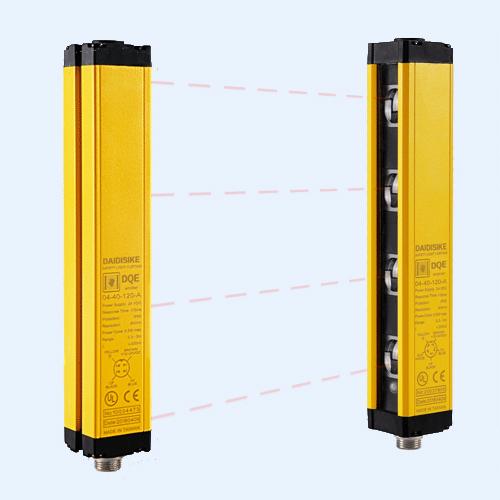
Russian and EAEU buyers reach this page from a few clear directions: looking for an аналог (analog / equivalent) of a SICK or Pilz product they can no longer get through the authorized channel; doing the EAC / TR CU certification homework before importing; scoping a safety circuit for a reopened automotive line, a packaging machine or a new AGV fleet; or working out how payment and logistics actually function under sanctions. This guide answers all of those in order, with the market context, honest certification, qualified logistics, and no invented local presence.
Why is there a brand vacuum — and where does a China factory fit?
After 2022, the Western safety-automation incumbents stopped being reliable authorized suppliers, and that is the structural opening. More than a thousand Western firms curtailed Russian operations, and sanctions specifically target dual-use “laser sensors”, “optical measurement systems” and “infrared detectors” — exactly the category safety light curtains and scanners sit in. Those goods now reach Russia mainly through grey parallel-import / transshipment networks, which means real-world problems for integrators: uncertain availability, longer lead times and added markup from intermediaries, and curtailed warranty and technical support from the original OEM. The recognized category leaders Russian buyers used to rely on (SICK, Pilz, Schmersal, Leuze) are precisely the names now appearing in “аналог SICK”, “аналог Pilz” and “замена сканеров безопасности SICK” searches.
DAIDISIKE is that still-shipping factory — a China-based manufacturer (est. 2013, exporting to 20+ countries) selling direct. The lane is real: China–Russia trade hit a record USD 244.8bn in 2024, with machinery & equipment around USD 27.29bn of China's exports to Russia. We do not operate a Russian office, warehouse or appointed distributor; you buy direct from the factory with MOQ 1 set, so you can sample a curtain or relay, bench-test it, and validate the EAC route before committing to volume.
Which Russian sectors are buying — automotive, packaging, electronics, AGV?
The demand is concentrated in reopening and import-substituting industries that all need point-of-operation and perimeter guarding. Russian vehicle production rose 16.5% to 985,400 units in 2024, and shuttered Western auto plants reopened under Russian/Chinese operators — the ex-Nissan plant near St. Petersburg (now AvtoVAZ “Xcite”), AGR in Leningrad region, Sollers in Ulyanovsk and Vladivostok, AvtoVAZ in Tolyatti and Izhevsk, and Haval/Great Wall in Tula. These are stamping/press, body-weld and assembly lines — core users of light curtains, guard-locking switches and safety relays. The table below maps the live sectors to the products they pull.
| Russian sector (verified driver) | Where | DAIDISIKE products pulled |
|---|---|---|
| Automotive — reopened press/weld/assembly lines | St. Petersburg, Leningrad obl., Tolyatti, Izhevsk, Ulyanovsk, Tula | Type 4 curtains (DQC/DQT4), DA31 relay, DX guard-locking switches |
| Industrial SEZs — auto components, machinery, electronics | Alabuga (Tatarstan), Lipetsk SEZ | Curtains, relays, proximity sensors |
| Electronics / cleanroom (state import-substitution funding) | Zelenograd — Mikron, Angstrem, Milandr | Light curtains, presence sensing, proximity |
| Food / beverage & packaging machinery | Nationwide import-substitution build-out | Curtains (DQR IP68 washdown), relays, switches |
| Warehouse robotics / AGV-AMR (fast-growing segment) | e.g. RoboCV at Knauf, Krasnogorsk (2024) | DLD-series safety laser scanners / LiDAR |
Two macro tailwinds reinforce this: a record-low unemployment rate (~2.4%) is pushing automation, and Russia approved a national project “Production and Automation Equipment” (2024–2030, ~RUB 300bn) targeting ~145 robots per 10,000 workers by 2030 — up from only ~29/10,000 at end-2024. Every new robot cell needs perimeter guarding and a control-reliable safety circuit, which is exactly what we build.
Is the DA31 a good аналог for a Pilz PNOZ safety relay?
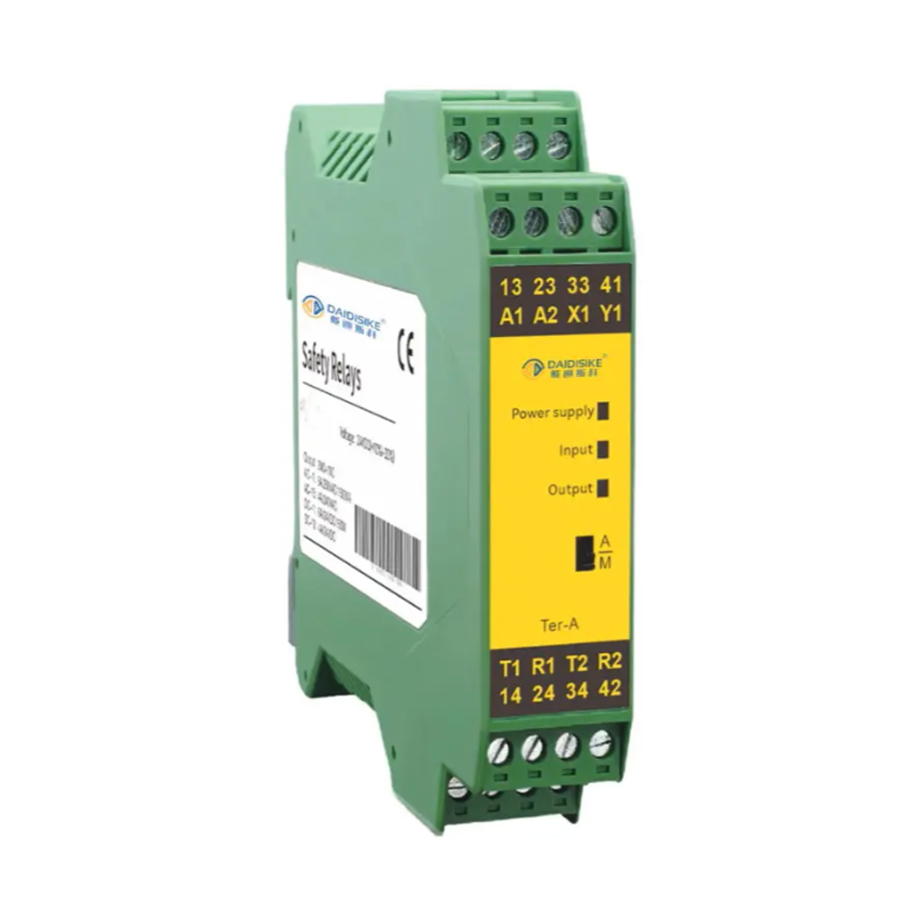
Yes, as a PNOZ-class replacement — same job, same architecture — but we position it honestly, not as a certified one-to-one equivalent. “Реле безопасности” is the single dominant Russian term, and “аналог Pilz PNOZ” / “аналог реле безопасности Pilz” are high-intent import-substitution searches. The DA31 does what a basic PNOZ-style E-stop / guard-monitoring module does: dual-channel safety inputs, force-guided (positively-driven) contacts, external device monitoring (EDM), fast response, on a 22.5 mm DIN-rail body, rated to PL e (ISO 13849-1) / SIL 3 at system level (IEC 61508/61511). To migrate, match the input type (E-stop, light-curtain OSSD, guard switch), the count and rating of NO/NC outputs, the reset mode, and the EDM loop, then rewire to the same architecture shown below.

What is a good аналог / replacement for SICK or Leuze light curtains and scanners?
A like-for-like Type 4 device that keeps the safety class — matched on the four numbers that define a curtain. Russian distributor pages literally title themselves “замена сканеров безопасности SICK” (replacement for SICK scanners) and “доступная замена SICK” (affordable SICK replacement), so the replacement intent is explicit. To swap a curtain, line up resolution (14 mm finger or ~30 mm hand), protective height, sensing range and output/OSSD type, and a DAIDISIKE DQC / DQA / DQT4 drops into the same ISO 13855 safety-distance envelope the outgoing unit occupied. For AGV scanners, match the protective-field radius and response time.
| Western brand / series (RU search) | Origin | Category | DAIDISIKE like-for-like |
|---|---|---|---|
| SICK C4000 / M4000 / deTec | Germany | Type 4 light curtain | DQT4 (Type 4 / PL e) · DQC |
| SICK nanoScan3 / microScan3 / outdoorScan3 | Germany | AGV safety laser scanner | DLD-series safety LiDAR (5–40 m) |
| Pilz PNOZ | Germany | Safety relay | DA31 / DA31-B (PNOZ-class) |
| Leuze RSL / MLC | Germany | Scanner / Type 4 curtain | DLD-series · DQT4 |
| Schmersal AZM / Pizzato / Euchner | Germany / Italy | Guard-locking door switch | DX-series (up to 1300 N) |
| Balluff / ifm / Contrinex / Pepperl+Fuchs | Germany / Switzerland | Inductive proximity sensor | M8 / M12 / M18 / M30 inductive |
Every brand name above is used nominatively for comparison from public knowledge — no partnership or endorsement is implied, and we never quote a competitor parameter we can't verify or claim a certified equivalence. For full model-by-model maps, see the brand replacement & compatibility hub and the SICK / Keyence light-curtain alternatives guide.
How do you mount a Type 4 curtain to the ISO 13855 safety distance?
The curtain has to sit far enough from the hazard that the machine stops before a hand reaches it — that distance is calculated, not guessed. ISO 13855 fixes the minimum safety distance from the approach speed and the total system response time (curtain + relay + machine stopping time), and the chosen resolution feeds the calculation (14 mm finger detection allows a shorter distance than a 30 mm hand-detection field for the same geometry). Get this wrong and a fast hand reaches the point of operation before the stroke stops — which is the whole reason a Type 4, control-reliable system exists. Work it through with our ISO 13855 safety-distance calculator and the ISO 13855 guide.

What EAC / TR CU certification do safety sensors need for the EAEU?
EAC conformity (Евразийское соответствие) is mandatory and one document covers all five EAEU states. The single market is the EAEU — Russia, Belarus, Kazakhstan, Armenia, Kyrgyzstan — and the EAC mark must be affixed to the product or packaging; goods placed on the market without it risk fines or confiscation. For electronic safety sensors the relevant technical regulations are TR CU 020/2011 (EMC, in force since 15 Feb 2013) and, where the device is supplied as a safety component of a machine, TR CU 010/2011 “On the safety of machinery and equipment”; TR CU 004/2011 (low-voltage) applies only above its voltage threshold, so a 24 V DC sensor may fall below it.
Conformity is shown by a Certificate of Conformity (Сертификат соответствия — accredited body, accredited-lab testing) or a Declaration of Conformity (Декларация о соответствии); common schemes include Scheme 1c (serial production, factory audit + annual surveillance) and Scheme 3c (single batch, no audit), and a serial-production certificate is typically valid up to 5 years. Manuals/passports and labels must be translated into Russian, and a Chinese manufacturer without an EAEU legal entity normally needs an authorized representative/applicant inside the union to hold the certificate.
How do payment (RUB / CNY) and logistics (rail / sea) actually work?
Settlement has pivoted to rubles and yuan, and rail is often the fastest reliable route — but plan for friction. Roughly 99% of China–Russia trade now settles in RUB/CNY, so a “price in yuan, no USD/EUR exposure” arrangement is normal. The honest caveat: even CNY settlement has been strained because several Chinese banks have slowed or paused Russia-related payments over secondary-sanctions concerns, which can add delays — so deals are frequently handled through Chinese intermediary/agent companies that also bundle transport and customs (the DDP-agent model). On logistics, the table is the quick reference buyers ask for.
| Route (China → Russia) | Gateway | Typical transit* | Best for |
|---|---|---|---|
| Rail | Manzhouli–Zabaykalsk (busiest crossing) | ~12–18 days to European Russia | Electronics; faster & more on-time than W. sea |
| Sea — Pacific | Vladivostok / Vostochny | ~10–15 days | Fastest sea gateway + onward rail |
| Sea — Baltic / Black Sea | St. Petersburg / Novorossiysk | ~30–40 days (transshipped) | European / southern Russia bulk |
*Typical forwarder ranges, not guarantees; border congestion at Zabaykalsk can vary. DDP door-to-door (we / our forwarder handle Russian customs clearance and duty/VAT) is very common on this lane; FOB and CIF are also available. On duty and tax: import duty is ad-valorem on the customs value and depends on the binding TN VED (HS) code — we won't print a percentage that could be stale, so confirm it with your customs broker. VAT (НДС) was historically 20% and rose to 22% effective January 2026 (Federal Law No. 425-FZ), so use the rate in force on your clearance date; all duties and VAT are paid in rubles before clearance completes.
What else does DAIDISIKE supply into Russia — scanners, switches, proximity?
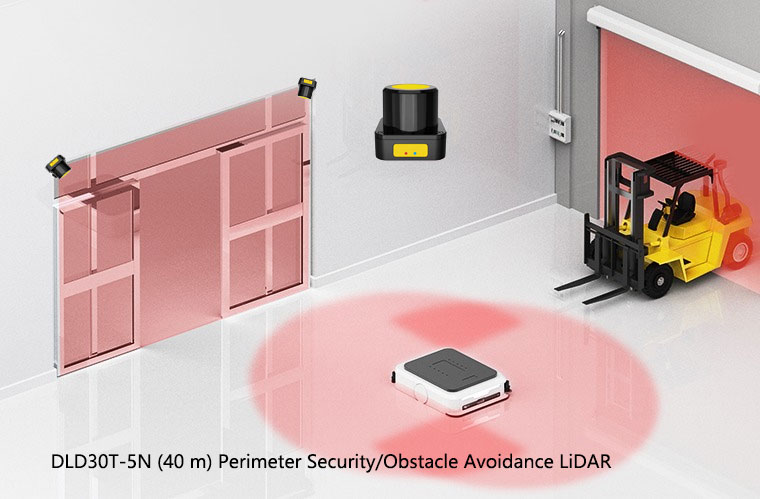
The whole safety circuit from one factory — curtains, LiDAR, relays, guard-locking switches and proximity sensors. A curtain rarely ships alone, and each line has its own Russian “купить / цена / со склада” search demand. For AGV/AMR mobile-robot protection — a growing Russian intralogistics market — the relevant line is our safety laser scanners / LiDAR (лазерный сканер безопасности для AGV): DLD05A3 (5 m), DLD20A5 (20 m), DLD30T-5N (40 m perimeter) and the SDLD-05A TOF (14 m), built to the IEC 61496-3 architecture (CE self-declared; we do not claim Type 3 certification). The DA31 / DA31-B safety relay closes the stop loop; DX-series non-contact coded and guard-locking door switches (дверной выключатель безопасности / выключатель блокировки двери защитного ограждения, holding force up to 1300 N) handle doors and gates; and inductive proximity sensors (индуктивный датчик приближения / бесконтактный выключатель) in M8/M12/M18/M30 (NPN/PNP, NO/NC, IP67/IP68) cover position sensing.
Tell us which brand/model you're replacing (аналог SICK / Pilz / Leuze…) and the four numbers off your line — resolution (14 mm finger / 30 mm hand), protective height, sensing range, output/OSSD type — plus quantity, preferred Incoterm (FOB / CIF / DDP), payment channel (RUB/CNY) and EAC needs, and we'll return a firm quote, the documents your certification body and customs broker need, and a realistic lead time. Sample at MOQ 1 set.
Contact DAIDISIKE → | Phone / WhatsApp / WeChat +86 15218909599 · 915731013@qq.com
Sources & references
- DAIDISIKE — DQC Type 4 safety light curtain and the DA31 safety relay — published resolutions, OSSD interface and PL e / SIL 3 rating.
- IEC 61496-1/-2/-3, ISO 13849-1 (PL), ISO 13855 (safety distance) and IEC 61508/61511 (SIL) — the standards that fix Type 4 architecture, PL e and the safety-distance calculation referenced throughout.
- EAEU technical regulations — TR CU 010/2011 (machinery), TR CU 020/2011 (EMC), TR CU 004/2011 (low-voltage); EAC mark mandatory across all five EAEU states. Confirm the applicable TR, scheme and document with a local EAEU-accredited certification body.
- China–Russia trade and sector data — record USD 244.8bn 2024 trade and ~USD 27.29bn machinery exports (chinadaily.com.cn / investing.com); RUB/CNY settlement share (carnegieendowment.org / merics.org); auto-output and reopened-plant, SEZ, electronics, packaging and warehouse-robotics figures per the market research cited in the body.
- Logistics & tax — Vladivostok / St. Petersburg / Novorossiysk sea transit and Manzhouli–Zabaykalsk rail ranges (forwarder sources); Russian VAT 20% historical → 22% from Jan 2026 (Federal Law No. 425-FZ). Duty/HS classification per your Russian customs broker.