
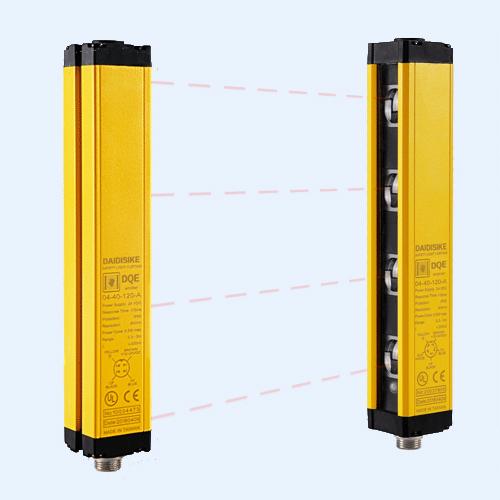
Mexican buyers arrive here from a few clear directions: pricing a Type 4 cortina de luz de seguridad for a press or body-shop cell; looking for an alternativa a SICK / Banner / Allen-Bradley they already run; scoping AGV/AMR scanner protection for a new intralogistics line; or doing the customs and 2026-tariff homework before importing from China. This guide answers all of those in order, with the nearshoring demand context, NOM-004-STPS compliance, honest certification, and no invented local presence.
Why is Mexico the hottest safety-sensor market right now — and who is buying?
Nearshoring has turned Mexican manufacturing into the anchor demand story for machine-guarding hardware. Mexico built a record ~3.99 million light vehicles in 2024 (up 5.56% on 2023, with ~87% exported), and EV output jumped from 6,717 units in 2020 to 206,870 in 2024 — automotive and EV are the heaviest users of light curtains and safety relays through their body-shop, stamping and assembly lines. The clusters concentrate in Puebla (VW/Audi), Guanajuato and San Luis Potosí, with the Bajío (Guanajuato / Querétaro / Aguascalientes) as the core nearshoring auto region. Monterrey / Nuevo León now counts 15 industrial clusters and ~50 major industrial parks and drew USD 4.15B FDI in 2025 (+162% YoY); Mexico captured over USD 18B in manufacturing FDI in 2024.
The demand isn't only automotive. Metal stamping and press shops (Tier-1/Tier-2) run mechanical and hydraulic presses where the point-of-operation is the canonical light-curtain + safety-relay + two-hand-control application. The border maquiladoras are dense: Ciudad Juárez has 321+ active manufacturing sites (INDEX Juárez reports 350+ operations across automotive, electronics and medical devices, with at least three new maquilas opened in 2024), and Tijuana specializes in electronics and medical devices. Guadalajara / Jalisco is the electronics-assembly and smart-packaging hub, and food & beverage makes up 45.1% of Mexico's packaging market — all robot-cell and line-guarding demand. Underneath it all, the Mexico factory-automation & industrial-controls market is about USD 5.90B in 2025 (~7.83% CAGR toward ~USD 8.60B by 2030), with field devices like sensors at 61.92% of revenue.
| Region / cluster | Dominant sectors | Heaviest safety-sensor demand |
|---|---|---|
| Bajío (Guanajuato / Querétaro / Aguascalientes) | Automotive, EV (core nearshoring auto region) | Light curtains, safety relays (body-shop, stamping) |
| Monterrey / Nuevo León | Sheet-metal fabrication, auto, 15 clusters / ~50 parks | Press guarding, AGV scanners, relays |
| Puebla / SLP | VW / Audi / GM / Stellantis / Mazda assembly | Type 4 curtains, guard-locking switches |
| Ciudad Juárez / Tijuana (border maquiladoras) | Electronics, medical devices, appliances | Curtains, proximity sensors, robot-cell guarding |
| Guadalajara / Jalisco | Electronics assembly, F&B / packaging | Light curtains, AGV/AMR scanners |
Market and FDI figures above are published industry data (TECMA / NAPS / Mordor Intelligence / American Industries) describing the demand backdrop — not DAIDISIKE projections, and not a Mexico-specific unit-demand figure for safety sensors, which is not separately published.
What does a cortina de luz de seguridad cost in Mexico — and where does factory-direct fit?
Branded Type 4 barriers carry a real premium through the Mexican distributor channel; factory-direct removes the importer/distributor margin layer. The verifiable retail anchor: Risoul lists an Allen-Bradley-channel Type 4 safety barrier (450L-B, 14 mm resolution, 600 mm) at roughly MXN $19,000, with a safety-curtain cable around MXN $850. SICK, Banner, Omron and Keyence sit in comparable premium territory through their networks. DAIDISIKE sits deliberately in that gap: branded-grade Type 4 / PL e at China factory-direct price, quoted FOB China. We will not publish a fixed percentage undercut — your landed MXN depends on freight, IGI duty, the 16% IVA and your agente aduanal — but the structural saving is the distributor margin you stop paying.
| Channel (Mexico) | Price reference | What it is | Where DAIDISIKE sits |
|---|---|---|---|
| Branded distributor (anchor) | ≈ MXN $19,000 (Risoul 450L-B, 14 mm / 600 mm) | Allen-Bradley-channel Type 4 barrier | Same class, factory-direct |
| SICK / Banner / Omron / Keyence | Premium (distributor + support) | Genuine Type 4, local stock | Like-for-like, lower cost |
| MercadoLibre Chinese product | Variable / unverified class | Mixed; verify Type rating | Factory-direct w/ documentation |
| DAIDISIKE (FOB China) | Quoted per configuration, MOQ 1 | Type 4 / PL e, IEC 61496 | Factory-direct, MOQ 1 set |
The MXN figure is a published Risoul listing used as a price anchor, not a DAIDISIKE quote; we quote your exact configuration FOB and supply the export documents your broker files with the pedimento.
Who supplies safety sensors in Mexico — and how is buying factory-direct different?
The channel is owned by entrenched incumbents with real local stock and engineering support; that is the wall, and the white-space is price + MOQ. SICK has the strongest footprint — SICK Automation Solutions S.A. de C.V. has been a subsidiary since 2008, headquartered in Silao, Guanajuato (the heart of the auto Bajío), distributed through ABT Automation, ISEL and Pymatek, with the full safety-light-curtain line (C4000, M4000, deTec) sold locally. Allen-Bradley / Rockwell GuardMaster is dominant via Risoul (22+ years, sales points in 22 Mexican cities, HQ Monterrey) and HERMOS (Querétaro / Guanajuato / SLP / Michoacán) — Rockwell leads the global machine-safety segment at ~12% share. Banner (EZ-SCREEN LS budget line), Omron, Keyence, Pilz and Schmersal are all present through Newark Electrónica México and local distributors.
DAIDISIKE is the factory itself — a China-based manufacturer (est. 2013, exporting to 20+ countries) selling direct. We do not operate a Mexican office, warehouse or appointed distribuidor; you import directly from us under your own RFC and Padrón de Importadores. Chinese factory-direct brands are largely absent from the formal distributor channel (some Chinese product appears on MercadoLibre), so the honest pitch pairs the price/MOQ advantage with the things buyers actually value — verifiable Type 4 / PL e compliance, clean export documentation, and application support — because the incumbents' real edge is local stock, distribution and the engineers behind it (Mexico faces a ~34% national shortage of qualified automation engineers, so integration support matters as much as the box).
What is a good alternative to SICK, Banner or Allen-Bradley that keeps the safety class?
A like-for-like Type 4 device matched on the four numbers that define a curtain — not a downgrade. Mexican engineers benchmark against SICK (C4000, M4000 Advanced, deTec), Banner (EZ-SCREEN LS), Allen-Bradley GuardMaster, Omron, Keyence, Pilz and Leuze, and they search with intent like “equivalente a SICK”, “alternativa a Banner” or “compatible con Allen-Bradley”. To swap safely, line up resolution (14 mm finger or ~30 mm hand), protective height, sensing range and output/OSSD type, and a DAIDISIKE DQC / DQA / DQT4 drops into the same ISO 13855 safety-distance envelope the outgoing barrier occupied — same IEC 61496-1/-2 and ISO 13849-1 PL e architecture, dual-channel OSSD, EDM.
| Brand / series (Mexico) | Origin | Class | DAIDISIKE like-for-like |
|---|---|---|---|
| SICK C4000 / M4000 / deTec | Germany | Type 4 | DQT4 (Type 4 / PL e) |
| Allen-Bradley GuardMaster (450L) | USA | Type 4 | DQC · DQT4 (PL e) |
| Banner EZ-SCREEN LS | USA | Type 4 | DQA (10–30 mm) · DQC |
| Omron F3SG-RA / MS4800 | Japan / US | Type 4 | DQC · DQT4 |
| Keyence GL-R / SL-V | Japan | Type 4 | DQC · DQT4 |
| Pilz / Leuze / Schmersal | Germany | Type 4 / Type 2 | DQC · DQA · DQT4 |
Every brand name above is used nominatively for comparison from public knowledge — no partnership or endorsement is implied, and we never quote a competitor parameter we can't verify. For full model-by-model maps, see the brand replacement & compatibility hub.
Power press, stamping & body-shop: which curtain, what resolution, and how far back?
Press, stamping and automotive body-shop lines are the heaviest Mexican use-case — a Type 4 curtain mounted to the ISO 13855 distance is the right class, and NOM-004-STPS is the legal hook. Mexican stampers run mechanical and hydraulic presses (commonly 10–350 tons) where the point-of-operation guarding question is non-negotiable. Resolution selection comes first: use a 14 mm-resolution curtain for finger protection right at the point of operation, and a ~30 mm curtain for hand detection. DAIDISIKE's DQA covers 10–30 mm finger/hand; the DQC and DQT4 cover Type 4 hand guarding up to PL e; the DQR is the IP-rated build for washdown F&B lines.
Mounting distance is not optional. The curtain must sit at the ISO 13855 safety distance computed from the system response time and approach speed, or a fast hand reaches the hazard before the stroke stops — the diagram below shows the protective field and the S = K·T + C relationship.

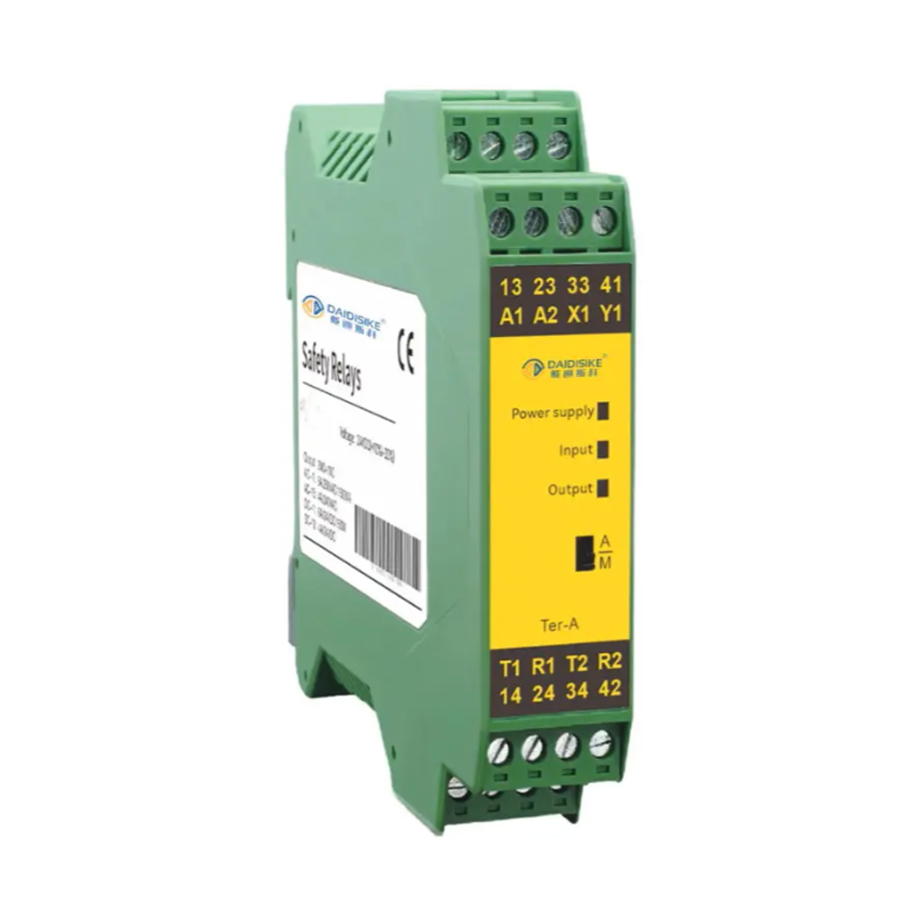
Close the circuit with a DA31 safety relay (relevador de seguridad, PL e / SIL 3, force-guided contacts, EDM, <30 ms) so the stop command is itself control-reliable — exactly the “risk-appropriate safety-function level” that the PROY-NOM-004-STPS-2020 update points toward. Mexican engineers more often say relevador de seguridad than relé de seguridad; both mean the same module.
What does NOM-004-STPS require — and does a light curtain satisfy it?
NOM-004-STPS is the legal demand mandate for the whole product category. It is the Mexican Official Standard (STPS labor ministry) governing protection systems and safety devices on machinery in the workplace, and it explicitly requires guarding on hazardous moving parts plus safety devices including cortinas de luz (light curtains), tapetes de seguridad (safety mats), limit switches and paros de emergencia (e-stops). The PROY-NOM-004-STPS-2020 update modernizes the specifications for electronic safety devices (proximity sensors, light curtains) and references achieving a risk-appropriate level for safety functions — i.e. proper safety-relay / SIL-PL logic. So a Type 4 cortina de luz de seguridad, mounted at the ISO 13855 distance and wired through a PL e / SIL 3 relevador de seguridad, is precisely the kind of arrangement the standard contemplates.
One distinction worth keeping straight: NOM-004-STPS is a workplace-safety obligation on the employer/operator and is enforced through your machine risk assessment — it is separate from the product NOM mark (NOM-001/003-SCFI) that governs customs clearance, covered below. DAIDISIKE supplies the hardware and the technical documentation; the on-floor compliance and risk estimation sit with your responsable de seguridad. See our ISO 13855 safety-distance guide for the calculation that backs the mounting.
AGV & AMR intralogistics: which safety laser scanner, and what fields?
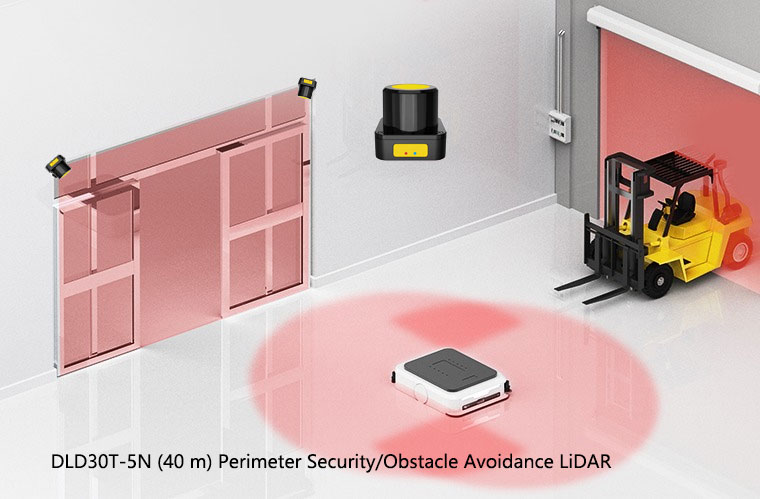
Nearshoring warehouses and intralogistics are the fastest-growing scanner segment — and the escáner láser de seguridad is what protects a mobile robot. Globally more than 200,000 AGV/AMR units were deployed in 2024 (+25% vs 2022), and the safety-laser-scanner market (~USD 361–377M in 2025–26, heading toward ~USD 545M by 2035) is led by the mobile/AGV segment — the exact build-out tied to Mexico's nearshoring warehouses. A scanner projects a protective field (slow/stop) and a warning field (pre-warn / speed-reduce) around the vehicle, switching field sets with speed and direction, as the diagram shows.

Can I import safety sensors from China to Mexico — MOQ, ports, and Incoterms?
Yes — and the MOQ objection is backwards: ours is 1 set, with a 3–15 day lead. Order a single sample, validate it against your ISO 13855 distance, fit-check the brackets and OSSD wiring, then repeat at volume. The two Pacific entry ports for Chinese cargo are Manzanillo (Mexico's largest container port) and Lázaro Cárdenas. Cited ocean transit Shanghai→Manzanillo is roughly 20–25 days (broader China→Mexico range ~18–30, occasionally up to 35); air freight is 3–7 days. Both ports have reported saturation and detentions up to ~30 days from the surge of Chinese goods plus new inspections, so build a buffer into press-line retrofit schedules.
The Incoterms reality matters here. Mexico does not permit non-resident importers of record, so a Chinese seller generally cannot perform true DDP into Mexico without a local entity. The practical, lower-risk terms are FOB (China port) or CIF (Manzanillo / Lázaro Cárdenas), with you — the Mexican buyer — clearing import. To do that commercially you must be on the Padrón de Importadores (SAT registry) with an active RFC, e.firma and a verifiable fiscal domicile (electronics often also need a sectoral registry); a licensed agente aduanal then files the pedimento with the commercial invoice, bill of lading and certificate of origin. Common payment is T/T wire, frequently a 30% deposit / 70% balance; an L/C is typical for higher-value or first-time deals.
NOM mark, IVA, IGI duty & the 2026 tariff — the import questions to settle first
Three things gate a clean import: the NOM mark for the product, the duty/VAT math, and the live 2026 China-tariff question. On the NOM mark: electrical/electronic products in scope must bear it (Norma Oficial Mexicana) before they clear customs and can be sold — product can stall at the border without it. The two most-cited electrical-safety standards are NOM-001-SCFI (NOM-001-SCFI-2018) and NOM-003-SCFI (NOM-003-SCFI-2014); industrial sensors most plausibly fall under one of these, but the exact NOM and edition for a specific SKU must be confirmed with an accredited certification body — ANCE and NYCE are the two named Mexican Organismos de Certificación, and labeling must be in Spanish with importer info, voltage ratings and warnings. DAIDISIKE does not hold and does not claim a NOM mark; we supply the technical file (CE self-declared to IEC 61496, ISO 9001, TÜV per order) to support certification.
On duty and VAT: import VAT (IVA) is the general 16% on the customs value plus duties and other contributions, and it is creditable for a registered importer. The import duty (IGI, Impuesto General de Importación) is per tariff line (fracción arancelaria / TIGIE) and varies widely; China-origin goods do not get USMCA / T-MEC preference, so they pay the general MFN rate — have your broker classify the exact line rather than trusting a printed percentage. Additional charges include the DTA (customs processing fee), broker fees and NOM-certification cost.
The decisive 2024–2026 variable — and the single most important due-diligence item for a China importer — is the Paquete Económico 2026: Mexico is imposing tariffs of 5%–50% on roughly 1,463 tariff lines from non-FTA countries (China, South Korea, India, Indonesia, Russia, Thailand, Turkey), about 8.6% of imports (~USD 52B), effective Jan 1 2026, with up to 50% on autos, auto parts and electronics — driven by USMCA pressure to close the “back door” to Chinese goods. Whether safety light curtains, relays and laser scanners specifically land on the affected list is not yet confirmed — industrial electronics fall within the exposed categories, so this can erode or erase a factory-direct price advantage. Verify the precise fracción arancelaria for your exact product with your agente aduanal before ordering; we won't print a rate that may not apply to these lines.
What else does DAIDISIKE supply into Mexico — switches, proximity, full circuit?
The whole safety circuit from one factory — curtains, safety LiDAR, relays, coded/guard-locking switches and proximity sensors. A curtain rarely ships alone, and each line has its own Mexican “proveedor / cotización” search demand. For AGV/AMR protection the DLD-series escáner láser de seguridad above; the DA31 / DA31-B relevador de seguridad closes the stop loop; the DX-R1 coded magnetic switch (ISO 14119) and DX-W2 guard-locking switch (interruptor de seguridad con bloqueo, holding force up to 1300 N, IP67) handle puertas de protección; and inductive proximity sensors (sensor inductivo de proximidad) in M8/M12/M18/M30 (NPN/PNP, NO/NC, IP67/IP68) cover position sensing — all factory-direct from the same supplier, MOQ 1 set.
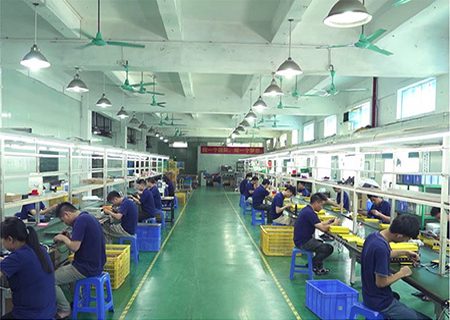
Send the four numbers off your press or line — resolution (14 mm finger / 30 mm hand), protective height, sensing range, output/OSSD type — plus quantity and whether you want FOB or CIF Manzanillo / Lázaro Cárdenas, and we'll return a firm quote, a 3–15 day lead, and the export documents your agente aduanal needs for the pedimento. Sample at MOQ 1 set.
Contact DAIDISIKE → | Phone / WhatsApp +86 15218909599 · 915731013@qq.com
Sources & references
- DAIDISIKE — DQC Type 4 safety light curtain and the DQA finger/hand model — published resolutions and OSSD interface.
- IEC 61496-1/-2/-3, ISO 13849-1 (PL) and ISO 13855 — the standards that fix Type 4 architecture, PL e and the safety-distance calculation referenced throughout; ISO 14119 for the coded switch.
- NOM-004-STPS / PROY-NOM-004-STPS-2020 (STPS / asinom.stps.gob.mx) — machine guarding and electronic safety-device requirements; confirm your machine risk assessment with your responsable de seguridad.
- NOM mark — NOM-001-SCFI-2018 / NOM-003-SCFI-2014 electrical safety; ANCE / NYCE accredited certification. Confirm the exact NOM and edition for your SKU with a NOM consultant.
- Mexico nearshoring & market data — TECMA / NAPS / Mordor Intelligence / American Industries (vehicle production, FDI, factory automation market, port TEUs); treated as published context, not DAIDISIKE figures.
- Import mechanics — Padrón de Importadores (SAT), pedimento, agente aduanal, IVA 16%, IGI / TIGIE; Paquete Económico 2026 tariff on non-FTA imports (El Financiero / N+). Confirm the live fracción arancelaria and duty with your customs broker.
- Incumbent channel — SICK Automation Solutions S.A. de C.V. (Silao), Risoul & HERMOS (Allen-Bradley/Rockwell), Newark Electrónica México; Risoul 450L-B price listing used as a published anchor, not a DAIDISIKE quote.