
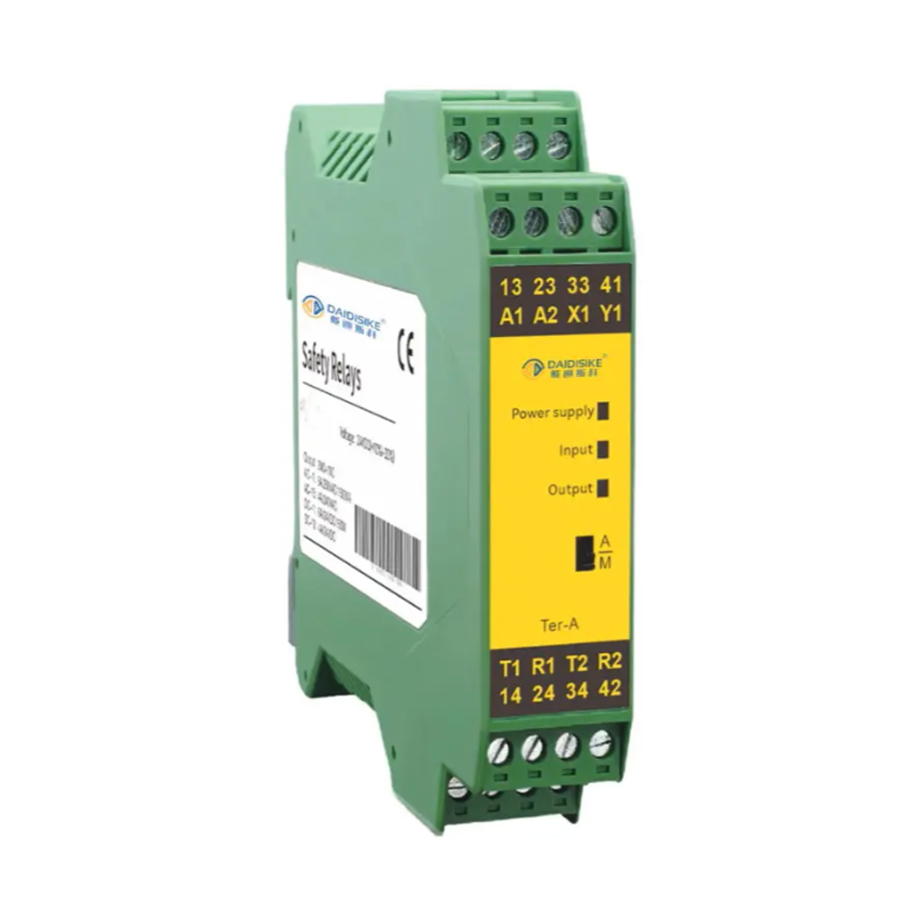
A safety relay module is the small DIN-rail device that watches your safety inputs — an emergency stop, a safety door switch, the OSSD outputs of a light curtain — through two independent channels, and de-energizes its output contacts to bring the machine to a safe state when an input opens or a fault appears. It is the cheapest, fastest way to build a hardwired safety function for a single machine or a handful of zones, which is exactly why most panel builders reach for one before they consider a safety PLC. The question is rarely “do I need a safety relay” — it is “which one, from whom, at what MOQ, and how soon.”
Who is the supplier — and what are the MOQ, lead time and OEM terms?
DAIDISIKE manufactures the DA31 directly, sells from MOQ 1 set with a 3–15 day lead time, and runs OEM/ODM customization inside the PL e / SIL 3 design envelope. Foshan DAIDISIKE Optoelectronics Technology Co., Ltd. has built industrial safety sensors since 2013 from a roughly 3000 m² factory and exports to more than 20 countries. Because we are the manufacturer and not a stocking reseller, the commercial terms that usually stall a small project are removed: you can order a single DA31 to prototype, then move to wholesale tiers for production runs, and the per-order certificate of conformity and functional test report come with the goods either way.
For OEM and ODM work we customize the label and branding, packaging and documentation, and — within the safety architecture — the terminal and contact arrangement. The hard line we hold: we will not relabel a module with a performance level it was not engineered and tested to, so every ODM change stays inside the dual-channel, force-guided, EDM, PL e / SIL 3 design. Send a drawing or a sample and we quote tooling, the custom-variant MOQ and lead time. For a firm price and ship date, contact our engineering team or message +86 15218909599 directly.
Tell us the quantity, supply voltage and whether you need OEM/ODM customization. MOQ 1 set, 3–15 day lead time, factory-direct price.
Request a quote →or WhatsApp/Phone +86 15218909599What exactly is the DA31, and is it really PL e / SIL 3?
Yes — the DA31 is designed to EN/ISO 13849-1 Category 4 / PL e and IEC 62061 SIL 3, with 3NO+1NC outputs, EDM and force-guided contacts, releasing in under 30 ms. It reaches that performance level the way a serious safety relay has to: dual-channel redundant inputs, high-speed mutual verification between the channels so a cross-fault is caught, and positively guided (force-guided) contacts so a single welded contact is revealed rather than failing silently. The safety output is three normally-open instantaneous contacts plus one normally-closed (3NO + 1NC), with a separate transistor signal output (<500 mA, 24 V DC) for status to a PLC.
The electrical envelope is built for real panel duty: 24 V DC supply (+10% / −20%), AC-1 contact rating 6 A / 250 VAC and DC-1 6 A / 24 VDC with a 12 A maximum switching capacity across the safety contacts, AgSnO₂ + gold-flash contact material, 80,000-cycle electrical life, −25 °C to 85 °C operation, and a flame- retardant PA66 housing of 112 × 99.5 × 22.6 mm — the slim ~22.5 mm DIN width that keeps cabinet real estate down. Inputs accept PNP or NPN sources with 1 kΩ–10 kΩ tail resistance for open-circuit detection, and terminals take 0.5–2.5 mm² (AWG 24–12) conductors.
How do you wire an E-stop or light curtain to it (S11/S12/S14)?
A dual-channel E-stop feeds two independent contacts into the two safety input channels, with the reset on a separate terminal — the same S11/S12/S14-style pattern as a PNOZ-class module, so PNOZ wiring knowledge transfers directly. Channel 1 takes one E-stop contact, channel 2 the other; the relay's mutual verification detects a cross-fault or a stuck channel. A Type 4 safety light curtain is wired the same way — its two OSSD outputs become the two channels, so a DAIDISIKE DQC, DQA or DQT4 curtain drops straight onto the DA31 as a pre-matched OSSD-to-relay chain. The 1 kΩ–10 kΩ tail-detection resistance gives you broken-wire detection on the input loop.
One honest note for buyers cross-referencing from a Pilz drawing: terminal numbers differ between manufacturers even when the scheme is identical, so do not assume the DA31's terminals are numbered S11/S12/S14 like a PNOZ. We supply the exact DA31 terminal map and a worked E-stop and light-curtain example with every order, so you map the PNOZ S11/S12/S14 logic onto our terminal numbers correctly the first time. For the full curtain-to-relay wiring treatment, see our light-curtain safety-relay wiring guide.
Why EDM and force-guided contacts are not optional at PL e
EDM (external device monitoring) and force-guided contacts are the two mechanisms that let the DA31 detect a downstream or internal fault and stay safe — skip either and you are not at Category 4 / PL e. Force-guided contacts mechanically tie the safety NO contacts to the monitoring NC: if a safety contact welds, the linked NC physically cannot close, so the next test cycle reveals the weld. EDM extends that discipline to your own contactors — the feedback loop checks the external switching elements before permitting a reset, so a stuck contactor blocks re-energization instead of leaving live output behind a “stopped” machine. Wire the EDM loop; it is the difference between a safety function that proves itself and one that merely looks stopped. If your downstream switching is solid-state rather than contactor-based, tell us and we advise on the feedback arrangement.
How does the DA31 compare to Pilz PNOZ, Phoenix PSR, Sick and IDEC?
On the core function — dual-channel E-stop / OSSD monitoring, 3NO+1NC, EDM, PL e / SIL 3, sub-30 ms — the DA31 matches the established modules; the difference is sourcing: MOQ 1, 3–15 day lead time, and factory-direct price. The table below is built from each vendor's own published figures. Where a number is brand-specific or we can't verify it from a public spec, it is left out rather than invented — including competitor prices, which we do not quote.
| Module | Outputs | Rating | Notes |
|---|---|---|---|
| DAIDISIKE DA31 | 3NO + 1NC (+ transistor signal) | Cat 4 / PL e, SIL 3 | EDM, force-guided, <30 ms, 22.6 mm DIN, PNP/NPN inputs; MOQ 1, 3–15 day lead |
| Pilz PNOZ X2.8P | 3NO (semiconductor signal output) | Cat 4 / PL e, SIL 3 | E-stop / guard-door monitoring; established European reference |
| Phoenix PSR-MC32-3NO-1NC | 3NO + 1NC | SIL 3 / PL e (per datasheet) | 3NO+1NC PSR-MC32-class; premium European pricing |
| Sick RLY3-OSSD100 | Relay outputs for OSSD source | PL e (per datasheet) | Designed specifically to convert ESPE OSSD to relay contacts |
| IDEC HR1S-AC5121 | Force-guided safety relay output | Per datasheet | Compact E-stop / interlock monitoring module |
Competitor figures are from each manufacturer's public documentation; competitor pricing is qualitative only and is not a DAIDISIKE quote. Always confirm the exact variant's rating against its current datasheet for your application.
The practical read: if you already trust a PNOZ-class architecture, the DA31 gives you the same dual-channel, EDM, force-guided behaviour with a 3NO+1NC contact set, and you buy it without import margin and without waiting on a distributor allocation. For the deeper architecture question — relay versus a programmable safety controller — read our safety relay vs safety PLC selection guide; for one machine and a few functions, the relay is faster to wire and lower cost, which is the case the DA31 is built for.
Relay vs safety controller — and where cost actually goes
For a single E-stop, one light curtain or a couple of door switches, a fixed-function safety relay like the DA31 is the lower-cost, faster- to-commission choice; a programmable safety controller earns its higher cost only when you have many zones or complex logic. A safety relay is hardwired and fixed-function: no programming, no validation of software, no licensing — you wire it, test the function, and document it. A safety controller or safety PLC scales to many inputs and conditional logic but carries software, configuration and validation cost that a one- or two-function machine never recovers. Most presses, simple robot cells and guarded openings sit firmly in relay territory, which is why a sub-30 ms PL e relay at a factory price is the workhorse part rather than the exception.
Is naming Pilz, Phoenix, Sick and IDEC legitimate here?
Yes — naming a competitor product to describe a compatible, equivalent alternative is nominative reference, which is lawful; we keep it honest by using only each vendor's published specs and by never implying a partnership or endorsement. We reference Pilz PNOZ, Phoenix PSR, Sick RLY3-OSSD100 and IDEC HR1S to tell you where the DAIDISIKE DA31 fits relative to parts you already know. We do not reproduce their manuals, use their logos as our own, or quote a parameter — or a price — we cannot confirm from public documentation. The DA31 figures are from DAIDISIKE's own spec sheet; the competitor figures are from theirs. There is no implied relationship between DAIDISIKE and any of these companies.