
Most people arrive at this page from one of two searches. Either “safety laser scanner for AGV” / “AGV LiDAR supplier” — you are designing a vehicle and need the onboard safety sensor — or “SICK nanoScan3 alternative” / “cheaper safety laser scanner” — you already know the incumbent part and want a second source at a better price. This guide serves both. It explains the technology in the vocabulary the datasheets use, segments the product by the two real use-cases (compact onboard vs area/perimeter), benchmarks the mainstream models honestly, and tells you exactly which DAIDISIKE scanner maps to your job — and where it does not.
What is a safety laser scanner, and how does it work?
It is a TOF (time-of-flight) optical safety device that sweeps one pulsed laser across a horizontal plane and switches OSSD outputs off when an object enters a protective zone. A rotating mirror fans a single 905 nm Class 1 laser beam across a wide arc — commonly a 270-degree scanning angle — and the device measures distance from the return time of each pulse. Firmware divides that plane into configured zones. A break in the protective field switches the dual OSSD safety outputs OFF, which the vehicle or machine safety circuit uses to stop or safely slow. Because the scanner maps free space rather than a fixed beam line like a safety light curtain, a single unit can guard an irregular floor area or the front of a moving AGV.
Protective field vs warning field — the distinction that trips buyers up
The protective field is the safety-rated stop zone; the warning field is a larger, non-safety alert zone. Both are monitored at once. On an AGV you run a short, tight protective field directly ahead — usually a few metres, because it must guarantee a stop before contact — and a longer warning field beyond it that only triggers a horn, a status output or a slow-down so people and the vehicle can react first. The warning field is where the long-range numbers live: a scanner with a 5 m protective field may carry a 20 m or even 40 m warning/measurement range. Do not confuse the two when comparing datasheets — a “40 m” scanner is almost always quoting the warning/measurement range, with a far shorter protective field. Both fields reshape automatically as the AGV speeds up, slows or turns, which is why field switching matters so much.
Is a safety laser scanner the same as LiDAR? Can you use a LiDAR for AGV safety?
A safety laser scanner is a LiDAR — but a navigation LiDAR is not safety-rated and must not be the device that stops the machine. This is one of the most-searched and most-misunderstood points in the whole AGV-safety space, so it is worth being blunt. Both a safety laser scanner and a 2D navigation LiDAR use time-of-flight ranging to build a map. The difference is functional safety. A safety laser scanner is Type-rated to IEC 61496-3 with continuous self-diagnostics, a defined fault reaction and dual OSSD outputs, so it can be relied upon to command a safe stop. A general-purpose measurement/navigation LiDAR — the Pepperl+Fuchs R2000 is a classic example, and security LiDARs like OPTEX REDSCAN another — is superb for mapping, localisation and intrusion awareness but is not machine-safety rated. The correct architecture: navigation LiDAR for guidance, a separate Type 3 safety laser scanner for personnel collision protection. Never collapse the two into one non-rated sensor.
The two buyer tiers: onboard AGV/AMR vs area / perimeter protection
Safety laser scanners split cleanly into two jobs, and conflating them is the most common sourcing mistake. Tier 1 — compact onboard AGV/AMR safety: a small, light scanner mounted on a front corner of the vehicle, with a 3–5 m protective field, lots of field sets and an encoder input for speed-based switching. Tier 2 — area / perimeter protection: a fixed scanner guarding a robot cell floor, a hazardous machine area, or a building perimeter, where the headline is the much larger warning/measurement range (20–40 m). DAIDISIKE has SKUs purpose-built for each, so you do not over- or under-spec:
| Tier / job | What you optimise for | DAIDISIKE model | Headline range |
|---|---|---|---|
| Onboard AGV / AMR collision protection | Compact, encoder field switching, 3–5 m protective field | DLD05A3 | 5 m |
| Onboard AGV / AMR, longer-look TOF | Extended TOF range for fast vehicles / wide aisles | SDLD-05A | 14 m (TOF) |
| Area protection (cell floor, machine zone) | Larger warning/area field, fixed mount | DLD20A5 | 20 m |
| Outdoor / perimeter protection | Long-range virtual wall / intrusion line | DLD30T-5N | 40 m |
Note the perimeter side: DAIDISIKE's DLD20A5 (20 m) and DLD30T-5N (40 m) out-range most onboard-class incumbents on the warning/perimeter field — a genuine differentiator when your job is a long virtual wall rather than a tight onboard stop. Range and angle figures here are from DAIDISIKE's own datasheets; confirm the exact number for your SKU before you design the field around it.
How DAIDISIKE compares with SICK, Hokuyo, Leuze, Datalogic, Omron and IDEC
The mainstream brands define the feature set; DAIDISIKE builds to the same IEC 61496 architecture as a second-source OEM at lower cost. The table below collects each vendor's own published protective-field range, scan angle and zone/field-set count so you can benchmark like for like. These are the incumbents you will see on existing AGV fleets when you are searching for an alternative.
| Model | Class | Protective field | Scan / warning | Zone / field sets |
|---|---|---|---|---|
| SICK nanoScan3 | Type 3, SIL2 / Cat 3 | ~3 m (safeHDDM) | 275° | up to 128 scenarios |
| SICK microScan3 | Type 3 (safeHDDM) | Larger than nanoScan3 | 275° | Configurable |
| Hokuyo UAM-05LP | Type 3, SIL2 / PLd / Cat 3 | 5 m | 270°, 20 m warning | up to 128 field sets |
| Leuze RSL 400 | Safety laser scanner | 0–4.5 m (to ~8.25 m op.) | 270°, 20 m warning | 100 switchable pairs |
| Datalogic Laser Sentinel | Safety laser scanner | 0.05–5.5 m | 275°, up to 40 m warning | Multiple zone sets |
| Omron OS32C | Type 3 | up to 4 m (70 mm min) | 270°, 15 m warning | 70 zone-set combos |
| IDEC SE2L | Type 3, ultra-compact | 5 m | 270°, 20 m warning | Master + up to 3 slaves |
| DAIDISIKE DLD05A3 / SDLD-05A | IEC 61496 safety scanner | 5 m / 14 m TOF* | See datasheet | See datasheet |
| DAIDISIKE DLD20A5 / DLD30T-5N | Area / perimeter scanner | 20 m / 40 m range* | See datasheet | See datasheet |
* DAIDISIKE figures are headline ranges from DAIDISIKE's own spec sheets. We deliberately do not copy competitors' SIL2 / PLd / Cat 3 ratings onto DAIDISIKE models: DAIDISIKE scanners are CE self-declared and built to IEC 61496 with ISO 9001 manufacturing, and TÜV testing is available per order. Always confirm the exact protective-field range, scan angle, resolution, IP rating and any safety rating against the datasheet for your specific DLD / SDLD SKU before designing the safety function.
Field switching, OSSD and master/slave — the AGV integration details
Three features decide whether a scanner drops cleanly onto your vehicle. First, encoder input and speed-based field switching: the protective field must grow as the AGV accelerates (longer stopping distance) and shrink when it slows, and it must reshape on turns. The scanner reads wheel-encoder pulses and selects from its bank of zone / field sets — mainstream units carry 70 to 128 of them — in real time. Second, OSSD outputs: two redundant safety-rated solid-state outputs that go OFF on intrusion or fault, wired into the vehicle's safety controller (often alongside a safety relay like the DA31). Third, master/slave: a single 270-degree scanner on a front corner covers the front and two sides; for full 360-degree AGV coverage you pair a master with one or more slave scanners — IDEC's SE2L and Hokuyo's UAM, for instance, support one master plus up to three slaves. Tell your supplier which of these you need so the model and firmware are configured for it.
ISO 13855 safety distance for a horizontal scanner field
Size the protective field at top speed using S = K(TM + TS) + ZG + ZR + CRO. For a horizontally mounted scanner on a moving vehicle, K is the closing speed (human walking speed plus the AGV speed), TM is the vehicle stopping time and TS the scanner response time, so the K(TM+TS) term is the distance the vehicle travels during a full stop. ZG is the general margin for a horizontal field, ZR covers measurement tolerance and resolution, and CRO adds distance for the scanning-plane height and the risk of stepping over or under it. The protective field edge must sit at least S ahead of the danger. Because the stopping term scales with speed, you compute S at maximum speed, then use speed-based field switching to relax the field when the vehicle is slow — which is the whole reason the encoder input and the large bank of field sets exist. For the static background, see our IEC 61496-3 explainer.
One-stop safety: scanners, light curtains, relays and switches together
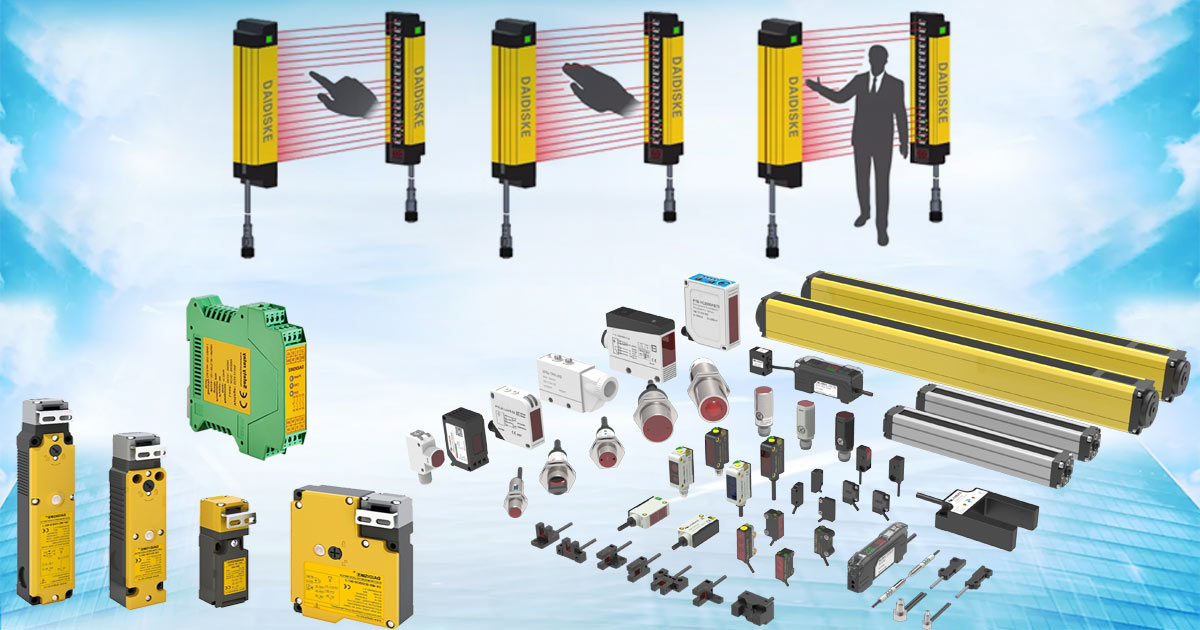
A safety laser scanner rarely ships alone. The same AGV or automated cell usually needs point-of-operation guarding from a Type 4 safety light curtain, a safety relay (DA31, PL e / SIL 3) to evaluate the OSSD signals, and non-contact coded safety switches (DX-R1) on guards and access doors. Sourcing the scanner and the rest of the machine-safeguarding chain from one manufacturer simplifies the BOM, the documentation and the support line — which is exactly the position DAIDISIKE holds as a safety light curtain and laser scanner supplier for AGV/AMR builders and cell integrators.
Why source from DAIDISIKE — and how to get a quote
DAIDISIKE is a Chinese OEM/ODM safety-sensor manufacturer with MOQ 1 set, 3–15 day lead times and export to 20+ countries. Foshan DAIDISIKE Optoelectronics Technology Co., Ltd. has built industrial safety sensors since 2013 from a 3000 m² factory. For a safety laser scanner or AGV LiDAR enquiry, send four things: (1) onboard or area/perimeter, (2) the protective-field range you need (or the AGV top speed and stopping distance and we will compute it), (3) scan angle and whether you need master/slave for 360-degree coverage, and (4) the output/fieldbus and IP environment. We will return a matched DLD05A3, SDLD-05A, DLD20A5 or DLD30T-5N with its datasheet.
Phone / WhatsApp +86 15218909599 · email 915731013@qq.com. MOQ 1 set, 3–15 day lead time, OEM/ODM welcome.
Contact DAIDISIKE →Sources & specifications cited
- SICK nanoScan3 / microScan3 — Type 3 (IEC 61496-3) safety laser scanner, safeHDDM, ~3 m protective field, 275° scan, up to 128 monitoring scenarios (SICK published specs).
- Hokuyo UAM-05LP — Type 3, SIL2 / PLd / Cat 3, 5 m safety zone, 20 m warning, 270° FOV, 905 nm Class 1, encoder input, up to 128 field sets, master/slave, IP65 (Hokuyo published specs).
- Leuze RSL 400 — 270° scan, protective field 0–4.5 m (operating range up to ~8.25 m), warning to 20 m, 100 switchable field pairs, 2 independent protective functions (Leuze published specs).
- Datalogic Laser Sentinel — protective field 0.05–5.5 m, warning to 40 m, 275°, multiple zone sets (Datalogic published specs).
- Omron OS32C — Type 3, safety zone to 4 m (70 mm min resolution), warning to 15 m, 270°, 70 zone-set combinations, EtherNet/IP (Omron published specs).
- IDEC SE2L — ultra-compact Type 3, 270°, 5 m safety zone, 20 m warning, master + up to 3 slaves for 360° AGV coverage (IDEC published specs).
- Pepperl+Fuchs R2000 — 2-D navigation/measurement LiDAR (NOT safety-rated); OPTEX REDSCAN — perimeter/intrusion LiDAR (not machine-safety rated). Cited to illustrate the safety vs navigation distinction.
- DAIDISIKE DLD05A3 / SDLD-05A / DLD20A5 / DLD30T-5N — ranges and build from DAIDISIKE's own datasheets; CE (self-declared), IEC 61496, ISO 9001; TÜV testing per order.