
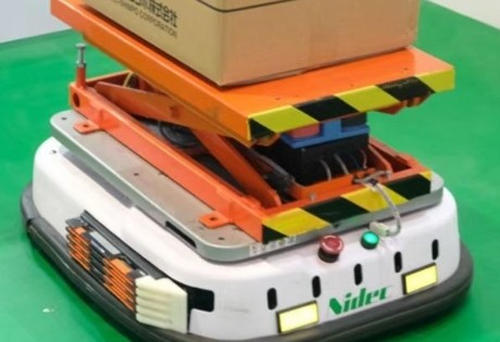
Walk through almost any modern warehouse or large plant and you will see them: low, flat vehicles gliding down aisles, carrying racks, totes, or pallets, threading between people who barely look up any more. The fleet has grown fast. The safety engineering, in a lot of facilities, has not quite kept pace.
A mobile robot is, in safety terms, a moving machine operating in a space full of people. It cannot be fenced off — its whole purpose is to travel through shared areas. So the guarding has to travel with it. That is the job of the safety laser scanner, and this article explains how one actually works, the standards that govern it, and the distinctions that get blurred in marketing.
AGV, AMR — and why the safety job is the same
A quick definition, because the terms get used loosely. An AGV, automated guided vehicle, follows a fixed route — historically a wire, a magnetic tape, or a line of reflectors. An AMR, autonomous mobile robot, navigates freely: it builds a map, localizes itself on it, and plans its own path, routing around obstacles as it goes.
The distinction matters for fleet software and flexibility. For safety, it matters less than people expect. Both move mass through shared space; both must stop before contact. An AMR's free navigation makes its path harder to predict, which puts a little more weight on getting the field design right — but the core protective device, a safety laser scanner watching the direction of travel, is common to both.
Protective field and warning field
A safety laser scanner sweeps a laser beam across a horizontal plane, usually a wide arc in front of the vehicle, and measures the distance to whatever it hits. It is configured to monitor two kinds of zone.
The protective field is the one that matters most. Anything that enters it — a foot, a leg, a dropped box — causes the scanner to command an immediate stop. The warning field is larger and sits beyond the protective field. An intrusion there does not stop the vehicle; it triggers a slowdown, an audible warning, or a light, giving a person time to step clear before the situation becomes critical.
The single rule that governs all field design: the protective field, measured in the direction of travel, must always be at least as long as the vehicle's stopping distance at its current speed — plus margin for the person's own movement and for tolerances. If the protective field is shorter than the stopping distance, the vehicle detects the person and still rolls into them. That is the whole game.
Speed-dependent field switching
Here is the problem a fixed protective field cannot solve. Stopping distance grows with speed — roughly with the square of it, once you account for reaction time and braking. A field sized for the vehicle's top speed would be enormous, and the robot would freeze every time someone walked within several metres of it in a slow, congested area. A field sized for slow areas would be lethal at speed.
The answer is speed-dependent field switching. The vehicle controller continuously reports speed, and often steering angle, to the scanner. The scanner holds a set of pre-configured field pairs and selects the right one in real time:
- Fast, straight ahead — a long, relatively narrow protective field reaching well down the aisle.
- Slow — a much shorter field, so the robot can work close to people and racking without nuisance stops.
- Turning — a field shifted and widened toward the inside of the turn, to cover the path the vehicle's corners will actually sweep.
Configured correctly, the active protective field always exceeds the current stopping distance. Configured carelessly — too few field cases, switching points set without margin — you get either a robot that stops constantly or a robot that does not stop soon enough. Both outcomes are common, and the second one is dangerous.
The standards that apply
Mobile-robot safety sits under several standards at once, and a compliant deployment respects all of them rather than picking one:
| Standard | What it covers |
|---|---|
| ISO 3691-4 | Driverless industrial trucks and their systems — the central application standard for AGVs and many AMRs. |
| ANSI/RIA R15.08 | Industrial mobile robots — the North American framework for AMR safety. |
| IEC 61496-3 | Electro-sensitive protective equipment — Part 3 covers scanning devices specifically. |
| ISO 13849-1 / IEC 62061 | Functional-safety reliability of the stop function — its Performance Level or SIL. |
That last row is worth a note. The scanner being a certified protective device is necessary but not sufficient — the whole stop function, from scanner to brake, has a Performance Level that has to meet what the risk assessment requires. If that phrase is unfamiliar, our companion guide to Performance Level and SIL covers it properly.
Navigation LiDAR is not a safety scanner — be clear on this
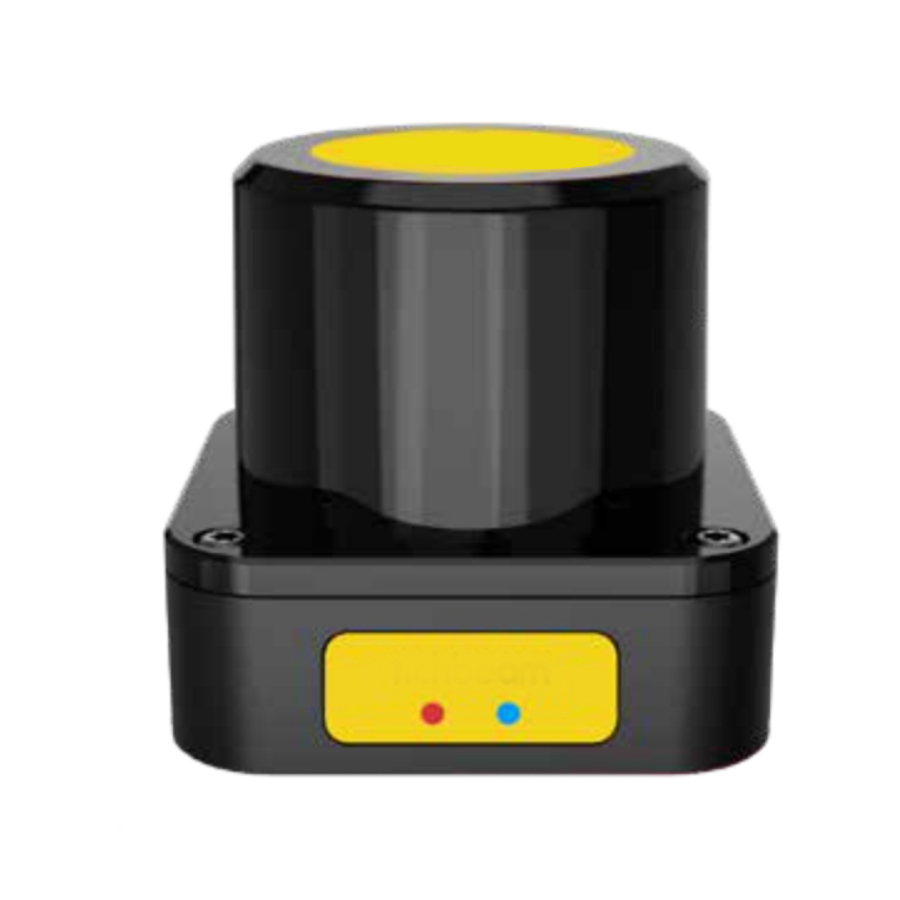
This is the distinction that gets blurred most often, and it is worth being blunt about. A navigation or obstacle-avoidance LiDAR exists to help a robot map its surroundings and route around obstacles. It is an operational sensor, and a good one can be very capable.
A certified safety laser scanner is a different class of device. It is tested and rated under IEC 61496-3, with the internal redundancy, self-test, and defined failure behaviour that justify relying on it for a safety function. The difference is not how well the device sees obstacles on a good day. The difference is what happens on a bad day — when a component drifts, a window fouls, or the unit fails. A safety scanner is engineered so that a failure leads to a stop. A navigation LiDAR has no such obligation.
In practice, many mobile robots carry both, and that is the right architecture: a navigation LiDAR for path planning and mapping, and a separate certified safety scanner dedicated to the protective stop. If a vendor offers you one sensor and implies it does both jobs, ask precisely which certification the protective function carries — and get the answer in writing.
Mixed traffic — the hard part
A robot's own scanner protects against one thing: the robot striking a person ahead of it. It does nothing about a manually driven forklift striking the robot, a person stepping out from behind racking into the side of a vehicle, or two vehicles meeting at a blind corner.
Mixed-traffic aisles — robots, forklifts, and pedestrians all sharing the floor — are where incidents actually happen. The robot is usually the best-behaved actor present. Treat the aisle as a system: clear floor markings and segregated lanes where the layout allows, warning fields tuned generously enough that people get real reaction time, conservative speeds in shared zones, and good sightlines at intersections. Where a robot route crosses a pedestrian walkway, consider fixed-infrastructure protection at the crossing — a light curtain or a fixed scanner mounted to the building gives a layer the vehicle-borne scanner structurally cannot.
Common mistakes
Too few field cases. A vehicle with only two field pairs — fast and slow — has large speed bands where the protective field is either wastefully long or dangerously short. More field cases, switched at well-chosen speed thresholds, give a field that tracks stopping distance closely.
Ignoring the turn. A vehicle turning sweeps its rear and corners through space the forward-facing field never covers. Field cases tied to steering angle, and sometimes a second scanner, are needed for vehicles that turn in occupied areas.
Low obstacles and overhangs. A scanner monitors one horizontal plane, typically about 150-200 mm off the floor. It will not see a load that overhangs the vehicle above that plane, nor a low obstacle beneath it. Both have to be addressed in the vehicle and load design, not assumed away.
Stopping distance measured once and never again. Brakes wear, loads change, floors get slippery. The stopping distance that justified the field configuration at commissioning should be re-verified periodically — especially after any change to vehicle mass or top speed.
Where DAIDISIKE fits — honestly
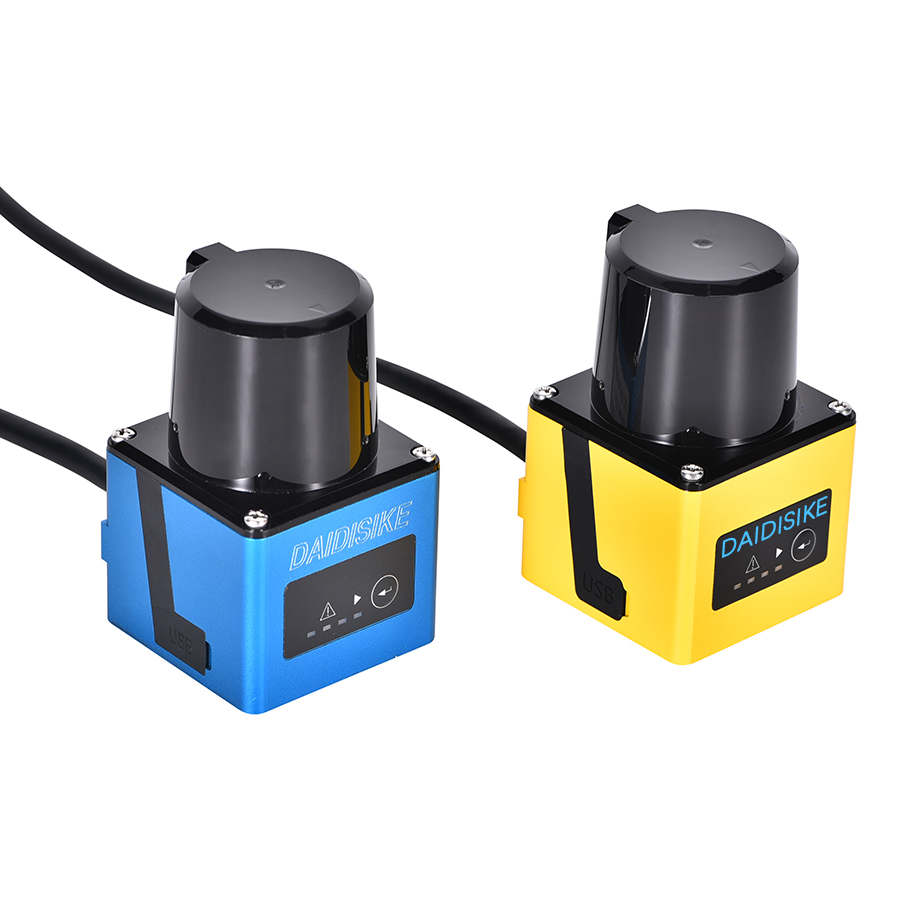
A straight answer, since you may be on our site. DAIDISIKE builds laser scanning sensors including the DLD05A3 / DLD20A5 obstacle-avoidance laser radar and the longer-range DLD30T-5N. These are strong choices for the navigation and obstacle-avoidance role on AGVs and AMRs, and for perimeter detection of moving equipment — the kind of application in our overhead-crane LiDAR case study.
What we will not do is tell you that a navigation LiDAR replaces a certified safety scanner in the protective stop function — the point of the whole section above. If you are specifying a mobile robot and need to sort out which sensor does which job, talk to our engineering team. We would rather give you an honest architecture than a neat-looking single-sensor bill of materials.
The bottom line
Mobile-robot safety comes down to one geometric fact: the protective field has to be longer than the stopping distance, at every speed and on every turn. Safety laser scanners and speed-dependent field switching exist to keep that true. Respect the standards as a set, keep navigation and safety functions properly separated, and design the aisle — not just the robot — and a mobile fleet is one of the safer things on a modern factory floor. Skip those steps and it is one of the more dangerous.