
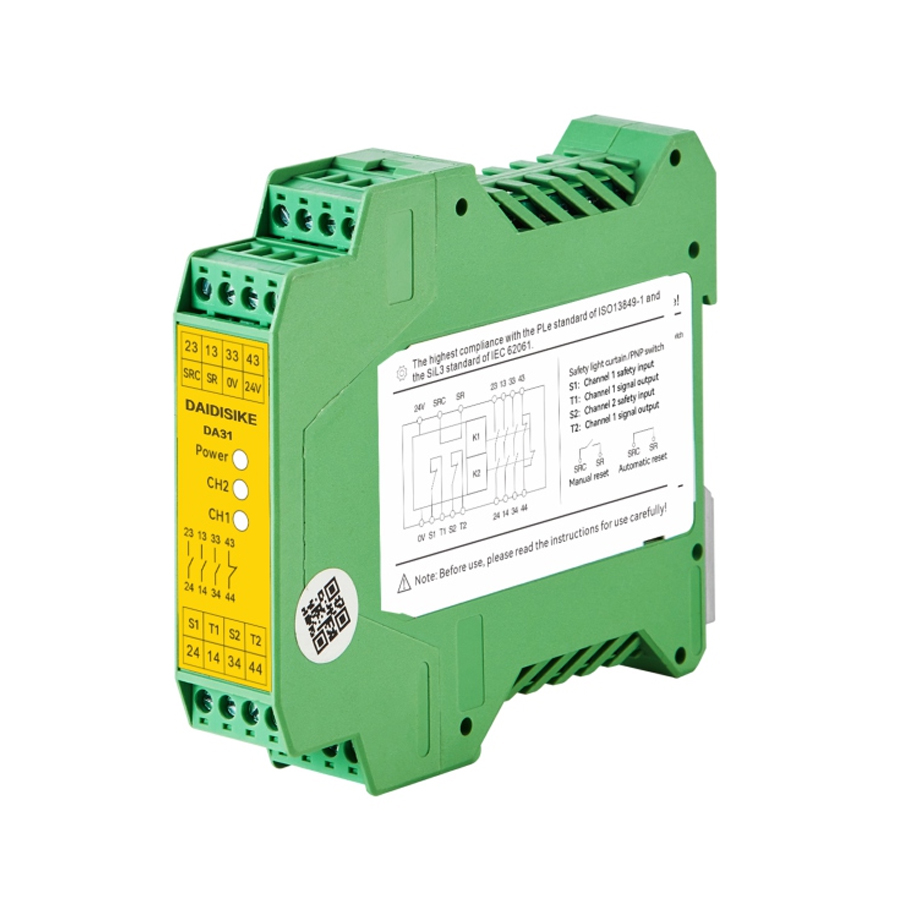
We keep cross-reference notes for the brands customers most often arrive with, and in the European interlock-and-relay world Schmersal is one of them. The inquiries land two ways: someone has a discrete SRB301LC or SRB200 on a DIN rail and wants a like-for-like substitute, or someone has a configured PROTECT SRB-E doing several jobs at once and assumes any “safety relay” will swap straight in. Those are two very different conversations, and this page is honest about both. Everything here is built the way we build every cross-reference — from Schmersal's own published specs and our own DA31 datasheet, never from a copied manual.
One blunt point up front. A safety relay is not a part number you look up and drop in. Schmersal's order numbers — SRB301LC, SRB-E-201ST, SRB200EXi-1A and the rest — belong to Schmersal parts; the DA31 has its own terminal layout and its own rated SKU. The swap is sound when six things line up: safety function, input channels, output contacts and rating, EDM/reset, PL/SIL, and DIN width — and you re-wire to the new module. Get those six right and the rest of this page tells you exactly which Schmersal SRBs the DA31 fits, and which it deliberately does not.
What is an SRB, and what is the DAIDISIKE DA31?
A safety relay is a self-monitoring switching module. It reads a safety input — an emergency-stop button, a safety-gate or interlock switch, or the OSSD outputs of a light curtain — on two independent channels, and only closes its enabling (NO) contacts when both channels agree and an EDM feedback loop confirms the downstream contactors have actually dropped out. A single welded contact, a cross-shorted wire, or a stuck contactor makes it refuse to enable. That self-checking is the whole point, and it is why a safety relay can carry a Category 4 / PL e / SIL 3 rating while an ordinary relay cannot.
Schmersal's SRB line spans both ends of that spectrum. The classic single-function relays — SRB301LC, SRB201LC, SRB200, SRB 301AN, SRB 031MC, SRB-400CS — each monitor one safety function and reach Category 4 / PL e / SIL 3. The PROTECT SRB-E family (SRB-E-201ST, SRB-E-204ST, SRB-E-204PE, SRB-E-301MC, SRB-E-402ST) is the configurable, multi-function generation. And the SRB200EXi / SRB101EXi variants are intrinsically-safe units for ATEX Zone 2 gas-Ex areas. The DAIDISIKE DA31 answers the first group: PL e / SIL 3, 3NO+1NC force-guided contacts, dual-channel inputs with cross-fault detection, EDM, DIP-switch auto/manual reset, a release response time under 30 ms, and a 22.6 mm DIN footprint.

Which Schmersal SRB does what? A family map before you cross-reference
Match the SRB family to the function first; only then decide whether a single DA31 is even the right shape of answer. The SRB catalogue is broad because it covers discrete relays, a configurable multi-function platform, and ATEX variants. Here is the honest map of the real families and a few anchor models.
| Schmersal SRB family | What it is | Anchor models | DA31 the right answer? |
|---|---|---|---|
| SRB classic (single-function) | Discrete electromechanical safety relays, one function each, up to Cat. 4 / PL e / SIL 3 | SRB301LC, SRB201LC, SRB200, SRB 301AN, SRB 031MC/031LC, SRB-400CS | Yes — this is the DA31's native target |
| PROTECT SRB-E (configurable) | Multi-function; rotary mode (up to 16 apps) + rotary time delay; up to 10 safe in / 5 safe out; <10 ms | SRB-E-201ST, SRB-E-204ST, SRB-E-204PE, SRB-E-301MC, SRB-E-402ST | Only if it's doing one simple function — not a feature match |
| SRB-E “-PE” semiconductor | p-type fail-safe semiconductor (OSSD-style) outputs up to 5.5 A | SRB-E-204PE | No — DA31 has relay (contact) outputs, not semiconductor |
| SRB-E two-hand | Adds two-hand control evaluation to ISO 13851 / EN 574 | SRB-E-402ST | No — DA31 has no two-hand evaluation logic |
| SRB200EXi / SRB101EXi (ATEX) | Intrinsically-safe, Zone 2 gas-Ex / ATEX-IECEx | SRB200EXi-1A, SRB200EXi-1R, SRB101EXi-1A/1R | No — DA31 is not Ex-rated; keep the Ex device |
| PROTECT SELECT | Programmable; replaces up to ~8 safety relays | PROTECT SELECT | No — multi-function; scope a controller |
The takeaway: the DA31 is a single-function relay. It cross-references cleanly to the discrete SRB units — SRB301LC, SRB201LC, SRB200 and their siblings — and it deliberately does not pretend to replace a configured PROTECT SRB-E, a -PE semiconductor module, a two-hand SRB-E-402ST, an ATEX SRB200EXi, or a PROTECT SELECT. When your existing SRB is doing one job (E-STOP, gate, or light-curtain monitoring), read on.
DA31 vs a classic single-function Schmersal SRB — the side-by-side
The DA31's honest 1:1 comparison target is a classic single-function Schmersal SRB (SRB301LC / SRB201LC / SRB200 class) — both target Category 4 / PL e / SIL 3 with force-guided contacts and EDM. This is a function-and-rating comparison from public Schmersal / distributor specs, not a drop-in claim. Confirm against your installed unit's label and datasheet before ordering.
| Parameter | DAIDISIKE DA31 | Schmersal SRB classic (e.g. SRB301LC / SRB201LC / SRB200) |
|---|---|---|
| Safety class | PL e (EN ISO 13849-1) / SIL 3 (IEC 62061), Cat. 4 chain | Up to Cat. 4 / PL e / SIL 3 |
| Output contacts | 3 NO + 1 NC | Per model (e.g. NO safety contacts + signalling) — check label |
| Contacts force-guided | Yes (positive-guided) | Yes |
| Input channels | Single / dual-channel, high-speed cross-fault detection | Single / dual-channel |
| EDM (external device monitoring) | Yes | Yes |
| Reset | DIP-switch selectable: auto or monitored-manual | Auto / monitored-manual per model |
| Contact rating | AC-1 6 A/250 VAC, DC-1 6 A/24 VDC; 12 A max across contacts; AgSnO2+0.2 µm Au; 80,000-cycle life | Per Schmersal datasheet |
| Response time (release) | < 30 ms | Per Schmersal datasheet |
| Supply | 24 V DC (+10% / −20%), 2.9 W | Per model (24 V DC / AC variants) |
| DIN width | 22.6 mm | Per model |
| Typical functions | E-STOP, safety gate / interlock, light-curtain (OSSD) monitoring | E-STOP, safety gate, light-curtain monitoring (single-function) |
| Sourcing | Factory-direct China, MOQ 1 set, 3–15 day lead | Schmersal distributor channel |
Where the Schmersal column reads “per Schmersal datasheet,” that is deliberate — we will not put a number in a Schmersal column unless it is published, and exact contact count, switching current and response time vary by SRB model. Pull them from your unit's label and confirm against Schmersal's own datasheet. Every figure in the DA31 column is from DAIDISIKE's published spec.

What about the configurable PROTECT SRB-E? Where the DA31 stops
The DA31 is a fixed single-function relay; it does not replace a configured PROTECT SRB-E feature-for-feature, and it is important to be straight about that. The PROTECT SRB-E is genuinely a different class of device. On a single module Schmersal puts a rotary “mode” switch that selects the safety function (up to 16 applications), a rotary “time” switch for the drop-out (off-delay) timing, and on the larger units up to 10 safe inputs and 5 safe outputs with a response time under 10 ms. The -ST versions use relay (contact) outputs — for example the SRB-E-204ST monitors four sensors with a STOP 0 reaction, two safety plus four signalling outputs at 230 V/6 A or 24 V/2 A. The -PE versions (e.g. SRB-E-204PE) use p-type fail-safe semiconductor outputs up to 5.5 A. The SRB-E-402ST adds two-hand control evaluation to ISO 13851.
The DA31 has none of that configurability. It is one hard-wired function, relay outputs only, no off-delay safety outputs, no rotary mode/time selection, no multi-zone 10-in/5-out consolidation, and no two-hand logic. So the only place a DA31 stands in for an SRB-E is when the SRB-E was bought to do one plain job — a single E-STOP or a single gate — and its configurability is going unused. If the SRB-E is configured for several zones, an off-delay, a two-hand station, or semiconductor outputs, the right replacement is a configurable controller, not a DA31. We would rather lose that line than mis-sell it.
- ATEX / Zone 2: the Schmersal SRB200EXi / SRB101EXi are intrinsically-safe Ex devices. The DA31 is not Ex/ATEX/IECEx rated and must never be installed in a hazardous (explosive-atmosphere) area. There is no DAIDISIKE counterpart — keep the Ex unit.
- Response time & stopping distance: the SRB-E publishes <10 ms; the DA31 publishes <30 ms. If the relay sits behind a trip device, recompute the EN ISO 13855 safety distance with the DA31's <30 ms before you finalise mounting — do not assume parity.
How does the response-time gap affect my safety distance?
A sub-30 ms relay where a sub-10 ms one used to sit adds up to ~20 ms to the total stopping time, and that lengthens the EN ISO 13855 safety distance — you must recompute it. For a hard-wired E-STOP button this is a non-issue: the operator's reaction dominates, and 20 ms of relay time is noise. But when the safety relay is downstream of a light curtain or another presence-sensing trip device, its response time is part of the machine's total stopping performance T, and that feeds straight into the minimum safety distance:
S = (K × T) + C
where S is the safety distance, K the approach speed constant, T the total system stopping time (trip device + logic + machine run-down), and C the intrusion/penetration factor. Increase T by 20 ms and S grows by K × 0.02 s — at the usual hand-speed K of 2000 mm/s that is an extra 40 mm of required distance. That is small but real, and on a tightly-packed guard it can be the difference between compliant and not. Work it through our ISO 13855 safety-distance guide with the DA31's <30 ms figure before you sign off the layout. We will not pretend the DA31 matches the SRB-E's <10 ms — it doesn't, and flagging it is the honest engineering.
What to match before you swap any Schmersal SRB for a DA31
Six numbers decide the swap; get them off the installed unit and its datasheet. This is the same discipline we apply to every brand cross-reference.
- Safety function — E-STOP only, or E-STOP + safety gate + light-curtain (OSSD) monitoring. The DA31 handles all three as a single-function module. (If the SRB is configured for two-hand, off-delay, or multiple zones, stop — you need a controller.)
- Input channels — single-channel, or dual-channel with cross-fault monitoring (required for higher PL/SIL).
- Output type, count & rating — relay contacts vs semiconductor (DA31 is contact-output only), how many NO enabling and any NC signalling contact, and switching current. DA31 = 3NO+1NC, AC-1 6 A / DC-1 6 A, 12 A max across contacts.
- EDM / reset — is external device monitoring used, and is reset automatic or monitored-manual? DA31 does both via DIP switch.
- PL / SIL target — from your risk assessment (DA31 is PL e / SIL 3). And the response time, if a trip device is upstream (recompute EN ISO 13855 with <30 ms).
- DIN width & supply & area — panel space (DA31 is 22.6 mm), 24 V DC supply, and confirm it is not a hazardous (Ex) area.
Send those six off your installed safety relay and we will confirm the DA31 fits or tell you plainly that it doesn't — for instance, if you actually need a configurable controller, a semiconductor-output module, a two-hand unit, an off-delay, or an Ex-rated device. If the existing Schmersal SRB is paired with a guard-door interlock, note that DAIDISIKE also makes matched door-monitoring hardware (the DX-R1-B coded interlock to ISO 14119 Type 4 and the DX-D6 guard-locking switch to IEC 60947-5-3), so the SRB and its interlock can be cross-referenced together. The wider method and the other brand cross-references — such as our Pilz PNOZ alternatives and Allen-Bradley Guardmaster alternatives — live in the safety relay manufacturer guide.

Is naming Schmersal and SRB legal, and how do you keep this honest?
Naming a competitor's product to describe a compatible alternative is nominative reference and is legitimate; we keep it honest by using only Schmersal's published specs. We reference Schmersal and the SRB / PROTECT SRB-E models by name to tell you what the DAIDISIKE equivalent is — normal, lawful comparison, with no implied partnership or endorsement. What we deliberately do not do: we do not reproduce Schmersal manuals, we do not use their trademarks or logos as our own, we do not reuse Schmersal order numbers (SRB301LC, SRB-E-201ST, SRB200EXi-1A, etc.) on DAIDISIKE parts, and we do not invent matching certificate numbers, MTTFD/PFHD figures, or specs we cannot publish. Every DA31 figure here is from DAIDISIKE's own datasheet; every Schmersal figure is from Schmersal / distributor public data. Where a number isn't verifiable for your exact variant, the page says “confirm against the original unit” rather than faking a precision we don't have — and where the DA31 genuinely cannot do the job (ATEX, semiconductor outputs, off-delay, two-hand, multi-zone), it says so plainly.
Sources & specifications cited
- Schmersal — safety relays (SRB) overview — classic SRB single-function modules (SRB301LC, SRB201LC, SRB200) up to Cat. 4 / PL e / SIL 3.
- Schmersal — PROTECT SRB-E configurable safety relays — SRB-E-201ST / -204ST / -204PE / -301MC / -402ST; rotary mode & time; up to 10 safe in / 5 safe out; <10 ms; ISO 13851 two-hand on -402ST.
- Schmersal — SRB200EXi / SRB101EXi intrinsically-safe (ATEX) variants — Zone 2 gas-Ex; no DAIDISIKE counterpart.
- DAIDISIKE DA31 safety relay datasheet — PL e / SIL 3, 3NO+1NC force-guided, EDM, dual-channel, DIP auto/manual reset, AC-1/DC-1 6 A, 12 A max, AgSnO2+0.2 µm Au, 80,000-cycle life, 24 V DC 2.9 W, 22.6 mm DIN, <30 ms.