
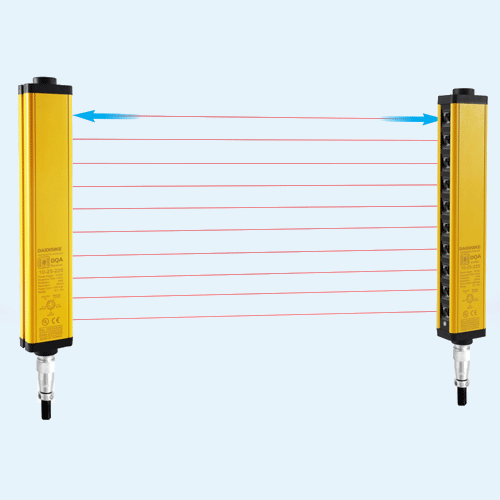
Indonesian buyers arrive here from a few clear directions: pricing a Type 4 curtain for a press shop; looking for a cheaper alternative (alternatif / pengganti) to an Omron or Autonics they already run; doing the SNI / customs / landed-cost homework before importing from China; or scoping the wider safety circuit — AGV scanner, relay, guard-locking switch, proximity sensor — for a new line. This guide answers all of those in order, in the English and Bahasa terms a procurement engineer actually searches (jual, harga, distributor), with honest certification and no invented local presence.
Where are safety sensors used in Indonesia — which estates and sectors?
About 60% of Indonesia's manufacturing sits in West Java's Bekasi–Cikarang–Karawang belt, and that is where the guarding demand concentrates. Manufacturing is roughly 19–21% of GDP, and the “Making Indonesia 4.0” roadmap prioritizes food & beverages, automotive, electronics, chemicals and textiles. The estates that anchor the belt are dense, near-full and full of machine builders and assembly lines — which means both new-line and retrofit demand for machine guarding (pengaman mesin / guarding mesin):
| Estate / region | Scale | Dominant sectors | Safety-sensor demand |
|---|---|---|---|
| Jababeka (Cikarang) | ~5,600 ha · 1,700+ companies | Automotive, electronics, chemicals, pharma | Press/assembly guarding, finger curtains |
| KIIC (Karawang) | ~1,400 ha · 200+ companies | Automotive & electronics | Stamping curtains, relays, interlocks |
| MM2100 (Bekasi) | ~1,700 ha (phase-dependent) · 300+ companies | Electronics, automotive, machinery | Conveyor / area guarding, proximity |
| Batam | Electronics / semiconductor backend | EMS, semiconductor (Infineon expanding) | Finger-protection curtains, AGV |
| Surabaya / East Java | Cement & heavy industry | Cement (Semen Indonesia, Holcim), shipyard | Heavy-machine & perimeter guarding |
| Semarang / Central Java | Textile & garment hub | Textiles (large majority of national capacity) | High machine count, basic guarding |
The single heaviest application is automotive and 2-wheeler stamping / press shops — the classic light-curtain + safety-relay + guard-locking case. PT Toyota Motor Manufacturing Indonesia (TMMIN) runs casting, engine, stamping and assembly; PT Unipres Indonesia presented stamping techniques at the 2024 ASEAN Advanced Automotive Manufacturing Summit; and the 2-wheeler segment is enormous (industry bodies report on the order of 6 million motorcycles sold a year, with Honda via PT Astra Honda Motor holding the dominant share — roughly three-quarters). Electronics / EMS is the next wedge — Indonesia's EMS market runs into the tens of billions of USD and is widely projected to keep growing, hubbed in Karawang/Bekasi and Batam — needing finger-protection curtains and conveyor guarding. Palm-oil mills (off Java in Sumatra/Riau and Kalimantan, with explicit fire/explosion-prevention and corrosion-resistance equipment-safety requirements), cement and textiles round out the machine count.
Who supplies safety light curtains in Indonesia — and what is the factory-direct difference?
Omron and Autonics own the formal channel; SICK and Keyence own the premium spec; DAIDISIKE is the China factory at the top of the import chain. Discovery in Indonesia runs through B2B platforms (Indonetwork, Indotrading, Ralali, Monotaro.id) and marketplaces (Tokopedia, Lazada, Shopee), and buyers type a transactional pattern — “jual / harga / distributor + product + city” (Jakarta, Surabaya, Bekasi, Tangerang). The established names:
| Brand (Indonesia presence) | Channel | Class | DAIDISIKE like-for-like (setara) |
|---|---|---|---|
| Omron F3SJ-series | PT Omron Mfg (EJIP) + omron.co.id + PT Elmecon | Type 4 / PLe / SIL3 | DQC (Type 4 hand) · DQA (finger/hand) |
| Autonics SFL-series | autonics.com/id + PT Lestari Elektrik Otomasi | Type 4 (value/mid anchor) | DQA (10–30 mm) · DQC · DQT4 |
| SICK | Global premium (thinner local footprint) | Type 4 | DQT4 (Type 4 / PL e) |
| Keyence | Global premium, sells in-region | Type 4 | DQC · DQT4 |
Every brand above is named nominatively for comparison from public knowledge — no partnership or endorsement is implied, and we never quote a competitor parameter we can't verify. DAIDISIKE is a China-based manufacturer (est. 2013) selling direct. We do not operate an Indonesian office, warehouse or appointed distributor (distributor resmi); you import directly from the factory, which removes the importer's margin layer — and note that Indonesia's safety/automation supply is already structurally import-dependent (sensor modules sourced mainly from Japan, China, the US and Germany), so Chinese origin is normal and accepted by buyers. For full model-by-model maps, see the brand replacement & compatibility hub.
K3, SMK3 and Kemnaker: what makes Indonesian factories install guarding?
The K3 / SMK3 regime is the real demand engine — compliance pressure, not brand prestige, is what puts curtains on presses. K3 (Keselamatan dan Kesehatan Kerja — Occupational Safety & Health) is governed by Kemnaker (the Ministry of Manpower). The foundational law is UU No. 1 of 1970 (workers must be informed of hazards), and the SMK3 (Sistem Manajemen K3 / OSH Management System) is mandated by Government Regulation PP No. 50 of 2012 — which replaced Permenaker No. 5/1996 — and supervised by the Directorate of OSH Supervision. SMK3 audits and K3 enforcement push factories to install machine guarding regardless of brand, which is exactly why a value-priced, fully-conforming Type 4 offer wins in a cyclical, price-sensitive market (PMI hovering near the 50 line through 2025–early 2026).
Practically: an SMK3 risk assessment that flags a stamping press or a robot cell calls for guarding to recognised machine-safety standards. A DAIDISIKE Type 4 curtain built to IEC 61496-1/-2, with the safety function rated to ISO 13849-1 (up to PL e) and mounted to the ISO 13855 safety distance, is the kind of point-of-operation guard that assessment is looking for — backed by a control-reliable stop circuit (more below). Do not conflate workplace K3 (Kemnaker/SMK3) with the Ministry of Trade's K3L consumer-product regime; they are different regulations.
Press shop & stamping: which curtain, what resolution, how is it mounted?
Automotive and 2-wheeler stamping is the heaviest Indonesia use-case — a Type 4 curtain, mounted to the ISO 13855 distance, is the right class. Resolution selection is the first decision: use a 14 mm-resolution curtain for finger protection right at the point of operation, and a ~30 mm curtain for hand detection. DAIDISIKE's DQA covers 10–30 mm finger/hand; the DQC and DQT4 cover Type 4 hand guarding up to PL e; and the DQR is the IP-rated washdown build for F&B and wet lines.
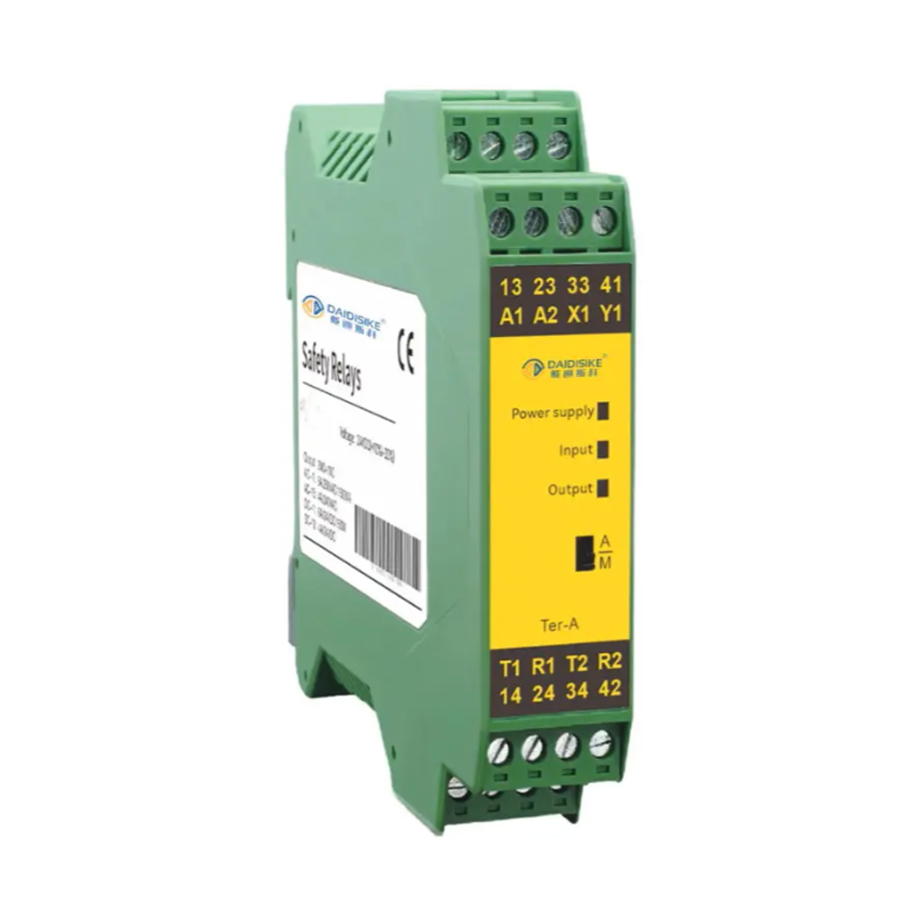
Mounting distance is not optional: the curtain must sit at the ISO 13855 safety distance computed from the system response time and approach speed, or a fast hand reaches the hazard before the stroke stops — see our ISO 13855 safety-distance calculator. Close the circuit with a DA31 safety relay (PL e / SIL 3, force-guided contacts, EDM) so the stop command is itself control-reliable.
Guard-locking door switches: protecting robot cells and stamping enclosures
Where a guarded enclosure must stay locked until dangerous motion has stopped, you need a guard-locking interlock — and this is a weaker-incumbent wedge in Indonesia. Robot welding cells, stamping enclosures and packaging machines on Java estates use guard-locking door switches to keep an operator out while the hazard runs down. DAIDISIKE's DX-W2 guard-locking switch (holding force up to 1300 N) and DX-R1 coded magnetic switch (to ISO 14119) cover this. One terminology note for buyers: search in English — “safety door switch”, “guard locking switch” or “safety interlock switch” — because the Bahasa phrase “pintu pengaman” returns consumer anti-theft door locks, not industrial interlocks. The diagram below shows the operating principle.

AGV / AMR safety scanners: the EV & electronics intralogistics wedge
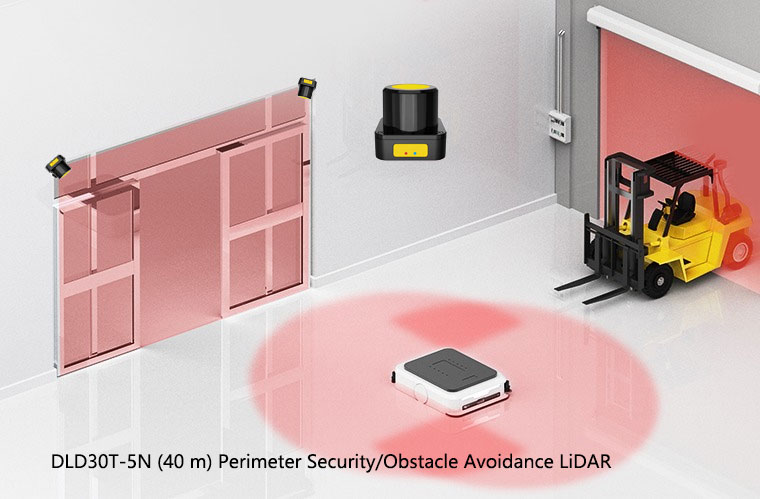
Indonesia's EV/battery and electronics expansion is the qualitative driver behind AGV/AMR adoption — and AGV safety LiDAR is less visibly localized by the incumbents than light curtains. Mobile robots moving material on EMS and automotive lines need a safety laser scanner that defines a protective field (a hard stop if a person enters) and a warning field (slow down). DAIDISIKE's DLD-series safety laser scanners / LiDAR are built to the IEC 61496-3 architecture for exactly this. The diagram shows how the protective and warning fields wrap an AGV.

Can I import safety sensors from China to Indonesia — MOQ, Tanjung Priok, FOB vs CIF vs DDP?
Yes — and the MOQ objection is backwards: ours is 1 set, so you sample before bulk. Order a single unit, validate it against your ISO 13855 distance, fit-check brackets and OSSD wiring, then repeat at volume. Indonesia's primary gateway is Tanjung Priok (Jakarta) — cited as handling ~70% of national trade and the gateway to the West Java belt; Tanjung Perak (Surabaya) serves East Java. Ocean transit South China → Tanjung Priok is commonly ~8–14 days port-to-port, with door-to-door FCL realistically ~18–25 days once Bea Cukai (customs) inspection and origin-labeling are factored in.
On Incoterms, the difference is who carries freight and — crucially — who holds the Indonesian import licenses:
| Incoterm | Freight / insurance | Who clears & holds licenses |
|---|---|---|
| FOB China | Buyer arranges main freight | Buyer clears & must hold import licenses |
| CIF Tanjung Priok | Supplier covers freight + insurance to port | Buyer still clears & holds licenses |
| DDP | Supplier/forwarder end-to-end | Forwarder absorbs the import-license burden |
This matters because of a 2025 licensing change: under Permendag 16/2025 and 22/2025, importers use an NIB (via OSS-RBA) with API-U, and many goods now need a PI (Persetujuan Impor) tied to the Neraca Komoditas (Commodity Balance) quota system, with electronics in a dedicated cluster. Forwarders note that an importer lacking the right PI/quota often cannot import under standard CIF and is pushed to a DDP arrangement where the forwarder of record absorbs the requirement. Confirm applicability for your exact HS lines with your forwarder; we supply the commercial invoice, packing list and certificate of origin (including Form E) so clearance is clean.
HS code, duty / PPN, SNI & ACFTA Form E — the import questions buyers research first
HS classification is product-dependent and your importer's call; the lines that come up are the 8536 and 9031 classes. SNI is addressed honestly below. A safety light curtain or relay is variously presented under the 8536 class (electrical apparatus for switching/protecting circuits) or the 9031 class (measuring/checking instruments) — have it classified per SKU against Indonesia's current tariff (INSW/BTKI). Indonesia uses the CIF value as the taxable base: Bea Masuk (import duty) on CIF, PPN (VAT) on (CIF + duty), and an import income-tax prepayment (PPh Pasal 22) typically also applies. Rates depend on the exact line and origin, so we won't print a percentage that could be stale — confirm the live duty and the standard PPN rate on INSW/DJP at time of import.
The lever worth using: Chinese-origin goods may qualify for reduced or zero import duty under the ASEAN–China FTA (ACFTA) with a valid Form E certificate of origin, which can offset the estimated ~5–10% landed-cost uplift from duties and logistics. On SNI: we have not confirmed a mandatory SNI (“SNI wajib”) specific to safety light curtains, and DAIDISIKE does not hold and does not claim an SNI mark. The framework is that SNI (administered by BSN with the Ministry of Industry) becomes mandatory only for listed product categories, and the certificate authorizing the mark — the SPPT-SNI — requires product testing plus a factory surveillance audit. A separate Ministry of Trade regime, K3L, covers some non-SNI products. IEC 61496 is the relevant international standard family, and some SNI are adoptions of IEC — but whether a mandatory SNI applies to a specific safety-sensor SKU must be verified with a local certification body (LSPro). DAIDISIKE's conformity rests on CE (self-declared) to IEC 61496, ISO 9001 quality control, and TÜV third-party testing per order.
What else does DAIDISIKE supply into Indonesia — the whole safety circuit?
Curtains, AGV LiDAR, relays, coded/guard-locking switches and proximity sensors — one factory, MOQ 1 set. A curtain rarely ships alone, and each line has its own Indonesia “jual / harga / supplier” search demand. The DA31 / DA31-B safety relay closes the stop loop; the DX-R1 coded magnetic switch (ISO 14119) and DX-W2 guard-locking switch (up to 1300 N holding force) handle doors and gates; the DLD-series safety laser scanners / LiDAR cover AGV/AMR and perimeter protection; and inductive proximity sensors — the buyer term is “sensor proximity induktif” — in M8/M12/M18/M30 (NPN/PNP, NO/NC) cover position sensing. The safety relays and guard-locking switches are the weaker-incumbent wedge: less visibly localized in Indonesia than light curtains, so factory-direct DA31 and DX-series parts compete strongly there.
Send the four numbers off your press or line — resolution (14 mm finger / 30 mm hand), protective height, sensing range, output/OSSD type — plus quantity and whether you want FOB or CIF Tanjung Priok / Tanjung Perak, and we'll return a firm quote, a short lead time, and the export documents (including ACFTA Form E) your importer needs. Sample at MOQ 1 set.
Contact DAIDISIKE → | Phone / WhatsApp +86 15218909599 · 915731013@qq.com
Sources & references
- DAIDISIKE — DQC Type 4 safety light curtain and the DQA finger/hand model — published resolutions and OSSD interface.
- IEC 61496-1/-2/-3, ISO 13849-1 (PL), ISO 13855 (safety distance) and ISO 14119 (interlocks) — the standards that fix Type 4 architecture, PL e, mounting distance and coded-switch operation referenced throughout.
- Indonesia market & geography — West Java Bekasi–Cikarang–Karawang belt, Jababeka / KIIC / MM2100, EMS and automotive/2-wheeler figures, “Making Indonesia 4.0” (the-shiv.com, Colliers/martini.ai, marketresearchfuture, Statista / Mordor Intelligence, industrysourcing.com).
- K3 / SMK3 framework — Kemnaker, UU No. 1 of 1970, PP No. 50 of 2012 (replacing Permenaker No. 5/1996) (spanset, indonesia.incorp.asia, envidata).
- Conformity & import — SNI / SPPT-SNI (BSN + Ministry of Industry), K3L (Ministry of Trade), LSPro; Tanjung Priok / Tanjung Perak; CIF taxable base, Bea Masuk / PPN / PPh 22; ACFTA Form E; Permendag 16/2025 & 22/2025, PI / Neraca Komoditas (TUV SUD, UL Solutions, Cekindo, PwC, Lexology). Confirm current classification, duty, VAT and registration scope with your customs broker / LSPro.