
Safety Light Curtain NPN/PNP, PLC, Safety Relay — What They Are and How to Wire Them (with DAIDISIKE DQE Examples)
Whether you’re a plant engineer or a buyer, this guide will help you quickly understand safety light curtain output types and wiring. We’ll break it down step by step and use DAIDISIKE DQE series as the running example.
What is a Safety Light Curtain?
A safety light curtain is the “electronic eye” of machine guarding. It creates a protective field using opposed infrared beams. When any beam is interrupted, the curtain switches its dual self-monitoring safety outputs (OSSD1/OSSD2) to stop hazardous motion within the required safety distance. Typical standards involved include IEC 61496, ISO 13849 and ISO 13855. It is widely used on presses, robot arms, hydraulic machines and automated lines.
NPN vs PNP Output Types
NPN and PNP are two common ways a light curtain presents its OSSD signals to a control system. They affect how you wire the device and how the logic is interpreted downstream.
- PNP output (most common): when the curtain actuates, it sources +24 V. Excellent noise immunity and easy matching with most safety relays or safety PLCs—ideal for new installations.
- NPN output (seen on legacy systems): when actuated, the signal is pulled to 0 V. This requires stricter grounding and wiring discipline and is more sensitive to noise, but is appropriate where the downstream only accepts sinking logic.
Either type can achieve PL e or SIL 3 when correctly matched to the downstream safety inputs. The keys are dual-channel consistency and built-in self-monitoring.
PLC vs Safety PLC
A standard PLC is the “brain” for process control, but it is not safety-certified and cannot alone handle emergency stop functions.
A Safety PLC (or a safety relay) includes cross-monitoring, self-tests and fault detection to meet ISO 13849 or IEC 61508. Think of it as a dedicated safety guardian that reliably processes the curtain’s OSSD signals so the machine stops when danger is present.
Rule of thumb: simple stop chains → use a safety relay; complex interlocks → use a safety PLC.
What a Safety Relay Does
A safety relay is a ready-made safety logic module commonly used with E-Stops, guard doors and light curtains. It provides dual-channel inputs and an EDM feedback loop, and switches force-guided contacts or certified solid-state outputs to reach Category 4 / PL e.
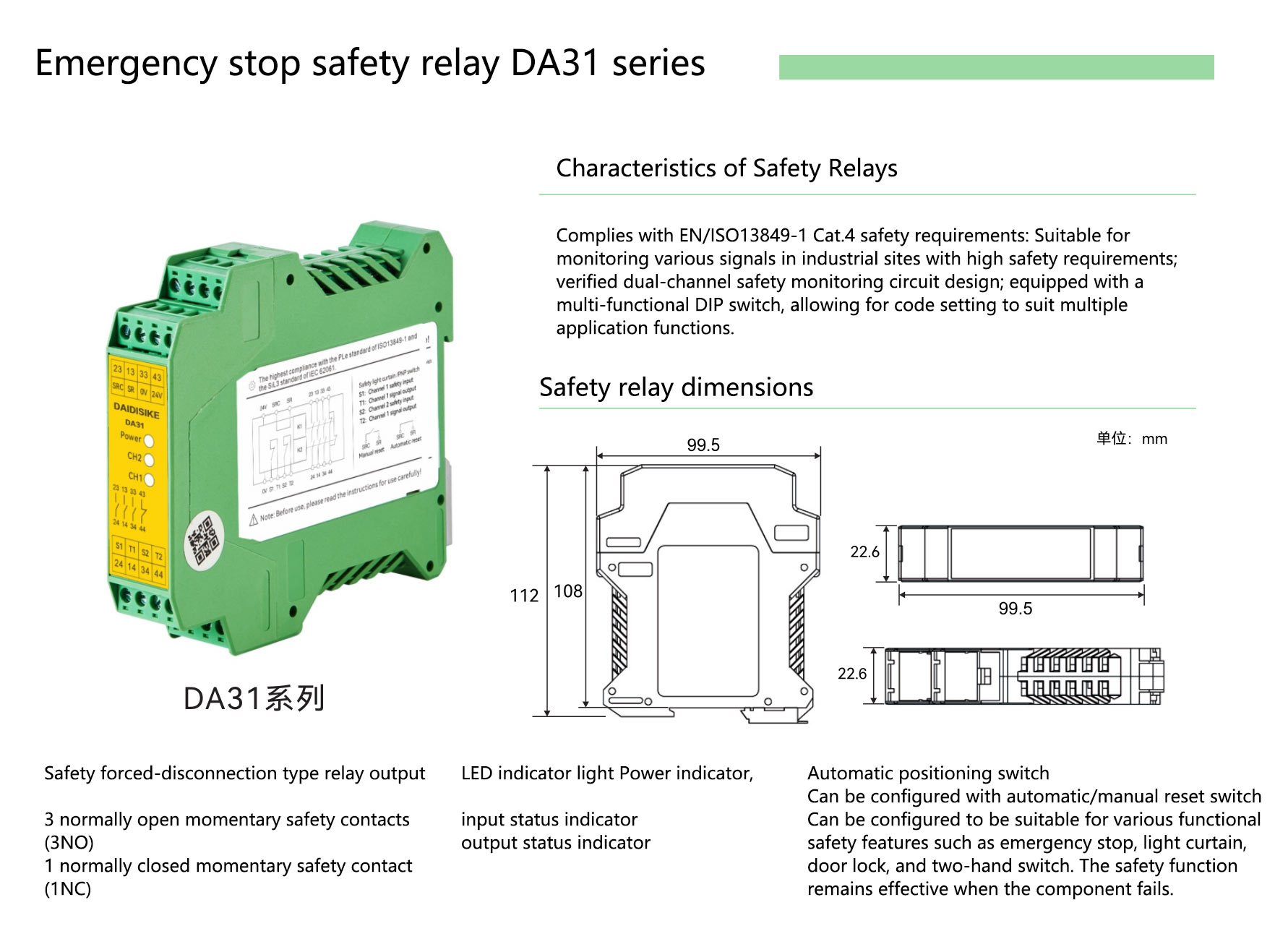
For example, the DA31 series is a classic light-curtain safety relay that converts OSSD signals into a reliable stop command to protect personnel.
DQE Wiring Guide (NPN / PNP)
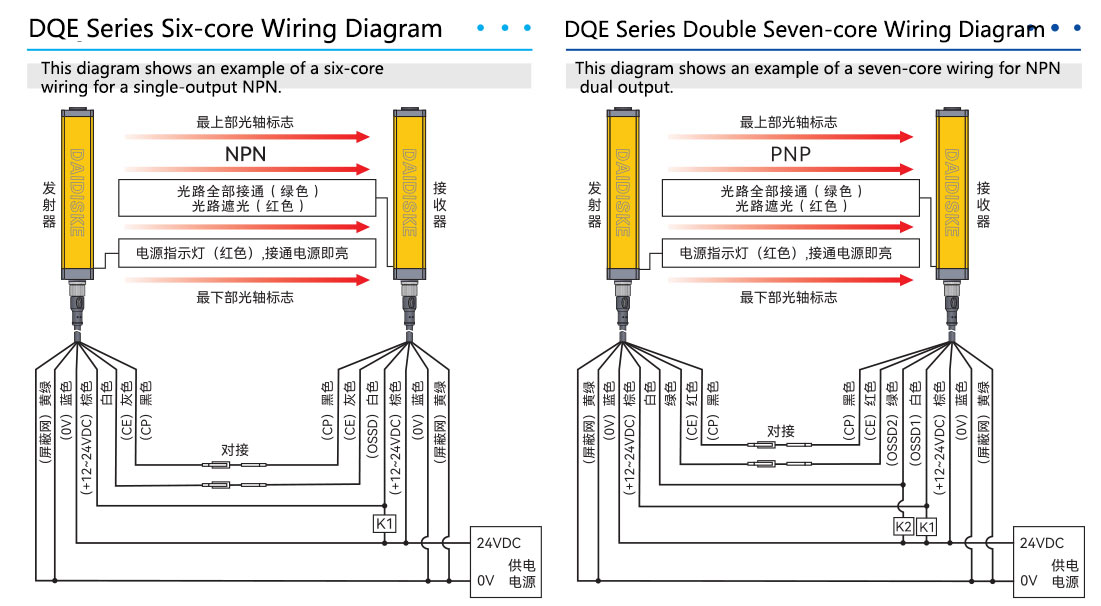
The DAIDISIKE DQE series offers six-core (single output) and seven-core (dual output) variants. Your diagrams clearly show NPN and PNP examples. Typical wire functions (always confirm with the product manual and nameplate):
- BN (brown): +24 VDC supply (+)
- BU (blue): 0 V (–)
- BK (black): OSSD1
- WH (white): OSSD2 (seven-core only)
- Other colors (e.g., grey): sync (CP/CE), reset or vendor-specific functions
Shielding: bond the cable shield at a single designated point (0 V or PE per manual) to avoid ground loops.
- Never merge OSSD1 and OSSD2. They must land on two independent safety inputs.
- Use shielded twisted pairs for sync/OSSD and route power and signal in separate ducts.
Three Common Wiring Schemes
- PNP dual-channel curtain → Safety relay (most recommended): for new systems. After powering up, wire OSSD1/2 to the relay’s two safety inputs and add EDM feedback. Verify with a test rod. Advantages: broad compatibility and easy commissioning.
- PNP dual-channel curtain → Safety PLC: for complex logic (multiple door interlocks, mode selection, etc.). Land OSSD1/2 on safety DI channels, configure test pulses/filters as per the manual, and use safety DO to drive contactors or STO.
- NPN curtain → Safety relay or safety PLC: for legacy systems. Requires proper pull-ups (or inputs that support sinking logic) and strict common-grounding. Power quality is critical.
How to Choose: NPN or PNP? Relay or Safety PLC?
Step 1 — Look at the downstream safety input. Most safety relays favor PNP and are simplest to configure. Choose NPN only if the system explicitly expects sinking inputs.
Step 2 — Consider system complexity. A single stop chain is cost-effective with a safety relay. If you must integrate multiple safety functions, a safety PLC scales better.
Quick power tip from the field
If the customer’s machine already provides a clean 24 VDC supply, the curtain can usually be connected directly—often without a separate converter. If the machine only has AC 110–220 V and no DC supply, recommend adding a light-curtain controller or a DA31 safety relay module with suitable power conversion.
Six-Step Commissioning & Acceptance
- Verify documentation: manual, wiring diagram and risk assessment. Confirm resolution, protected height, range and response time.
- Power & grounding: use a dedicated 24 VDC supply with ripple < 5%; single-point grounding.
- Dual-channel landing: OSSD1/2 to separate inputs; shielded cables away from power lines.
- EDM feedback: return auxiliary NC contacts of the actuators to form a monitored loop.
- Functional test: use the test rod, measure total stop time T, and verify the ISO 13855 safety distance (
S = K × T + C). - Fault simulation: open one channel or EDM and confirm the system trips and requires correction before reset.
Common Errors & Troubleshooting
- Merging OSSD channels: loses redundancy and is unsafe.
- Landing on a standard PLC: the PLC sees the signal but provides no certified safety integrity—non-compliant.
- Grounding issues: floating grounds cause nuisance trips—use single-point grounding as per the manual.
- Skipping EDM: welded contacts go undetected, creating a dangerous failure.
- Insufficient safety distance: the machine stops too late—calculate and verify against ISO 13855.
- Poor shielding: heavy noise environment requires shielded twisted pairs and proper bonding. DAIDISIKE’s yellow-green shield should be earthed to suppress nearby interference sources.
DQE Application Notes
- Six-core NPN (single output): suitable for legacy sinking systems; more sensitive to grounding quality.
- Seven-core PNP (dual output): mainstream option—connects cleanly to DA31 or to safety PLC dual inputs. Recommended first choice.
- DQET with built-in controller: follow the terminal legends (+24, 0V, S, CP, CE, K1/K2, T1/T). Keep AC and safety contact blocks clearly separated—never mix low-voltage and mains wiring.
- With DA31: land OSSD1/2 on IN1/IN2, wire EDM through NC auxiliaries, and select reset mode based on the risk assessment.
Selection Checklist
- Resolution: 14 mm (finger), 30 mm (hand), or larger for body/area
- Protected height, operating range, response time
- Output type: PNP dual-channel preferred (choose NPN only when required)
- Logic device: safety relay (simple) or safety PLC (complex)
- Environment: IP rating (e.g., IP67), anti-vibration, oil resistance, EMC
- Cabling: shielded twisted pairs, segregated routing
- Standards: target PLr, ISO 13855 safety distance, IEC 61496
- Certificates: CE, type-test reports (see the DAIDISIKE website)
FAQ
Q: Why does merging OSSD channels still stop the machine?
A: It may stop, but it is not a safe stop. You lose dual-channel monitoring and cross-short detection, so it won’t meet PL requirements and creates hidden danger.
Q: Do I need new hardware to switch from NPN to PNP?
A: You can convert using an interposing relay or a dedicated conversion module to achieve NPN→PNP or PNP→NPN. However, this adds extra components and failure points and tends to be troublesome. Best practice is to decide the output type at selection time and avoid converting the signal after installation.
Q: How do I confirm the wiring is correct?
A: Run the six-step process plus fault simulation: block → stop; open one channel → trip/fault; open EDM → reset inhibited. Only when all pass is it acceptable.