
We keep cross-reference notes for the brands customers most often arrive with, and in the area-scanning category that means SICK, Omron, Keyence, Leuze and Banner. But this page is different from our relay or light-curtain cross-references in one important way: it is mostly about telling you when not to buy our product. A safety laser scanner is a personnel-protection device, and we would rather lose the sale than have someone install an obstacle LiDAR where a certified scanner is legally required. So the honest line runs straight through the middle of this article.
Here is that line in one sentence: a certified safety scanner performs the safety-rated stop; the DAIDISIKE DLD does navigation, obstacle avoidance and non-safety perimeter detection. Both look at the world as a 270–275° fan of laser measurements and both output “zones,” which is exactly why they get confused. Everything below is about why that surface similarity does not make them interchangeable, and where each one actually belongs.
What makes a safety laser scanner “safety-rated,” and what is the DLD?
A certified safety laser scanner is a Type 3 device under IEC 61496-3 that delivers its protective function through four things an ordinary measuring LiDAR does not have:
- Dual OSSD safety outputs — two independent, self-tested switching signals (not general NPN/PNP), so a single output fault is detected and forces a safe state.
- A validated safety response time — a guaranteed, type-tested figure you are allowed to enter into the EN ISO 13855 safety-distance calculation
S = K×T + C. - Multiple-sampling / probability-of-detection behaviour — tested to IEC 61496-3 so the device reliably detects a person (e.g. a leg) within a defined resolution.
- Third-party type-examination (TÜV) — yielding the Type 3 / PL d / SIL 2 marks. The rating is certified by an independent body, not self-asserted.
The DAIDISIKE DLD-series has none of those four. It is an obstacle-avoidance / navigation / perimeter LiDAR: it measures distance across a 270° fan and switches general-purpose NPN/PNP outputs (plus RS485/Modbus) when an object enters a learned zone. DAIDISIKE says this plainly on its own product pages — for example the DLD05A3/DLD20A5 page states the units are “obstacle-avoidance LiDARs intended for AGV/AMR navigation and general detection, not a Type 3 safety scanner certified to IEC 61496-3,” and the DLD30T-5N page calls it “an economical industrial obstacle avoidance and perimeter-security LiDAR, not a certified IEC 61496-3 Type 3 safety device.” There is no published PL/SIL/Type rating, no OSSD pair, and no TÜV certificate. That is the whole basis of this article.
The seven certified safety scanners buyers cross-shop — the comparison table
All seven are certified Type 3 / Cat. 3 / PL d / SIL 2; they differ mainly on range, scan angle, zone count and interface. The figures below are from public OEM / distributor data and are for orientation when you cross-shop — confirm against each vendor's current datasheet and the label on your installed unit. The DLD row at the bottom is included only to show what it is and what it is not.
| Scanner | Certification | Scan angle | Protective / warning field | Notes |
|---|---|---|---|---|
| SICK microScan3 (MICS3 family) | Type 3 / Cat. 3 / PL d / SIL 2 | 275° | Protective up to 9 m | safeHDDM; I/O, EFI-pro, EtherNet/IP CIP Safety, PROFINET PROFIsafe, EtherCAT FSoE; successor to S3000 |
| SICK nanoScan3 | Type 3 / Cat. 3 / PL d / SIL 2 / SIL CL2 | 275° | Compact protective field | Ultra-compact; AMRs, cobots, tight spaces; successor to S300 |
| SICK S300 (S30B family) | Cat. 3 / PL d / SIL 2 | 270° | Protective 2–3 m | ~80 ms response; 30/40/50/70 mm resolution; up to 16 fields, triple-field mode; legacy but widely installed |
| Omron OS32C | Type 3 / Cat. 3 / PL d / SIL 2 | 270° | Safety up to 4 m / warning up to 15 m | Up to 70 zone-set combinations; 30/40/50/70 mm; Ethernet config/monitoring |
| Keyence SZ-V | Type 3 / Cat. 3 / PL d / SIL 2 | (per Keyence datasheet) | Protection up to 8.4 m / warning up to 26 m | Separate display unit, multi-zone, cascading; SZ-V04/V32/V32N |
| Leuze RSL400 | Type 3 / Cat. 3 / PL d / SIL 2 | 270° | Operating range up to 8.25 m | Up to 10 reversible field pairs; two autonomous protective functions; AIDA variants; successor to RS4 |
| Banner SX5 | Type 3 / Cat. 3 / PL d / SIL 2 / SIL CL2 | 275° max | Protective 0.05–5.5 m | Class 1 laser; IP65; standalone SX5-B/B6 or cascade SX5-M/ME |
| DAIDISIKE DLD (DLD05A3/20A5/30T-5N) | None — NOT a Type 3 / PL / SIL device | 270° | Detection 0.05–5 m / 0.05–20 m / up to 40 m | Obstacle avoidance / navigation / perimeter only; NPN/PNP + RS485/Modbus; no OSSD; 905 nm Class 1 |
Where a cell reads “per datasheet,” that is deliberate — we will not print a precise number in a competitor column unless it is published and stable across variants. Pull scan angle, resolution and response time from the specific part number you are replacing.
Why can't the DLD just drop into the safety stop? The response-time math
Because its “response time” and “zones” are not validated for a personnel safety-stop and cannot enter the EN ISO 13855 distance formula. The minimum safety distance for an approach to a detection plane is S = K × T + C, where:
- K ≈ 1600 mm/s, the assumed approach speed for walking;
- T = the total system response time — the scanner's certified safety response time plus control and machine stopping time;
- C = an intrusion distance derived from the scanner's certified detection capability (e.g. a 70 mm leg-detection resolution).
A certified scanner gives you a guaranteed, type-tested number for T and a certified detection capability for C. The DLD05A3/20A5 do list a typical response time (about 134 ms at 15 Hz, 66 ms at 30 Hz, adjustable) and the DLD30T-5N about 33 ms at 30 Hz — but those are detection-update figures, not validated safety response times, and the DLD has no certified detection capability for a person. Substituting them into S = K × T + C produces a distance that no competent assessor can defend, because the inputs were never type-examined for that use. That is the precise, technical reason the DLD cannot replace any of the seven scanners for the protective field.

So where is the DLD the right, cost-effective choice?
Anywhere the function is navigation, obstacle avoidance, slow-down logic or non-safety perimeter — not a PL/SIL stop. On a mobile robot, and around fixed machinery, plenty of laser-sensing jobs are not personnel safety-stops, and paying certified-scanner money for them is wasteful. The DLD is built for these:
- AGV/AMR obstacle avoidance & path-planning — seeing pallets, racking and people ahead so the vehicle re-routes (DLD20A5 covers 0.05–20 m).
- Warning-field slow-down logic — the outer, non-safety zone that drops the vehicle's speed before the certified inner field would trigger a stop.
- Navigation / contour sensing — 270° at 15/30 Hz, 0.1° resolution, ±30 mm error, 16 self-learning zone groups.
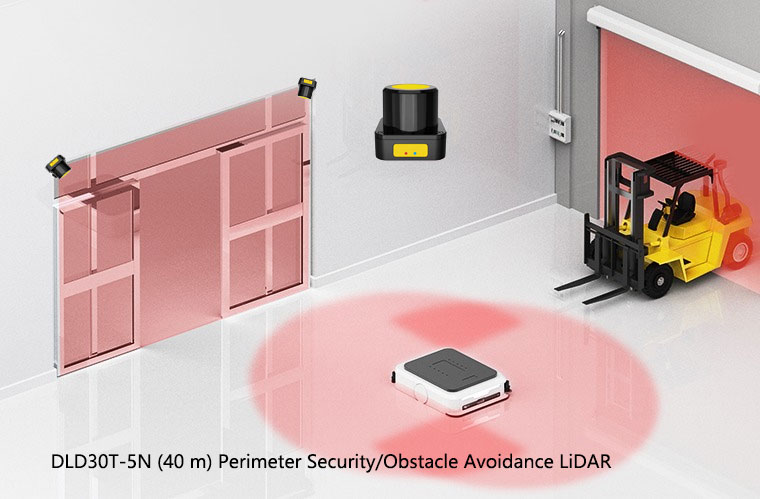
- Perimeter / gate / parking / barrier detection — including outdoor work with the IP67 DLD30T-5N reaching up to 40 m, where no PL/SIL stop is claimed.
The integration pattern most builders land on is the honest one shown in the diagram above and below: a certified safety scanner owns the safety-rated stop zone, and a DLD owns obstacle avoidance, navigation and the outer non-safety warning zones — certified where the standard requires it, factory-direct cost where it does not.

What DAIDISIKE certified parts do belong in the safety loop?
The DA31 relay and the Type-4 light curtains — not the DLD. Being honest about the scanner gap does not mean DAIDISIKE has nothing certified for the safety chain. It has the parts that sit around a certified scanner:
- DA31 / DA31-B safety relay — EN ISO 13849-1 Cat. 4 / PL e, IEC 62061 SIL 3, force-guided contacts, <30 ms release, 3NO+1NC. This is exactly the kind of relay that takes a certified scanner's OSSD outputs and performs the stop. Verify dual-channel wiring and that the integrator validates the final PL/SIL of the whole chain.
- DQA / DQT4 Type-4 light curtains — opto-electronic line/area guarding with dual OSSD, ≤15 ms response, IP65. DAIDISIKE's careful wording is that the DQA is “designed to IEC 61496 Type 4 architecture, suitable for PL e / SIL 3 chains,” with the integrator validating the final PL/SIL. These are a different device class from a 2D scanner — they guard a line or plane at an opening, they do not provide a scanner's area coverage, so use them where the original solution was a light curtain, not a scanner.
The blunt gap, stated once more so no one misreads it: DAIDISIKE has no certified IEC 61496-3 Type 3 safety laser scanner equivalent to the microScan3, nanoScan3, OS32C, SZ-V, S300, RSL400 or SX5. For the safety-rated area/AGV stop, keep a certified scanner from one of those vendors (or another certified maker). DAIDISIKE's job around that scanner is the certified DA31 relay, the Type-4 curtains, and the DLD navigation LiDAR — each in its proper place.
A representative AGV application — how the zones split in practice
Take a typical intralogistics AGV in a warehouse aisle (a representative scenario, not a named customer). The risk assessment calls for a personnel safety-stop if someone steps into the vehicle's travel path. That stop function is non-negotiably a certified Type 3 scanner: its OSSD pair drives the drive-disable through a certified relay such as the DA31, and its certified response time and detection capability go into S = K × T + C to set the protective-field reach for the AGV's top speed. None of that can be a DLD.
But the same AGV benefits from sensing that is not a safety stop: an outer warning ring to slow down gracefully before it ever needs the certified stop, obstacle avoidance to nose around a misplaced pallet, and contour/navigation sensing. Those are the DLD's jobs. A DLD20A5 on the outer ring and obstacle-avoidance duty, with the certified scanner reserved for the inner stop field, gives a clean split: certified where the law demands it, economical where it does not. If the vehicle also needs long-range outdoor perimeter awareness at a yard gate, the IP67 DLD30T-5N (up to 40 m) covers that non-safety perimeter. For the underlying distance math, see our ISO 13855 safety-distance guide.
What to match when you cross-shop SICK, Omron, Keyence, Leuze and Banner
For the certified scanner itself, six numbers off the installed unit's label and datasheet decide the replacement.
- Certification — confirm Type 3 / Cat. 3 / PL d / SIL 2 with a current TÜV type-examination. This is the one you never compromise.
- Protective-field range — e.g. microScan3 up to 9 m, SZ-V up to 8.4 m, RSL400 up to 8.25 m, OS32C up to 4 m safety / 15 m warning, SX5 up to 5.5 m, S300 2–3 m.
- Scan angle — 270° (S300, OS32C, RSL400) or 275° (microScan3, nanoScan3, SX5).
- Detection capability / resolution — 30/40/50/70 mm; this sets the C term and whether you detect a leg or a hand.
- Zones & field sets — how many simultaneous protective + warning fields and switchable sets (e.g. OS32C's up to 70 zone-set combinations).
- Interface — discrete OSSD/IO vs safe fieldbus (EtherNet/IP CIP Safety, PROFINET PROFIsafe, EtherCAT FSoE).
For the non-safety zones around that scanner — obstacle avoidance, navigation, slow-down, perimeter — send us the range, environment (indoor/outdoor, IP, ambient lux), output type (NPN/PNP or RS485/Modbus) and zone behaviour you need, and we will match a DLD variant. The wider method and the other cross-references live in the safety scanner / LiDAR sourcing guide.
Is naming these brands legal, and how do you keep this honest?
Naming a competitor's product to describe a comparable or adjacent alternative is nominative reference and is legitimate; we keep it honest by using only published specs and by drawing the safety line clearly. We name SICK, Omron, Keyence, Leuze and Banner and their models to tell you what they are and where the DAIDISIKE DLD does — and does not — fit. What we deliberately do not do: we do not reproduce their manuals or logos, we do not reuse their part numbers (MICS3-…, S30B-…, OS32C-BP, SZ-V…, RSL4xx, SX5-…) on any DAIDISIKE product, we do not invent matching certificate numbers or DLD safety ratings, and above all we do not imply the DLD closes the certified-scanner gap. Every DLD figure here is from DAIDISIKE's own published product pages; every competitor figure is from public OEM / distributor data; and where a number varies by variant the page says “per datasheet” rather than faking precision.
Sources & specifications cited
- DAIDISIKE DLD05A3-3N / DLD20A5-5N obstacle-avoidance LiDAR product page — 0.05–5 m / 0.05–20 m, 270°, 15/30 Hz, 0.1° resolution, ±30 mm, 905 nm Class 1, NPN/PNP + RS485/Modbus, IP65; explicit “not a Type 3 safety scanner” FAQ.
- DAIDISIKE DLD30T-5N 40 m perimeter-security / obstacle-avoidance LiDAR product page — up to 40 m, 3–30 Hz, 905 nm Class 1, RS485/Modbus + 48 PNP/NPN channels, IP67; explicit “not a certified IEC 61496-3 Type 3 safety device” FAQ.
- SICK microScan3 / nanoScan3 / S300 public product data — Type 3 / PL d / SIL 2; 275° / 270°; protective field up to 9 m (microScan3); safeHDDM; safe fieldbus interfaces.
- Omron OS32C, Keyence SZ-V, Leuze RSL400, Banner SX5 public product data — all Type 3 / Cat. 3 / PL d / SIL 2; ranges, scan angles and zone counts as cited.
- EN ISO 13855 — positioning of safeguards with respect to approach speeds; S = K × T + C. DAIDISIKE DA31 safety relay datasheet (Cat. 4 / PL e, SIL 3, <30 ms).