
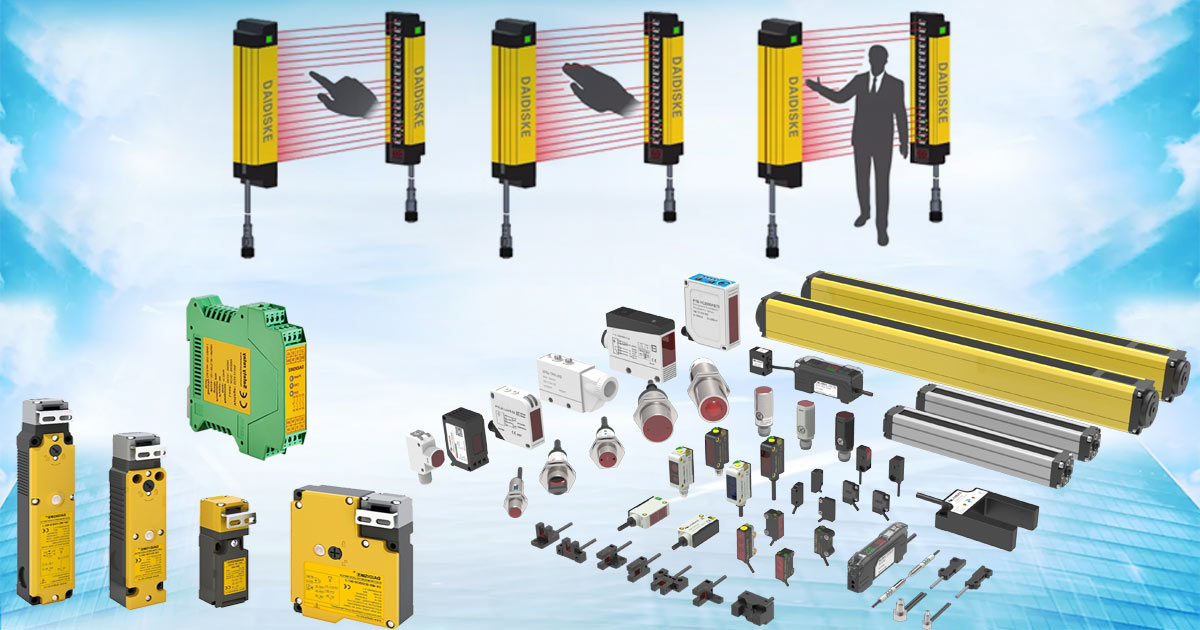
REER — ReeR S.p.A. of Turin, Italy — is a long-standing European ESPE maker, and its curtains are exactly what you'd expect from an Italian safety-electronics house: well-built, fully certified, and priced as a premium import. When buyers come to us looking for a REER light curtain alternative or a REER light curtain replacement, the driver is almost never a complaint about the REER product. It is procurement: a single unit ordered against a high MOO threshold, or a multi-week lead time on a line that's already down. So let me be straight about the pitch up front — this is a cost-and-availability cross-reference, not a “we're better” story.
DAIDISIKE (Foshan DAIDISIKE Optoelectronics Technology Co., Ltd.) is a Chinese OEM/ODM that builds the DQ-series to the same governing standards REER builds to: IEC 61496 for the ESPE itself, ISO 13849-1 PL e for the safety function, and ISO 13855 for the mounting distance, with the same dual-channel OSSD output architecture. The wedge is MOQ 1 set and a 3–15 day lead time at factory-direct pricing. Everything below maps a REER family to its nearest DQ-series part by Type, resolution, range and output.
One blunt rule before the detail: a safety curtain “equivalent” is not a part number you look up and drop in. It's a match on five numbers — Type/class, resolution, protected height, range, and the OSSD output scheme — followed by re-bracketing, re-pinning and a fresh ISO 13855 calculation. When those line up and the DAIDISIKE response time is equal or faster, the swap is sound. When they don't, no badge change makes it safe.
What is the DAIDISIKE equivalent of a REER EOS4 or EOS2?
The DQC (Type 4 hand) and DQA (10–30 mm finger/hand) cover the EOS4's finger-and-hand resolutions; the Type 2 EOS2 maps to lower-cost DQA / DQC configurations. REER's EOS4 is a compact Type 4 curtain to IEC 61496, rated PL e / SIL 3 / Cat. 4, in 14, 20, 30, 40, 50 and 90 mm resolutions (finger, hand and body), with a standard range of roughly 6–12 m and up to about 20 m on the AH/XH high-range builds, a response time around 4 ms, two PNP OSSD outputs rated 400 mA at 24 V DC, IP65/IP67, a 28 x 30 mm profile and a −10 to +55 °C operating range. The EOS2 is the Type 2 budget tier in the same compact body and the same resolution set plus multibeam access-control, with integrated EDM and auto/manual restart.
For the 14–30 mm finger and hand band, the DAIDISIKE DQA (finger/hand 10–30 mm) and the Type 4 DQC hand guard are the cross-reference. The EOS4's class — Type 4, PL e, dual PNP OSSD — matches the DAIDISIKE Type 4 / PL e architecture. For an EOS2 (Type 2) job the lower-cost DQA / DQC configurations are the equivalent. Pull the resolution and protected height off the original label, because that pair, plus whether the unit was a high-range AH/XH build, decides the match and whether you need a longer-range Type 4 unit instead.
What replaces a REER Admiral, Janus or Safegate muting curtain?
The Type 4 / PL e DQT4, the dual-output DQE and the area DQSA cover REER's Admiral (blanking), Janus (muting) and Safegate (muting) families. The REER Admiral / Admiral AX is Type 4 (SIL 3 / PL e / Cat. 4) in 14 mm finger and multibeam 2/3/4-beam access versions plus 30/50/90 mm, with two PNP OSSD outputs rated 500 mA at 24 V DC and integrated blanking (response around 6 ms on short bars). REER Janus is a short-to-mid range multibeam muting curtain (Type 4, SIL 3 / SILCL 3 / PL e) in a 2/3/4-beam multibeam layout (300/400/500 mm beam pitch) with a 90 mm MI limb option, protected heights 300–1800 mm, a response time around 7 ms, built-in muting with no programming, and cable runs to 100 m — built for palletizing and access points. REER Safegate (SM / SMPO) is Type 4 with integrated muting, directly-connectable muting sensors, configuration via Safegate software, and IP65.
On the DAIDISIKE side the DQT4 (Type 4 / PL e) is the core match, with the dual-output DQE where a second output set is needed and the DQSA area curtain for access / palletizing geometries. Two honest caveats so nobody is surprised on the bench. First, REER's integrated muting and blanking feature sets — and the Safegate configuration software — are REER-specific; confirm which of those functions your machine's safety logic actually relies on before swapping, so the replacement keeps the functions that matter. Second, for muting we typically pair a DAIDISIKE curtain with discrete muting sensors and a safety relay such as the DA31 (PL e / SIL 3) rather than relying on a single curtain's on-board muting logic — tell us the muting geometry (sensor count, sequence, timeout) so we reproduce it.
What is the DAIDISIKE equivalent of a REER SafeReady or Vision?
SafeReady (premium, rugged, wide-temp) maps to the rugged DQR and DQT4; the Type 2 Vision hand-detection curtain maps to the DQA. REER's SafeReady is a premium programmable Type 4 curtain (PL e / Cat. 4) with protected heights up to 2 m, range up to 18 m (Low 0–8 m / High 6–18 m), fixed and floating blanking, zero blind-zone on both sides, IP65/IP67, a wide −30 to +55 °C range, a 4-LED alignment aid, and Bluetooth / app configuration on the Plus models. REER's Vision / Vision V / VX / VXL is a Type 2 hand-detection curtain with a selectable max range of 6 m or 16 m, an integrated start/restart interlock plus EDM input, and two PNP safety outputs rated 500 mA at 24 V DC.
For a SafeReady in a harsh / washdown / wide-temperature install, the DAIDISIKE rugged DQT4 and the DQR (IP68 outdoor/washdown) are the cross-reference; the DQE covers cases needing the second output set. For a Type 2 Vision hand-detection job, the DQA is the equivalent. As always, confirm the SafeReady's actual IP, temperature and blanking requirements against your application — if the IP67 / −30 °C rating was specified for a genuine environmental reason rather than just because it came that way, that decides whether you need the sealed DQR build.
Is there an alternative to the REER Micron measuring light curtain?
Yes — but the Micron is a measuring grating, not a safety guard, so it cross-references to the DAIDISIKE DQL and DQM measurement curtains, never to a safety curtain. The REER Micron is a measurement light curtain: per REER's data it comes in 5/10/25/30/50/75 mm beam spacing, reaches up to roughly 18 m depending on beam spacing, and detects small objects and fast-moving edges depending on beam spacing. It is used for dimension / profile measurement, object counting and hole / edge detection — not for protecting a person at a point of operation.
The clean cross-reference is the DAIDISIKE DQL measurement light curtain (from 2.5 mm resolution) and the DQM, both built for dimension / profile / height measurement, object counting and hole/edge detection. Beyond beam spacing and reach, the DAIDISIKE measurement line adds output options that measurement users often want and that REER's lines emphasize differently: NPN/PNP, RS-485 Modbus-RTU, 4–20 mA and 0–10 V, which makes it straightforward to feed a PLC, an HMI or an analog input directly. The wider grating range — including vehicle separation — lives on the detection & measurement grating page.
REER-to-DAIDISIKE cross-reference table
This is a starting map from public REER specs, not a drop-in part number. REER resolutions and ranges vary by model code, so they are shown as ranges; always confirm against the original unit's datasheet and label before ordering. The DAIDISIKE column lists published DQ-series families only.
| REER family | Type / class (REER published) | Key REER specs (public) | Nearest DAIDISIKE match |
|---|---|---|---|
| EOS4 | Type 4, PL e / SIL 3 / Cat. 4 | 14/20/30/40/50/90 mm; ~6–12 m (to ~20 m AH/XH); ~4 ms; 2 PNP OSSD 400 mA; IP65/67 | DQC (Type 4 hand) + DQA (10–30 mm finger/hand) |
| EOS2 | Type 2 | 14/20/30/40/50/90 mm + multibeam; EDM; auto/manual restart; PNP OSSD; 28 x 30 mm body | DQA / DQC (lower-cost Type 2 tier configs) |
| Admiral / Admiral AX | Type 4, SIL 3 / PL e / Cat. 4 | 14 mm + 2/3/4-beam + 30/50/90 mm; 2 PNP OSSD 500 mA; integrated blanking; ~6 ms | DQT4 (Type 4 / PL e) + DQE (dual output) |
| Janus | Type 4, SIL 3 / SILCL 3 / PL e | 2/3/4-beam multibeam (300/400/500 mm pitch); 90 mm MI limb; 300–1800 mm; short-to-mid range; ~7 ms; built-in muting; cable to 100 m | DQT4 (Type 4 / PL e) + DQSA (area / access) |
| Safegate / SM / SMPO | Type 4 | Integrated muting; directly-connectable muting sensors; software config; IP65 | DQT4 + DQSA (with DA31 + discrete muting sensors) |
| SafeReady (Plus) | Type 4, PL e / Cat. 4 | Heights to 2 m; range to 18 m; fixed/floating blanking; zero blind-zone; IP65/67; −30 to +55 °C | DQR (IP68 rugged) + DQT4 |
| Vision / V / VX / VXL | Type 2 | Hand detection; range 6 m or 16 m; start/restart interlock + EDM; 2 PNP outputs 500 mA | DQA (Type 2 hand detection) |
| Micron (measuring) | Measurement grating (not a safety guard) | 5/10/25/30/50/75 mm beam spacing; up to ~18 m depending on spacing; detects small objects / fast-moving edges | DQL (from 2.5 mm) + DQM measurement gratings |
How do I cross-reference a REER light curtain to DAIDISIKE without guessing?
Read five numbers off the installed REER unit, send them to us, and we return a matched DQ-series part — or tell you plainly when it doesn't map. The five that decide every match are: (1) Type / class (Type 4 PL e vs Type 2); (2) resolution in mm (finger 14 mm, hand 30/40 mm, body/access 50/90 mm or multibeam); (3) protected height; (4) operating range emitter-to-receiver (and whether it was a high-range build); and (5) the output / OSSD scheme plus whether muting, blanking or EDM is in use. Add the connector and supply voltage and the match is unambiguous. This is also the answer to the REER obsolete replacement case — a discontinued EOS or Admiral model swaps cleanly when those five numbers are known, which is exactly what a cross-reference table is for.
One safety reminder that applies to every entry above: after any swap, re-run the ISO 13855 minimum distance S = K × T + C. It depends on the curtain's resolution (which sets the C intrusion term) and its total response time T. If you keep the resolution and the DAIDISIKE response time is equal to or faster than the REER original, the distance does not grow and your mounting position stays valid. Change resolution — say from a 14 mm finger curtain to a 30 mm hand curtain — and you recompute and re-position. Treat any resolution change as a recalculation, never an assumption.
Is naming REER legal, and how do you keep the comparison honest?
Naming REER to describe a compatible alternative is nominative reference and is legitimate; the comparison stays honest because every REER figure here is from REER's own published data. We reference REER, EOS, Admiral, Janus, Safegate, SafeReady, Vision and Micron by name only to tell you what the DAIDISIKE equivalent is — normal, lawful comparison, with no implied partnership or endorsement. What we deliberately do not do: we don't reproduce REER's manuals, we don't use their trademarks or logos as our own, and we don't quote a REER parameter we can't confirm from their public datasheet. The DAIDISIKE column carries only DQ-series specs the company has actually published. Where a number isn't verifiable, the table says “confirm against the original unit” rather than pretending to a precision we don't have for your build.
Replacing a REER curtain? Send us the five numbers.
Resolution, protected height, range, Type/class and output — plus the connector and supply voltage — and our engineering team returns a matched DQC, DQA, DQT4, DQE, DQSA, DQR, DQL or DQM, or tells you plainly when it doesn't map. MOQ 1 set, 3–15 day lead time.
Contact DAIDISIKE · Phone / WhatsApp +86 15218909599 · Email 915731013@qq.com
Sources & specifications cited
- ReeR S.p.A. (Turin) — safety light curtains overview — EOS4 / EOS2, Admiral, Janus, Safegate, SafeReady, Vision families; Type 4 / Type 2; PL e / SIL 3.
- REER EOS published specifications — resolutions 14/20/30/40/50/90 mm; 2 PNP OSSD 400 mA; ~4 ms; IP65/67; 28 x 30 mm.
- REER Micron measuring light curtain — 5/10/25/30/50/75 mm beam spacing; up to ~18 m depending on spacing; detects small objects / fast-moving edges (measurement, not a safety guard).
REER specifications above are taken from the manufacturer's own public material; confirm against the current datasheet for your exact model code before ordering.