
We keep cross-reference notes for the brands customers most often arrive with — and in the safety-relay category that brand is PILZ. The word “PNOZ” turns up in inquiries the way “light curtain” does, because PILZ launched the first E-STOP safety relay (the PNOZ) in 1987 and the name stuck to the whole product class. So when an engineer asks for a “PNOZ alternative,” nine times out of ten they mean: I have a single-function safety relay, what do I buy instead. This page answers that, built the same way we build every cross-reference — from PILZ's own published specs and our own DA31 datasheet, never from a copied manual.
One blunt point before the detail. A safety relay is not a part number you look up and drop in. PILZ's own order numbers (the PNOZ s3 is 750103, the PNOZ X2.8P is 777301, and so on) belong to PILZ parts; the DA31 has its own terminal layout and its own rated SKU, the DA31-B. The swap is sound when six things line up — safety function, input channels, output contacts and rating, EDM/reset, PL/SIL, and DIN width — and you re-wire to the new module. Everything below is about getting those six right.
What is a PNOZ, and what is the DAIDISIKE DA31?
A safety relay is a self-monitoring switching module. It reads a safety input — an emergency-stop button, a safety-gate switch, or the OSSD outputs of a light curtain — on two independent channels, and only closes its enabling (NO) contacts when both channels agree and an EDM feedback loop confirms the downstream contactors have actually dropped out. A single welded contact, a cross-shorted wire, or a stuck contactor makes it refuse to enable. That self-checking is the whole point, and it is why a safety relay can carry a PL e / SIL 3 rating while an ordinary relay cannot.
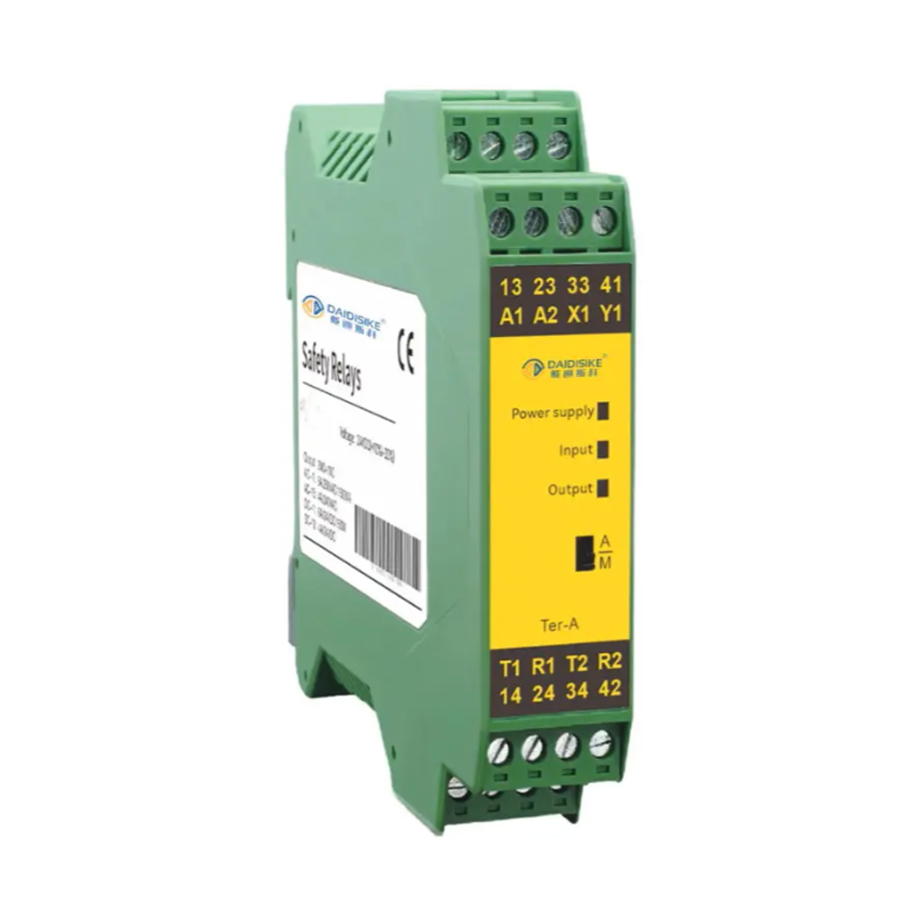
PILZ's PNOZ is the family that defined this. The PNOZ X range is the classic electromechanical generation (roughly 22.5–90 mm wide, 2–8 safety contacts, 24 V AC/DC). PNOZsigma / PNOZ s is the compact generation (from 12.5–17.5 mm, plug-in terminals, still up to PL e / SIL 3). PNOZmulti 2 is a configurable controller for several functions at once. The DAIDISIKE DA31 is DAIDISIKE's single-function answer to the same need: PL e / SIL 3, 3NO+1NC force-guided contacts, dual-channel inputs with cross-fault detection, EDM, a response time under 30 ms, and a 22.5 mm DIN footprint. The rated SKU is the DA31-B.
Which PNOZ does what? A quick family map before you cross-reference
Match the PNOZ family to the function first; only then pick the DAIDISIKE part. The PNOZ catalogue is large because it spans single relays, timers, two-hand controllers and configurable controllers. Here is the honest map of the real families and a few anchor models, so you know whether a single DA31 is even the right shape of answer.
| PNOZ family | What it is | Anchor models | DA31 the right answer? |
|---|---|---|---|
| PNOZ X (classic) | Electromechanical relays, 22.5–90 mm, 2–8 contacts, 24 V AC/DC | PNOZ X3 / X3P, X2.8P (777301), X6, X7, PNOZ 11 | Yes for single-function 3NO+1NC class (X2.8P / X3-style) |
| PNOZsigma / PNOZ s | Compact relays from 12.5/17.5 mm, plug-in terminals, PL e / SIL 3 | PNOZ s2 (750102), s3 (750103), s4, s5/s9 (timers), s6 (two-hand) | Yes for s3 / s4 E-STOP & gate monitoring |
| PNOZelog | Electronic, two-function relays | PNOZ e5.11p, e5.13p | Only for the single-function case |
| PNOZmulti 2 | Configurable controller, multiple safe in/out, up to several functions, PL e / SIL CL 3 | PNOZ m B0.1 base + PNOZ m EF 2DOR relay-output module | No — multi-zone; scope a controller, not one relay |
| PNOZpower / myPNOZ / PNOZcompact | High-current (16 A/contact), modular, and compact variants | PNOZpower, myPNOZ, PNOZcompact | Case-by-case — check current & modularity needs |
The takeaway: the DA31 is a single-function relay. It cross-references cleanly to the single-function PNOZ units — the PNOZ s3, s4 and the PNOZ X2.8P / X3-class — and deliberately does not pretend to replace a PNOZmulti controller or a dedicated two-hand or timer module. When your existing PNOZ is doing one job (E-STOP, gate, or light-curtain monitoring), read on.
DA31 vs PNOZ s4 vs PNOZ X2.8P — the side-by-side
The DA31's honest 1:1 comparison targets are the PNOZ s4 and the PNOZ X2.8P — all are 3NO+1NC, PL e / SIL 3 single-function relays, and the DA31's 22.5 mm width is actually narrower than the 45 mm s4 / X2.8P, saving DIN-rail space. This table is a function-and-rating comparison from public PILZ / distributor specs, not a drop-in claim. Confirm against your installed unit's label and datasheet before ordering.
| Parameter | DAIDISIKE DA31 | PILZ PNOZ s4 | PILZ PNOZ X2.8P (777301) |
|---|---|---|---|
| Safety class | PL e (ISO 13849-1) / SIL 3 (IEC 62061) | PL e / SIL 3, Cat. 4 | PL e / SIL 3, Cat. 4 |
| Output contacts | 3 NO + 1 NC | 3 NO + 1 NC | 3 NO + 1 NC |
| Contacts force-guided | Yes (positive-guided) | Yes | Yes |
| Input channels | Single / dual-channel, cross-fault detection | Single / dual-channel | Single / dual-channel |
| EDM (external device monitoring) | Yes | Yes | Yes |
| Response time | < 30 ms | Per PILZ datasheet | Per PILZ datasheet |
| Supply | 24 V DC | 24 V DC | 24 V AC/DC variants |
| DIN width | 22.5 mm | 45 mm | 45 mm |
| Typical functions | E-STOP, safety gate, light-curtain (OSSD) monitoring | E-STOP, safety gate, light-curtain monitoring | E-STOP, safety gate, light-curtain monitoring |
| Sourcing | Factory-direct China, MOQ 1 set, 3–15 day lead | PILZ distributor channel | PILZ distributor channel |
Where the columns read “per PILZ datasheet,” that is deliberate — we will not put a number in a PILZ column unless it is published, and exact response-time and contact-rating figures vary by PNOZ variant. Pull them from your unit's label and confirm against PILZ's own datasheet. The DA31 column is from DAIDISIKE's published spec.
What is the equivalent of a PNOZ X3, and what about PNOZ s3?
For both, the DA31 is the functional match — with a contact to spare against the s3. The PNOZ X3 / X3P is PILZ's Category 4 E-STOP and gate relay with three NO enabling contacts (terminals 13-14, 23-24, 33-34) plus one auxiliary NC (41-42), in 24 V AC/DC. The DA31 mirrors that contact arrangement exactly — 3NO+1NC, force-guided, EDM, dual-channel, PL e / SIL 3 — so the map across is one-for-one on function. The one thing to confirm is supply: the classic PNOZ X3 offers AC coil variants, while the DA31 is a 24 V DC module, so make sure your control voltage is 24 V DC before you swap.
The PNOZ s3 (PILZ order 750103) is a narrower 17.5 mm PNOZsigma relay with 2 NO safety contacts. The DA31 covers it and gives headroom — its 3NO+1NC means you get the two enabling contacts the s3 provides plus a spare NO and an NC for signalling to a PLC or pilot light. The trade you accept is width: 22.5 mm versus the s3's 17.5 mm, so check your DIN-rail budget. And the pricing hook is real — a PNOZ s3 (750103) carries a Western-distributor price premium; ordering the DA31 direct from the DAIDISIKE factory at MOQ 1 set with a 3–15 day lead time strips out the distributor margin.
What to match before you swap any PNOZ for a DA31
Six numbers decide the swap; get them off the installed unit and its datasheet. This is the same discipline we apply to every brand cross-reference.
- Safety function — E-STOP only, or E-STOP + safety gate + light-curtain (OSSD) monitoring. The DA31 handles all three as a single-function module.
- Input channels — single-channel, or dual-channel with cross-fault monitoring (required for higher PL/SIL).
- Output contacts & rating — how many NO enabling contacts and any NC signalling contact, plus switching current. DA31 = 3NO+1NC.
- EDM / reset — is external device monitoring used, and is reset automatic or monitored-manual?
- PL / SIL target — from your risk assessment (DA31 is PL e / SIL 3).
- DIN width & supply — panel space (DA31 is 22.5 mm) and 24 V DC supply.
Send those six off your installed safety relay and we will confirm the DA31 fits or tell you plainly that it doesn't — for instance, if you actually need a controller, a two-hand module, or a higher switching current than a single DA31 provides. The wider method and the other brand cross-references (such as our Allen-Bradley Guardmaster alternatives) live in the brand replacement & compatibility guide.
Is naming PILZ and PNOZ legal, and how do you keep this honest?
Naming a competitor's product to describe a compatible alternative is nominative reference and is legitimate; we keep it honest by using only PILZ's published specs. We reference PILZ and the PNOZ models by name to tell you what the DAIDISIKE equivalent is — normal, lawful comparison, with no implied partnership or endorsement. What we deliberately do not do: we do not reproduce PILZ manuals, we do not use their trademarks or logos as our own, we do not reuse PILZ order numbers (750103, 777301, etc.) on DAIDISIKE parts, and we do not invent matching certificate numbers or specs we cannot publish. Every DA31 figure here is from DAIDISIKE's own datasheet; every PILZ figure is from PILZ / distributor public data. Where a number isn't verifiable for your exact variant, the page says “confirm against the original unit” rather than faking a precision we don't have.
Sources & specifications cited
- PILZ — PNOZsigma (PNOZ s) safety relays — PNOZ s2/s3/s4/s5/s6/s7/s9; PL e / SIL 3; compact widths.
- PILZ — PNOZ X classic safety relays — PNOZ X3/X3P, X2.8P (777301), X6, X7, PNOZ 11; contacts & terminals.
- PILZ — PNOZmulti 2 configurable control systems — PNOZ m B0.1 base unit, PNOZ m EF 2DOR relay output, PL e / SIL CL 3.
- DAIDISIKE DA31 safety relay datasheet (DA31-B) — PL e / SIL 3, 3NO+1NC, EDM, force-guided, <30 ms, 22.5 mm DIN, 24 V DC.