Sterile fill-finish is the last and most exposed step in making an injectable: the drug product is metered into vials, syringes or cartridges, stoppered, capped and packed, all inside or behind a controlled environment. It is also where the most automation, the most moving mechanism and the most operator intervention collide with the tightest contamination requirements anywhere in the plant. So the safety engineer on this line carries an unusual brief — the guard has to protect the person and respect the sterile boundary.
The two rulebooks are genuinely separate, and the most common mistake is to assume one covers the other. It does not. Let us take them in turn, then show where they meet on the machine.
Annex 1 sets the cleanliness brief, not the safety brief
The revised EU GMP Annex 1, “Manufacture of Sterile Medicinal Products,” became applicable on 25 August 2023 (with the lyophilisation provisions following on 25 August 2024). Its through-line is the Contamination Control Strategy (CCS) — a documented, holistic view of every source of contamination and every control that addresses it — together with a strong push toward barrier technology: isolators and restricted access barrier systems (RABS) to separate people from the critical zone.
What Annex 1 does not do is tell you which light curtain to buy or where to put a safety scanner. It does, however, constrain those choices heavily, because anything you bolt onto the line becomes a surface that has to be cleaned, a potential particle source, and a feature in your CCS. A safety device with ledges that trap cleaning fluid, threaded fasteners that harbour biofilm, or a housing that cannot take the sanitiser regime is a contamination liability even if it is a perfect guard.
The Machinery Regulation sets the safety brief
Operator protection on the same line comes from the machine-safety stack, not from GMP. In the EU that means the EU Machinery Regulation (EU) 2023/1230, which becomes mandatory on 20 January 2027 and replaces Machinery Directive 2006/42/EC. Underneath it sit the usual harmonised standards: ISO 12100 for risk assessment, IEC 61496-1 and -2 for electro-sensitive protective equipment (ESPE / safety light curtains), IEC 61496-3 for safety laser scanners, ISO 13855 for the safety-distance calculation, and ISO 13849-1 (or IEC 62061) to fix the required Performance Level or SIL.
None of that changes because the product is a sterile drug. A point-of-operation hazard on a capper or a cartoner is assessed and guarded exactly as it would be on any packaging machine. The pharma context changes the physical form of the device you may use, not the safety logic behind it.
Where the two briefs meet: cleanability of the sensor
This is the practical core of the article. The sensor that satisfies both rulebooks is the one that is fully cleanable while still being a compliant guard. In practice that points at the same design language the food-and-beverage industry already standardised on for washdown lines:
- Smooth, flush housings with no liquid-trapping ledges, recesses or exposed fastener pockets — nothing for residue or biofilm to sit in.
- Stainless or washdown-grade enclosures that tolerate caustic and acidic sanitisers and repeated wet cleaning.
- High ingress protection. Aseptic and grade C/D cleaning is aggressive; an IP69K rating (per ISO 20653) specifically covers the high-pressure, high-temperature close-range jets that ordinary IP65/IP67 devices are not tested against.
- Robust optical-window sealing, so repeated wet cleaning does not creep behind the lens and fog or fail the device.
The point worth making to a validation engineer is that this is not a new product category invented for pharma. It is the food-grade washdown safety light curtain, already proven on meat, dairy and beverage lines, where the failure mode being designed out — ingress and crevice contamination — is the same one Annex 1 cares about. The transfer is direct.
Guarding around isolators and RABS
Barrier technology changes where the safety sensors live. The fill zone itself is increasingly inside an isolator or behind a RABS, so the barrier is the primary guard and the operator works through gloves rather than reaching in. Electro-sensitive protective equipment therefore tends to sit at the interfaces:
- Closed isolator: the sealed barrier protects the critical zone and the operator. Safety sensors guard the loading and unloading machinery, transfer ports, and any open-door maintenance or intervention position — outside the sealed decontamination volume.
- RABS: doors are normally closed during production. Opening a door is the access event, so guard-locking interlocks and, where the risk assessment calls for it, a light curtain or area scanner address that event.
- Upstream / downstream: depyrogenation tunnel exits, cappers, labellers, tray loaders and cartoners are conventional machine-guarding problems — point-of-operation light curtains and perimeter scanners, chosen and placed per ISO 13855.
The governing design rule is simple to state and easy to violate: adding a safety sensor must not breach the barrier classification or introduce an uncleanable feature. If mounting a curtain means drilling a new penetration through a grade boundary, or a bracket creates a horizontal ledge inside a graded area, the safety win has bought a GMP problem. Plan the mounting with the cleaning and qualification team, not after them.
The contamination-vs-access tension
Every point where a person can reach a moving machine is also a point where the person — the largest particle source in any cleanroom — can enter a controlled zone. Annex 1 resolves this by pushing interventions out of the process entirely: isolators first, then RABS, then engineered access with interlocks. Machine safety resolves it the same way, in the same order. A guard-locked door that keeps people out during production is good for both the operator and the product; a light curtain that allows quick, frequent manual reach-in may be convenient for throughput but works against the contamination strategy.
So on an aseptic line the two disciplines actually pull in the same direction more often than not: design out the intervention. Where access genuinely cannot be removed — format changeover, fault clearance, in-process loading — the residual hazard is covered by ESPE chosen to support the closed-barrier philosophy: cleanable, flush, no new openings, and interlocked so the machine is in a safe state before the boundary is opened.
A note on VHP and material compatibility
Isolators are commonly bio-decontaminated with vaporised hydrogen peroxide (VHP / H2O2). If a sensor will ever be exposed to that cycle, material compatibility becomes a project-specific question, not a catalogue line. Confirm the housing material, window material and seal compatibility with your specific sanitiser and peroxide concentrations, and — wherever the safety function allows — place the device outside the sealed decontamination volume so it is not in the VHP exposure at all. Treat any “VHP-compatible” claim as something to verify against published materials of construction, not assume.
How DAIDISIKE devices fit, factually
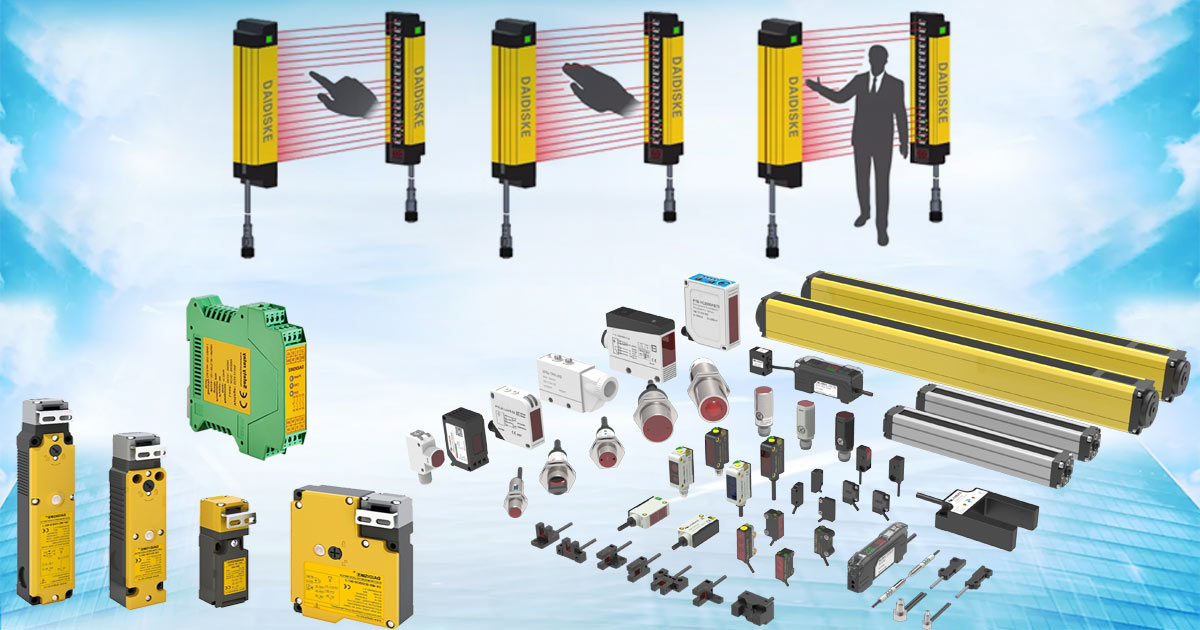
DAIDISIKE builds Type 2 and Type 4 safety light curtains, DLD-series safety laser scanners / LiDAR, proximity sensors, and safety relays such as the DA31, with IP65 / IP67 / IP69K options and stainless / washdown-grade housing choices depending on the model. For a fill-finish or aseptic packaging line that maps cleanly: a Type 4 / PL e curtain at point-of-operation hazards on cappers and cartoners; a DLD-series scanner for perimeter or area coverage where a fixed light-curtain plane is impractical; and a washdown-rated housing where the device sits in a wet-cleaned zone.
Two honest caveats. First, the sensors carry dual-channel OSSD safety outputs; integrating them onto a line's safety network is done through an external safety controller or safety relay (for example the DA31) — the curtain or scanner is a safety input, not a fieldbus node. Second, DAIDISIKE publishes ingress ratings and housing materials, but does not publish a specific VHP decontamination qualification or pharma-specific certification; for those, request the materials of construction and validate against your own cleaning and decontamination regime. Specify what is real, verify the rest.