
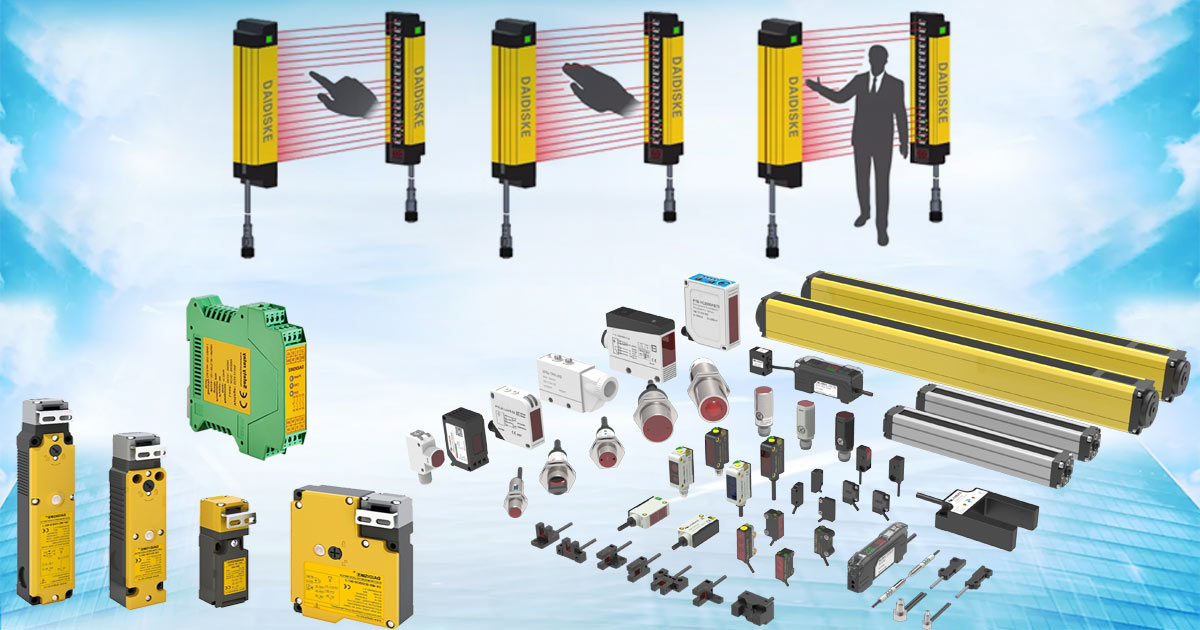
We keep cross-reference notes for the brands buyers most often arrive with — Omron, Keyence, SICK, Banner, Leuze. Autonics comes up a lot in Southeast Asia, and it is worth treating properly because, unlike a single light-curtain vendor, Autonics sells a whole small safety family: the SFL and SFLA light curtains, the SFC / SFC-R controllers and relays, the SFN magnetic non-contact switches with their SFC-N controller, and the SFD mechanical door switches. A real alternative has to answer all of those, not just the curtain. So this guide walks the stack part by part, built only from Autonics' public headline specs and DAIDISIKE's published specs.
One honest framing before the detail: a “replacement” for a safety device is never just a part number. It is a match on resolution, protective field height, sensing range and output / OSSD scheme, followed by re-bracketing, re-pinning and a fresh ISO 13855 distance check. When those line up and the response time is equal or faster, the swap is sound. Everything below is about getting those numbers right.
What is the DAIDISIKE equivalent of the Autonics SFL light curtain?
The DQA matches the SFL14 Ø14 mm finger curtain and the DQC matches the SFL20 Ø20 mm hand curtain — same Type 4 class, same PNP OSSD interface. The Autonics SFL Series is a Standard Type ESPE / AOPD safety light curtain certified Type 4, SIL3, Category 4 and PL e. It comes in Ø14 mm finger detection (SFL14, short-range build to about 5 m and long-range to about 10 m), Ø20 mm hand detection (SFL20, short-range to about 8 m and long-range to about 15 m), and a Ø30 mm hand/body type. It is rated IP65 / IP67 / IP69K, operates from −30 to 60 °C, carries a 7-segment display, and supports muting and blanking through the atLightCurtain software.
The DAIDISIKE side maps cleanly. For Ø14 mm finger detection, the DQA finger/hand curtain (10–30 mm) is the match; for Ø20 mm hand detection, the DQC Type 4 hand-guard is the match; for the Ø30 mm body type, a coarser DQC build covers it. All are built to IEC 61496 Type 4 with dual-channel PNP OSSD outputs and ISO 13849-1 PL e architecture. Because the SFL uses standard OSSD1 / OSSD2 PNP outputs, a DAIDISIKE curtain wires into the same safety relay the same way — the retrofit is brackets and pinout, not a re-architecture.
What is the difference between the SFL and SFLA — and which DAIDISIKE model fits each?
SFL is the Standard Type; SFLA is the High Performance Type. The DQC / DQA cover SFL cases; the Type 4 / PL e DQT4 is the closer match for SFLA. Both series are Type 4 (SIL3 / SIL CL3 / Category 4 / PL e) and both come in Ø14 mm finger, Ø20 mm hand and Ø30 mm hand/body detection. The SFLA adds advanced muting / blanking and CE / UL Listed / S-Mark, and is aimed at higher-risk personnel guarding. The practical deciding factor is resolution plus whether muting / blanking is genuinely used on the machine, not the series name. Where the SFLA High Performance build was specified, the DAIDISIKE DQT4 — a Type 4 / PL e curtain — is the closer match, while the DQC and DQA handle the SFL Standard cases.
Autonics SFL / SFLA ↔ DAIDISIKE cross-reference table
Match on detection capability (Ø14 / Ø20 / Ø30 mm) and Type 4 / PL e class first; confirm protective height and range against the original label. This is a starting map from public specs, not a drop-in part number.
| Autonics part / line | Class | Key public spec | DAIDISIKE match |
|---|---|---|---|
| SFL14 (finger) | Type 4 / SIL3 / PL e | Ø14 mm; ~5 m / ~10 m; IP65/67/69K | DQA (10–30 mm finger/hand) |
| SFL20 (hand) | Type 4 / SIL3 / PL e | Ø20 mm; ~8 m / ~15 m | DQC Type 4 hand-guard |
| SFL Ø30 (hand/body) | Type 4 / SIL3 / PL e | Ø30 mm hand/body detection | DQC (coarse 30 mm build) |
| SFLA (High Performance) | Type 4 / SIL3 / PL e; CE / UL / S-Mark | Ø14 / Ø20 / Ø30 mm; advanced muting/blanking | DQT4 (Type 4 / PL e) |
| SFC / SFC-R relay | SIL3 / SIL CL3 / PL e | 24 V DC; relay A-contact + PNP sub-output | DA31 safety relay (3NO+1NC, PL e/SIL3) |
| SFN non-contact switch | SIL3 / Cat 4 / PL e (with SFC-N) | Magnetic coded; needs SFC-N controller | DX-R1 magnetic coded (ISO 14119 Type 4) |
What is the equivalent of the Autonics SFC-R safety relay?
The DAIDISIKE DA31 safety relay — PL e / SIL 3, 3NO + 1NC — does the same job as the SFC / SFC-R unit. The Autonics SFC Series controllers and SFC-R relay units run on 24 V DC (about 4.0 W, 6.0 W on R23 variants), with a safety output of a relay A-contact plus one PNP transistor sub-output, rated SIL3 / SIL CL3 / PL e (CE / UL Listed / S-Mark). They use a slim DIN design with screw or screw-less push-in terminals, and the SFC-A / SFC-N base models accept up to five SFC-E expansion relay units. The DAIDISIKE DA31 is a PL e / SIL 3 safety relay module with a 3NO + 1NC contact set — it evaluates the dual-channel OSSD from the curtain or switch and drives the machine's safety contactors, with EDM feedback, the same way. Confirm your required contact count and any expansion before swapping.
Is the Autonics SFN a magnetic or RFID non-contact switch, and what replaces it?
The SFN is MAGNETIC coded — not RFID — so the like-for-like DAIDISIKE alternative is the magnetic-coded DX-R1, not an RFID “upgrade”. The Autonics SFN Series non-contact safety door switches use magnetic coded detection in cable and connector types (for example SFN-M-050, SFN-M-W), with vertical, horizontal or both-side mounting. They require the dedicated SFC-N controller to achieve SIL3 / Category 4 / PL e, and up to 30 switches can run in series. The DAIDISIKE DX-R1 is a magnetic coded non-contact safety switch to ISO 14119 Type 4 — a true like-for-like for the SFN's coding principle. For the mechanical SFD door switches (rotatable head, multiple key-insert directions), match the interlock and operation-key type to your door geometry; talk to us with the mounting direction and we'll spec it.
How does the Autonics SFL compare with SICK and Banner — and where does a China OEM fit?
All three are Type 4; the practical difference for a buyer is channel, lead time and price, not the safety class. SICK (C4000, miniTwin, deTec) and Banner (EZ-SCREEN LS, 14–40 mm resolution, range to ~12 m) sit in the premium Western tier; Datasensing SH4, Schmersal and AutomationDirect are also Type 4 comparison points. Autonics positions between them and the value tier, but its safety line is sold through distributors at price-on-inquiry. DAIDISIKE's role is the OEM-direct option: the same Type 4 / PL e class and matching Ø14 / Ø20 / Ø30 mm resolutions, shipped from the factory with MOQ 1 set, 3–15 day lead time, exporting to 20+ countries. If you are comparing the Autonics SFL against SICK or Banner mainly on cost and availability, a DAIDISIKE quote belongs in that comparison.
Buying Autonics safety light curtains in Vietnam — and the local alternative
Autonics ships through distributors with price-on-inquiry; DAIDISIKE sells the equivalent direct, which is the practical edge in Vietnam and Southeast Asia. Because Autonics lists no public prices on its safety line, a quote depends entirely on your distributor and stock. For buyers in Vietnam looking for an Autonics SFL distributor alternative (đại lý / cảm biến rèm an toàn Autonics thay thế), DAIDISIKE offers OEM-direct pricing on the SFL / SFLA-class curtains, the DA31 relay and the DX-R1 switch — MOQ 1 set, 3–15 day lead time, and direct engineering support. Send the four spec numbers off your installed Autonics unit and we will return a matched DQC / DQA / DQT4 build, or tell you plainly if it doesn't fit.
Send Engineer Cai the resolution, protective height, range and output type off your installed unit. Phone / WhatsApp +86 15218909599, or use the contact page — matched DAIDISIKE build, MOQ 1 set, 3–15 day lead time.
Is naming Autonics legal, and how do you keep the comparison honest?
Naming Autonics to describe a compatible alternative is nominative reference and is legitimate; the comparison stays honest by using only Autonics' published headline specs. We reference Autonics, SFL, SFLA, SFC, SFN and SFD by name to tell you what the DAIDISIKE equivalent is — normal, lawful comparison. We do not reproduce Autonics manuals, use their logos, or quote a parameter we cannot confirm from their public datasheets. Every Autonics figure above is a published headline spec; every DAIDISIKE figure is from our own spec sheets. We deliberately do not invent prices, certificate numbers or response-time figures for either brand — where a number isn't verifiable, it isn't in the table.
Sources & specifications cited
- Autonics — SFL Series safety light curtains — Type 4 / SIL3 / PL e; Ø14 / Ø20 / Ø30 mm; IP65/67/69K.
- Autonics — SFLA High Performance light curtains — Type 4; advanced muting/blanking; CE / UL Listed / S-Mark.
- Autonics — SFC / SFC-R safety controllers & relays — 24 V DC; relay A-contact + PNP sub-output; SIL3 / PL e.
- Autonics — SFN magnetic non-contact safety switches — magnetic coded; requires SFC-N controller; SIL3 / Cat 4 / PL e.