
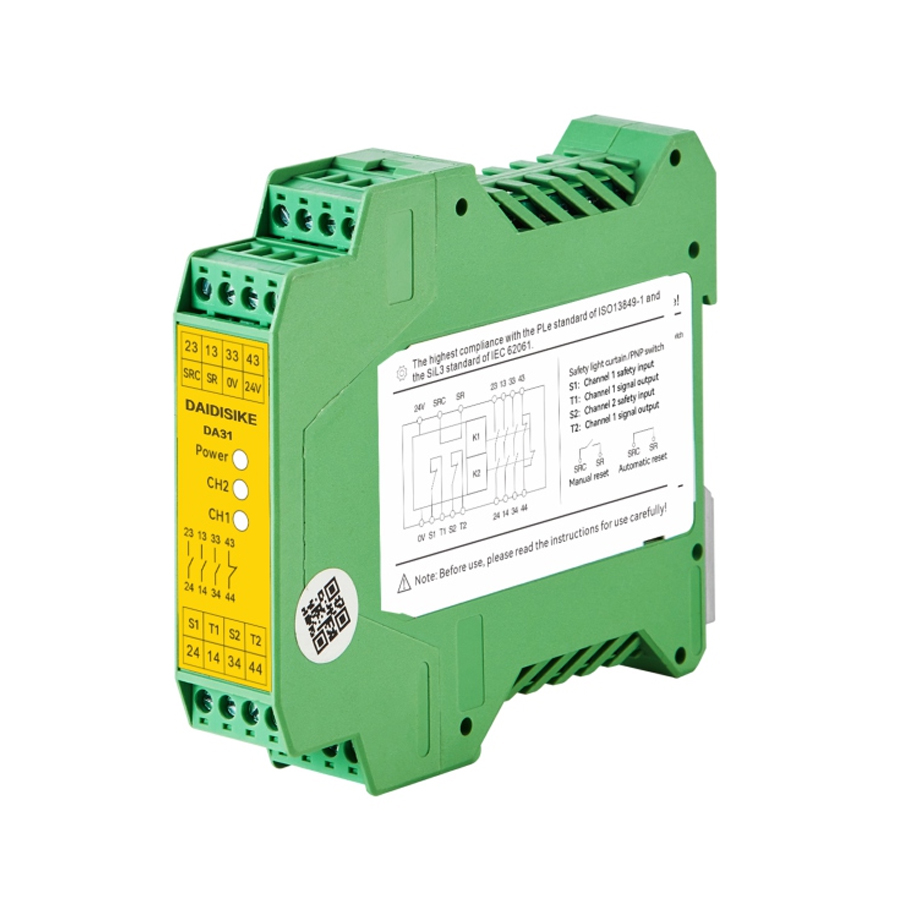
We keep cross-reference notes for the brands customers most often arrive with, and in panels built around a Siemens PLC that brand is Siemens itself. SIRIUS 3SK turns up in inquiries because it is the relay Siemens ships alongside its own controllers, and because Siemens explicitly positions the 3SK1 and 3SK2 as the replacement for the older 3TK28 series — a narrower design that, per Siemens, can replace nearly every 3TK28 device. So when an engineer asks for a “3SK alternative,” the first job is to find out which 3SK: a basic 3SK1 doing one job, or a configurable 3SK2 doing several. That distinction decides whether a single DA31 is the right answer at all.
One blunt point before the detail. A safety relay is not a part number you look up and drop in. Siemens' own order numbers (the basic 3SK1112-1BB40, the 3SK1121-1AB40, the 3SK1121-1CB42, and the configurable 3SK2112-1AA10 / 3SK2112-2AA10) belong to Siemens parts; the DA31 has its own terminal layout and its own rated SKU. The swap is sound when six things line up — safety function, input channels, output type and rating, EDM/reset, PL/SIL, and DIN width / supply — and you re-wire to the new module. Everything below is about getting those six right, and about not mis-matching tiers.
What is SIRIUS 3SK, and what is the DAIDISIKE DA31?
A safety relay is a self-monitoring switching module. It reads a safety input — an emergency-stop button, a safety-gate switch, or the OSSD outputs of a light curtain — on two independent channels, and only closes its enabling outputs when both channels agree and an EDM feedback loop confirms the downstream contactors have actually dropped out. A single welded contact, a cross-shorted wire, or a stuck contactor makes it refuse to enable. That self-checking is the whole point, and it is why a safety relay can carry a PL e / SIL 3 rating while an ordinary relay cannot.
Siemens' SIRIUS 3SK is the family that does this in the Siemens world, and it has two distinct halves. The 3SK1 is the basic relay: hard-wired, with one shut-down behaviour — when it trips, it disables all of its fail-safe outputs simultaneously. The 3SK2 is the configurable relay: it can disable its fail-safe outputs individually, it is parameterized in software rather than by wiring links, and it can connect to a higher-level control system over PROFINET. Above both sits the 3RK3 Modular Safety System (MSS), a modular controller offered with Basic, Advanced and ASIsafe central modules for monitoring many functions at once.
The DAIDISIKE DA31 is DAIDISIKE's single-function answer to the basic tier: PL e / SIL 3, 3NO+1NC force-guided contacts, dual-channel inputs with cross-fault detection, EDM, a response time under 30 ms, and a 22.5 mm DIN footprint. It maps cleanly onto a 3SK1 doing one job. It deliberately does not pretend to be a 3SK2 or a 3RK3 — those are configurable systems, and the honest DAIDISIKE answer there is a configurable safety control module such as the DADISICK LS-2A4S, which supports up to 6 safety element inputs, 2 relay safety outputs and 4 semiconductor outputs covering E-stop, safety doors, two-hand buttons and light curtains, meeting EN/ISO 13849-1 Cat. 4.
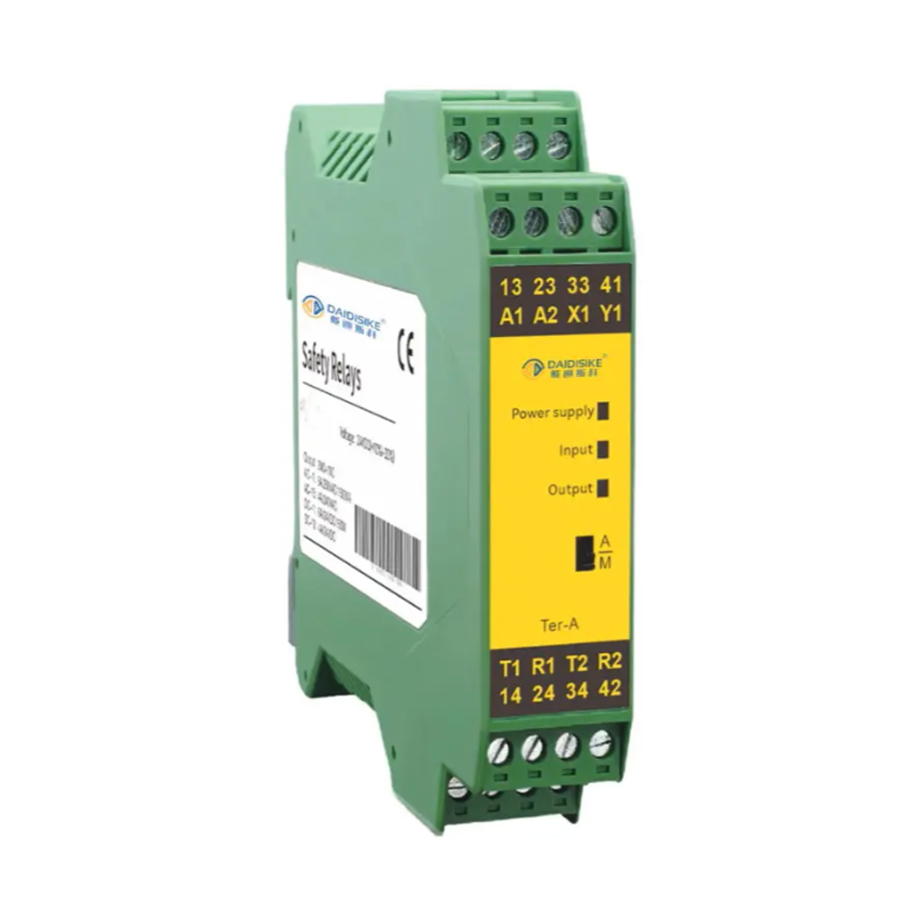
Which 3SK does what? Match the tier before you cross-reference
Identify whether you have a basic 3SK1, a configurable 3SK2, or a 3RK3 system first — only then pick the DAIDISIKE part. This is the single most common place a Siemens-to-third-party swap goes wrong: dropping a hard-wired single relay in where the original was doing software-defined, individually-switchable logic. Here is the honest map.
| Siemens tier | What it is | Anchor order numbers | DAIDISIKE answer |
|---|---|---|---|
| SIRIUS 3SK1 (basic) | Hard-wired safety relay; disables all fail-safe outputs simultaneously | 3SK1112-1BB40, 3SK1121-1AB40, 3SK1121-1CB42, 3SK1121-2AB40, 3SK1121-2CB42 | DA31 — single-function E-STOP / gate / light-curtain |
| SIRIUS 3SK2 (configurable) | Software-parameterized; disables fail-safe outputs individually; PROFINET to higher-level control | 3SK2112-1AA10, 3SK2112-2AA10 | Configurable controller (DADISICK LS-2A4S class), not a single relay |
| 3TK28 (legacy) | Older Siemens safety relays; Siemens migrates these to 3SK | 3TK28 series | DA31 if the function is single; controller if multi-zone |
| 3RK3 Modular Safety System (MSS) | Modular controller; Basic / Advanced / ASIsafe central modules; many functions | 3RK3 MSS central modules + expansion | No — configurable safety controller, not one relay |
The takeaway: the DA31 is a single-function relay. It cross-references cleanly to a basic 3SK1 (and to a 3TK28 doing a single job), and it deliberately does not pretend to replace a 3SK2's software logic or a 3RK3 system. When your existing 3SK is doing one well-defined job — E-STOP, gate, or light-curtain monitoring — read on; when it is doing several, jump to the configurable section.
DA31 vs Siemens 3SK1 — the side-by-side
The DA31's honest 1:1 comparison target is the basic 3SK1, the hard-wired tier of the SIRIUS family. This table is a function-and-rating comparison from public Siemens / distributor specs, not a drop-in claim. Note that 3SK1 variants ship with either relay or solid-state (semiconductor) outputs and differing contact counts, so confirm against your installed unit's label and datasheet before ordering.
| Parameter | DAIDISIKE DA31 | Siemens SIRIUS 3SK1 (basic) |
|---|---|---|
| Safety class | PL e (ISO 13849-1) / SIL 3 (IEC 62061) | Up to PL e / SIL 3, Cat. 4 (per variant) |
| Output contacts | 3 NO + 1 NC (relay) | Relay or solid-state outputs; count varies by order number |
| Contacts force-guided | Yes (positive-guided) | Yes (on relay-output variants) |
| Input channels | Single / dual-channel, cross-fault detection | Single / dual-channel |
| EDM (external device monitoring) | Yes | Yes |
| Output behaviour | All enabling outputs switch together | All fail-safe outputs disabled simultaneously |
| Response time | < 30 ms | Per Siemens datasheet |
| Supply | 24 V DC | 24 V DC (per variant) |
| Configurability | Hard-wired, single function | Hard-wired (3SK1); configurable is 3SK2 |
| Typical functions | E-STOP, safety gate, light-curtain (OSSD) monitoring | E-STOP, safety gate, light-curtain monitoring |
| Sourcing | Factory-direct China, MOQ 1 set, 3–15 day lead | Siemens distributor channel |
Where the Siemens column reads “per Siemens datasheet,” that is deliberate — we will not put a number in a Siemens column unless it is published, and exact response-time, output-type and contact-rating figures vary by 3SK1 order number. Pull them from your unit's label (e.g. 3SK1121-1AB40 versus 3SK1121-1CB42) and confirm against Siemens' own datasheet. The DA31 column is from DAIDISIKE's published spec.

When should you use a configurable controller instead of a DA31?
When the Siemens unit is a 3SK2 or a 3RK3, the original is doing more than one relay's job — match it with a configurable controller, not a single DA31. The tell-tales are concrete: the 3SK2 can disable its fail-safe outputs individually (so different zones stop independently), it is set up in software rather than by wiring links, and it reports diagnostics to a higher-level controller over PROFINET. The 3RK3 Modular Safety System goes further — its Basic, Advanced and ASIsafe central modules monitor many functions across a machine. None of that is reproducible with one hard-wired relay, and we will not claim it is.
The honest DAIDISIKE answer at this tier is a configurable safety control module. The DADISICK LS-2A4S supports up to 6 safety element inputs, 2 relay safety outputs and 4 semiconductor outputs — enough to cover E-stop, safety doors, two-hand buttons and light curtains together, meeting EN/ISO 13849-1 Cat. 4. That is the right shape of answer for a 3SK2-class job, where you previously leaned on individual output groups and combined-function logic. For a true 3RK3-scale, multi-zone modular system, send us the full input/output count and the function list so we scope the controller correctly rather than over-fitting one module.

What to match before you swap any 3SK for a DA31
Six numbers decide the swap; get them off the installed unit and its datasheet. This is the same discipline we apply to every brand cross-reference.
- Safety function & tier — one function on a basic 3SK1 (DA31 territory), or several with individual outputs on a 3SK2 / 3RK3 (controller territory).
- Input channels — single-channel, or dual-channel with cross-fault monitoring (required for higher PL/SIL).
- Output type, count & rating — relay (NO/NC) versus solid-state, how many enabling outputs, and switching current. DA31 = 3NO+1NC relay outputs.
- EDM / reset — is external device monitoring used, and is reset automatic or monitored-manual?
- PL / SIL target — from your risk assessment (DA31 is PL e / SIL 3).
- DIN width & supply — panel space (DA31 is 22.5 mm) and 24 V DC supply.
Send those six off your installed safety relay and we will confirm the DA31 fits, or tell you plainly that it doesn't — for instance, if you actually need a configurable controller, a two-hand module, or a higher switching current than a single DA31 provides. The wider method and the other brand cross-references (such as our Pilz PNOZ alternatives and our Allen-Bradley Guardmaster alternatives) live in the safety relay manufacturer guide.
Is naming Siemens, SIRIUS and 3SK legal, and how do you keep this honest?
Naming a competitor's product to describe a compatible alternative is nominative reference and is legitimate; we keep it honest by using only Siemens' published specs. We reference Siemens, SIRIUS and the 3SK / 3RK3 models by name to tell you what the DAIDISIKE equivalent is — normal, lawful comparison, with no implied partnership or endorsement. What we deliberately do not do: we do not reproduce Siemens manuals, we do not use their trademarks or logos as our own, we do not reuse Siemens order numbers (3SK1121-1CB42, 3SK2112-1AA10, etc.) on DAIDISIKE parts, and we do not invent matching certificate numbers or specs we cannot publish. We also do not claim DAIDISIKE products are Siemens-certified or Siemens-approved — they are not. Every DA31 figure here is from DAIDISIKE's own datasheet; every Siemens figure is from Siemens / distributor public data. Where a number isn't verifiable for your exact variant, the page says “confirm against the original unit” rather than faking a precision we don't have.
Sources & specifications cited
- Siemens SIRIUS 3SK1 basic safety relays — positioned by Siemens as the replacement for the 3TK28 series; disables all fail-safe outputs simultaneously. Public Siemens / distributor data (order numbers 3SK1112-1BB40, 3SK1121-1AB40, 3SK1121-1CB42, 3SK1121-2AB40, 3SK1121-2CB42).
- Siemens SIRIUS 3SK2 configurable safety relays — can disable fail-safe outputs individually, parameterized by software, connects to higher-level control via PROFINET. Public Siemens / distributor data (order numbers 3SK2112-1AA10, 3SK2112-2AA10).
- Siemens 3RK3 Modular Safety System (MSS) — Basic, Advanced and ASIsafe central modules for multi-function safety. Public Siemens data.
- DADISICK LS-2A4S configurable safety control module — up to 6 safety element inputs, 2 relay safety outputs, 4 semiconductor outputs; covers E-stop, safety doors, two-hand buttons and light curtains; meets EN/ISO 13849-1 Cat. 4.
- DAIDISIKE DA31 safety relay datasheet — PL e / SIL 3, 3NO+1NC, EDM, force-guided, <30 ms, 22.5 mm DIN, 24 V DC.