Indian buyers arrive at this page from a few clear directions: pricing a Type 4 curtain for a press; looking for a cheaper alternative to an Omron or SICK they already run; doing the customs and landed-cost homework before importing from China; or scoping the wider safety circuit — scanner, relay, coded switch, proximity sensor — for an AGV line or an SPM. This guide answers all of those in order, with India price reality, honest certification, and no invented local presence.
What does a safety light curtain cost in India — and where does factory-direct fit?
The Indian market is three-tiered, and genuine Type 4 starts well above the cheapest boards. On IndiaMART, TradeIndia and Justdial you see basic infrared measuring/safety boards around ₹1,500–₹4,700 a pair; mid-tier Type 4 area sensors roughly ₹10,000–₹20,000; and branded Omron / SICK / Keyence Type 4 curtains generally from ₹18,000 upward, climbing with protective height and resolution. The trap is comparing a ₹1,500 board to a ₹20,000 device as if they do the same job — they don't. Only the genuine Type 4 device gives you dual-channel OSSD, self-checking optics and the IEC 61496 architecture a press guard actually needs.
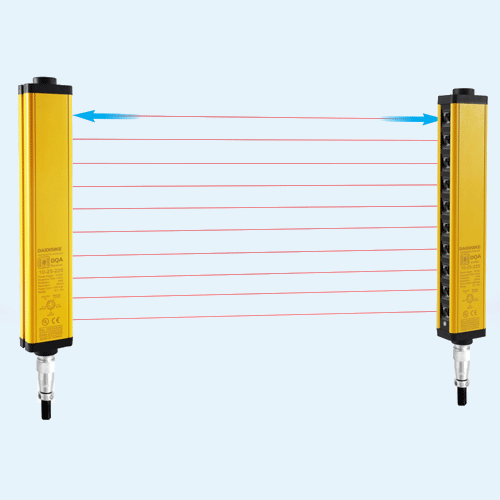
DAIDISIKE sits deliberately in the value gap: branded-grade Type 4 / PL e performance at China factory-direct price. Export quotes for our curtains commonly fall in the US$65–US$676-per-set range depending on protective height and resolution; your landed INR then depends on freight, duty and your forwarder. The table below is the price-anchoring view buyers ask for first.
| Tier (India market) | Typical street price | What it really is | Where DAIDISIKE sits |
|---|---|---|---|
| Local IR board | ~₹1,500–₹4,700 / pair | Basic measuring / non-Type-4 board | — |
| Mid-tier Type 4 / area | ~₹10,000–₹20,000 | Genuine Type 4 area sensor | Value-gap position |
| Branded import | ₹18,000+ (rises w/ height) | Omron / SICK / Keyence Type 4 | Same class, lower cost |
| DAIDISIKE (FOB China) | US$65–US$676 / set | Type 4 / PL e, IEC 61496 | Factory-direct, MOQ 1 |
The INR bands above are published India market ranges (IndiaMART / marketplace listings), not DAIDISIKE quotes; the FOB band is our export range. Confirm your exact landed price with your forwarder and broker — we quote the configuration, not the duty.
Who supplies safety light curtains in India — and how is buying factory-direct different?
Discovery in India runs through IndiaMART, TradeIndia, Justdial and IndustryBuying, and the field is global brands + India-local makers + importers reselling Chinese product. Buyers search by a tight intent pattern — “manufacturer / supplier / dealer / distributor + city + price” — for hubs like Pune, Nashik, Mumbai/Bhiwandi, Chennai, Coimbatore, Gurugram and Delhi. You'll meet the global names (Omron, SICK, Banner, Keyence, Leuze, Pilz, Schmersal), India-local manufacturers and channels (REER via Binex Controls, Orbital Mekatronik, Sai Control System), and a layer of importers who buy Chinese curtains and resell them with margin.
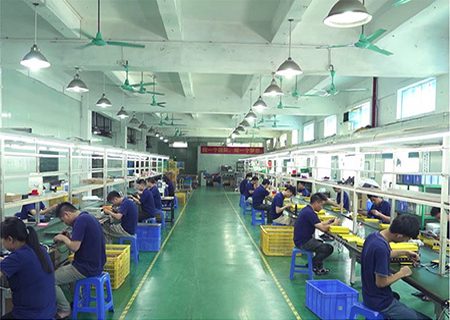
DAIDISIKE is the factory at the top of that last chain — a China-based manufacturer (est. 2013, ~3,000 m² plant, 20+ export countries) selling direct. We do not operate an Indian office, warehouse or appointed distributor; you import directly from us under your own IEC. The practical effect is that the importer's margin layer disappears and the MOQ that importers assume is high is, with us, a single set.
What is a good cheaper alternative to Omron F3SJ / F3SG or SICK C4000?
A like-for-like Type 4 device that keeps the safety class but drops the price — matched on the four numbers that define a curtain. Branded Omron (F3SJ-B0305N25, F3SJ-E0305P25, F3SG-RA, F3SG-SR, MS4800) and SICK (C4000, M4000 Advanced, deTec) curtains are the premium anchor in India. The replacement intent is real and high-value — Omron itself markets MS4800 retrofit kits — so the question isn't whether you can swap, it's matching specs. Line up resolution (14 mm finger or ~30 mm hand), protective height, sensing range and output/OSSD type, and a DAIDISIKE DQC / DQA / DQT4 drops into the same ISO 13855 safety-distance envelope the outgoing unit occupied.
| Brand / series (India) | Origin | Class | DAIDISIKE like-for-like |
|---|---|---|---|
| Omron F3SJ / F3SG-RA / F3SG-SR | Japan | Type 4 & Type 2 | DQC (Type 4 hand) · DQA (finger/hand) |
| Omron MS4800 | Japan/US | Type 4 | DQC · DQT4 (PL e) |
| SICK C4000 / M4000 / deTec | Germany | Type 4 | DQT4 (Type 4 / PL e) |
| Banner S4B (14/30 mm) | USA | Type 4 | DQA (10–30 mm) · DQC |
| Keyence GL-R / SL-V | Japan | Type 4 | DQC · DQT4 |
| REER (Binex) / Autonics / local Type 4 | Italy / Korea / India | Type 4 | DQC · DQA · DQT4 |
Every brand name above is used nominatively for comparison from public specifications — no partnership or endorsement is implied, and we never quote a competitor parameter we can't verify. For full model-by-model maps, see the brand replacement & compatibility hub.
Power press & press brake: which curtain, what resolution, and does it need PSDI?
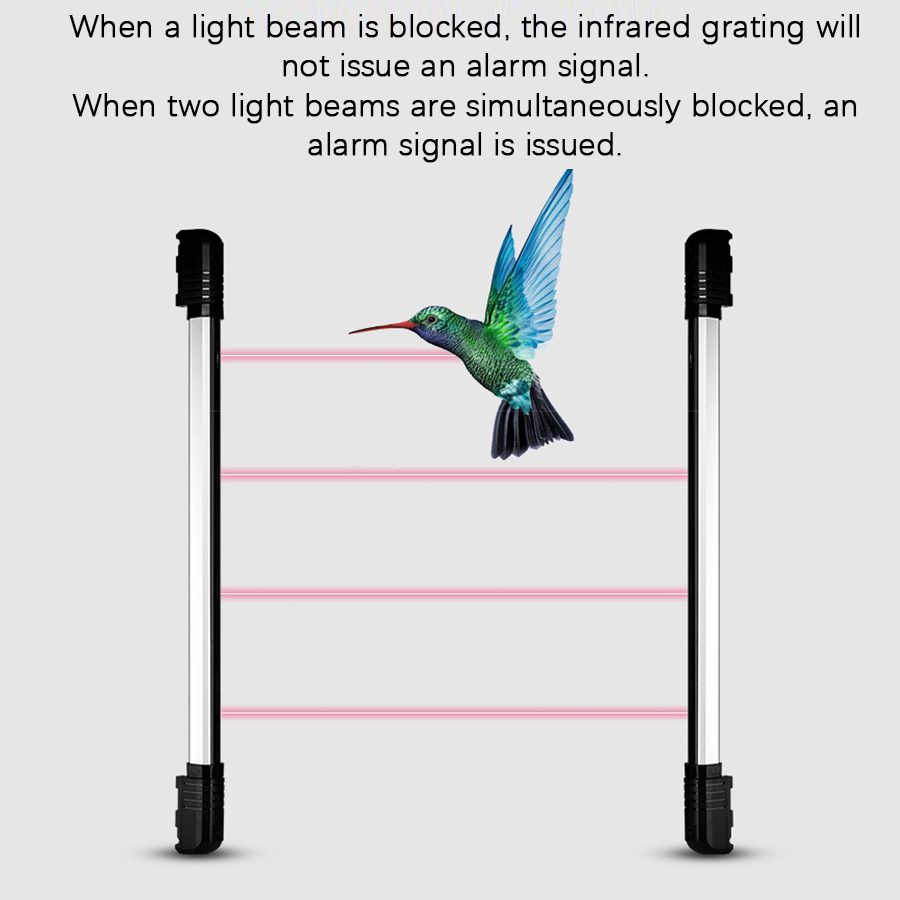
Power presses and press brakes are the heaviest India use-case — a Type 4 curtain, mounted to the ISO 13855 distance, is the right class. The Factories Act and standard press-shop practice push point-of-operation guarding, which is why press-shop retrofits drive so much Indian demand. Resolution selection is the first decision: use a 14 mm-resolution curtain for finger protection right at the point of operation, and a ~30 mm curtain for hand detection. DAIDISIKE's DQA covers 10–30 mm finger/hand; the DQC and DQT4 cover Type 4 hand guarding up to PL e; and the DQR is the IP68 build for washdown lines.
Mounting distance is not optional: the curtain must sit at the ISO 13855 safety distance computed from the system response time and approach speed, or a fast hand reaches the hazard before the stroke stops. PSDI (Presence-Sensing Device Initiation) — where clearing and re-breaking the field initiates the next stroke for fast cycling — demands a control-reliable Type 4 system with the correct interface and a thorough risk assessment; it is not enabled casually and not on every press. Close the circuit with a DA31 safety relay (PL e / SIL 3, force-guided contacts, EDM, <30 ms) so the stop command is itself control-reliable.
Can I import safety light curtains from China to India — MOQ, lead time, FOB vs CIF?
Yes, and the MOQ objection is exactly backwards: ours is 1 set, with a 3–15 day lead. Indian importers often expect a Chinese factory to demand a 500-piece minimum; DAIDISIKE's 1-set MOQ directly counters that — order a single sample, validate it against your ISO 13855 distance, fit-check the brackets and OSSD wiring, then repeat at volume. You import under your own IEC. We quote FOB (typically FOB Shenzhen/Guangzhou) by default, or arrange CIF Nhava Sheva (JNPT) / Chennai on request; sea freight suits bulk, air suits an urgent press-line retrofit.
The difference between FOB and CIF is who carries freight and insurance: under FOB your assessable value to Indian customs is the goods value plus the freight and insurance you add; under CIF those are already in our price, so the CIF figure is close to your customs assessable value. A quick way to estimate: CIF ≈ FOB + sea/air freight + insurance, and Indian duty (BCD + IGST + cess) is levied on that CIF/assessable value. We supply the commercial invoice, packing list and certificate of origin so your CHA can file cleanly.
HS code, customs duty & BIS — the import questions buyers research first
HS classification is your broker's call; the common lines are 9031, 8536 and 8537. BIS is addressed honestly below. A safety light curtain is most often presented under HS 9031 (measuring/checking optical instruments and appliances, e.g. 9031.49), with HS 8536 (electrical apparatus for protecting circuits, e.g. 8536.50) and HS 8537 (boards/panels) used where the assembly is characterised that way. India then applies Basic Customs Duty plus IGST and any cess on the CIF/assessable value. Rates and exemption notifications move, so confirm the live line and duty with your CHA rather than relying on a number that may be out of date.
On BIS: we have not found a confirmed mandatory BIS / CRS registration specific to safety light curtains. India's CRS (Compulsory Registration Scheme) covers listed electronics and LED lighting categories — not safety-sensor light curtains as such. Buyers still search “BIS safety light curtain” defensively, so to be completely clear: DAIDISIKE does not hold and does not claim a BIS mark. Our conformity rests on CE (self-declared) to IEC 61496, ISO 9001 quality control, and TÜV third-party testing per order. If your particular tender or sector imposes a registration requirement, verify it with BIS or your CHA before ordering.
What else does DAIDISIKE supply into India — scanners, relays, switches, proximity?
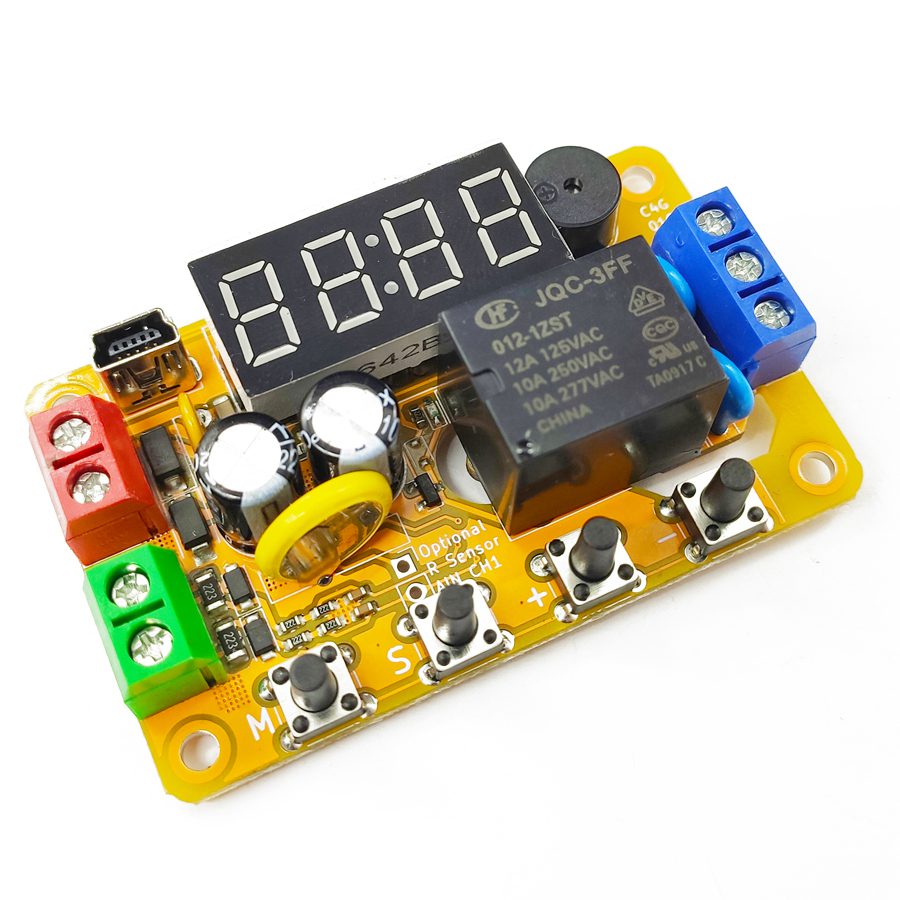
The whole safety circuit from one factory — curtains, LiDAR, relays, coded/guard-locking switches and proximity sensors. A curtain rarely ships alone, and each of these has its own India “supplier / price” search demand. For AGV/AMR mobile-robot protection — a fast-growing Indian intralogistics market — the relevant line is our safety laser scanners / LiDAR: DLD05A3 (5 m), DLD20A5 (20 m), DLD30T-5N (40 m perimeter) and the SDLD-05A TOF (14 m), built to the IEC 61496-3 architecture (CE self-declared; we do not claim Type 3 certification). The DA31 / DA31-B safety relay closes the stop loop; the DX-R1 coded magnetic switch (ISO 14119 Type 4) and DX-W2 guard-locking switch (holding force up to 1300 N, IP67) handle doors and gates; and inductive proximity sensors in M8/M12/M18/M30 (NPN/PNP, NO/NC, IP67/IP68) cover position sensing.
Send the four numbers off your press or line — resolution (14 mm finger / 30 mm hand), protective height, sensing range, output/OSSD type — plus quantity and whether you want FOB or CIF Nhava Sheva / Chennai, and we'll return a firm quote, a 3–15 day lead, and the HS-code documents your CHA needs. Sample at MOQ 1 set.
Contact DAIDISIKE → | Phone / WhatsApp +86 15218909599 · 915731013@qq.com
Sources & references
- DAIDISIKE — DQC Type 4 safety light curtain and the DQA finger/hand model — published resolutions and OSSD interface.
- IEC 61496-1/-2, ISO 13849-1 (PL) and ISO 13855 — the standards that fix Type 4 architecture, PL e and the safety-distance calculation referenced throughout; ISO 14119 for the coded switch.
- India price bands — published market listings on IndiaMART / TradeIndia / Justdial; treated as general ranges, not DAIDISIKE quotes.
- World Customs Organization Harmonized System — HS chapters 9031, 8536, 8537; classification and India BCD/IGST per your CHA.
- Bureau of Indian Standards (BIS) Compulsory Registration Scheme — scope of CRS; confirm applicability to your product with BIS or your CHA.