Buyers arrive at this page from one of four directions: looking for a factory-direct manufacturer instead of a reseller; spec'ing a Type 4 curtain for a guarding job; scoping an OEM/ODM build for their own machine line; or doing the customs and landed-cost homework before they commit. This guide answers all four, in that order, with no fluff and no invented numbers — only what DAIDISIKE has actually published and what your own broker can verify.
Why buy safety light curtains factory-direct from a China manufacturer?
Because the safety architecture is identical to the premium brands while the MOQ, lead time and price structure are not. A Type 4 curtain's job is fixed by IEC 61496-1/-2 and ISO 13849-1: dual-channel OSSD outputs, self-checking optics, a defined detection capability (resolution) and a response time fast enough to satisfy the ISO 13855 safety distance. A SICK, a Banner, an Omron, a Keyence and a DAIDISIKE DQC all answer to that same standard. What differs is commercial: a large premium brand or a Western distributor typically carries a higher minimum, a longer lead and a margin stack of manufacturer-plus-distributor-plus-reseller. Buying direct from the factory collapses that stack — you talk to the people who make the curtain, order a single sample to validate, and repeat at volume on a 3–15 day cadence.
DAIDISIKE has built safety sensors since 2013 from a ~3,000 m² factory and ships to 20+ countries, so “direct” here does not mean unproven — it means the OEM/ODM, the certs, the customs paperwork and the after-sales all come from one source. That is the whole pitch of a safety light curtain supplier in China that owns its line rather than rebadging someone else's.
What is the MOQ, lead time, and FOB / payment structure?
MOQ is 1 set; lead time is 3–15 days; default terms are FOB China with 30% deposit / 70% before shipment. The MOQ matters more than it looks. A 1-set minimum means you can order one DQC or DQT4, bench-test it against your ISO 13855 distance, fit-check the brackets and the OSSD wiring, and only then place a production order. Compare that to suppliers who gate you behind a 500-piece minimum and a 15–30 day lead before you have even seen the part. The table below is the procurement snapshot buyers ask for first.
| Procurement term | DAIDISIKE (factory-direct) | Typical large-supplier pattern |
|---|---|---|
| MOQ | 1 set (sample before bulk) | Often 500-piece minimum |
| Lead time | 3–15 days | 15–30 days |
| Incoterms | FOB default; EXW / CIF / DAP on request | Varies; often distributor-set |
| Payment | 30% deposit / 70% before shipment (T/T); sample paid in full | Varies by channel |
| OEM / ODM | In-house, no middleman re-quote | Limited / surcharged |
The “typical large-supplier pattern” column is the general market shape we hear from buyers, not a quote attributed to any named competitor. Your actual terms with any vendor depend on your volume and relationship — confirm them directly.
Are the curtains Type 4, and what certifications are published?
The DQC and DQT4 flagships are Type 4; certs published are CE (self-declared), IEC 61496 and ISO 9001, with TÜV testing available per order. DAIDISIKE makes both Type 2 and Type 4 families. For point-of-operation and finger/hand guarding where the risk assessment calls for the higher class, the DQC (Type 4, 30×30 mm profile), the DQA (10–30 mm finger/hand) and the DQT4 (Type 4 / PL e) are the relevant models, all built to IEC 61496-1/-2 and ISO 13849-1 with dual-channel OSSD outputs and ISO 13855-compatible response times. We are deliberately precise about certification: CE is self-declared, ISO 9001 governs the quality system, and where a project needs third-party documentation, TÜV testing is arranged per order. We do not claim a blanket TÜV or UL listing across the catalog — winning on depth and honesty beats over-claiming in a crowded search result.
What HS code and Section 301 tariff apply when importing to the US?
Safety light curtains usually classify under HS 9031, with 8536 or 8543 used depending on how the device is characterised; US imports of Chinese origin have historically carried Section 301 duties on top of the base rate. This is the part most procurement pages skip, and it is exactly what decides landed cost. The three lines that come up are HS 9031 (measuring/checking optical instruments and appliances), HS 8536 (electrical apparatus for protecting circuits, when the item is presented that way) and HS 8543 (electrical machines with individual functions). The correct line depends on how your broker characterises the device.
For the United States, goods of Chinese origin in these chapters have historically fallen under Section 301 additional duties layered on top of the MFN base rate, so your landed duty is “base rate + any Section 301 add-on.” Tariff schedules, exclusions and rates change, so we will not print a specific percentage that could be stale by the time you read it — confirm the current line and rate with your customs broker for your destination. What we provide is clean export documentation (commercial invoice, packing list, origin) that supports whichever HS code your broker files. EU and Vietnam buyers use their own duty schedules against the same 9031 / 8536 / 8543 family.
How does a China-made DQC compare to SICK, Banner, Omron and Keyence?
On safety architecture they are peers; the gap is commercial — MOQ, lead time and proprietary cabling. The honest read is that every serious Type 4 curtain on the market answers to the same standard, so the comparison below is about class, resolution envelope and origin, drawn only from each vendor's published material — not from any copied datasheet or invented spec.
| Brand / series | Origin | Class | Procurement note (general) |
|---|---|---|---|
| SICK deTec / C4000 | Germany | Type 4 | Premium price/lead anchor |
| Banner EZ-Screen | USA | Type 4 | US incumbent |
| Omron F3SG-R | Japan | Type 4 & Type 2 | Broad catalog |
| Pilz PSENopt / Leuze MLC | Germany | Type 4, up to PL e | German premium |
| Keyence GL-R | Japan | Type 4 | Proprietary cabling |
| DAIDISIKE DQC / DQT4 / DQA | China | Type 4 (Type 2 also) | Factory-direct, MOQ 1, 3–15 day lead |
A note on the wider China field, because buyers ask: ESPE's EFA Series was an early China Type 4 entrant, and CYNDAR and G-TEK Sensor also offer Type 4 curtains, AGV/AMR scanners and sensors. DAIDISIKE's differentiator inside that field is the same one that separates us from the premium brands — the 1-set MOQ and 3–15 day lead. For model-by-model replacement maps to specific competitors, see the dedicated Keyence / SICK alternatives guide and the Banner / Leuze / Datalogic / Schmersal replacements guide, which map the DQC, DQT4 and DQA to published competitor specs only.
Do you offer OEM / ODM, and what can be customized?
Yes — OEM (your label, housing, connector, cable, protective height) and ODM (resolution, range, output configuration) are both done in-house. Because DAIDISIKE manufactures the product rather than reselling it, customization happens on our own line without a middleman markup or a back-and-forth re-quote. A typical OEM brief covers your brand label, housing colour, connector pin-out, cable length and the protective height you need; an ODM brief goes further into resolution, sensing range and OSSD output type. The four numbers that scope any build are resolution, protective height, sensing range and output/OSSD type — send those plus your branding and connector spec and we'll quote the OEM/ODM variant.
Which products fit press brakes, AGV/AMR robots, and washdown lines — and what completes the circuit?
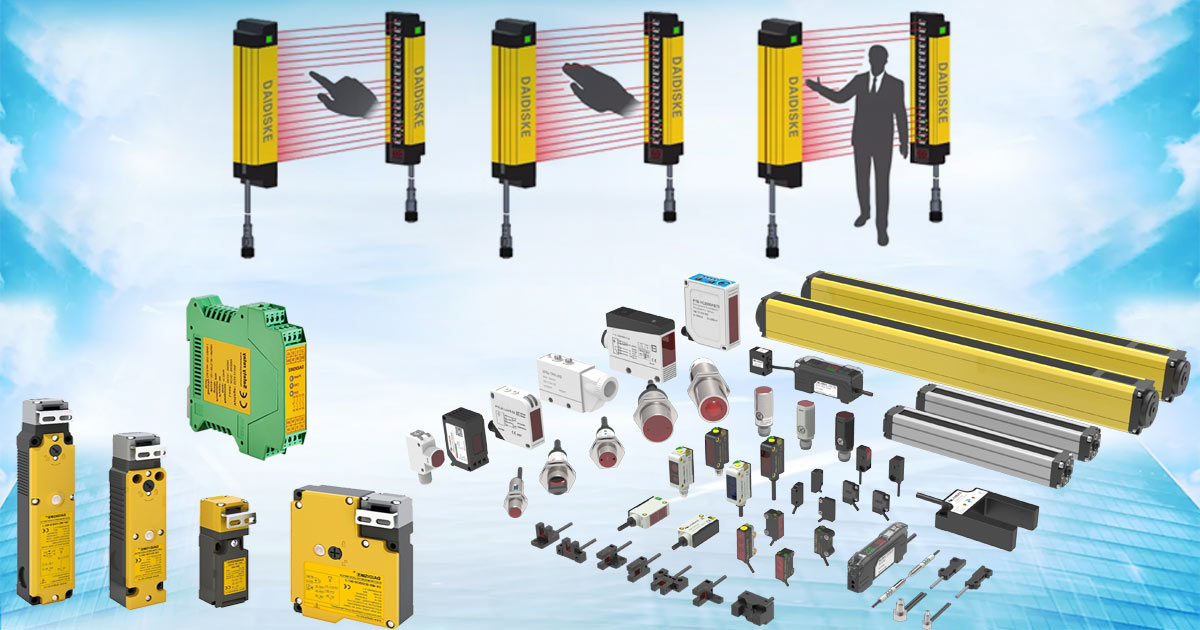
DQC / DQA / DQT4 for guarding, DLD safety LiDAR for mobile robots, DQR for washdown — finished off with the DA31 relay and DX-R1 switch. A safety light curtain rarely ships alone, so it is worth knowing the full range that comes from the same factory on the same lead time. The fact card below is the cross-sell map procurement teams use to spec a complete safety circuit from one supplier — curtain, scanner, relay, coded switch and proximity sensor.
For AGV and AMR mobile-robot protection the relevant line is our safety LiDAR / laser scanners — DLD05A3 (5 m), DLD20A5 (20 m), DLD30T-5N (40 m perimeter) and the SDLD-05A TOF (14 m); see the AGV/AMR safety laser scanner guide. The DA31 safety relay (PL e / SIL 3, 3NO+1NC) and the DX-R1 coded magnetic switch (ISO 14119 Type 4) close the loop, and inductive proximity sensors in M8/M12/M18/M30 cover position sensing — all from the same factory-direct China supplier.
Do you export to Vietnam, Europe and the US?
Yes — 20+ countries, with Vietnam, the EU and the US among the most active. Vietnam comes up constantly as manufacturing shifts there: a new line benefits from the low MOQ and a quick sample, and CE-built Type 4 curtains meet the common acceptance requirements. EU buyers receive the CE self-declaration and IEC 61496 documentation. US buyers should plan for the Section 301 duty position described above and can request TÜV testing per order where a customer demands third-party proof. Products carry a manufacturer warranty against defects — confirm the exact term, spares and support level at quotation.
Send the four numbers off your application — resolution, protective height, sensing range, output/OSSD type — plus quantity and destination, and we'll return a firm FOB quote, a 3–15 day lead time, and the HS-code documentation your broker needs. Sample at MOQ 1 set.
Contact DAIDISIKE → | Phone / WhatsApp +86 15218909599
Sources & references
- DAIDISIKE — DQC Type 4 safety light curtain — published specifications, resolutions and OSSD interface.
- IEC 61496-1/-2 and ISO 13849-1 / ISO 13855 — the standards that fix Type 4 architecture, PL e and the safety-distance calculation referenced throughout.
- World Customs Organization Harmonized System — HS chapters 9031, 8536 and 8543; classification per your broker for your destination.
- USTR Section 301 actions on goods of Chinese origin — confirm the current additional-duty rate and any exclusions with your customs broker.